Notes
1The Greek word σαββᾶτων does not mean “week.” It means Sabbath. If the Jews wanted to say week, they used the word ἑβδομας. This would have been particularly confusing to the Gentiles in Corinth who would have understood the meaning of Sabbath as “rest” or “rest day.” If the apostle had meant the first day of the “week” he would have used the term ἑβδομας.↩
2There is a Greek word that could have expressed “the next Sabbath,” and it is used in verse 44. However, in verse 42, an entirely different word is used that is nowhere else translated as “next.” The word in verse 42 is “between” (μεταξυ), and is elsewhere used to speak of Peter “bound with two chains between two soldiers” (Acts 12:6) and is used in Acts 15:9 to say that God made “no distinction between us and them.” The Sabbath “in between” the two Jewish Sabbaths would be Sunday.↩
3These could also be translated as “first day since the Sabbath” and have reference to the eight days of worship that occurred in the temple on the Feast of Tabernacles, with day 1, day 2, day 3, etc. having other activities (Numb. 29:7-40).↩
4This seems to be the most natural interpretation. For other possible interpretations, see a standard Bible Encyclopedia under “Second-first Sabbath.”↩
5To be distinguished from the firstfruits 50 days later at Pentecost.↩
6Bauer, Arndt, and Gingrich in A Greek English Lexicon of The New Testament define this word as a “Sabbath observance.”↩
7This helps to explain why the Old Covenant Sabbath (along with all the law) is seen as a curse in Colossians 2. As long as men are in the Old Adam, the covenant becomes a burden which is impossible to bear, which is “against us” and “contrary to us” (Col. 2:14). The Old Covenant Sabbath was simply “a shadow of things to come, but the substance is of Christ” (v. 16-17). This helps to explain the heightened form of punishment given for Sabbath breaking in the Old Covenant (Exodus 35:2). The Sabbath was a sign of the broken covenant. Until Christ kept the covenant fully, God’s people were continually reminded of their need for Him to bear the curse.↩
8Robert Young, “The Holy Bible consisting of the Old and New Covenants translated according to the letter and idioms of the original languages.”↩
9Some of the ancient versions that translate it this way include the old latin, the Peshita, the Syriac in Hebrew text, etc. Other Bibles that translate it as “on the first Sabbath” or “first day Sabbath” are Coverdale, The Great Bible, Bishops Bible, Modern King James Bible, CLV, ECB, EJ2000, Luther’s 1545 translation (“Auf je der Sabbate”), SE (“Cada primer sábado”), JBS, Vulgate, Clementine Vulgate, Mace, Julia Smith, Worrell, etc.
Latin Vulgate:
Matt. 28:1 vespere autem sabbati quae lucescit in primam sabbati venit Maria Magdalene et altera Maria videre sepulchrum
Mark 16:2 et valde mane una sabbatorum veniunt ad monumentum orto iam sole
Mark 16:9 surgens autem mane prima sabbati apparuit primo Mariae Magdalenae de qua eiecerat septem daemonia
Luke 24:1 una autem sabbati valde diluculo venerunt ad monumentum portantes quae paraverant aromata
John 20:1 una autem sabbati Maria Magdalene venit mane cum adhuc tenebrae essent ad monumentum et videt lapidem sublatum a rrantt
John 20:19 cum esset ergo sero die illo una sabbatorum et fores essent clausae ubi rrant discipuli propter metum Iudaeorum venit Iesus et stetit in medio et dicit eis pax vobis
Acts 20:7 in una autem sabbati cum convenissemus ad frangendum panem Paulus disputabat eis profecturus in crastinum protraxitque sermonem usque in mediam noctem
1 Corinthians 16:2 per unam sabbati unusquisque vestrum apud se ponat recondens quod ei beneplacuerit ut non cum venero tunc collectae fiant
Hebrew Peshita:
In the Hebrew of the Peshita translation, it is important to note that that the word for “first” (חַד) modifies the implied day since it is a different gender that “Sabbath” (בשַׁבֹא)
Matt. 28:1 ברַמשֹׁא דֵין בשַׁבתֹא דנֹגַה חַד בשַׁבֹא אֵתֹת מַריַם מַגדלֹיתֹא ומַריַם אחרִתֹא דנֵחזיֹ֯ן קַברֹא
Mark 16:2 בשַׁפרֹא דֵין בחַד בשַׁבֹא אֵתַ֯י לבֵית קבֻורֹא כַד דנַח שֵׁמשֹׁא
Mark 16:9 בשַׁפרֹא דֵין בחַד בשַׁבֹא קֹם וֵאתחזִי לֻוקדַם למַריַם מַגדלֹיתֹא הֹי דשַׁבעֹא שִׁאדִי֯ן אַפֵק הוֹא מֵנֹה
Luke 24:1 בחַד בשַׁבֹא דֵין בשַׁפרֹא עַד חֵשֻׁוך אֵתַ֯י לבֵית קבֻורֹא וַאיתִ֯י הֵרֻ֯ומֵא הֹלֵין דטַיֵב הוַ֯י וִאית הוַ֯י עַמהֵין נֵשֵׁ֯א אחרֹ֯ניֹתֹא
John 20:1 בחַד בשַׁבֹא דֵין אֵתֹת מַריַם מַגדלֹיתֹא בצַפרֹא עַד חֵשֻׁוך לבֵית קבֻורֹא וַחזֹת לכִאפֹא דַשׁקִילֹא מֵן קַברֹא
John 20:19 כַד הוֹא דֵין רַמשֹׁא דיַומֹא הַו דחַד בשַׁבֹא ותַר֯עֵא אַחִידִין הוַו דַאיכֹא דִאיתַיהֻון הוַו תַלמִידֵ֯א מֵטֻל דֵחלתֹא דִיהֻודֹיֵ֯א אֵתֹא יֵשֻׁוע קֹם בַינֹתהֻון וֵאמַר להֻון שׁלֹמֹא עַמכֻון
Acts 20:7 וַביַומֹא דחַד בשַׁבֹא כַד כנִישִׁינַן דנֵקצֵא אֵוכַרִסטִיַא ממַלֵל הוֹא עַמהֻון פַולוֹס מֵטֻל דַליַומֹא אחרִנֹא עתִיד הוֹא דנֵפֻוק לֵה וַאגַר הוֹא לַממַלֹלֻו עדַמֹא לפֵלגֵה דלִליֹא
1Cor. 16:2 בכֻל חַד בשַׁבֹא אנֹשׁ אנֹשׁ מֵנכֻון בבַיתֵה נֵהוֵא סֹאֵם ונֹטַר הַו מֵדֵם דמֹטֵא בִאידַ֯והי דלֹא מֹא דֵאתִית הֹידֵין נֵהויֹ֯ן גֵביֹתֹ֯א
Hebrew Syriac:
Matt. 28:1 ברמשׁא דין בשׁבתא דנגה חד בשׁבא אתת מרים מגדליתא ומרים אחרתא דנחזין קברא
Mark 16:2 ובשׁפרא בחד בשׁבא אתין לבית קבורא כד סלק שׁמשׁא.
Luke 24:1 בחדטבשׁבא דין בשׁפרא רבא אתי הוי לבית קבורא ואיתי הוי מדם דטיב ואתי הוי עמה֯ין נשׁ֯א אחר֯ניתא
John 20:1 ובלליא דנגה חד בשׁבא עד חשׁוך בשׁפרא רבא אתת מרים מגדליתא לבית קבורא וחזת דמגדליא כאפא ושׁקילא מן פום קברא
John 20:19 ובה ביומא הו דחד בשׁבא אתר דהוו תלמידא ואחידין הוו תרעיהון מן דחלתא דיהודיא אתא ישׁוע קם בינתהון ואמר להון שׁלמא עמכונ
Syriac: (notice the words)
First: 
and Sabbath: 
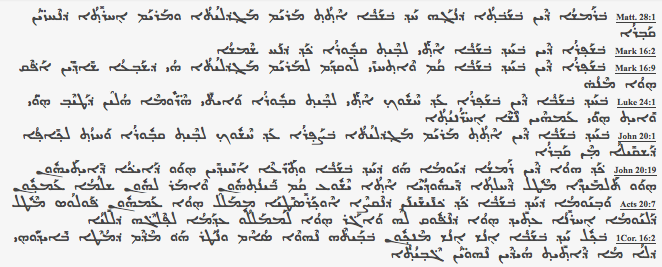
10Parker comments: “In these words the evangelist says the (Jewish) Sabbath “was past,” and he uses the verb διαγινομαι in the Second Aorist, signifying that the action was complete. The preposition δια in composition gives intensity to the verb to show that the transition of time was entirely finished through to the very end, that the (Jewish) Sabbath had transpired before the Sabbath commenced which is mentioned in the second verse. In Mark 16:9 the evangelist tells us Jesus rose very early on the first day of the week (ἀνασταστας δε πρωι σαββάτου) which gives us divine authority for observing the Sabbath on Sunday, the first day of the week.” p. 43. The Sabbath Transferred.↩
11See below on 1 Corinthians 16:1 where Paul commanded the “first day Sabbath” collection and said that this order was to all the churches, not just to Corinth.↩
12Ibid., pp 45-46.↩
13Gordon Fee. The First Epistle To The Corinthians, p. 813, footnote 26.↩
14Charles Hodge, I & II Corinthians, Banner of Truth, 1978; pp. 363-364.↩
15Francis Nigel Lee says that the sequence and number of meetings recorded indicate a meeting for each Sunday of the 40 days He was with the disciples.↩
16He was rushing to try to make it to Jerusalem by Pentecost (Acts 20:16). This being so, if the Seventh Day Adventists are correct, it is strange that Paul delayed his trip until Monday unless he wanted to worship once with them, and Sunday was the worship day.↩
17Verse 8 says, “For if Joshua had given them rest, then He would not afterward have spoken of another day.” David was speaking of the day of salvation that Christ brought in by His resurrection.
That day was not the end of History. Resurrection day was the first time that anyone entered into the kingdom of heaven, because it was then that Christ was given all authority in heaven and on earth.
Christ said, “among those born of women there has not arisen one greater than John the Baptist; but he who is least in the kingdom of heaven is greater than he” (Matt. 11:11). So verse 8 says that Psalm 95 anticipated that there must be another day besides the day when Israel crossed the Jordan to enter the land. That “other day” was none other than Easter Sunday when Christ led the way into the kingdom. He led the way over the Jordan like Joshua. Jesus Christ stands not only as the Joshua who leads the way into possessing the land for the kingdom, but He also stands as the High priest in verses 14-16, who parted the waters the moment their feet touched the Jordan.
In the same way, Jesus opened the way into the kingdom of heaven and enabled us not only to enter the kingdom by faith, but to conquer the land in such a way that multitudes of others would enter the kingdom (Heb. 4:14).
Verse 9 says that it is because we are in the entering stage that there remains a Sabbath observance, or a Sabbatism for the people of God. That is the sign of the everlasting covenant. That is the promise that one day the new heavens and the new earth will be brought in and we will cease from our labors and our works will follow us.
Verse 10 reinforces that thought by explaining that when we have (past tense) entered the rest as a finished fact, that we have completely ceased from our works as God did from His. Verse 10 defines the rest as when we cease from our labors. “For he who has entered His [that is, God’s] rest has himself also ceased from his works as God did from His.” Notice that phrase, “as God did from His.” Commentators point out how this cannot be referring to our initial salvation experience, but must be referring to heaven.
If we say that we are ceasing from evil works or from self-righteous works (which we do when we are justified by faith alone) then the analogy breaks down because the works that God ceased from were called very good. He was satisfied with them and the Joshua generation which was seeking to enter its rest (Joshua 1:13-15) was clearly the believing generation, not the unbelieving wilderness generation.
Just as God’s works leading up to His rest were good works that He was satisfied with, and the Joshua generation’s works (that is, their 15 year period of warfare in which they were entering into their rest) were good works that they finally ceased from; was an obedience motivated by faith, so too the works which we will cease from are good works done as believers while here on earth. Turn to Revelation 14:13 as an example of this type of language: “‘Blessed are the dead who die in the Lord from now on. ‘Yes,’ says the Spirit, ‘that they may rest from their labors, and their works follow them.’” So this rest is heaven.
We are not in heaven yet, nor is it the end of the world, and that is why verse 9 says, “There remains therefore a Sabbath observance; a Sabbath rest for the people of God.” The Sabbath has always been a pledge of God’s rest or of the kingdom of heaven held out to us. We aren’t in the rest yet, because we are in the period where we are entering it, where there is warfare, where we are conquering the land for Jesus in terms of the Great Commission.↩
18The Teaching of the Twelve Apostles, Chap. 14:1, Ante-Nicene Fathers Vol. 7, page 381↩
19“We keep the eighth day [Sunday] with joyfulness, the day also on which Jesus rose again from the dead” (The Epistle of Barnabas, 100 AD 15:6-8). Since the OT uses “eighth day” language in connection with festival Sabbaths, and since he uses the Sabbatarian language of keeping a day, this is very significant. The day-keeping on Sunday parallels the keeping of the Sabbath.↩
20Wherefore we Christians keep the eighth day for joy, on which also Jesus arose from the dead and when he appeared ascended into heaven. (15:8f, The Epistle of Barnabas, 100 AD, Ante-Nicene Fathers , vol. 1, pg. 147)↩
21Epistle of Barnabas, 15.6-8; 100 AD, Ante-Nicene Fathers, vol. 1, pg. 147↩
22Ignatius, Epistle to the Magnesians, ch 9. Ante-Nicene Fathers , vol. 1, pg. 62-63.↩
23Pliny, Letters to Trajan, Book X, in The Loeb Classical Library, eds E. Capps, T.E. Page, W.H.D. Rouse, Pliny Letters II, translated by William Melmoth. [London: William Heinemann, MCMXV], p. 403.↩
24Dialogue With Trypho the Jew, 150-165 AD, Ante-Nicene Fathers , vol. 1, page 207↩
25Dialogue With Trypho the Jew, 150-165 AD, Ante-Nicene Fathers , vol. 1, page 206↩
26Dialogue with Trypho 10:1↩
27First apology of Justin, Ch 68↩
28Dialogue 41:4↩
29Apology, 1, 67:1-3, 7; First Apology, 145 AD, Ante-Nicene Fathers, Vol. 1, pg. 186↩
30Ibid. Vii.xii.76.4↩
31On Fate, 5↩
32Tertullian’s Apology, Ch 16↩
33An Answer to the Jews 4:1, Ante-Nicene Fathers Vol. 3, page 155↩
34To the Nations 1: 133↩
35Homil. 23 in Numeros 4, PG 12:749↩
36Commentary on John 2:28↩
37Didascalia 2↩
38Epistle 58, Sec 4↩
39The Creation of the World↩
40Ecc. Hist., Book 1, Ch. 4↩
41Church History Ill.xxvii.5↩
42Proof of the Gospel 4:16:186↩
43On Sabbath and Circumcision 3↩
44Catechetical Lectures 4:37↩
45Canon 29↩
46Homilies on Galatians 2:17↩
47Homilies on Philippians 10↩
48Apostolic Constitutions 2:7:60↩
49How else can this be interpreted other than in a Sabbatarian fashion? In the Old Covenant the seventh day belonged to God. Here the Lord’s Day is interpreted as Sunday.↩
50Constitutions of the Holy Apostles, Ante-Nicene Fathers Vol. 7, pg. 449↩
51Constitutions of the Holy Apostles, Ante-Nicene Fathers Vol. 7, pg. 423↩
52Constitutions of the Holy Apostles, Ante-Nicene Fathers Vol. 7, pg. 471↩
53It is often assumed that Exodus 35:3 rules out every fire. However, Paul kept many lamps burning on the Sabbath (Acts 20:7-12). The Feast day Sabbaths had both burnt sacrifices and cooked feasts. Likewise, the 13 passages listed clearly show that cooking was allowed on the Sabbath. The context for the forbidden fire (v. 3) is the forbidden work (v. 2). As Jamiesson Faussett and Brown say, “As the kindling of a fire, therefore, could only be for secular purposes, the insertion of the prohibition in connection with the work of the tabernacle makes it highly probable that it was intended chiefly for the mechanics who were employed in that erection; as some of them might have supposed it was allowable to ply their trade in the furtherance of a structure to be dedicated to religious worship, it was calculated to prevent all such ideas, by absolutely forbidding any fire for the sharpening of tools, for the melting of metals, or any other material purpose bearing on the sanctuary.” This is reinforced when it is realized that the Piel (intensified) form of the Hebrew is used and indicates a roaring fire.↩
54Note that there is nothing miraculous about cooked manna not spoiling. They cooked what they could eat on Friday and God preserved the rest till Saturday.↩
55Verse 21 establishes this as occurring on Sunday.↩