1. The “First Day Sabbath” Concept
It is often alleged that the New Testament nowhere makes mention of Sunday as the Sabbath. However, many Greek scholars have pointed out that the concept of Sabbath has simply been translated away. We will later be demonstrating that this is clearly shown in the Greek of Matthew 28:1, Mark 16:1-2, Luke 24:1, John 20:1, Acts 20:7, and 1 Corinthians 16:2, all of which speak of a “first day Sabbath.” Indeed, the last passage commands the observance of a “first day Sabbath.”1 It says, “Now concerning the collection for the saints, as I have given orders to the churches of Galatia, so you must do also: on the first day Sabbath let each one of you lay something aside…”
Notice the three imperatives: 1) “as I have given orders,” 2) “so you must do also,” and 3) “let each lay aside.”
There is clearly a day-keeping which is commanded, and which is quite at odds with Jewish day-keeping. Further evidence is hinted at in Acts 13. Paul preached to the Jews on two consecutive Sabbaths (mentioned in 13:14 and 13:44). In Acts 13:42 the Gentiles begged Paul to preach to them on “the Sabbath in between.”2 What is the Sabbath that is “in between” these two consecutive Jewish Sabbaths? This book will seek to demonstrate that it was not the seventh day Sabbath (which Paul treats as no longer binding on the Christian – see Colossians 2:16), but was instead the “first day Sabbath,” a day which all “churches” were commanded to keep (1 Cor. 16:1-2).
To those who object that the concept of a “first day Sabbath” would have been confusing, it should be pointed out that exactly the same language is repeatedly used in the Old Testament. The phrase “first day Sabbath” as well as “eighth day Sabbath” occur in the Hebrew of Leviticus 23:39.
The Septuagint translation of the Old Testament makes provision for the midweek Sabbaths by providing titles to some of the psalms such as “A Psalm of David on a first day Sabbath”3 (Greek LXX title for Psalm 24 [23 in LXX]), “A song of praise for the sons of Core on a second day Sabbath” (Psalm 48 [47 in LXX]), “A Psalm of David on a fourth day Sabbath” (Psalm 94 [93 in LXX]).
David intended these psalms to be sung on midweek Sabbaths (i.e. intended for festival days, not for the regular Sabbath). Certainly a glance at the following Jewish calendar will show that there were not only 1st day Sabbaths, 2nd day Sabbaths, 3rd day Sabbaths, and 4th day Sabbaths, there were Sabbaths for every day of the week. Thus Luke 6:1 (Majority Text) can speak of the “second-first Sabbath,” a possible reference to the fact that the 15th and the 22nd of Nisan occurred on Sunday in that year, and Luke is referring to the 22nd, which would be the second first day Sabbath on that festival.4
1988-1989 Calendar
(Jewish year starts Nisan 1 which in 1988 was March 19)
Column 0 gives some examples of “first day Sabbaths” that occurred in the Jewish Calendar. It should be remembered that the Feast of First Fruits (resurrection day) was never a Sabbath day in its own right. God created something new when He called resurrection day a “first day Sabbath.”
This sample calendar illustrates numerous Sabbaths in the Hebrew Calendar. (The highlighted dates are dates that would be Sabbaths even if they occurred midweek.)
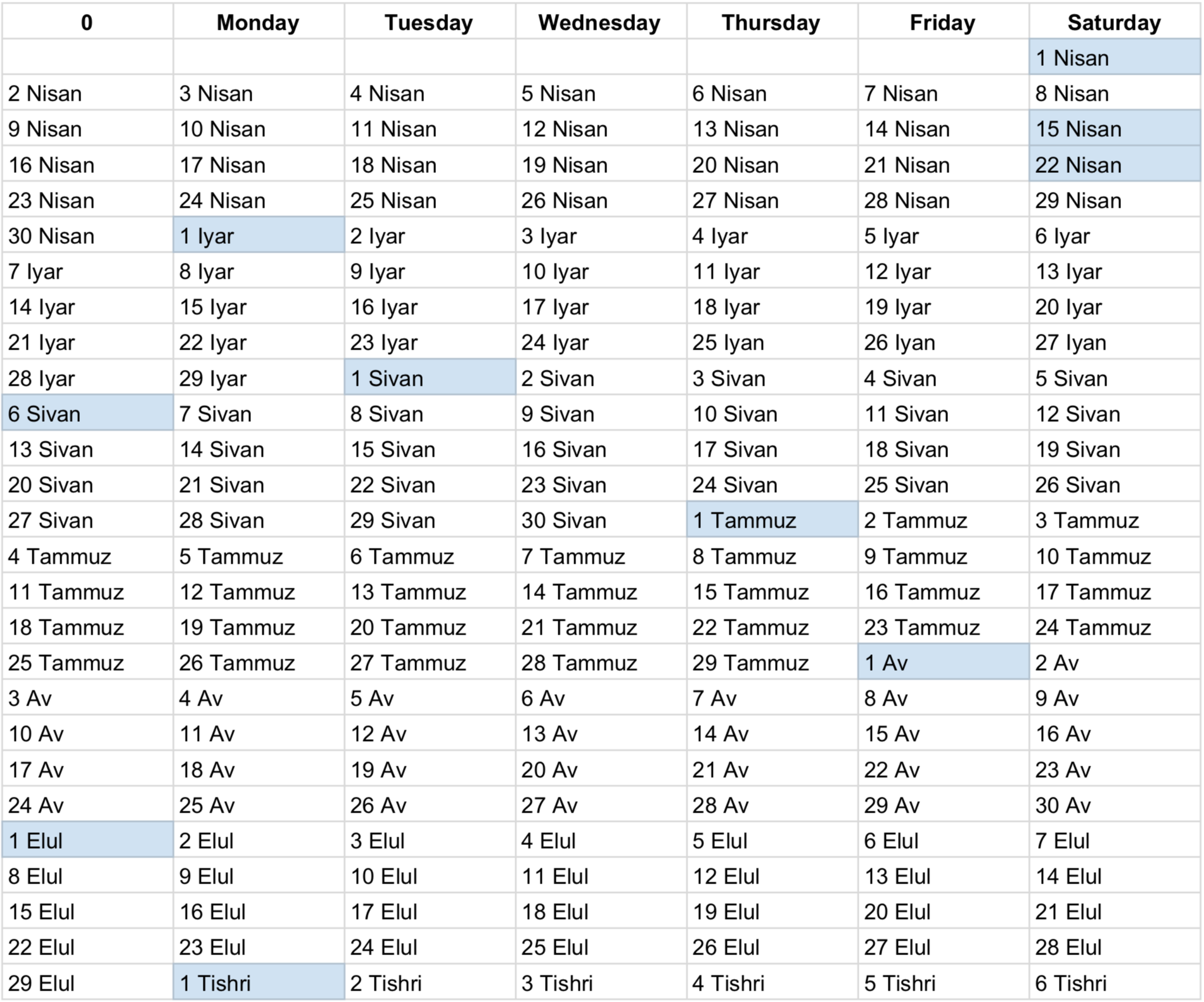
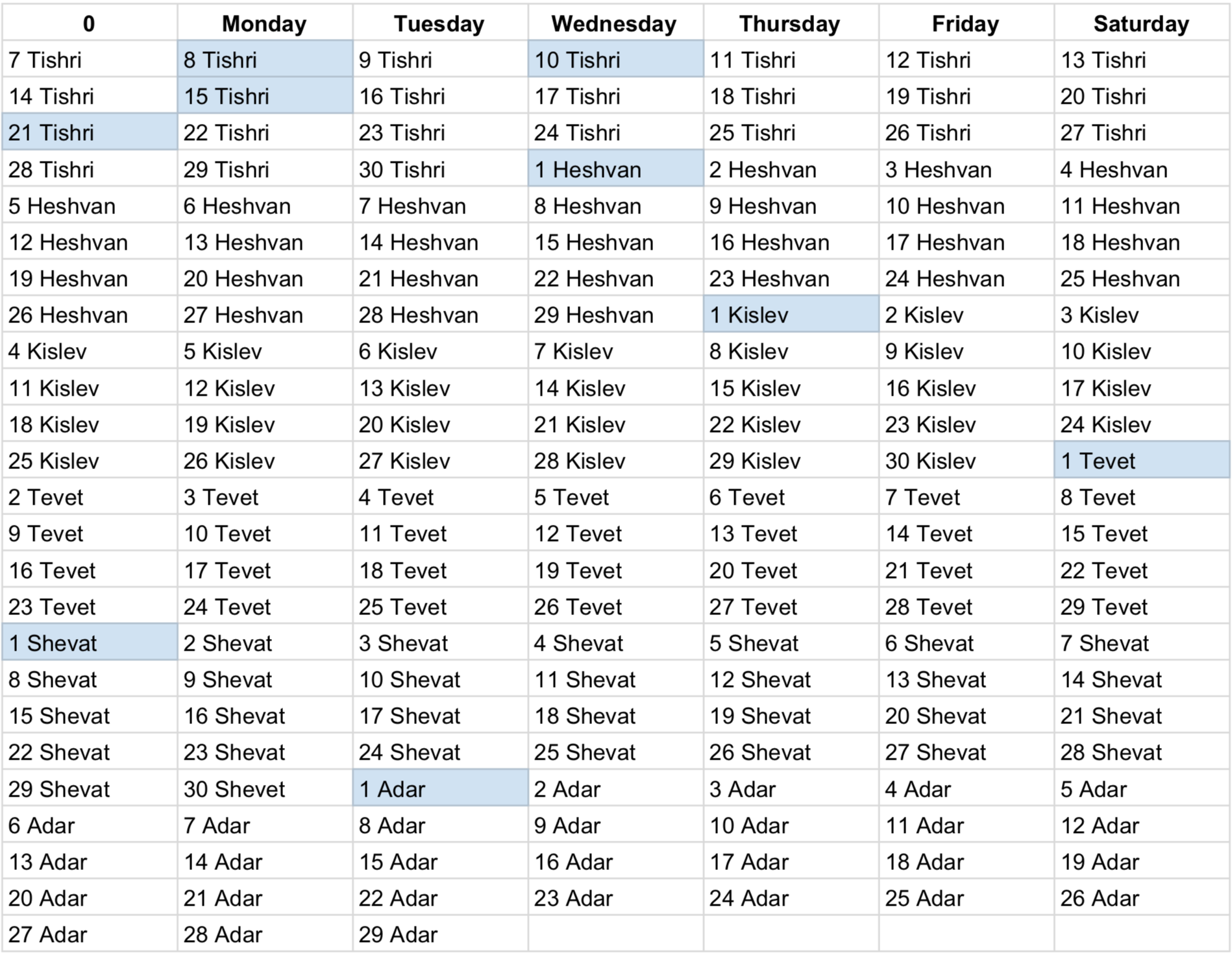
- The first of every month was a new moon Sabbath with the Seventh New Moon being a special Sabbath called the Feast of Trumpets (see below). (Numb. 28:11-15; 29:1-6; Lev. 23:23-25).
- Nisan 15 - the first day of the feast of unleavened bread was a Sabbath. (Lev. 23:6-7; John 19:31)
- Nisan 16 - the feast of firstfruits was not a Sabbath until the New Testament declared it to be so at Christ’s resurrection. When the Gospels, Acts, and Corinthians refer to a “first day Sabbath” they are not referring to a Jewish “first day Sabbath,” although those did occur in connection with other holidays. (Lev. 23:10ff). All the Jewish Sabbaths have been abolished (Col. 2:16) to make room for the new day that the Lord has made.
- Nisan 22 - the seventh day of the feast of unleavened bread was a Sabbath (Numb. 28:17-25).
- Sivan 6 - Pentecost was a Sabbath. In this year (as in the year of Christ’s crucifixion) it falls on Sunday (Lev. 23:15-22).
- Tishri 1 - the Feast of Trumpets was a Sabbath (Lev. 23:24; Numb. 29:1).
- Tishri 8 - the last day of the Feast of Trumpets was also a Sabbath (Lev. 23:36,39). Leviticus 23:39 actually uses the phrases “first day Sabbath” and “eighth day Sabbath.”
- Tishri 10 is the Day of Atonement (see Lev. 23:27-32).
- Tishri 15 - the first day of the Feast of Tabernacles was a Sabbath (Lev. 23:34-38).
- Tishri 21 - the 7th day of tabernacles was a Sabbath (Lev. 23:34-38).
What is of great significance for the New Testament however is that a new Sabbath was created in the Gospels. For the first time in history, the third day of the Passover festival (sometimes called Firstfruits5) was referred to as a Sabbath day in each Gospel (Matt 28:1; Mark 16:2; Luke 24:1; John 20:1). Never before had this been done because work was previously mandated on that day – threshing the green firstfruits harvest. To the Jews, the obvious creation of a new Sabbath day could not have been avoided. In each Gospel account there was a bold declaration that something new had come – indeed, that all things were beginning to be made new. No doubt this is why there was no controversy surrounding the church’s worship being on Sunday. If God had not authorized Sunday as a Sabbath day, the Christian Jews would have strenuously objected to substituting the days of worship. Later in the paper we will examine how this change of days was anticipated in the Old Testament, and why a “Berean” who searched the Old Testament would have been able to see that these things were so. This change from seventh day to first day was no surprise. It was the natural result of the coming of the Messiah.