1 Introduction
Where do we start?
A pendulum is a finding tool, a divining tool you hold in your hand. A ring on a string, swinging backwards and forwards like the pendulum on an old-fashioned clock. A fascinating tool. A useful tool.
At this point, right at the start of the book, probably your most predominant question is something like “Why bother?”. And the short answer, for here at least, is that it’s such an interesting tool for so many different applications in so many different areas; a general-purpose finding tool. And it’s all done with a piece of string, a weight of some kind, and a little thought (or, perhaps more accurately, a little sense). Nothing to it, really.
It’s such a general-purpose tool, in fact, that many books on the subject seem to propose it as some kind of universal ‘answer’ to everything. It’s the great secret of the ancients, perhaps; or the science of the future. Use a pendulum and you will receive enlightenment…
Oh well. If you must, go ahead; but you won’t find much of that here. What you will find here is a discussion of toolkits, of markers and pointers, of positive and negative, of coincidence and imaginary worlds, of inventing realities, of parlour games and hunting drainpipes, all of which brings us back to toolkits, which is where we started. Because the whole point of dowsing (of which the use of the pendulum is a part) is that it is something to put to use: after all, things aren’t exactly useful unless you can put them to use.
Putting it to use. That sounds like doing things: like technology, almost. Which is exactly what it is: a technology with a little magic. And in some ways a technology of magic, in every sense – a magical technology. The magic and the technology meet in you; through you; are you.
So in a way it isn’t quite so crazy to say “Use a pendulum and you shall receive enlightenment”. Though perhaps that’s too grand an expectation: a few light bulbs going ‘click’ in your mind might be more realistic. In learning the skills involved, and working your way through some of the mental acrobatics and other confusions that you’ll find on your way, you’ll also learn a few things about yourself. And that’s probably as good a reason as any for learning to play with a pendulum: it has few equals as a mirror of yourself and your view of the world.
But none of this will make any sense unless we put it to use: until we move these discussions away from abstract theory and on to practical uses and applications.
That practice is what this book is all about. If that’s what interests you, read on!
What is a pendulum?
You can use almost anything as a pendulum. All you need is a weight on a short length of string. Or perhaps on a spring. And that’s all.
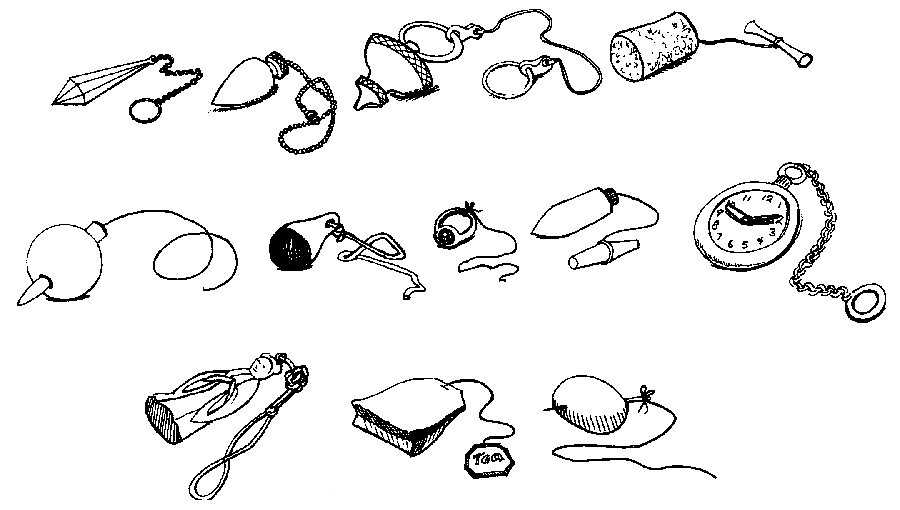
Assorted pendulums
There are plenty of variations on the theme. Traditional dowsers might use a ring on a thread. Students at some dowsing classes I ran used anything from a plastic white elephant to a four-pound pottery gnome on a large piece of rope (which met up with a wall and became a four-ounce handle, but that’s another story…). It’s more common, though, to use a small balanced weight like a builder’s plumb-bob.
It’s a form of dowsing that you can easily learn on your own at home. And it’s nothing like as difficult (or, for that matter, embarrassing) as learning how to search for water with a forked stick in the way that traditional dowsers do.
To use the pendulum, you swing that weight backwards and forwards; and, by interpreting its movements, decipher the answers to any kind of questions you care to put to it.
All of which sounds ridiculous: the movements of a plumb-bob answering questions? He’ll be asking us to tell fortunes from tea-leaves next! Science of the future, indeed… unscientific rubbish!
True. But then I did describe the use of a pendulum as a technology, not a science: and as far as I’m concerned, there’s a great deal of difference. We don’t actually need to know how the pendulum works: like any technology, we only need to know how it can be worked — which is not the same thing at all as ‘how does it work’. Indeed, as we’ll see later, one of the shortest yet most accurate descriptions of dowsing is to say that it’s entirely coincideence and mostly imaginary: which would hardly inspire confidence if you look at it only as a science, but should make perfect practical sense when we get there.
The key to it all is the word ‘interpret’. Or understand; decipher; divine: all much the same thing, if you think about it. The pendulum’s movements don’t mean anything on their own, they have to be interpreted according to the context. Using a pendulum is all about making sense of a vast morass of information; collecting sense out of an often chaotic muddle of options and possibilities. In reality the pendulum doesn’t do anything on its own: you do. It simply reflects your choices in a way that you can see and feel and sense. And through that, in practice, you learn judgement, discrimination, taste; more important, you know what your intuitive decisions have been. Using a pendulum, if you like, is a way of putting the technology back into that magic: of learning to know when you know.
What’s it used for?
A pendulum is used for answering questions: and, for that matter, questioning answers. So it can be used for anything in which you need some help with questions and answers. Anything: from finding keys to finding errors in computer programs, from drains to diagnosis, for cooking and catching. Anything. Well, almost anything… it’s up to you.
The pendulum’s answers tend to be limited to ‘Yes’ or ‘No’ or (with a little encouragement) perhaps a number or a direction: but then that’s all that computers can do, and we can teach them to do quite a lot within those restrictions. The trick is in presenting the question in such a way that ‘Yes’ or ‘No’ makes practical sense. As we’ll see, getting an answer is the easy part: it’s framing usable questions that’s hard…
Another way of looking at it is to say that it’s all inspired guesswork: the pendulum is a way of improving the inspiration! Anywhere where you rely on intuitive judgement, using a pendulum can help, because it makes the process more formalised, more reliable, more known. With practice, at least. Which is, after all, the whole point of this book.
How does it work?
Everyone asks how it works. The short answer is ‘yes’. It does. Sometimes. Better, with practice. Next question…
I’m well aware that I’m cheating here. But in fact people have been hunting for a very long time, in many serious scientific studies, for a sensible answer as to how dowsing works: and have been led round and round in some very interesting but definitely circular paths. We simply don’t know: and all the indications are that we never will.
More important, we don’t actually need to know how it ‘really’ works, because what we do have is a good understanding of how it can be used, how it can be worked: again, technology rather than science. During the course of this book we will of course look at theory from time to time: but only with the intention of using it to point out other ways of looking at practical work. In practice, that’s all that matters.
If you really do want to know how it works, stop talking about it and just do it: then you’ll know. Perhaps. But do it anyway; because if you don’t, no amount of theorising will make it make sense. Practice may not always make perfect, but at least it makes more sense than theory!