Introduction to Grails 3
Grails is a full stack Web framework, covering all the aspects of a modern web application development. Its plugins system is unique in the Java world - you can divide your application into complete functional modules, containing presentation and business logic. Because it runs in JVM, it has access to the entire Java ecosystem. Because is written in Groovy, it has access to all Groovy libraries and tools.
The main site for Grails 3 is grails.org. Here is the definition of Grails on the official site:
Grails is a powerful web framework for the Java platform, aimed at multiplying developers’ productivity, thanks to Convention-over-Configuration, sensible defaults, and opinionated APIs. It integrates smoothly with the JVM, allowing you to be immediately productive, whilst providing powerful features, including integrated ORM, Domain-Specific Languages, runtime and compile-time meta-programming, and Asynchronous programming.
If you have developed multiple applications over time, you have recognized a set of principles and good practices that can be reused. You don’t want to start from scratch each time you build your new application. Grails has good technical principles that make it a good starter for your new applications. With Grails, you have an established architecture from the beginning, and you can implement new features in an easy way, using scaffolding and the plugins ecosystem. And this is more valuable when you have to get to the market first, before your competitors.
Some history
Grails 3 is based on a stack of other technologies Java, Spring, Groovy, Hibernate, Sitemesh. We try here to show the history of these technologies and how they are used in Grails 3.
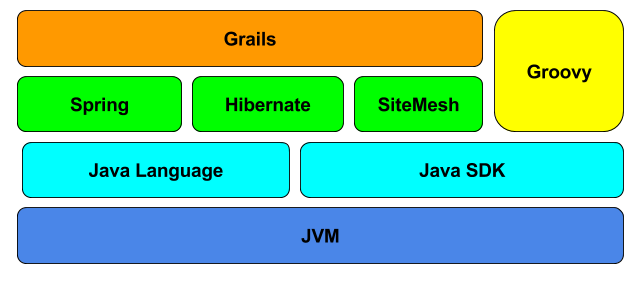
Java history
First it was Java, and was created by Sun Microsystems and its father was James Gosling. Java came with the idea of JVM - Java Virtual Machine that lets you Write once, Run everywhere. Everywhere means on any operating system. You write the code in a source file which is compiled to a byte code runnable by the JVM. Any operating system has an implementation for the Java Virtual Machine specification.
Because Sun was bought by Oracle, now Java is in Oracle’s portfolio. Java is used by millions of developers (Oracle claims 10 million) and is the number one TIOBE index of most used languages in the world.
Why was Java such a strong language from the beginning? Some clues:
- It was totally object-oriented from the beginning and let people think everything is an object (this is the name of a chapter from one of the best Java books Thinking in Java - TIJ) written by Bruce Eckel.
- It eliminates the pointers and memory deallocation, letting this be handled by the JVM and the garbage collector; the GC is constantly improved by the Oracle team. G1 GC is the most advanced GC these days.
- It has multithreading inside from the beginning.
- It has exceptions handling inside.
- It has modularity inside, represented by packages and the possibility of packaging libraries in .jar files that can be reused between projects; there are a lot of libraries on the market, and as proof, you can search a Maven global repo
Java EE history
After this was the Java EE (known in the past as J2EE or JEE) – an attempt to make it easy to create enterprise applications (compared to other 2 profiles Java SE for desktop applications and Java ME for mobile applications). The language and Java EE is specified by a committee named JCP Java Community Process, which is responsible for creating JSRs, specifications implemented by various vendors. Any JSR has a reference implementation which is a proof that the specification can be implemented.
For example, the last specification for the Java Servlet is JSR 315: JavaTM Servlet 3.0 Specification and the reference implementation for this standard is Oracle GlassFish 3.x (RI). Grails embeds by default inside, in DEV mode, a Tomcat server and you can see what version of Java Servlet is implemented on each Tomcat version.
Here are the Java EE Full Platform Compatible Implementations on different Java EE versions. The current version is Java EE 7, and here is the official tutorial
Spring history
But the Java EE standards were too de jure for the Java community, compared to a lot of frameworks that emerged in the Java open source space, considered more the facto standards like: Struts for Web, Hibernate for persistence, etc. And then Spring Framework was born as a response to this committee style and specification centric style of driving the Java future - Rod Johnson and others put the foundation, and Juergen Hoeller is now responsible for the framework as part of the Pivotal portfolio. The framework introduced Dependency Injection and reaffirmed the power of POJOs (Plain Old Java Objects) - in contrast to EJBs (Enterprise Java Beans) which were at version 2 when Spring emerged - things have improved in EJB 3.
In time, these two technologies are evolving in parallel. For example, Java EE adopted the DI in its CDI, some implementations of JPA wrap Hibernate. Spring embraces annotations for configurations, instead of XMLs, as in Java EE. And Spring Framework has integration with some JSRs and is based on some technologies provided by Java EE.
The main documentation for Spring Framework is the reference documentation.
Groovy history
Java is an imperative style programming language and, compared with functional programming languages, it suffers from accidental complexity as Venkat Subramaniam says.
Groovy is a functional programing language that is bringing functional style to Java programming. It introduces the notion of closure which is the idea of function as a main citizen of your code. It is also a scripting language because it has the characteristic of incorporating a lot of semantics in a short syntax.
It was started by James Strachan, back in 2003, as a dynamic language for the JVM, inspired by Ruby, but closer to Java. Guillaume Laforge become the project lead after James leaves the project, and he is still the lead today. Here is a history of the most important moments of the language and the main contributors to the project.
The official Groovy site is groovy-lang.org. Here is the definition of Groovy on the official site:
Apache Groovy is a powerful, optionally typed and dynamic language, with static-typing and static compilation capabilities, for the Java platform aimed at improving developer productivity thanks to a concise, familiar and easy to learn syntax. It integrates smoothly with any Java program, and immediately delivers powerful features to your application, including scripting capabilities, Domain-Specific Language authoring, runtime and compile-time meta-programming and functional programming.
Some characteristics of Groovy:
- it was a way to get functional programming into JVM; it introduced closure to the Java world long before the Lambda Expressions in Java 8
- it is compiled to Java bytecode that is running in JVM (there is a groovyc compiler that is compiling Groovy code to Java bytecode in the same way the javac compiler is doing with Java code)
- Groovy scriptlet can be embedded in Java code and the resulted mixture is still working after compilation
- is enriching the Java classes with other convenient methods resulting in a new API named GDK
Grails history
This is a timeline created by Matt Raible where he tries to describe the history of Web Frameworks.
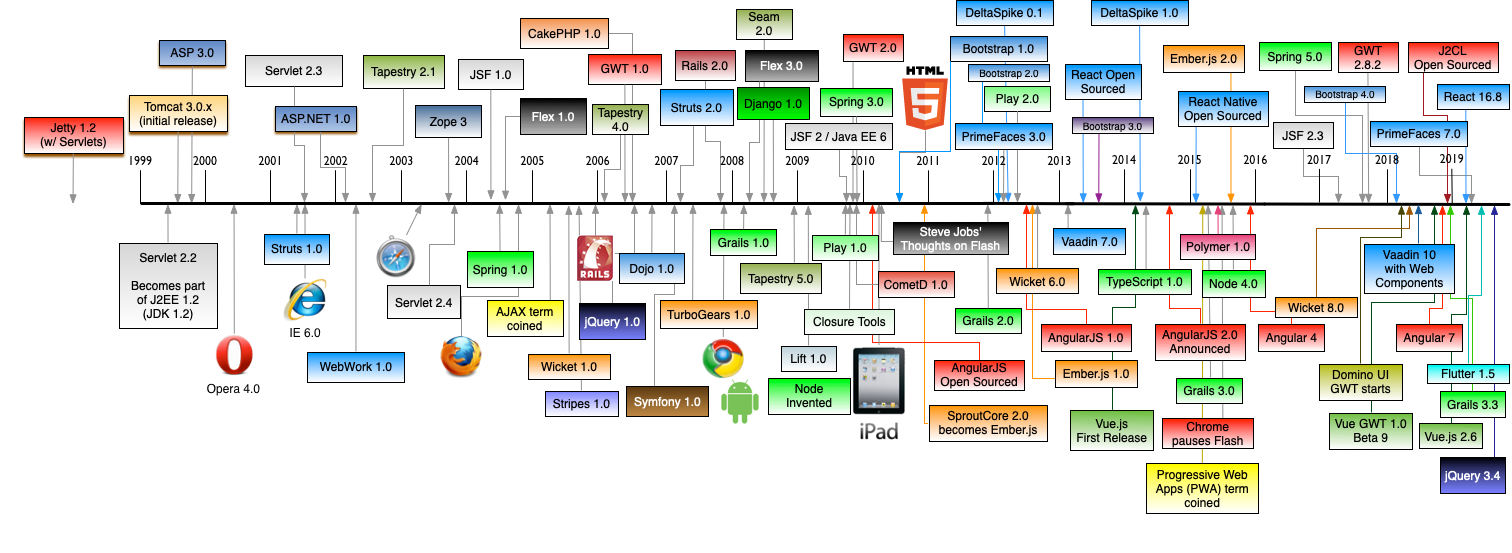
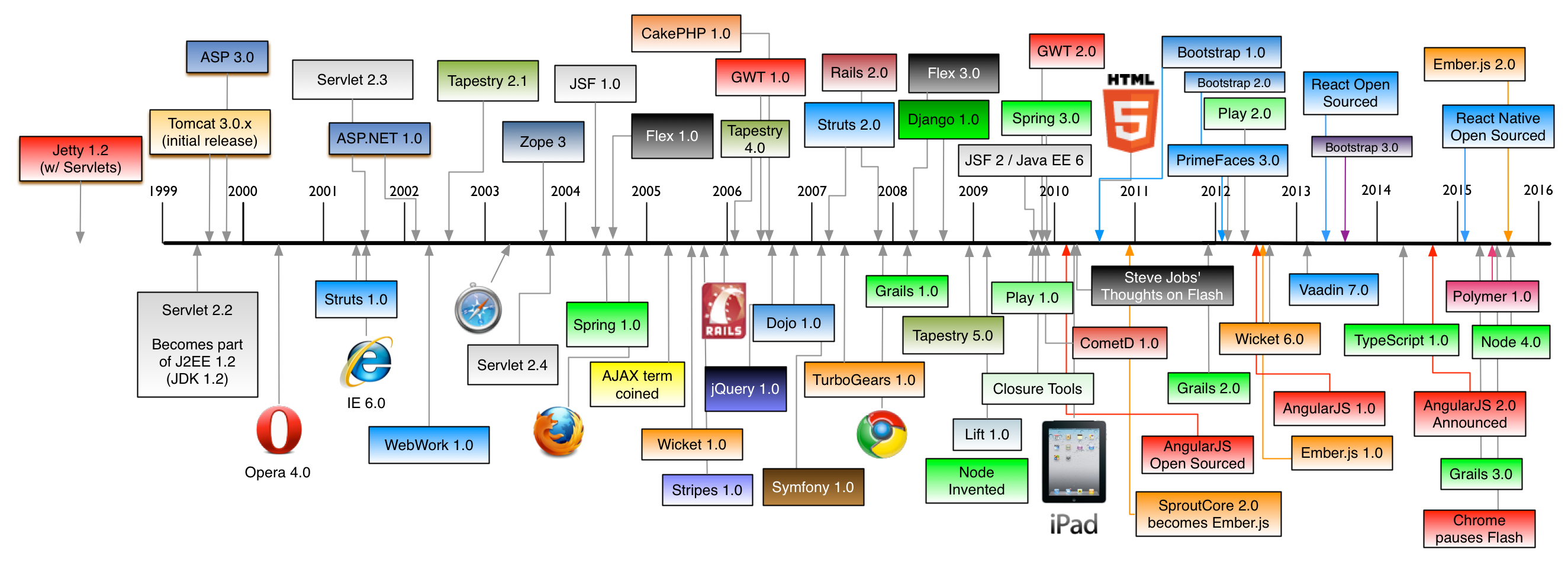
As you can see in this diagram the Grails framework was born in 2008 with its first GA release. Grails 2 was released in 2011. And Grails 3 was first released in 2015.
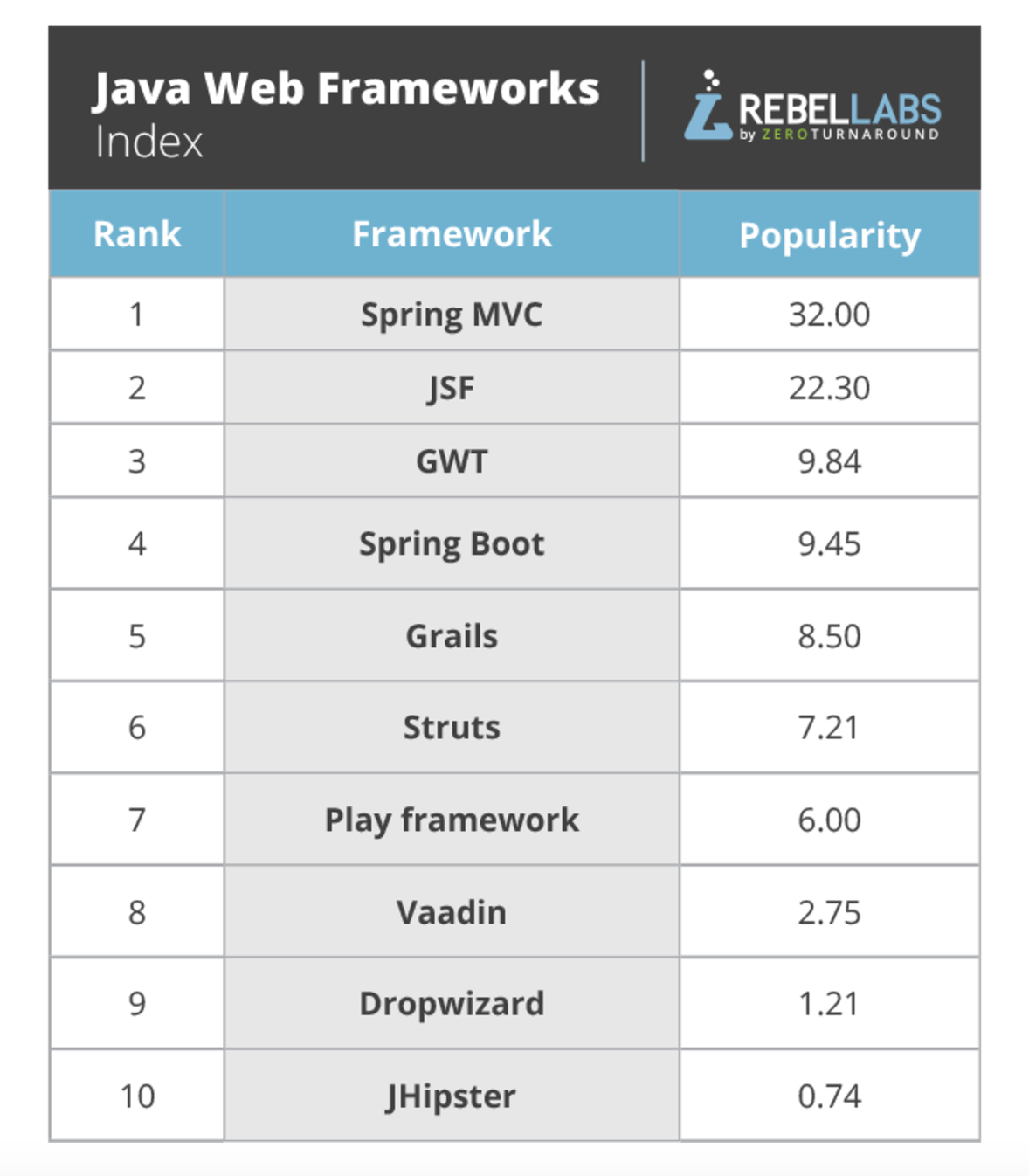
Here is a top of Java Web frameworks published by RebelLabs in 2017. Grails is placed on the 5th position immediately after SpringBoot (and Grails 3 has SpringBoot inside). Grails 3 is not a simple Web framework like the majority of the frameworks presented in this top but a full stack framework like Play which is the 7th position. JHipster which can be an alternative to the Grails 3 Angular(2) profile is the 10th position on the list.
What makes Grails a good choice from the multitude of frameworks for building Web applications:
- Grails is a full stack web framework in the sense that you can create an entire Web application using it. It covers the web presentation, business domain and database persistence aspects of your application. Not alone, but integrating the right technologies for this: Java, Spring, Hibernate. And all of these are linked by Groovy language with is used for configuring your application - the DSL for configurations are Groovy based (now in Grails 3 you will have the option to use YAML also)
- conventions over configurations
- for creating a service, it is enough to place a groovy file containing a class without state in /service folder without annotating it with @Service or mark it in a configuration file like in Spring or annotate with @Stateless for a EJB 3 stateless session bean
- for creating an entity, it is enough to place a POJO class in a /domain folder and no @Entity annotation like in JPA or Hibernate or declaring it in configuration files
- scaffolding for generating a seed application or a variety of elements starting from domain objects; it can be static (generating the corresponding files in filesystem) or dynamic (generating just proxies in memory)
- environments inside from the beginning like TEST, DEV, PROD (or a custom one) letting you take different actions in runtime based on the given environment
- testing inside the framework (unit - in isolation using mocking, integration, functional) using JUnit, Spock and Geb
- static resources served in an optimized way (asset pipeline plugin replacing resources plugin)
- asynchronous features based on plugins in first versions and directly inside in version 3 using Reactor
- dynamic reload of classes and resources in runtime based on spring-loaded technology and on the fly reloading in Tomcat (dev mode); no server restarts are needed in development mode or products like JRebel
- and many more…
Also, the history of the companies that stay before the framework is interesting. First it was supported by G2One Inc a company founded by the Groovy and Grails project leads, Guillaume Laforge and Graeme Rocher. It was acquired by SpringSource (first Interface 21) which was on background of Spring Framework. SpringSource was acquired by VMWare and transferred to the Pivotal portfolio. In 2015, the end of support from Pivotal for Grails and Groovy was announced and Grails is now supported by OCI and Groovy was adopted by Apache Foundation.
G2One Inc -> SpringSource -> VMware -> Pivotal -> OCI
We present here a list of the main contributors to the Grails framework and the plugins ecosystem, Groovy or other related tools:
- Graeme Roche - the father of framework with more than 10 years of development
- Jeff Scott Brown - Cofounder, implementer of Rest API and Grails books writer
- Guillaume Laforge - Groovy project lead
- Burt Beckwith - Security guy (Spring security and other security plugins)
- Craig Burke - Asset Pipeline suite of plugins
- Alvaro Sanchez - Rest security plugin
- Marco Vermeulen - SdkMan
Here is the contributors list for Grails core Git repository Here is the reference documentation
Grails application architecture
A classical layered architecture
If we are talking about the architecture of a Grails 3 application, we should express this in architectural design patterns. And the right place to find architectural design patterns is this book Patterns Of Enterprise Application Architecture written by Martin Fowler. His catalog of design patterns is available online. We will use a set of patterns from this book but other patterns are used inside the Grails integrated frameworks.
First of all, a Grails application is a classical three layered architecture composed from presentation, domain and data source layers.

In a Grails application, the layers are represented by:
- Presentation Layer - is a classical Model View Controller - MVC represented by Spring MVC framework. The Spring MVC framework is wrapped by Grails which has some specific elements. In Grails, the C are the Grails controllers, the V are the Grails GSP views (rendered from layouts, templates and tag libraries), and the M are the domain entities (the entities are part of the domain layer but are reused in this layer). Also, the Spring MVC framework is based on Servlet API, JSPs, tag libraries and is responsible for interaction with the user via HTTP 1 (or 2)
- Domain Layer - Is split between a Services Layer which are Spring singletons beans and a Domain Model of entities which are the mappers to the database
- Data Source Layer - represented by GORM framework and domain entities which are classical Active Record. Gorm offers access to Sql databases and is based on Hibernate which is based also on Java JDBC API and uses SQL for queries.
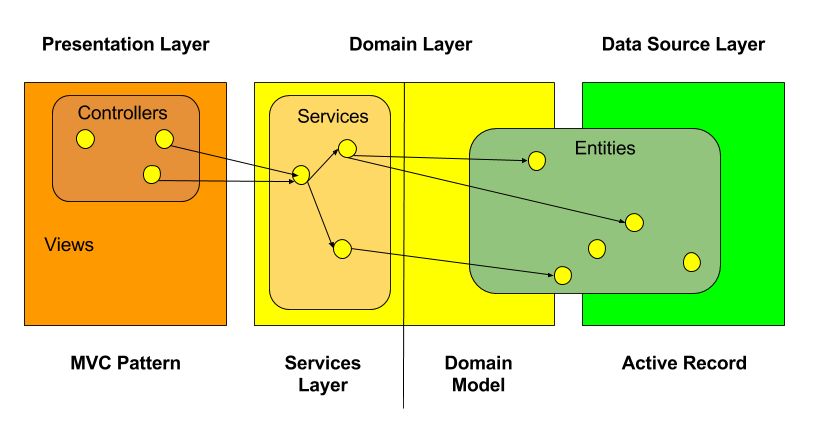
Because it is a technology stack, we have to deal with a lot of knowledge and abstraction:
| Layer | Presentation Layer | Domain Layer | Data Source Layer |
|---|---|---|---|
| Patterns | MVC | Service Layer & Domain Model | Active Record |
| Frameworks and libraries | Spring MVC | Spring Beans, DI, Transactions | GORM (Hibernate and NoSql) |
| Java technologies | Servlets, JSP, tag libraries | POJO | JDBC |
| Basic technologies | HTML and HTTP | - | SQL |
Some observations:
- The domain/persistence entities are used in the entire Grails application from presentation to the persistence with different roles; they are primary persistence objects having state and persistence methods (CRUD operations but also finders generated dynamically by the Grails framework) but you can choose to enrich them with other functionality because they are part of the domain layer
- Dependency injection (which is coming from Spring) is used for injecting services in other services and in controllers
- The services layer acts as a façade or as an API to the layer in front of it; typically, on this layer we will offer the ACID transactional support
- Controllers from the MVC are responsible just for managing the user interaction flow and will not contain any logic; the place for logic is in the services (and eventually in the domain entities)
New technologies inside Grails 3
Grails 3 is a rewrite of Grails 2 and now is based on Spring Boot and not just on Spring framework. The old build system (Gant scripts) are replaced with Gradle with is already used by Spring Boot. This migration has a downside - all the plugins have to be migrated to the new Grails version. The good thing is that the most important plugins were already been migrated by the Grails community. And a set of plugins are not needed anymore because they can be replaced with Gradle plugins and Spring starters.
Spring Boot
You can access the reference documentation for SpringBoot.
Some advantages from having Spring Boot as your Grails 3 heart:
- All Spring Boot starters (starter is the SpringBoot plugin system) are available for your application
- In SpringBoot you can have both Java and Groovy source files
- Some new technologies like websockets and reactive (Reactor project) are available now to your Grails application via Spring Boot
Gradle
In Grails 3, the old Gant scripts were replaced with Gradle build tool. You can access the Gradle main site. The Gradle user guide is also available. Gradle is the third generation build tool for Java after Ant and Maven and has inside all the accumulated experience from its predecessors.
We present here a diagram from a report published by ZeroTurnaround’s RebelLabs which provided a timeline of build tools for Java ecosystem from 1977 through 2013
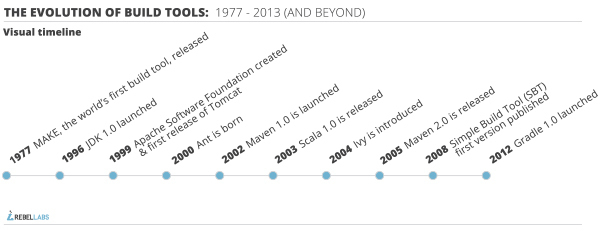
As an example of its importance, Gradle was chosen by Google as the de facto build tool for Android projects. We try to enumerate here just a part of the advantages that come with Gradle:
- All Gradle plugins are now available for you and can now be used in a variety of aspects of building
- The main scripting language in Grails is (still) Groovy, the same scripting language used in Grails. In this way, it will be simple for you to improve your build system whenever you like.
- Gradle is now offering the possibility to create multi projects builds for Grails 3
Gorm
Starting with Grails 3 the database persistence part of the framework named Gorm was extracted completely outside the framework by the Grails team and was redesigned to be a wrapper over both Sql and NoSql databases. Also, starting with Gorm 4, this persistence framework can be used outside of Grails applications (in other Spring Boot applications for example).
In the new Gorm with Hibernate integration (which was the default persistence mechanism in Grails 1 and 2), you can still have support to the main SQL databases on market: MySql, Oracle, Postgresql, MsSql Server, etc. Also the framework is now offering support for other persistence technologies like the NoSql databases: MongoDB, Neo4j, Cassandra, Redis. And the trend of Gorm is to use non-blocking drivers and to offer as reactive an approach as possible.
LogBack
LogBack is the most modern logging framework (the successor of Log4J) and it comes to Grails 3 because was chosen as the logging framework for Spring Boot. You can access the LogBack main site.
Modularity aspects of Grails
Plugins
Plugins were a main feature of Grails from the beginning of the framework. Here is the list of Grails 3 plugins. Even the framework itself in his core is a bunch of essential internal plugins. In fact, Grails is an aggregator for its plugins. If you look in a web profile of a Grails application you can see the default Grails plugins that are declared for this profile (will be different plugins for different profiles)
 1 dependencies {
 2     ....
 3     compile "org.grails:grails-core"
 4     compile "org.grails:grails-dependencies"
 5     compile "org.grails:grails-web-boot"
 6     compile "org.grails.plugins:cache"
 7     compile "org.grails.plugins:scaffolding"
 8     compile "org.grails.plugins:hibernate5"
 9     console "org.grails:grails-console"
10     profile "org.grails.profiles:web"
11     runtime "com.bertramlabs.plugins:asset-pipeline-grails:2.11.6"
12     testCompile "org.grails:grails-plugin-testing"
13     testCompile "org.grails.plugins:geb"
14     ....
15 }
Here we try to enumerate some plugins and let you understand how many technologies can be accessible in such a simple way:
- internal plugins
- Hibernate plugin is the plugin with the GORM implementation for Hibernate 5 persistence framework
- Asset Pipeline it is responsible for rendering in an optimal way (unification in one file, compression, minification, and cache-digests) for static resource in Web pages; it is a replacement for the old Resources plugin from Grails <2.x and there are other plugins responsible for other aspects of serving resources: compile of CSS from LESS and SASS, trans-piling of Javascript from CoffeeScript
- external plugins
- Spring Security Core Plugin is the plugin responsible for the security of the Grails applications; it is based on Spring Security library and it has a lot of companion plugins for other aspects of security - for example Spring Security REST Plugin for REST API security
- Quartz plugin for Grails is the plugin responsible with scheduling jobs based on a well known Java library Quartz; you can use it with another plugin Quartz Monitor Grails Plugin responsible for monitoring the list of jobs
- Mail plugin is the plugin that can be used to send emails via a configurable SMTP server
- Elastic Search plugin will let you implement search for your site; your data is indexed using Elastic Search library
- Audit Logging plugin can be used for auditing your application activity
About plugin’s benefits:
- should be declared in configuration files and are resolved as dependencies in a Maven, Ivy, Gradle style
- expose Grails constructs like services, controllers, views, entities, et cetera
- come with configurations that must be added to main app configuration file
- easy to integrate Java, Groovy and even client side JavaScript libraries into Grails applications
Profiles
Profiles were introduced in Grails 3 and now we can create different types of applications, not just the main type that was available till now, based on a server side HTML rendered interface using technologies like Gsp (based on a MVC framework on the server side). Now we can create a Grails 3 application that is just exposing a web service API without a classical server side rendered Web interface. Also, we can create a rich client directly from the server side - using scaffolding in the same way we have done till now for the classical type.
This is in accord with the global trend of IT industry these days which is trying to break the monolith application into small pieces, introducing the concept of Miroservices. In these days, Java EE is creating a new Microprofile for microservices in addition to their Full Profile and Web Profile.
You can see very clear the evolution of software architecture in the last decades in a tweet from Benoit Hediard:
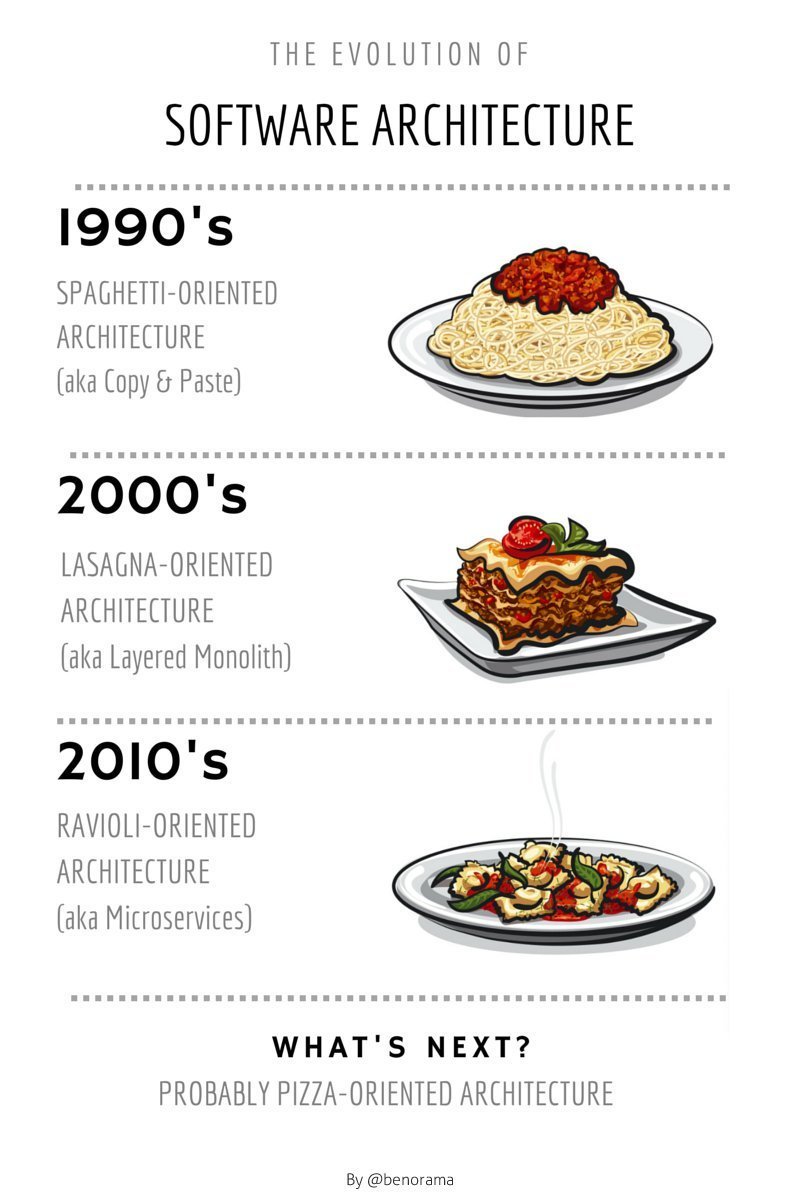
Another reason for this profiles movement is the need to expose just Web services and not a HTML based Web interface. And this is more valuable in the context of the mobile application and the mobile first approach in developing applications. That’s why a new set of server side rendering technologies were introduced in Grails 3 like Grails Views that are rendering JSON and XML from domain objects.
Here you have the complete list of Grails 3 profiles. Here is the Git official repository for Grails 3 profiles.
These are the profiles introduced in Grails 3:
- angular - A profile for creating applications using AngularJS
- rest-api - Profile for REST API applications
- base - The base profile extended by other profiles
- angular2 - A profile for creating Grails applications with Angular 2
- plugin - Profile for plugins designed to work across all profiles
- profile - A profile for creating new Grails profiles
- react - A profile for creating Grails applications with a React frontend
- rest-api-plugin - Profile for REST API plugins
- web - Profile for Web applications
- web-plugin - Profile for Plugins designed for Web applications
- webpack - A profile for creating applications with node-based frontends using webpack
Some details about the most important profiles that will be used in the application built in this book:
- web - is a profile for creating classical Grails applications with a server side MVC framework in the same way it was in Grails 1 and 2; the presentation web interface is rendered on the server side
- rest-api - is a profile for creating applications that are exposing REST APIs; don’t have a Web presentation and no MVC is needed
- angular(2) - is a profile for creating applications with a rich client based on AngularJS(1 or 2 versions) Javascript framework where MVC is located on client side (JavaScript) and the communication with the server side is via REST