What Is an Agile Retrospective?
The agile manifesto proposes that a “team reflects on how to become more effective”. Agile retrospectives can be used by teams to inspect and adapt their way of working.
At the end of an iteration typically two meetings are held: the sprint review (or demo) that focuses on getting product feedback and discussing how to proceed and the retrospective that focuses on the team and the processes that are used to deliver software. The goal of retrospectives is helping teams to continuously improve their way of working. This book is about performing and improving retrospectives.
An agile retrospective, or sprint retrospective as Scrum calls it, is a practice used by teams to reflect on their way of working and to become continuously better at what they do.
The twelfth agile principle states:
At regular intervals, the team reflects on how to become more effective, then tunes and adjusts its behavior accordingly.
All team members attend the retrospective meeting where they “inspect” how the iteration has gone and decide what to improve and how they want to “adapt” their way of working and behavior. Retrospectives are an effective way to move toward short-cycled improvement.
The retrospective facilitator (often the Scrum master) should have a toolbox of possible retrospective exercises and should be able to pick the most effective one given the situation at hand.
Typically a retrospective meeting starts by checking the status of the actions from the previous retrospective to see if they are finished, and to take action if they are not finished and still needed. The actions coming out of a retrospective are communicated and performed in the next iteration.
To ensure that actions from a retrospective are done they can for instance be added to the product backlog as user stories, brought into the planning game and put on the planning board so that they remain visible to the team.
Sailboat
The reason why this exercise is so interesting is the fact of allowing a team to think about their own objectives, impediments, risks, and good practices, in a simple piece of paper.
(LG) I learned this exercise a few years ago when I worked with Vasco Duarte. Recently, I saw an upgrade on Pedro Gustavo’s blog where I got the idea of the rocks(risks). From my experience, this technique is well received by teams due to its simplicity.
What you can expect to get out of this exercise
This exercise helps teams to define a vision. It helps them to identify risks in their path and allows them to identify what slows them down and what actually helps them to achieve their objectives.
When you would use this exercise
This technique is simple and does not require any special occasion. It might be interesting for retrospectives conducted with more than one team. (LG) I had a situation, not long ago, when two teams worked together. Because of their level of dependency on each other, they decided to conduct a common retrospective to solve some ongoing issues. Using this exercise, we put the names of both teams on the boat and we reminded everyone that we are on the same vessel, heading in the same direction.
This technique reveals all good things and less positive things. It allows the team to identify possible risks and reminds them where they need to go as a team.
The boat exercise is suitable for any team. It does not require any specific level of maturity.
As with many other exercises, this exercise does not require colocation of the team.
How to do it
Draw a boat, rocks, clouds, and couple of islands as shown below:
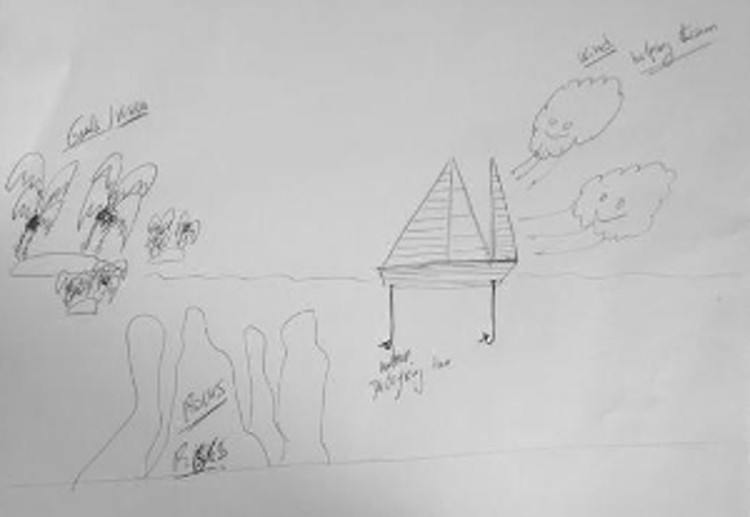
The islands represent the team’s goals/vision. They work every day in order to reach these islands. The rocks represent the risks they might encounter along the way. The anchor on the boat is everything that slows them down on their journey. The clouds and the wind represent everything that helps them to reach their goal.
With the picture on the wall, write down the team visions or goals. Start a brainstorming session during which the team dumps their ideas into the different areas according to the picture. Give the team 10 minutes to write their ideas down on post its. Afterwards, give each person five minutes to read their ideas out loud.
At this point, discuss with the team how can they continue to practice what is written on the clouds/wind area. These are good ideas that help the team and they need to continue with them. Next, discuss how the team can mitigate the identified risks.
Finally, let the team choose the most important issue that is slowing them down. If there is disagreement within the team about which topic to tackle, you can use vote dots. At the end the team defines the steps to take in order to fix the problem and concludes the retrospective.