Introduction
Hi Generation Z Developer, if you are one and want to learn as much as you can about your craft, this is the book for you.
I decided to write this book after doing a series of presentations to Gen Z audiences. As part of this process I discovered gaps in your generation’s understanding of the history behind a number of key ideas and technologies that underpin the technological revolution that we are the in middle of. I also wanted to share a number of real-world concepts, practices and technologies that will make you a much better and effective professional in today’s highly competitive tech world.
Here is the slide that started it all in 2017, how many logos do you recognize?
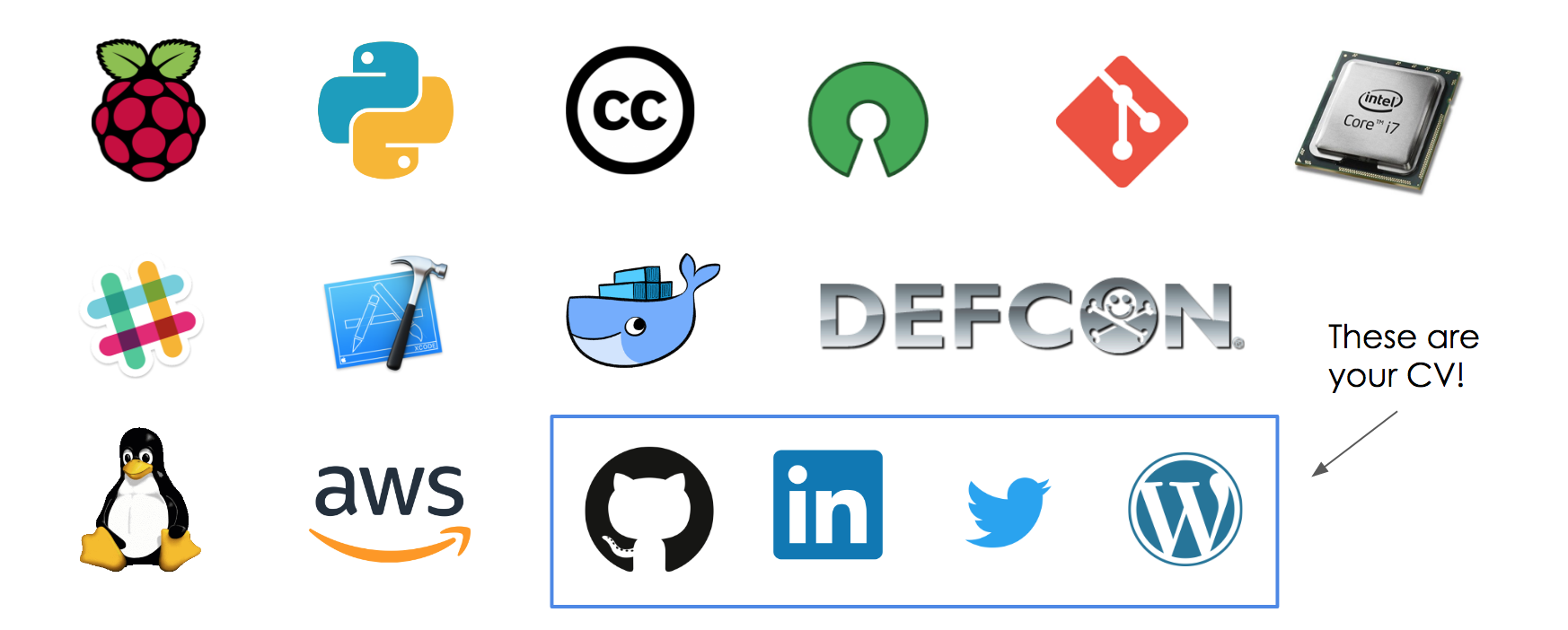
The presentation started with me asking the audience if the logos looked familiar. I soon realised that, not only did the audience not recognize most of the logos, they didn’t know the history behind them. More importantly, the audience didn’t understand the story behind why they where created nor they were aware of the problem (or itch) they originally looked to address.
Why is the why important? All of these icons were ‘catalysts for change’. It is important to understand the history behind them, why they occurred and the change they drove. Each one of these icons changed the world of technology, and created paradigms shifts that still impact our world today.
For example, one of the really significant innovations was the creation of the Creative Commons license - an adaption of a traditional copyright license. This was one of my initial ‘WFT! you don’t know what Creation Commons is???’ realizations.
Creative Commons licensing gives a number of rights to the consumer of creations (rather than the originator of a creation holding onto the rights). It allows ideas, creations and concepts to spread easily and without limitation.
This book is released under a ‘Creative Commons Attribution 4.0 International License’. This license means, amongst other things, that you are free (as in ‘entitled to’) to use all the material and content from this book. The only requirement on your part being around acknowledgement of the author and source attribution. You can even sell other books and any derived work based on the content from this book.
Fundamentally, the freedom of knowledge isn’t a new idea but the real impact of Creative Commons was about how it became applied to technology, an industry often dominated solely by commercial interests. For better or worse, the closed approach has shaped the technology and systems that dominate the world today. As you will see through the book, what I find interesting is not a particular technology or idea, but the ways in which those ideas change how we act, think and behave.
We are in the middle of a massive technological and cultural revolution and you have the opportunity to decide if you want to be a pawn, a player or even a play-maker in this new world. By understanding the history, thinking and mechanics of this change you will be in the best position to adapt and thrive. If you don’t understand the past, you are not only bound to repeat its mistakes but also miss opportunities you may not even be aware of.
Please join me in this interesting trip down memory lane, where I will try to explain how I understand and learned from a multitude number of technologies, ideas and events.
Be involved and contribute
If you have never contributed to an Open Source (or Creative Commons) project, then how about using this book as your first experiments?
You can find all content for this book in this GitHub repo and you can submit ideas and issues (you found when reading this book) here
Please share your views, suggestions and criticisms and don’t hesitate to reach out to me on @DinisCruz
Generation Z
Generation Z is the generation born after 1996. Like all generation boundaries, their differences may be generalized and there will always be exceptions to this rule. That said, when viewed constructively, it represents an interesting mix of great values and digital capabilities.
The older members of this generation (at the time of writing, 2018) are about 22 years old. They don’t remember the 9/11 attackers, were 11 when the first iPhone came out (2007) and are the first real ‘born online’ generation. In parts of the world that are privileged enough to enjoy ubiquitous access to technology, many members of this generation have not experienced a world without ready access to the internet on some kind of device. This is the generation that is entering the job market right now.
I have personal experience of this generation, I have two daughters currently aged 13 and 15, and I have also been professionally involved in a number of projects focused on Generation Z. I’ve run sessions teaching UK high school kids how to ‘hack’ (in the ethical rather than illegal sense of the word) and even younger developers how to code so they would be able to apply their skills in real world scenarios.
I’m focusing on Generation Z because I believe they’ve missed the historical understanding of a number of key technological revolutions required to be competitive in the market place. At the current pace of technological advancement so much history can be taken for granted. Without a full understanding of the past, we only learn from shadows and curated versions of reality.
I’m worried about Gen Z
Although Generation Z has some spectacular traits and values, I occasionally perceive a lack of intellectual curiosity that worries me. This is arguably the most tolerant and diversity-aware generation. But, having grown up with an innate acceptance of the technology around us, many of the building blocks of today’s technology stacks are simply assumed to be ever present. Much like driving a car or flying a plane with no knowledge of the engineering involved.
This is a huge advantage in a sense; many of the older generation perceived boundaries don’t inhibit Generation Z. By the same token however, even more opportunities can come from understanding the origin, history and evolution of the technology journey so far.
This is an age when information and knowledge is often a Google search away. Yet, conversation after conversation I’ve found - perhaps unsurprisingly - that Generation Z teenagers have a very superficial understanding of the history that underpins the technologies they use. How and why this technology came to be in the first place and the original problems it tried to solve.
My hope with this book is to fill these gaps and provide context and references to inform and enable better decision making. This is very important because they are the generation will need to save the world from the mess previous generations have created.
Overwhelming curiosity
How will I know if this book has succeded? I’m hopeful that the reader can enjoy a few moments of overwhelming curiosity and go on learning more about a certain topic. Moments when you follow link after link about a particular topic, and think ‘WOW, that is fr**** awesome!’.
If you are lucky enough to find yourself in this place, congratulations! You just found ‘the zone’. An amazing mental place where you have the chance to be single minded and 100% absorbed. This is the best way to learn.
Whenever you find yourself in this headspace, dont stop! Follow it as long as your brain allows it, and don’t stop for anything. Social events, eating and sleeping can always wait (more or less; respect your physical and mental health and never take them for granted). The ‘zone’ is a magical place to be, so learn to recognize when you find yourself inside it, and use it to explore as much as you can.
How to get a job
One of my objectives with this book is to help you to find a great job. One that you will love going to everyday; one where you are in for a steep learning curve and one that aligns what you are passionate about with what your employer is happy to pay for.
It is very important to realise that if you are in a job (or school) where your learning curve is not off-the-charts, you are short-changing your life and your career. Nobody cares as much about your career as you do, and you are the only one that has full control over your attitude to learning. You can chose everyday on how engaged and receptive you are to learn and to be taught by others. It is not exaggeration to say that you decide your future’s direction and path with every decision you make.
There is a lot of competition out there and if you look at what is coming next, namely AI and the next billion internet users, you’ll need to maximise your chances and opportunities.
I really like the Gen Z realization that a job is something that should be rewarding and not just a way to make money. After all, the best job is when you are paid to do something that you would do for free. Although I am very fortunate to be in that situation, where I love my job and what I do every day, it didn’t happened by accident. I made a number of key decisions in my life, some with very short-term negative implications, that allowed me to align what I love to do with what the market wants to pay.
Being passionate and loving your job
Find what you are passionate for, what you really care about and align your career with those ideas. The best part is that this is a massive win-win situation, since the more passionate you are about a particular topic, the more you care about it, and the more valuable you are to the company that is employing you.
Having one competitive advantage
The best way to get a job is to have ONE competitive advantage. One activity or task that you can do better than the person or company hiring you. For example in the 1990s for a lot of companies it was simply that you could use a computer! In the 2000s is was using the Internet. In the early days of software development or security, all it took was good programming or hacking experience. Although it might look that the bar was lower those days, the reality is that those who could do it were the ones who proactively embraced the technologies and learned them against all odds. Individuals can become experts at new technology faster than the tech companies. You can be first in line for a job when they need that expertise. These days, it is technologies and ideas like (all covered in this book):
- ML/AI
- Graphs
- Chaos Engineering
- GitHub
- Git
- Jira
- Creative Commons Licences
- Continuous Integration
- AWS
- WallabyJs
Own your career development
You are the one in charge of your career. Yes, listen to advice but only you can ultimately choose which paths to follow. You need to discover those paths by yourself, via trial and error, and a great way to do that is to work for companies who are aligned with those paths.
And how do you start working with those companies?
Easy, start collaborating on their Open Source projects. Act like you are part of the company. Understand their values, and behave in ways that will add value to that company, namely the tech stack.
Start by approaching the key individuals and developers from those companies and communities, both offline and online, in a way that adds value to them. Build relationships that will teach you a lot, and potentially lead to very interesting job offers, or at least references. Start by learning how to add value and how to become good at proactively solving problems, which is one of the most valuable assets you can bring to a company.
What’s interesting is that there is nothing stopping you from doing this! We are in very open, collaborative and creative times. You have nothing to lose by giving it all you’ve got, and everything to gain.
How this book is being created
This book is being created using the principles and technologies described in this book :)
- All content is available under an CC License (Creative Commons)
- Markdown is used to write the content
- All content is managed using git and published under an public GitHub repository
- GitHub Issues are used to track bugs, issues and ideas
- Leanpub is used to create and publish the digital versions of this book
- Content is being published early and often on Leanpub and on some blogs (to share the ideas, get feedback and build community)
If you have never used git, github or markdown, why don’t you help out in the creation of this book? You can do this by opening up issues with your feedback on the ideas and content (I really value those comments since it helps me to make sure the content makes sense to the target audience)