Do it while you’re young
“Of all sad words of tongue or pen, the saddest are these, ‘It might have been.’”
John Greenleaf Whittier
After many years of travel blogging, I grew tired of writing about me, my life, and the corners of the Earth with which I was getting acquainted. These stories felt more like showing off and less like I was making an impact on people’s lives.
Were people traveling more because of my writing?
Doubtfully.
Were people’s experiences at destinations altered because of some tips I offered up?
Rarely.
Was I engaged in a valuable feedback loop with my audience and learning from them as they learned from me?
Nope.
So then why was I spending so much of my creative energy writing about my latest trip, rather than making efforts to make a real impact on people’s lives? This thought had been itching the back of my brain for some time, but it took me a long time to arrive at a eureka moment.
I spent a few days buried in a subterranean apartment in Washington, D.C., during the Snowpocalypse of 20161 that covered the East Coast in over 3-feet of ice and snow. While waiting out the storm, I suddenly realized I needed to write not about what I have done, but how I have done it. More of the back story. More of the rationale behind opportunities. All the opportunities for me, started while young, which, as I will explain, was the single most crucial factor in my future successes.
I spun up a new section of my blog and called it #WhileYoung2. I wrote about my experiences from the view of age, rather than location. Youth is an asset. Perhaps the most valuable asset anyone has, for it cannot be purchased at any price, and once spent, it is gone forever from this universe.
But why? When we are young, we have more flexibility in the way we spend our time. Of course, we still have obligations with school, family, extracurricular events, friends, …and the list goes on and on. But most of these things are somehow flexible when we are young.
As I wrote in the first chapter, I grew up in a fairly typical suburban neighborhood in a medium-sized American city. I had a loving family with two parents and a brother. I received an excellent public education, and I grew up with the Internet Revolution. Throw a little white privilege on top of my good fortune to be born male in a Western culture, and it is easy to think that I had all of the world’s advantages.
However, unless you skipped both the introduction and Chapter 1, you know that not everything was perfect. Just like all people, I had my own set of stresses to deal with and challenges to overcome. From a global perspective, I indeed had some inherent advantages, but by and large, I was a relatively unextraordinary American kid.
A defining moment in my life came during the summer that I turned 16 years old. I was attending a youth camp3 organized by the Rotary Clubs4 in my area. Part of the camp schedule included daily presentations from various community and business leaders.
One of the speakers was a woman representing the Rotary Youth Exchange Program5. This program is a comprehensive global exchange program for high school students to study abroad for up to one year, all expenses paid.
The speaker informed us that the program paid all flights, insurance, necessary living costs, and it vetted and organized host families with whom to live. As exchange students, we would attend local schools, have local friends, and participate in local events. Possible destinations were anywhere you could imagine.
The call to action at the end of the presentation was that any interested camper should simply come to talk with the presenter and express interest.
I thought to myself, “that is a LINE I must get in!” When the presentation concluded, I prepared to elbow my way to the front of the room. To my amazement, there were no obstacles in my way. All of the other campers ran outside to play a game! I was the only one who approached the program representative to express interest. As a result, a year later, I found myself on my first airplane, headed to Germany, where I would live for one year as an exchange student.
That experience started by merely expressing interest and has shaped every day of my life since.
I’ve shared this story for years as an anecdote about showing up. In many ways, showing up is the key to all of life’s successes, which is why I dedicated all of chapter 5 to the topic. Before we get to that, I first want to impress upon you the reasons why showing up is best done sooner rather than later.
Youth = flexibility = opportunity
When we are young, we have more flexibility in the way we spend our time. Of course, we still have obligations with school, family, extracurricular events, friends, …and the list goes on and on. But most of these things are somehow flexible when we are young.
As a student, I was able to leave home and study in another country for one year. My family obligation was a bit flexible and allowed this. On the other hand, what do you think would have happened if my parents decided to leave me at home alone while they went to live in Europe for a year? That was much less likely to happen! As a young person, I had this flexibility in a way that my parents did not.
To help visualize the flexibility we have while young, take a look at the chart fig 3.1. Everyone’s life is different, and not everyone will pursue the things laid out in this diagram, the point should still be apparent.
As we get older, we have more responsibilities and pressures that take up our time. It does not matter if what you want to accomplish in life involves leaving the place where you grew up or not. As we age, we accumulate more and more responsibilities that occupy our time and make it more challenging to focus on a big goal or to change course altogether.
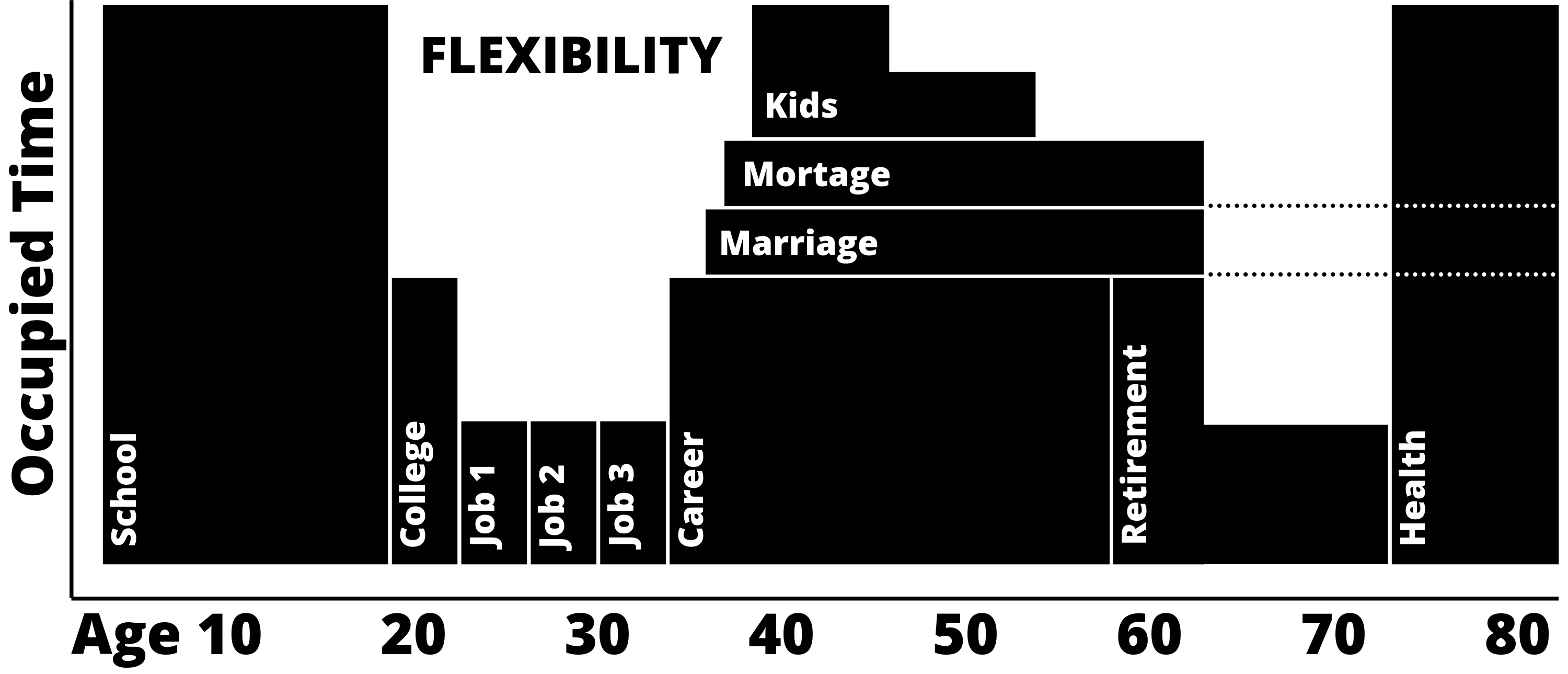
Imagine you want to travel for one year, or maybe you want to take some time off work to write a book, but you have a mortgage and three mouths to feed. You probably cannot quit your job and abandon your bills and family. Nor would I ever endorse such a decision. That is why you should focus on living your what if before you attain those responsibilities, i.e., do it while you’re young!.
Many people delay travel until their retirement. However, certain activities become more difficult as health conditions change, and knees get weaker if you even have the good fortune of living that long. I had knee surgery two years ago, so I am particularly sensitive to this topic.
Let’s talk for a minute about the obligations in this chart. Again, not everyone will live this cookie-cutter diagram, but in one way or another, this flow of responsibilities vs. flexibility is representative of many people’s lives.
School
Primary education is, indeed, a primary responsibility for both you and your parents. Some laws penalize parents who don’t send their kids to school. Other laws punish kids who choose not to go. More importantly, this formative time of life is full of wonder and exploration of the mind. But you get very little flexibility to make your own schedule or to set your own priorities. One could argue that a lack of autonomy at this age is even a good thing. It is likely beneficial to have structure provided to you at this age.
As we get a little older, we gain some freedoms. We can pick our sports, extracurricular activities, how we express ourselves in the way we dress, and the music to which we listen. We can choose how to spend the weekend. Start a small business, become a creator on YouTube, volunteer in the community. There are many open doors.
In America, we can drive at 16 years of age, still while having a few years left in school. In other parts of the world, it might be easier to travel alone on public transit or go out on weekends before clubs.
There are always opportunities if you think creatively and seek them. Just find a path that works for you and pursue it rigorously with all the resources you can find around you.
I was so surprised when I lived in Germany when I was 17 years old that I could travel across Europe, and no one thought it was weird at all. “Youth hostels” are a thing, after all.
Example: When I was 14, I got involved in community theater. My first production was Rodgers & Hammerstein’s South Pacific6. I attended rehearsal every day after school for months, and then we performed to hundreds of people every night for two weeks. As this was community theater, everyone on stage was a volunteer. They came from all walks of life, were all ages, and we all shared a passion for music, community, production, and fun. The theater was all great fun and taught me many valuable lessons, including getting me over stage fright, very useful for a career in public speaking!
Gap year
A gap year is a year taken between high school and university, or between university and going to work, in which you pursue some other endeavor. Many people use this time to travel or to pursue some other life goal.
Before college and directly after college is a great time to pursue your life goals. You might feel pressured to go straight from school to university, or from university to work, but these are times when you do genuinely have a choice.
Example: I streamlined my high school senior year classes and dropped my extracurriculars so I could graduate a few months early. I got a job and worked every day after school and saved money. Then, I spent six months solo-backpacking Brazil before I started university.
That experience was the most life-impacting, self-defining, and educational experience of my lifetime. It taught me more than any schooling ever could, and it was critical in guiding my choices regarding what to study at university.
College
Attending university offers us a great experience with autonomy. We choose for ourselves what we will study, who we will spend our time with, and what extracurricular activities or jobs we will have to fill in the gaps. All colleges have vast door-opening opportunities with internships, study abroad programs, and career development programs. Utilize these programs to the best of your ability; after all, you’re paying for them already!
Example: I joined a wide variety of student organizations that covered every topic I could imagine at the time. But the most meaningful series of events is what led me to action after Hurricane Katrina struck New Orleans in 2005. I went to the local American Red Cross chapter7 in the middle of the night and began a sequence of volunteering activities that somehow led to full-time employment. During my two years as an emergency response planner, I sat at the table with local, state, and federal policymakers as the Red Cross’s representative. Together, we shaped policies that would impact the state for years to come.
Jobs
Long gone are the days of finishing your schooling, landing a job, and keeping that job until you retire. Instead, you will likely find yourself with a lot of flexibility to move around to different employers and experiment in diverse professional environments. At this stage, it might not be extraordinarily comfortable to quit a job and take a risk on something else, but it is certainly possible.
Opportunities are all around us. We need only look for them and work hard to get the doors open. Patience is a virtue, but being young and flexible is an asset that will not last much longer. Use your early career to gain as many experiences as possible. Building your library of professional skills and life experience will serve you well until your dying breath.
The first jobs you have after school are a perfect time to reach out for mentorship. You shouldn’t feel shy about this! Senior people expect that you are smart, ambitious, and hard-working. They do not expect that you know everything and that you have all the answers. No matter your educational background, you do not know it all, and you have not learned yet what the job will teach you.
When you are in your early career, you are expected to be a bit ignorant. Don’t hide from this. Promote yourself by asking questions and being inquisitive. Asking questions is one of the best traits you can show your peers and managers. (By the way, this never changes, you will learn new things for the rest of your life!)
Example: During the first week of starting a new job, I always ask everyone who interviewed me, “Why did you hire me, and more importantly, why were you thinking not to hire me?” I ask this because I want to know what parts of my character I should promote as a strength, and what parts of my skillset I should improve. It is better to get this feedback on the first day than at the end of the first year. I recently landed a great opportunity that I was not quite qualified for on paper. When I asked them my question, they replied that my lack of experience in this job was a concern for them. However, the decision to hire me seems to have been an easy one for them to make. What made me the obvious choice was not my experience in that same role, but rather all of the years I spent in other roles. My diverse experience left the hiring managers feeling that I would bring a different thought process and some needed empathy for the team. My “nomadic lifestyle” made me an even more attractive candidate than those who had more traditional experiences.
Career
Now things are getting a bit more serious. You’re a little older. You’ve gained some more experience. You’ve found the professional path that makes you the happiest, or at least seems to be the right direction for your life. Excellent! But now more than ever, you have to stay the course and put in your time at work.
This company has invested in you and expects to get a return on that. Likewise, you need to establish your professional stability by not having an update to your resume every six months. Now you are putting all of your life’s learnings to the test.
The period when you get to do meaningful work that makes you happy is a wonderful time of life. As you can imagine, however, your ability to just up and change everything in your life is becoming more and more difficult.
Example: My strategy from an early age was to live my 20’s gaining as many diverse experiences as possible, and then spend my 30’s focusing those learnings into a stable career. Coincidently, I finished service in the Peace Corps one-month before my 30th birthday and then got recruited into a tech company. I’ve stayed in tech ever since and have worked a variety of jobs. Being inside the ecosystem taught me a lot and helped me find what I wanted to do professionally, which is product management. I’ve now been doing that for a few years, and I am confident this is what I will stick with (along with writing books, of course!) until I retire.
Marriage
You’ve found the love of your life, and now you’re set to spend your life together. It is a huge milestone. But now, you have two sets of life goals to balance — two careers to consider. Two schedules to coordinate. To make some significant life change or travel the world, now two of you have to make adjustments simultaneously to many parts of your life for it to work out. Flexibility is fleeting.
Example: I am not married, and so this is an area where I can’t offer a story from my own life. One of my friends who had lifelong ambitions to travel was studying German in preparation for a road trip around Germany. Suddenly, he met the love of his life, married rapidly, had children quickly after that, and although he has the passport, it remains void of stamps.
Mortgage
Your career is advancing. You are living in a community that makes you happy. The person you want to spend the rest of your life with is by your side. The time has come to make a long-term investment in some property and have an asset in the future. These are all great things, but now you have to pay a bank some significant sum of money every month for the next 30 years. Now, quitting your job is not an option. Making any super drastic changes in your life is not going to come easy, if at all.
Example: My best friend from high school still lives in our small hometown. He never wanted to stay there. He was even much more ambitious than me to leave. He waited, very nobly, so as not to leave his father all alone after his mom had died. He didn’t want his dad to be lonely. My friend is a hero. But my friend also inherited the house and the bills that came with it. He doesn’t even care about the house anymore, but he is stuck there. He can’t quit his job, he can’t risk bankruptcy, and he has to work, work, work, to make the mortgage. There is no relocation in his foreseeable future, and there is little chance for pursuing his dreams until he can relocate.
Family
It’s time to fill those extra rooms in the house with some kiddos! Having children is one of the greatest achievements in many peoples’ lives. To have a family is an extraordinary thing. But it also means that most of the next two decades are solely about those little humans.
If you thought it sounded challenging to balance the schedules of two people, just you wait! Sure, you can travel with kids. People do it all the time. But they are now priority #1, and moving as a unit comes with extra stresses (and costs). Any significant life change during this period has to consider their best interest.
Example: I recently visited a friend of mine living near the Baltic Sea, where he and his wife have two young children. Before the kids came along, the pair had traveled extensively around the world. When I asked him how the kids have impacted their flexibility, he confirmed my suspicions that the joy of children comes with embracing more spontaneity and reduced flexibility to do whatever you want for yourself. The kids are priority number one, now. That said, the travel has only slowed down marginally. Because the newly-minted parents had already mastered the ins and outs of travel, it meant that they could travel more easily with their kids. By leveraging the years of flexibility between finishing school and having children to hone their own skills, the parents are now better prepared to guide their kids through the adventure of life.
Retirement
If you have planned well, saved up, and are in good health, then retirement can be golden years for pursuing your life dreams not yet accomplished. However, there are a lot of boxes to check for this period to have maximum flexibility. Many things will need to have gone just right throughout your life for retirement to be the time when you can do all you’d ever hoped to do in your later years.
Example: Some people retire early. Some people retire late. Some people never make it to retirement. The person whom I most admire in retirement was a fellow Peace Corps volunteer with me in Kyrgyzstan. Many people think that the Peace Corps is for the young, but in fact, there is no upper age limit. The oldest volunteer in my group was in her 70’s. She was a retired teacher, and so joining the Peace Corps was a perfect opportunity for her to share her skills and knowledge while having an incredible experience. As a volunteer, she didn’t have any expenses. I can imagine that allowing pension, social security, and other retirement benefits pile up in the bank made her later retirement that much sweeter. She has gone on to travel the world for months at a time several times now. She is one of the most impressive people I know, and probably one of the luckiest as well.
Health
As we age, health becomes more complicated. Health issues do not need to be blockers, but they can certainly slow down the things we do. Often, health issues steal long-sought flexibility people hoped to have later in life.
Example: Two years ago, my mom came to visit me in Germany. We had a grand ole’ time touring around castles and museums. She did extra training in advance to ensure she would manage all the extra walking for those two weeks. It all paid off because I have to admit, she had more energy than me! I’m so grateful we had this trip when we did because six months later, she fell at home and hurt her back. The result was a tremendous pain in her feet that has prevented her from walking any substantial distance ever since. If she had waited just a short while longer, then I’m afraid that trip to Europe would have never happened at all. I love you, Mom.
Impact your life before you live it
Now that we have discussed some of the typical phases in life, let us take a look at what experiences while young can do to shape those periods.
As I mentioned above, I solo-backpacked Brazil for six months before beginning university. While in Brazil, I witnessed first-hand some of the world’s most extreme poverty and harshest living conditions. I also met some amazing community leaders and people working to improve the conditions of Brazil’s bottom 1%.
While visiting favelas during volunteer and community impact projects, I met with people living in these slums. They had nothing and lived in a constant state of struggle. They were not ignorant of their place in the world, and many had a sense of self that was as acute as any you’d find elsewhere.
What struck me most about the people I met in the favelas was that they were happy. I mean, they were utterly happy. I come from America’s consumption culture, where we are programmed always to seek more. We never have enough stuff, and we are not satisfied until we get more. This vicious never-ending cycle makes sustained happiness elusive for many Americans. But in the Brazilian favelas, where people had nothing, they were happy. They chose happiness. They lived happiness.
It was incredible to me.
The kids, who kicked around a clump of trash as a soccer ball, even they were happy. It was an extraordinary thing for me to experience. As one who was born in a community that offers so much social and economic mobility, being in the favelas really checked my privilege.
It was this experience that most-informed the mission statement of my life, which I discussed in Chapter 2, “to make a positive impact on people’s lives while working from the international arena.” This impact informed my decision to study political science and foreign policy at university. It distilled in me a greater sense of volunteerism and helping others, which led to my working with the American Red Cross after Hurricane Katrina. And later on to joining the Peace Corps and serving for over two years in Kyrgyzstan, developing media networks. My now lifelong pursuit of helping others is deeply grounded in that time I spent in Brazil.
If I had not traveled to live this what if, I would not have formed a direction for my life at a time when I desperately needed it. To have gone to university without inspiration for what I wanted to do with my life would have made the time, effort, and money of university a little more than a waste. I took my classes much more seriously because real-world experiences influenced my chosen course of study. Additionally, I was able to pursue a topic that I was confident would serve me well.
We all have experiences in our lives which shape who we are and what we desire. Our upbringing, our friends, and our family all influence, for better or for worse, the path we are on. Our lives are our own, and the sole responsibility for making decisions in our life rests within ourselves.
What do you choose for yourself? On what path do you want to be? Is it the path you are on now? Do you need to make a change? I believe there is no other line of questioning more important than this.
Carpe diem.
Align your goals with the actions you are taking today. Of the things in your life that you do have influence over, which ones are distracting you from your goals? What steps can you take to better-align your day-to-day actions with the pursuit of your goals?
Find ways to have experiences today, now, which feed into these life goals of yours. By building up your experiences now, you will be better able to accomplish the end goals. Also, don’t be surprised if, by having a few experiences, your goals change. It is natural for your interests to evolve. Many people change their field of study during university. Why do they do this? At university, students get exposed to new ideas and possibilities. They learn that what they wanted when starting university is not what same by the time they finish. Higher education’s aim is not only to teach skills and knowledge for your future career, but it is also about discovering what you do not want to spend your life doing. I argue that the latter is even more valuable.
With a few life-impacting experiences, you will be well-prepared to choose the path that is best for you. Knowing what are the specific actions to take from which you can base the foundation of your life gets easier and easier.
Life without regrets
Regrets are among the saddest things we can have in our lives. Why are they so terrible? Because they are often avoidable. Let’s define what precisely a regret is. “Regret” is a term that gets misused quite often, so let’s first define what regret is.
I will make one edit to this classic definition. I do not believe that you should regret a decision just because it was the wrong decision. If you decide to do or not do something, only to later learn that it was the wrong decision, this is not regrettable. You should only regret something which you knew at the time of action or inaction to be wrong.
If, at the moment of making a decision, you choose to act in the best way possible based on the information available to you, then you should not regret the decision. Simply put: your life is full of decisions. If at the deciding moment you believe you are doing the correct thing, then you are. Anything you learn later about why that decision was a bad one, is simply an opportunity to learn and grow. And that, of course, is a good thing.
My only regrets
I only have two regrets in my life.
The first is that it took me so long to visit Mexico. When I was an exchange student in Germany at age 17, there was another student from Mexico who was in my class. We even had the same host families (swapped mid-year). She and I are brother and sister. She is one of the most important people in my entire life. But it took me 15 years until I visited her in Mexico.
This was just unacceptable.
I traveled all over the world, but it took me a decade and a half to get to my neighboring country. I am sorry for that, Johana, but I am so grateful that in the last few years we have seen each other so many times!
The other regret in my life is a terrible story. The short of it is that I was too weak to end a relationship at the moment when it was clear it was over.
Once upon a time while living abroad, I was in a great relationship with one of the best people I have ever known. Then suddenly, I had to leave the country unexpectedly.
The situation was such that she could not come to visit or be with me. And I could not likely return to visit her. We weren’t at a point in our relationship to discuss getting married, and now we weren’t ever going to have the chance to get to that point.
So what was the point to continue?
I am miserable in long-distance relationships, and this was set up for disaster. We had frequently discussed that the day might come when I would have to leave, and here it was: this was the end. But in that moment at the airport when we last embraced, we were both too emotional to go through with the breakup. She asked me to stay with her, and I was too weak to rip off the bandaid and end it there.
One miserable year later, it came to an end over the phone. It was terrible. I’ve not seen her since that day at the airport.
It might sound awful, but I regret that I was not strong enough to stand by what I knew was right for me at that moment at the airport.
Though I wish I had acted differently in these two cases, I did learn from these regrets. I am more motivated to not have any more regrets in my life as a result of having experienced these, and for seeing the way that my actions impacted others. Just the same, it would have been better if I could have avoided these regrets all together.
The secret to never regretting
Living a life without regrets is very simple. Just follow your heart, live your life for you, and make the best possible decisions based on all the information available to you at the time of making that decision. When you do these three things, then you should never feel the remorse of a regret. Your conscious will be clear.
Time is the only thing you can’t get more of
There is a famous Mark Twain quote which I think lacks imagination, “buy land, they’re not making it anymore.” Well, that is not true. We have been constructing land via reclamation projects for ages now. Mumbai was originally seven islands, which are now all filled in. A chunk of lower Manhattan stands on reclaimed land. Dubai is frantically building land in artful forms off of its coastline. China is building islands in the South China Sea to position itself more strategically in regional and geopolitics. The examples of building more land are seemingly endless.
Though it may come at a high cost, we are building more land. Lots of it. All the time. What no one can buy or sell at any price, though, is time. There is no other resource so abundant in its absolute infinite supply, but to which we as humans have such finite access. The time we have is all we get. Therefore, you should learn to make the most of the time you have.
I am pretty good at time management. I am obsessed with my calendar app. If something isn’t on my calendar, then it may as well not exist. I am astonishingly good at estimating the amount of time it takes to travel between two places, and therefore am excellent at arriving at destinations on time. This punctuality keeps me sane, and I know others appreciate it as well. I am not a time management expert, though, so I encourage you to read some books on the topic. I’ve compiled a list of my favorite time management books at the URL below so that you can gain access to the advice which has been so helpful to me.
Wisely managing your time is super important. Please do check out some of the books I recommend and make time management a priority. Remember, you don’t get more of it! And for some things, such as travel or building your financial security, it does matter when you start. Earlier is more impactful than later.
Exponential happiness
As I briefly mentioned in Chapter 1, economists refer to the interest paid on an investment’s prior interest earnings as “compounding interest.” Compounding means that over time, the growth curve of an investment rises exponentially, rather than in a steady climb. It is this principle that makes it so important to take advantage of your youth to start saving for retirement. When you begin saving for retirement very early, you can maximize this mechanism to gain free money later in retirement. The more years you let the investment grow, the more the magic of compounding interest will do for you. Starting while young is the key.
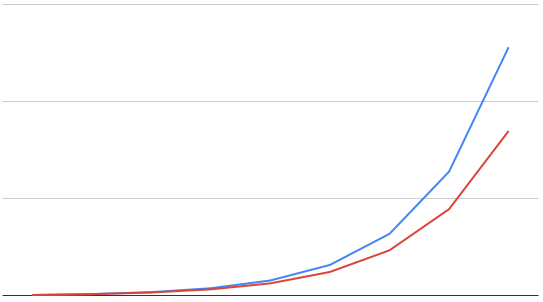
In the same way that compounding interest will benefit most those who start early, those who pursue their dreams beginning at an early age will experience “compounding happiness.” By pursuing your what if while young, you gain an irreplaceable advantage. Among the benefits is that you will experience and overcome many of the missteps everyone makes in life. The pursuit of happiness, knowledge, wisdom, relationships, and wealth is a process, and it is not always a smooth journey. When you start early, the bumps in the road are a lot less turbulent, and you recover from your mistakes much more quickly.
You will make mistakes. You will take steps backward. You will fail. You will have to start over. Recovering from the normal setbacks in life is much easier to do when you are a young adult. As you grow older, recovery from these things becomes more difficult.
Additionally, we learn from our mistakes. So start making those mistakes at a young age and learn from them sooner. The later you postpone that process, the more disservice you do to your learning.
Are you convinced yet? Are you ready to make your dreams come true? Are you feeling motivated to take the steps necessary to live your what if and to make your life as full of adventure, wonder, and success as possible? Then read on! In the next chapters, we will explore the nuts and bolts of decision making, taking the first steps, and much more!