Introduction
Writing is a very important skill to have and it can further your career significantly. Writing is clearly a core skill for students, academicians, and professional authors. But even in business, having good writing skills can be a huge boost to your career. Imagine your confidence if you could clearly communicate your ideas at work. For example, if you were able to write up a two-pager that explained how an important business problem can be solved in an innovative way. That two-pager may circulate up the corporate ladder and give you valuable exposure among bosses at the company. Writing is also important for thought leadership, in addition to your ability to conceptualize and develop an idea. In all these cases it’s not beautiful prose that’s needed, rather it’s simple and accurate prose. Prolific writing based on good analysis is the key to unlocking your career, to a large extent.
How can you be prolific? The only way to be prolific is if you can reduce the “hurdles” you face when you get down to writing and publishing. What are the hurdles? Well you may not be confident of crafting the right sentence or may even have doubts whether you can write well at all. Remember though that it’s more important to get your ideas out rather than worry about the many ways in which your prose doesn’t live up to the mark. Thus, what you need is a workflow that allows you to produce content quickly, that allows you to write iteratively which is the ability to write in multiple passes so that you can improve your work. You need a tool that does not sap your energy, but instead makes you feel good about the writing process itself. That is how you can achieve high output - by enjoying the process of writing.
One way to reduce fatigue involved in the writing process is to write the way you speak i.e. without laboring over every word or sentence. When we speak we tend to focus on the thoughts we want to convey, and we do not get bogged down by choice of word. We need to write in a similar manner by not focusing on words but rather on thoughts and ideas. We need a tool that allows us to write like we speak, and helps us focus on the broader topic, not the specific words.
For most people, speaking is far easier than writing. And this is because we accept that how we speak doesn’t have to be perfect. But, what we write is subject to a much higher bar. We can seek a middle ground though. What if we write the way we speak but add more structure & clarity than usually invested in speech? Thus, what we need is a technique that allows us to speak with structure and precision. For example, many people use a whiteboard or an outline that allows them to present ideas in a cohesive manner. Other people build index cards or cue cards which allows them to deliver a presentation. Others prefer to create a slide deck which sequences the talking points. Whatever is the tool that allows us to speak well, can also become the tool that allows us to write well. That is the promise of speech to text technology.
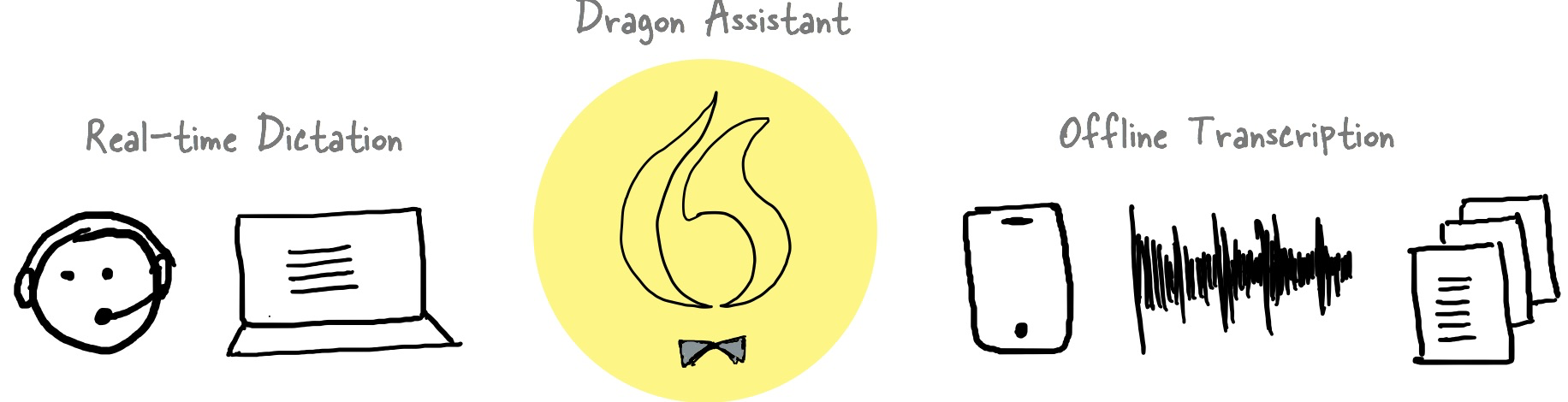
Speech to text technology covers both real-time dictation and offline transcription, and as we see later in this book, both of these technologies can be leveraged to help you become a prolific writer. When you use speech to text technology to write out your ideas with confidence, it indeed feels like magic – to paraphrase Sir Arthur C. Clarke.
Dragon Professional Individual version 15 for Windows, as of this writing, is the most advanced speech recognition technology available to the public. You will be amazed at what it can do for you, converting what you speak into text on the screen. However, it does require investment on your part to train it and to fit it into your writing workflow. That’s where this book comes in. The aim of this book is to help you get the most out of this versatile software by training it effectively and deploying it for your daily use. Moreover, we will build a robust workflow that fills the gaps in how this software operates.
It’s very important to have a complete end to end workflow, because wherever there is a hurdle, that is an excuse to abandon or postpone writing. Towards that end, we take great care in this book to make sure that each phase of this writing workflow is simple and straightforward. However, you’re encouraged to modify the workflow as you see fit. Because the fast track to becoming a prolific writer is built on a workflow that makes you glad to write.