4. The Regulative Principle of Worship Violated
It may seem strange that I would consider the Regulative Principle of Worship to be a presupposition that can help to settle this question. After all, there are people from all three basic camps that affirm their belief in the Regulative Principle of Worship. However, there are two reasons why this chapter is critical.
First, it is my opinion that most modern versions of the Regulative Principle of Worship are not Biblically defined or consistent. The first part of this chapter will show that the Bible is much more granular in its specification of what is allowable in worship than most modern Reformed people realize. The second part of the chapter will seek to show various ways in which both paedo-communionists and mature communionists have unwittingly violated the Regulative Principle of Worship.
Second, most of us tend to have blindspots. I only came to recognize my blindspots with regard to the subject matter of this book when I was challenged to prove the granularity of my views. I had already begun to recognize other blindspots through similar challenges to my other prejudices. For example, I was asked why I would be uncomfortable with lifting hands in prayer and praise when we are explicitly commanded to do so — “Lift up your hands in the sanctuary and bless the LORD” (Ps. 134:2); “I desire therefore that the men pray everywhere, lifting up holy hands” (1 Tim. 2:8); etc? Why was I uncomfortable with kneeling in prayer when we are explicitly commanded to do so — “O come, let us worship and bow down; let us kneel before the LORD our Maker” (Ps. 95:6)? Why was I uncomfortable with a loud “Amen!” from the congregation, when we are explicitly commanded to give such an “Amen!” — “And all the people shall answer and say, ‘Amen!’” (Deut. 27:15-26); “Let all the people say, ‘Amen!’” (Ps. 106:48); etc? After repenting of being regulated by something other than Scripture on these issues, I became much more conscious of other ways in which my practice was violating the Regulative Principle of Worship.
It is for this reason that I believe that one of the core presuppositions that must be settled before we can make progress in this debate is the Regulative Principle of Worship. It is not enough to ask, “Where does Scripture forbid infants from partaking?” We must instead ask, “Where in Scripture does the Bible explicitly authorize infants to partake?” Given all the conditions for worthy partaking that all sides agree are given in connection with communion, we would expect God to give an explicit exception for infants, who are not capable of fulfilling those conditions. Instead we have found examples of infants and toddlers being explicitly excluded. Chapters 2-3 have demonstrated that there is no explicit reference to infants partaking of the Passover Lamb, and there are many indications that faith, obedience, and minimal understanding were required prior to partaking. It is the Reformed perspective that every detail of our worship must be explicitly authorized in Scripture. At the time of the Reformation, this was a major difference between the Lutheran and the Reformed churches that continues to this day.132
Definition of the Regulative Principle of Worship
An even broader principle that was held to by the Puritans was that everything in the government of the church must be explicitly authorized by the Bible. This was known as Divine Right Presbyterianism. The Regulative Principle of Worship was a necessary subset of the broader principle of the Regulative Principle of Government133 which can be briefly summarized as follows: Christ as the King and only Lawgiver,134 has given to His Church a system of government, discipline, and worship that is complete.135 This historic jus divinum136 principle of ecclesiology requires that all laws,137 methods,138 and goals139 of church government, discipline, and worship must be either expressly set down in Scripture140 or be deduced from Scripture by good and necessary consequence,141 with nothing being added142 or taken away143 by mere human authority.144
Sometimes people will disregard the Regulative Principle of Worship with respect to what they call “circumstantial issues.” However, the Westminister Confession of faith is quite clear that all circumstantial matters must still be ordered “according to the general rules of the Word, which are always to be observed.”145 What is meant by that phrase? It means first of all that no circumstance of the church’s worship and government is unaddressed by the Scriptures in some fashion. Without this, we would not have divine right Presbyterianism.
Secondly, it means that where Scripture gives two or more options, it leaves the decision up to the sanctified judgment of the church’s leaders. That is not a liberty independent of Scripture but a liberty given by Scripture and defined by Scripture. For example, since there are numerous passages of Scripture that show worship in the open air as well as worship within the shelter of a building, the Scottish reformers were perfectly justified in leaving the official church buildings in times of persecution and worshiping in rainy mountain recesses away from threatening soldiers. The early church was certainly justified in worshiping in the catacombs. No one could complain that the worship was illegitimate since it did not occur within a “church building.” God had authorized worship inside and outside of buildings, and thus there was a liberty of choice that was left up to the sanctified wisdom of the church leaders.
Likewise, since Scripture gives liberty to preach while standing on a stage (Neh. 8:5; 9:3; 2 Chron. 24:2) or to preach while sitting on a chair (Luke 4:20-24), it is the Scripture itself that has authorized leaders of the church to make that decision based upon “the light of nature, and Christian prudence.” The fact that the Bible did not dictate one or the other posture does not mean that the Scripture did not address it or authorize it. It explicitly gave liberty to do either.
Likewise, if the Scripture gives liberty to have the congregation stand while listening to a sermon (Lev. 9:5; Neh. 9:5) or to sit when doing so (Deut. 33:3; Ezek. 33:31), we should not conclude that Scripture has failed to speak to the subject. Scripture has given the church a liberty of choice that others may not take away without violating the Regulative Principle of Worship.146 Those Scriptures allow us to make a decision within the general boundaries of propriety and expedience.
Likewise, when Scripture gives several different orders of worship (all of which contain the same elements of worship),147 then we have liberty to pick one of those orders of worship (or to use each of those Scriptural orders at different times).
Scripture addresses even the tiniest technical details of the church – like a working sound system,148 instruments being in tune,149 and whether it is legitimate to put words on the wall for the whole congregation to read responsively.150 Some people mock the regulative principle of government by saying that the Bible does not authorize electric lights or air conditioning, but I believe to the contrary that it does indeed address such subjects through its general principles.151
Even the circumstances of church worship and government (such as administrative details that help us to do things decently, in order, and for edification)152 are governed by the general rules of Scripture and must not go to the right hand or to the left hand of the liberties given in Scripture.
Thus, this portion of the Confession makes it clear that there is nothing that the church may do (circumstances included) which is not regulated by the general principles of the Word. What the divines had in mind was that when Scripture gives flexibility on an issue, we are not authorized to go the right or to the left of the liberties given, but within those Scriptural bounds (“the general rules of the Word”), leaders can make their choices according to “the light of nature, and Christian prudence.” The historic Presbyterian position is that “the only voice that should be heard in the church is the voice of God speaking through the Scriptures.”153
How this impacts the debate on communion
It is my contention that both the paedo-communion and mature-communion positions unwittingly violate the Regulative Principle of Worship. They do so by 1) adding things to the Word that are not explicitly there, 2) taking away things that are explicitly there, 3) and making assumptions that are not “good and necessary consequences” of the Scriptures they appeal to. Obviously this section will be subject to debate, but if we take the Regulative Principle of Worship seriously when it says that we may not “add to” or “take away” anything from worship that God has not explicitly authorized (Deut. 12:31-32), then this is a serious accusation that needs to be carefully evaluated. We have already seen in chapter 2 that mature-communionists “take away” the “little ones” from the table, and that paedo-communionists “take away” the numerous conditions to worthy partaking and make them inapplicable to children. In addition, both groups will occasionally appeal to the Talmud or other extrabiblical sources to prove their points — something that violates Paul’s dictum “that you may learn in us not to think beyond what is written” in the Bible (1 Cor. 4:6).
How logic is being misused and does not constitute “good and necessary consequence”
We will see that the Puritans believed that logic (what they call “good and necessary consequence”) is a Scriptural issue and is integrally bound up with the Regulative Principle of Worship. Since both sides seem to believe that they have logic on their side to justify failing to apply the “body of facts” that the other side throws at them, it will be important for us to discuss the issue of logic. For example, since mature-communionists are so convinced that young children cannot meet the conditions laid out concerning the sacramental meals, they feel duty-bound to come up with an answer as to why children never partook or no longer partake. Since paedo-communionists are absolutely (and rightly) convinced that young children did partake of the sacramental meals, and since they extrapolate that infants must have also partaken, they have to come up with an explanation of why infants are not subject to the conditions that are clearly connected to all the covenant meals. Both sides believe that their conclusions are logically necessary.
True logic (as opposed to assumptions, or a sense of what is going on) must be rigorous to match up to the Confessions’ biblical requirement that it it be “good and necessary consequence” (WCF 1:6). Our Confessional writers insisted on the importance of logic in discovering the whole counsel of God.154 They also insisted that rationality was an ethical issue. For example, the Larger Catechism sees as a violation of the third commandment not only faulty exegesis (“misinterpreting” Scripture), but also faulty deductions (such as “misapplying” Scripture155 and theology).156 The Confession treats as a violation of the first commandment the following: “ignorance, forgetfulness, misapprehensions, false opinions…vain credulity, unbelief, heresy, [and] misbelief.”157 In other words, these writers saw any form of irrationality as both a theological problem and an ethical problem. The irrationality may be deliberate rebellion or may be the secondary affects of Adam’s fall (noetic affects of the Fall). It is clear that the Westminster Assembly believed that irrationality led to having other gods than the rational Jehovah (first commandment) and that irrationality led to inconsistencies with wearing the name of God as His followers (third commandment). I say all of this to emphasize that to meet the Westminster Standards’ definition of the Regulative Principle of Worship, a logical conclusion for any of the fourteen positions on communion (my own included) must meet the rules of formal logic.
Sometimes both sides have numerous “assumptions” that form the basis for later argumentation. These assumptions are just that. For example, paedo-communionists sometimes assume that “if children asked about the meaning of Passover, then it seems as if they were participating,”158 while mature-communionists sometimes assume “if they had to ask about the meaning, it appears that they were not yet eating” or “it appears that they were being catechized.”159 These are assumptions, not explicit authorizations from Scripture. The Regulative Principle of Worship requires explicit permission from the Bible.
Paedo-communion violates the Regulative Principle of Worship
Paedo-communion adds to God’s Word
How does paedo-communion “add” to the Word of God? It does so by insisting that infants partook. We saw in chapter 3 that there is not a single verse that shows yeled (newborns), yonek (first year), or olel (nursing along with some solids) children partaking of the sacramental meals of either the Old Testament or the New Testament; yet many paedo-communionists insist that all three categories of childhood had the right to participate. Because there are no explicit references, paedo-communionists rely on logical deductions or inferences. If these arguments constituted “good and necessary consequence,” then we should all be paedo-communionists. Credo-communionists believe that all of their deductions either fail on the “good” side or the “necessary” side of rigorous logic.
For example, in chapter 1 of Tim Gallant’s book, Feed My Lambs, we see the following statement:
The table of the Lord belongs to the family of the Lord. The family of the Lord includes believers and their children…To His table then, is where our children ought to come, and He will receive them.160
When broken down into syllogistic format, the argument seems to be:
- Premise 1 — The table of the Lord belongs to the family of the Lord.
- Premise 2 — The family of the Lord includes believers and their children.
- Conclusion — Therefore, all of our children are welcomed (“He will receive them”) and commanded (“ought to come”) to eat at His family table.
Why is the conclusion not an example of “good and necessary consequence”? For at least three reasons: 1. The fallacy of deriving “ought” from “is.” 2. The fallacy of failing to distinguish (as Galatians 4:1-7 does) between possessing a privilege as an “heir” and having the right to exercise that privilege at a “time appointed by the father” (v. 2ff.). 3. A definitional ambiguity in the terms “children” and “family.” I will expand on each of these problems in the argument.
First, premises 1 and 2 are statements of fact (not moral imperatives) whereas the conclusion inserts an “ought to come,” which implies an ethical command. This fallacy is sometimes called the “is-ought problem” and other times is labeled the “fact-value” fallacy. Claims of what ought to be (commands, values, imperatives, ethics) cannot be proven from statements about what is. Another way of wording it is that there is a significant difference between positive statements (about what is) and prescriptive or normative statements (about what ought to be). This is precisely the issue that I have with paedo-communion — there is no explicit command to include infants that could potentially justify ignoring the numerous preconditions to partaking. While paedo-communionist appeals to the Biblical commands for “sons,” “daughters,” and “children” to partake are cogent arguments against adult-communion, they are not cogent arguments for paedo-communion. Our young-credo-communion position admits sons, daughters, children, and “little ones” (the taph children) if (and only if) they are able to meet the conditions for worthy participation. Nowhere are infants (who cannot keep the conditions) invited, commanded, or even exemplified as partaking of communion.
Second, this argument assumes what it needs to prove — that the possession of privileges (being an heir) is the same as the exercising of privileges (achieving qualifications). Not to beat a dead horse, but Galatians 4:1 asserts that a napios child is an “heir” to all the promises and “is master of all.” Until certain qualifications are met (including “time” qualifications — see v. 2), he “does not differ at all from a slave…but is under guardians and stewards” (vv. 1-2). Hebrews 11 asserts that even the adult heroes of the faith were possessors of certain promises by way of being heirs, “but did not receive the promise” in a way that they could exercise the privilege (vv. 38-39). The bottom line is that Gallant’s argument does not distinguish between being heirs and exercising every privilege in the covenant. Since God set qualifications for worthy participation, having a mouth that can eat is not sufficient. A toddler’s mouth no more qualifies him for the Lord’s Table than sexual organs qualifies him for marriage. There are spiritual qualifications that all participants must meet. This book has demonstrated that every category of child that the Bible authorized to partake was able to meet those conditions.
Third, there are definitional ambiguities in this argument. I have already dealt with the fact that the term “children” has a wide range of meaning. While Gallant’s argument certainly overturns the adult-communion position, he needs to give some granularity of definition to the term “children.” Which children does God admit to the feast? Chapter 3 demonstrated those categories with precision.
There is also ambiguity in the meaning of the term “family.” In Gallant’s book Feed My Lambs, he moves between two definitions of the word “family” when he calls it a “family meal.” After stating the above argument (p. 26), Gallant repeatedly concludes that all in our families are in God’s family, and that any apostasy of a child would be an anomaly. The meaning of “our families” (descendants of a literal father) and God’s family (adoptees of the heavenly Father) are quite different terms. What needs to be proved (and not assumed) is either that 1) there is no distinction between the visible and invisible church or 2) that all in the visible church are indeed in God’s family. He tries to prove something along the lines of the second point by appealing to Jeremiah 31:31-34 (see p. 26ff.), where God says about the New Covenant that “all shall know Me, from the least of them to the greatest of them (Jer. 31:34). Then he qualifies the “all shall know me” by saying that “it will no longer be normal” for our children to apostatize, but “all” is not the same as “most.” If Jeremiah is referring to the visible church, then he must be referring to some time in history when 100% of people will be saved (obviously still future to us). If Jeremiah is referring to the invisible church, then we cannot logically conclude something about the visible church. It is not talking about assumptions. It is giving an ironclad guarantee that “all shall know me.”
Both the Hebrew and the Greek words for “family” refer to a grouping of people who have a shared father. Of the 321 occurrences of the word “family,” all but one have the literal meaning of a genetically related nuclear, extended, or tribal family. The one passage that uses the term metaphorically is Ephesians 3:14-15, which says, “For this reason I bow my knees to the Father of our Lord Jesus Christ, from whom the whole family in heaven and earth is named.” Paul’s argument in Ephesians about being in God’s family does not relate to the visible church (a church that contains tares and wheat; non-elect and elect; Isaacs and Ishmaels). Instead, Paul clearly points to the invisible church of the elect. He says that God has “predestined us to adoption as sons by Jesus Christ to Himself, according to the good pleasure of His will” (Eph. 1:5). Though we are not genetically related sons, we are adopted sons. This adoption is based on being “in Christ” (Eph. 1:3; cf. 1:4,6-7,10-11,13,15,20; etc.). Those (and only those) who are savingly united to Jesus have His Father as their Father and His family as their family. To all others in the visible church, Jesus will say, “I never knew you” (Matt. 7:23). Jesus will not say, “I knew you once as brothers, but now you are kicked out of the family.” No. He said, “I never knew you.” Those who go out of the visible church “were not of us” in the first place (see 1 John 2:19). Therefore all “our children” is not necessarily identical with all “His family” — at least in the way that Ephesians uses the term “family.” The syllogism (and especially Gallant’s conclusions from that argument in pages 26ff.) seem to use these terms interchangeably. For the sake of the argument, let’s concede this point and assume that the visible church is indeed God’s family. Does that settle the ambiguities in the argument? No.
Even with this concession, his first premise (“The table of the Lord belongs to the family of the Lord”) is still assuming what it needs to prove — that the Scripture explicitly makes the Lord’s Table “a family meal” to which “all in the family” may come — something that is not obvious to me or other credo-communionists. Given that the word “family” is only used of the church in Ephesians 3:14-15, I fail to see the connection. Gallant tries to make a connection with a number of verses on pages 26-42, but none of them show that God’s claims upon our children usher them into all the privileges of the covenant. Galatians 4:1-2 denies that napios heirs have the full privileges that adopted sons (vv. 5-7) have. The natural carnal sons do not have the same privileges as the spiritual sons (1 Cor. 2:11-3:4). In 1 Corinthians 3:1-3, Paul explicitly excludes napios children from being able to eat the βρῶμα (translated “solid food” in 1 Cor. 3:2) that the professing “fathers” ate in 1 Corinthians 10:3 (βρῶμα is there translated as “food”). Just as lambs don’t automatically eat grass in the shepherd’s pasture, certain children don’t eat the Lord’s Table.
I want to comment further on Gallant’s frequent use of the phrase, “a family meal.” Is the essence of the meal inclusion of the whole family? If that was the case, then Moses violated the spirit of the sacramental meal when he celebrated the sacramental meal with Jethro and the elders alone in Exodus 18.161 The context indicates that others watched, but only the elders ate. Like the Lord’s Table (1 Cor. 11:6), it was a covenantal testimony, not a family meal. I do not deny that others (including children) ate on other occasions, but they too ate as a covenantal testimony. It takes only one example of a non-family sacramental meal to show the falsity of Gallant’s arguments related to it being essentially a family meal, and there are others: Exodus 24 shows an example where only the nobles ate with God while everyone else watched.162 Christ established the Lord’s Table only with His apostles and Him alone.163 This means that their wives and children were not present. This would be impossible if the essence of this meal was that it was a family meal. There is much more going on in the feast than what is assumed in the first two premises.
I won’t take the time to expose all of Gallant’s logical fallacies, but here are two more examples to alert the reader that the Regulative Principle of Worship requires “necessary consequence” to define any aspect of worship. In the same chapter, Gallant says:
“Let the children come to Me,” Christ says. And where is He that they are to come to Him? He promises us that He is at His table, awaiting us. To His table, then, is where our children are to come, and He will receive them. For His kingdom, and therefore the feast of that kingdom, are for such as these.164
His logic seems to be:
- Premise one — Christ commands children to come to Him.
- Premise two — Christ is waiting for them at His table.
- Conclusion — We disobey Christ (and are keeping children from Christ) when we keep children from the table.
Even our discussion of his previous argument is enough to show that there is something wrong with his logic. We need to ask, “Is coming to the table the only way that children can come to Christ?” No. The very verses Gallant cites (Matt. 19:13-14) have no sacramental meal in them at all. Obviously Jesus thought children could come to Him without coming to a meal. What are some ways they can come to Him? They come to Him in baptism. They come to Him in salvation. They come to Him in singing. They come to Him in prayer. They come to Him in service. Would a child have been able to come into the Holy of Holies in the Old Testament? Obviously not. He would come to God on God’s terms. We need to be careful about making deductions from Scriptures that do not meet the standards of logic — especially when we are dealing with as serious an issue as the Regulative Principle of Worship.165
Implicit in the logic of the above argument (and explicit elsewhere in the book and in the title of His book, “Feed My Lambs”) is that by denying infants the Lord’s Table, we are denying them their rightful food. Is the Table the only place that Jesus promises to feed us? No. He feeds us throughout the worship service. Indeed, those who witness others partaking are being called by the Gospel to embrace Christ. Gallant is failing to recognize that lambs receive a different source of food than grass while they are nursing. There are stages of life, as our discussion of Galatians 3:26-4:7 shows in the previous chapter. When Galatians 4:1 says, “Now I say that the heir, as long as he is a child, does not differ at all from a slave.” It uses the word νήπιος, which corresponds to the Hebrew yonek and olel stages of birth to age 3 or 4.166 It is clear that such a child does not have the same privileges as older children.
Paedo-communion takes away from God’s Word
We have examined how paedo-communion adds to the Word of God. Let us now examine how it also takes away from the Word of God (contrary to Deut. 12:32). Paedo-communion takes away from God’s Word by refusing to apply the many conditions of worthy partaking to those “infants” that it assumes were participants. They will say that infants are not able to keep those commands, so they do not apply. That is begging the question. As we have already demonstrated in this book, every category of child that God’s word explicitly welcomes to the table is able to keep the conditions, so it is arbitrary to remove those conditions from any participants — especially since so many passages apply the conditions to the very “children” that partook.
How many paedo-communion books mention that the “little ones” who partook of the sacramental meals in 2 Chronicles 31 were explicitly said to have met the conditions laid out in 1 Corinthians 11? The “little ones” exhibited “faithfulness,”167 “consecrated” themselves entirely to the Lord,168 and pursued “holiness”169 (v. 18). Obviously the “little ones” were not infants. In chapter 3, I showed how taph children ranged in age from 3-6 years old. It is clear that “little ones” did not automatically get admitted. The “because” indicates that they were only admitted because they met God’s conditions for worthy participation. With examples like this, it is arbitrary to dismiss the application of conditions to anyone unless the paedo-communionist can show a clear case of an infant partaking.
How many paedo-communionists will acknowledge that the children who partook of the sacramental meals in Nehemiah 8 were specifically defined as “those who could hear with understanding” (v. 2) and “those who could understand” (v. 3)? It is not enough to appeal to the terms “sons,” “daughters,” “little ones,” and “children” as proof that all children partook. Our elders have admitted such children if (and only if) they meet all the Biblical conditions. What is needed by the paedo-communionist is an explicit inclusion of infants, or he has violated the Regulative Principle of Worship by both adding (infants) and taking away (removing conditions).
James Jordan tries to put the burden of proof upon Francis Nigel Lee, stating:
There is no hint that children are excluded from communion, only that Paul is not addressing them here… Nothing Lee quotes or refers to hints at the exclusion of baptized children from the Lord’s Supper.170
That is irrelevant, though. Given the overwhelming evidence that all children who did partake of the sacramental meals referenced in 1 Corinthians 10:1-13 were old enough to be able to meet the conditions for worthy participation means that the burden of proof is upon the paedo-communionist to show that children should suddenly not need to heed conditions that they did keep in the Old Testament.
Assumptions do not constitute proof. J. Wright, in his defense of paedo-communion uses language such as “I believe they participated in all the sacrificial meals…it is safe to assume that in the days of Jesus and the early church this was still the practice of the Jewish people…nowhere in the New Testament is paedo-communion explicitly denied. It is inferred from 1 Corinthians 11:26-29. It seems to me… this probably…I know I am making a lot of assumptions but I guess you could sum up my argument as an argument from omission.”171 The Regulative Principle of Worship requires explicit permission from Scripture.
Typical paedo-communion response
The typical paedo-communion response is to say we are inconsistent. They argue that if repenting and believing is a condition that is suspended for infants with respect to baptism, then examining oneself should be suspended for children coming to the Lord’s Table in an age appropriate way. This is not an argument that fits within the Regulative Principle of Worship. The Regulative Principle would insist that if we cannot justify infants receiving the sign of baptism, then we should repent of infant baptism, not justify it by ignoring Biblical admonitions. The fact of the matter is that circumcision and baptism are parallel on many levels, and we are not left in the dark on what they symbolize:
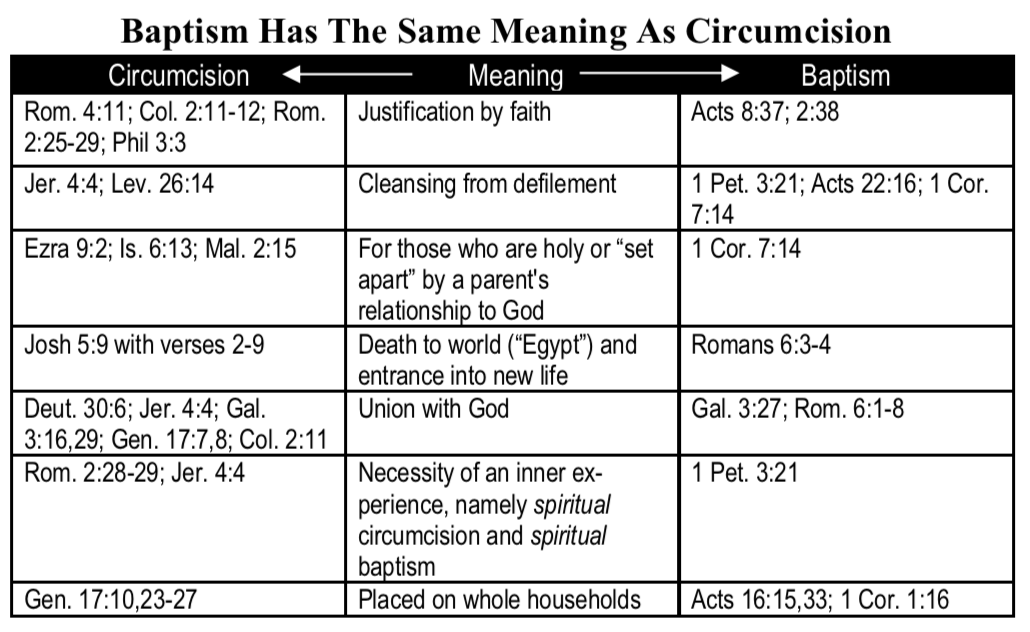
Nor is the New Testament silent on infants being baptized. As my book on Infant Baptism points out,172 New Testament baptism is explicitly said to sum up Old Testament baptism, which was applied to male infants on the eighth day and to female infants on the sixteenth day. While circumcision (as a bloody rite) has passed away, infant baptism has not. My book shows how the New Testament uses the term “unclean” in 1 Corinthians 7:14 as a synonym for “unbaptized,” so that it could be paraphrased, “otherwise your children would be unbaptized, but now they are holy.” Galatians 3:26-4:7 makes clear that it is not just believing adults who are heirs of the Abrahamic promises (every one of which was to Abraham and his seed), but the children of those believers are also heirs now just as they were heirs under Abraham (Gal. 4:1). Galatians 4:1 also makes clear that just because they are heirs through their parents’ faith does not make them automatically possessors of every privilege of the covenant. Indeed, it affirms the opposite — “now I say that the heir, as long as he is a toddler, does not differ at all from a slave, though he is master of all, but is under guardians and stewards until the time appointed by the father” (vv. 1-2). They are under stewards and guardians to lead them to faith (Gal. 4:1-7).
Here is the bottom line issue: The evidence for infants passively receiving the first sacrament (circumcision) is totally clear, unambiguous, and contested by no one. At least ten passages speak of God authorizing the sign of the Abrahamic covenant to be applied to infants eight days old.173 Consistent with the Regulative Principle of Worship, later circumcisions were done “on the eighth day…as God had commanded” (Gen. 21:4). Applying the first sign and seal to infants meets the qualifications of the Regulative Principle of Worship. In striking contrast, I have never seen a clear and unambiguous command for yeled, yonek, or olel children to partake of the sacramental meal. Thus, this paedo-communion objection does not hold water. It is an issue of authority — by what authority do adult-communion advocates exclude believing children and by what authority do paedo-communion advocates include non-professing children in the Lord’s Table?
Even the nature of the two sacraments helps to explain why this analogy simply does not work. Circumcision/baptism is an utterly passive sacrament for both children and adults174 and as a passive sacrament is totally appropriate for passive recipients who are acted upon and admitted to the church. We have already demonstrated that the Lord’s Supper is an active sacrament175 that is only appropriate for those who can obey the command to “Take, eat” and who have an active faith that characterizes them as overcomers (see exposition of Revelation’s sacramental meals in chapter 2). In Baptism we are acted upon (symbolizing monergisic grace in God’s initiatory regeneration), but in the Lord’s Table we are active agents (symbolizing the fact that both God and man must be active for sanctification to take place). You cannot argue from one sacrament to the other in a strictly logical sense. The Regulative Principle of Worship does not allow us to assume anything with regard to our children — they must be authorized by explicit mention to come to the Lord’s Table.
The final thing that I would say is that even in the first passage that deals with Passover, we see the distinction between circumcision and Passover. Exodus 12:48 says:
And when a stranger dwells with you and wants to keep the Passover to the LORD, let all his males be circumcised, and then let him come near and keep it; and he shall be as a native of the land. For no uncircumcised person shall eat it.
Notice that all his males are circumcised whether they have faith or not (consistent with God’s command to circumcise Ishmael, though he was an unbeliever). There is a difference mentioned in the second sacrament of Passover. Before the believing Gentile can partake of the Passover, he must obey God by circumcising everyone in his household. Once he has done that circumcising, do all who are circumcised partake? No. It says, “let all his males be circumcised, and then let him come near and keep it.” Only the professing believer is admitted to the feast. So even the foundational passage for sacramental meals (Exodus 12) makes a clear distinction between who may be circumcised and who may partake of the Passover. The first sacrament was applied to all the children of professing believers while the second sacrament was only given to professing believers.
The Regulative Principle of Worship applied to Passover
There are at least some features of the Passover meal that both adult-communionists and paedo-communionists fail to adequately apply. The variety of adult-communion advocates who say that children did not partake until they were age 12 or 13 (see chapter 2) can to some degree explain the phrase “a lamb for a household” (Ex. 12:3; cf. vv. 4,27) and “according to your families” (Ex. 12:21) since children are still part of the household even at the age of twelve and thirteen. Those who insist that only adult males partook of the Passover (see chapter 2 for this group) are not taking seriously the “household” references at all since (on their theory) neither the wife nor the rest of the household or family partook of the lamb. I fail to see how the word “household” in Exodus 12 fits the adult-only view of communion. Unlike the most consistent adult-communionists, both paedo-communionists and young credo-communionists do indeed take that word seriously. In both cases, a household is partaking as soon as each member of the household is providentially enabled to keep the conditions.
Adult-communionists do bring up at least some legitimate things related to Passover that they believe paedo-communionists are failing to apply. I have already dealt with those issues in the exposition of the Passover in chapter 2.
In addition to the objections in chapter 2, I would raise one additional objection that only applies to the variety of paedo-communion that admits infants. It is of the very essence of the Passover to partake of the unleavened bread, the lamb, and the bitter herbs (horseradish). The insistence on “one law” or “one ordinance” for all who partook (Ex. 12:49; Numb. 9:14; cf. 15:15-16) seems to imply that no exceptions could be allowed for anyone who partook. Every word of the Passover instructions should apply to every participant. This being so, it is legitimate to ask, “Did newborn infants partake of the lamb or the horseradish?” It is extremely unlikely that they did. Some have thought that the parent could chew up the meat or soften it in other ways, but the instructions are quite clear that the meat could not be mixed with water at all, but had to be eaten as roasted (Ex. 12:9). Nor could any parts be left out, but “they shall eat the flesh on that night; roasted in fire, with unleavened bread and with bitter herbs they shall eat it” (Ex. 12:8). Those paedo-communionists who see the trouble with this have gone one of two routes: 1) they have either claimed that the child receives the communion through the mother’s milk (and while in the womb through the placenta)176 or 2) they add conditions of ability or age.177
There are several reasons to reject the idea that babies received the Passover in the womb. The first is that Exodus 12:48 was quite clear that “no uncircumcised person shall eat it,” and babies in the womb would be uncircumcised. Second, when a stranger converted and wanted to partake, he had to first circumcise his entire family, but even then, only the professing believer was admitted to the feast (Exodus 12:48 — “let all his males be circumcised, and then let him come near and keep it;”). Third, it is not bread or lamb that the babies are eating. Certainly in the womb they aren’t eating at all; they are receiving nutrients through the placenta, but the nutrients are not in the form of bread, lamb, or bitter herbs. Fourth, this treads dangerously close to the Roman Catholic ex opere operato view of the sacrament and can easily lead to superstition. God did not seem to treat the non-communion of children and wives (when providentially hindered) as being nearly as detrimental to their spiritual health as some paedo-communionists do. Exodus 23:14-19 exempted women from having to come to this feast (v. 17; cf. 34:23).
If they take the second route and add conditions of age or ability, then they have no consistent way to object to the other Biblical conditions being applied to this feast. Certainly the Bible does seem to prohibit feeding newborn infants solid food (at least some paedo-communionists admit this). However, the ability to masticate food is not a sufficient qualification since the same Scriptures that refer to solid food also connect solid food with the ability to discern good and evil: “But solid food belongs to those who are mature, that is, those who by reason of use have their senses exercised to discern both good and evil” (Heb. 5:14). See also 1 Cor. 3:1-4, where Paul uses the illustration of babes who drink milk and are not able to receive solid food to illustrate lack of spirituality. When these Scriptures are compared with each other it is legitimate to conclude that God Himself links eating solid food with the condition of some maturity and some understanding and discernment. This would exclude all yeled, yonek, and olel children, and as we noted in the last chapter, it might exclude many taph children as well. If a child (or an adult for that matter) does not have enough understanding “to discern between their right hand and their left” (Jonah 4:11), they are not benefiting from table and for sure are not meeting the needed qualifications laid out by God to come.
The Regulative Principle of Worship applied to other meals
What is true of the Passover is also true of the other Old Testament sacramental meals. There are some features of those other sacramental meals that at least some paedo-communionists and some adult-communionists fail to adequately account for in their system.
Adult-communionists take away commands to include children in the holy food. The holy food of the Levites was for “you, your sons, and your daughters with you; for they are your due and your son’s due, which was given from the sacrifices of peace offerings of the children of Israel” (Lev. 10:14). Certainly adult-communionists will object that this was the pay for Levites. See the six objections that I raise in chapter 3 (under the discussion of 2 Chronicles 31) for why these meals were not the Levites’ common food, but were their sacramental food following all the rules related to sacraments. The various passages assume that the children of Levites will express faith quite young (see for example 2 Chronicles 31:16,18). While there is no evidence that the yeled newborns, the yonek one year olds, or the olel nursing children ever partook of the sacramental meals, we have shown clear evidence that at least some children of every other age above that did. The sacramental meals explicitly included “you and your children” (Deut. 12:25), “you and your household” (Deut. 14:26; 15:20), and other terms for children outlined in chapters 2-3. It is just as much a violation of the Regulative Principle of Worship for mature communionists to “take away” those terms as it is for paedo-communionists to “add” the younger categories of children.
Paedo-communionists appeal to the language of children that we have outlined in chapters 2-3, but then they broad-brush the assumption that all children were included. We demonstrated in the previous two chapters that the only children that are explicitly included in the feast are the ages of children who are also capable of adhering to the qualifications for worthy participation that even Gallant agrees are laid out in Isaiah 1 and 1 Corinthians 10-11. I would add that we have already demonstrated that those conditions were laid out in the law of God as well. To “take away” conditions when God has not directly authorized us to take them away for children is a violation of the Regulative Principle of Worship.
The Regulative Principle of Worship applied to 1 Corinthians 10-11
Adult-communion advocates have sometimes argued that in the Old Covenant, only adult males partook of the sacramental meals. Then they switch gears in the New Covenant and magically add in females on the basis of Galatians 3:28, a passage that says nothing about the Lord’s Table, but only relates to baptism (v. 27). The reason I say that this violates the Regulative Principle of Worship is that we demonstrated in the beginning portion of this chapter that everything in the New Covenant can be shown to exist in the law at least in seed form. Acts 26:22 says that Paul based 100% of his teaching upon the Old Testament “saying no other things than those which the prophets and Moses said would come.” This is why he praised the Bereans for searching the Old Testament Scriptures to check the truthfulness of everything Paul was saying (Acts 17:11). What the Bereans were doing would have been a pointless exercise if Paul had added new ideas (women coming to the Lord’s Table) that could not be found in the Old Testament. Paul’s admonition to the Corinthians was “that you may learn in us not to think beyond what is written” (1 Cor. 4:6). If indeed women were barred from participating in the Old Testament, then we violate the Regulative Principle of Worship if we allow women to participate in the New Testament because we are adding to the law. On the other hand, if women, children, families, households, and “little ones” partook of the sacramental meals in the Old Testament, then we violate the Regulative Principle of Worship if we “take away” those participants today — especially when Paul explicitly links all those sacramental meals to the Lord’s Table in 1 Corinthians 10 (see chapter 2).
Paedo-communionists “add” to the law of God if they choose to add infants, and they take away from the law of God when they do not apply the conditions of the law for worthy participation. As Gallant points out, Paul is not saying anything that the law did not say when he gave his conditions in 1 Corinthians 10-11. Because he has not looked at the granularity of God’s law related to children that we discussed in chapter 3, he comes to the wrong conclusion that these statements do not apply to certain participants (infants).178 Without explicit authorization for infants to participate in this sacrament (such as we have with circumcision/baptism), we “take away” from God’s law for certain participants.
Note that Paul applies his admonitions to “each one” who is partaking of the Lord’s Table (1 Cor. 10:24; 11:21) and to “whoever eats this bread or drinks this cup” (1 Cor. 11:27) and to “anyone” (1 Cor. 11:34). To add exceptions to these universal descriptions is to “add” to the law. There are no exceptions to his qualifications for worthy participation stated anywhere, and exceptions cannot be assumed. “For he who eats and drinks in an unworthy manner eats and drinks judgment to himself, not discerning the Lord’s body” (1 Cor. 11:29).
Notice that Paul treats each participant as if he is actively partaking (as opposed to having food put into his mouth) — “each one takes his own supper” (1 Cor. 11:21), “partake with thanks…food over which I give thanks” (1 Cor. 10:30), “Take, eat” (1 Cor. 11:24), “you proclaim” (1 Cor. 11:26), “let a person examine himself, and so let him eat of the bread and drink of the cup” (1 Cor. 11:28), “For if we would judge ourselves, we would not be judged” (1 Cor. 11:31). Paul speaks to each participant when he says, “Let no one seek his own, but each one the other’s well-being” (1 Cor. 10:24). Paul gives no hint whatsoever that there would be participants who are unable to to do these things.
With this in mind, consider Paul’s extended admonitions related to worthy participation and ask your conscience if these things can be “taken away” without clear explicit warrant from the law. In chapter 10 he says, “became our examples” (v. 6), “do not become idolaters” (v. 7), “nor let us commit sexual immorality” (v. 8), “nor let us tempt Christ” (v. 9), “nor complain” (v. 10), “take heed” (v. 12), “will not allow you to be tempted beyond what you are able” (v. 13), “flee from idolatry” (v. 14), “I speak as to wise men” (v. 15), “judge for yourselves what I say” (v. 15), “Observe Israel” (v. 18), “I do not want you to have fellowship with demons” (v. 20), “You cannot drink the cup of the Lord and the cup of demons” (v. 21), “you cannot partake of the Lord’s table and of the table of demons” (v. 21), “Or do we provoke the Lord to jealousy” (v. 22), “All things are lawful for me, but not all things are helpful; all things are lawful for me, but not all things edify” (v. 23), “Let no one seek his own, but each one the other’s well-being” (v. 23), “partake with thanks…food over which I give thanks” (v. 30), “whether you eat or drink, or whatever you do, do all to the glory of God” (v. 31), “Give no offense” (v. 32).
In chapter 11, Paul gives more admonitions on worthy participation — “Imitate me, just as I also imitate Christ” (v. 1), “keep the traditions” (v. 2),179 “every man praying” (v. 4), “every woman praying” (v. 5), “for a man indeed ought not to cover his head” (v. 7), “a woman ought to have a symbol of authority on her head” (v. 10), “I do not praise you” (v. 17), “you come together not for the better, but for the worse” (v. 17), “those who are approved180 may be recognized181 among you” (v. 19), “each one takes his own supper ahead of others” (v. 21), “I received from the Lord that which I also delivered to you” (v. 23), “Take, eat” (v. 24), “do this in remembrance of Me” (v. 24), “This do as often as you drink it, in remembrance of Me” (v. 25), “you proclaim the Lord’s death” (v. 26), “whoever eats this bread or drinks this cup of the Lord in an unworthy manner will be guilty of the body and blood of the Lord” (v. 27), “But let a man examine himself, and so let him eat of the bread and drink of the cup” (v. 28), “For he who eats and drinks in an unworthy manner eats and drinks judgment to himself, not discerning182 the Lord’s body”183 (v. 29), “For if we would judge ourselves, we would not be judged” (v. 31), “wait for one another” (v. 33), “But if anyone is hungry, let him eat at home,184 lest you come together for judgment” (v. 34).
Peter Allison on the paedo argument from baptism to communion
Peter Allison deals with an objection sometimes raised by paedo-communionists. He writes:
Some baptized communion advocates charge the reformed creeds with inconsistency on their paedo baptism and credo-communion position. They argue that if the repenting and believing can be suspended for children in baptism, then examining oneself in communion can also be suspended for children or carried out in an age appropriate way. This does not adequately deal with the fact that there are no commands in Scripture regarding the objects of baptism that need to be suspended for children.
This is a significant difference between circumcision/baptism and the Passover/Lord’s Supper. Both sacraments are commanded, but only the Lord’s Supper imposes requirements on the manner of participation that require an understanding which few, if any, small children could have. A few examples illustrate this difference.
Mat 28:19 — Go ye therefore, and teach all nations, baptizing them in the name of the Father,
This institution of baptism is a command to the disciples to teach and to baptize. It specifies no preparatory action on the part of the subjects of baptism. This is what we see the apostles doing. They teach, people believe, and they are baptized.
Mark 1:5 — and they of Jerusalem, and were all baptized of him in the river of Jordan, confessing their sins.
These people were baptized, confessing their sins.
Mark 16:16 — He that believeth and is baptized shall be saved; but he that believeth not shall be.
Jesus here prescribes two conditions for salvation — repentance and baptism. Those who repent and are baptized will be saved. It doesn’t command people to confess their sins in preparation for baptism. It simply makes a statement about who shall be saved.
Act 2:38 Then Peter said unto them, Repent, and be baptized every one of you in the name of Jesus Christ for the remission of sins, and ye shall receive the gift of the Holy Ghost.
This is a command to do two things: repent and be baptized. The Holy Spirit is promised to those who do so. The text does not command people to repent in order that they might be baptized nor does it attach a sanction if someone is baptized without repenting and believing.
While repentance without baptism is an incomplete repentance, baptism without repentance is not an improper baptism. The baptism of those who believe for a while (Luke 8:13) and then fall away due to trials or the cares of this world does not retroactively become an improper or an invalid baptism. Their baptism becomes a testimony against them, increasing the heinousness of their unbelief and the severity of their punishment (Luke 10:13-14). Their sin was not in being baptized, it was in falling away.185
A few additional examples are provided below where baptism is recorded following people believing, but there is no explicit statement that people must repent before being baptized nor is there a warning about coming under judgment for being baptized without believing.
Acts 8:12 When they believed Philip preaching the things concerning the kingdom of God, and the name of Jesus Christ, they were baptized, both men and women. Acts 18:8 And Crispus, the chief ruler of the synagogue, believed on the Lord with all his house; and many of the Corinthians hearing believed, and were baptized.
In at least one case, the order is even reversed with baptism being listed ahead of being justified:
Acts 22:16 And now why tarriest thou? arise, and be baptized, and wash away thy sins, calling on the name of the Lord.
The only possible exception to this is Acts 8:37, a verse not in the majority text (or the critical text).
A comparison of the preceding passages regarding participation in the Lord’s Supper and baptism shows that while unworthy participation in both communion and the Passover brings sanctions on the participants, there are no examples of judgment falling on unworthy participants in either circumcision or baptism. There are examples of sanctions for those that don’t administer circumcision (Exodus 4:24ff) and there are examples of the Apostles inquiring about people’s baptisms and baptizing again where necessary (Acts 19:3-5) showing that participation is important. There is no example anywhere of people being rebuked or judged for unworthy participation and the Scriptures never warn against unworthy participation in baptism or circumcision.
To baptize children obeys the command in Genesis 17 and does not require ignoring any commands regarding participation. To give communion to young children requires ignoring the commands regarding preparation and examination (at least with respect to children) and assuming a command which does not exist for them to partake. While this observation may be true, it should always be viewed in relation to the commands underlying the different treatment of children and not the basis of that difference. Children are baptized by the command of Scripture and refused participation in communion because there is no command to admit them. They are not refused participation in the Lord’s Supper merely because of their inability or diminished ability, relative to an adult, to properly examine themselves.186