13. Appendix B: Changes in the Office that Administered the Sacrament
Though the church is composed of “families” (Acts 3:25; cf. Acts 10:47-48; 11:14; 16:32-33; 18:8; 1 Cor. 1:16), admission of any member of a family to the Lord’s Table and barring such persons from the Lord’s Table is under the exclusive jurisdiction of the elders (Gen. 14:18; Numb 3:8-13; Deut. 12:18; 2 Chron. 30:21-22; 2 Chron. 31:14,15,16,19; 35:10-15; Neh. 13:13; Matt. 16:19; cf Luke 22:15-30; Acts 2:42; 1 Cor. 11:23-26).397 Since even “little children” received the sacraments from their hands (Deut. 31:12; 2 Chron. 31:16,18; Neh. 8:2; etc), logic dictates the conclusion that such children are under the authority and discipline of the elders. They are certainly under the formative discipline of preaching: “My little children, these things I write to you, so that you may not sin.” (1 John 2:1); “I write to you, little children…” (1 John 2:12,13); “My little children, let us not love in word or in tongue, but in deed and in truth.” (1 John 3:8; cf. 2:18,28; 3:7; 4:4; 5:21). But it is also clear that a young “child … shall be cut off [excommunicated] from his people” if “he has broken My covenant” (Gen. 17:14). This last text is a case of discipline without full process. Full process is not needed when the reason for being cut off is undisputed.
This appendix seeks to map out in cursory fashion the development related to the officers who had jurisdiction over the sacramental meal. While there is some continuity between the patriarchal “firstborn” to the Mosaic Levite to the New Testament elders, changes in redemptive history show a development as well. The following pages can be summarized in the following points:
- There is a continuity of function between the a) patriarchal “firstborn,” b) the Levites scattered throughout Israel, and c) New Testament officers.
- Patriarchal period: It is clear that when a firstborn was disqualified for office, the second or third born were given the office of “firstborn.” (See below for details.) At least in the patriarchal system, this qualification or disqualification from office happened at the local level. Abel replaced Cain; Isaac replaced Ishmael by God’s prophetic word; Jacob replaced Esau; Joseph replaced Reuben; Ephraim (who was born first, Gen. 38:14-20) replaced Manasseh by God’s authorization (Jer. 31:9).
- Mosaic period: It is clear that the Levites took over the office of firstborn (Numb. 3:12,41,45,46; 8:18). Other than a tiny minority of Levites who worked at the central temple, the vast majority of Levites lived and ministered in the synagogues found in every town and hamlet of Israel (Deut. 12:12,18; 14:27,29; 16:11,14; 18:6; 26:12; etc). While the qualifications for this Levitical eldership were determined by the broader leadership of the church (see Ex. 18:20-21; Numb. 8), the local assemblies chose which Levites would be their elders (Deut. 1:13; Zech. 8:23), and their calling (Deut. 1:13), pay (Neh. 10:37), and work (Neh. 8:7,9) were largely dictated by the local assemblies. This explains why God’s prophets so frequently exhorted the local communities to not neglect their elders. The Septuagint translates the “rulers of the congregation” as “rulers of the synagogues” (Ex. 16:22; 34:31; Numb. 31:13; Josh. 9:15,18; 22:30). Those sessions were the locus of authority.
- The Old Testament prophetically describes the New Testament church as having “priests and Levites” (Isa. 66:21; Jer. 33:18,21,22; Ezek. 45:5; 48:11,12,13,22), and Christ shows continuity into the New Testament by using the same Old Covenant terms that described the Levites in the Old Testament (scribe, shepherd, elder) to describe the officers He will send forth (Matt. 13:52; 23:34). Thus it is no surprise to find local authority over officers used well (1 Pet. 5:1-4) and misused (3 John 9-12).
To flatten out the Patriarchal data as proving a “household communion” is to miss the fact that the patriarchal household included far more than the nuclear family398 and that the Levites took over the function of the firstborn (Numb. 2:12,41,45,46; 8:18).
Principle #1 — We must see some continuity of office from Old Testament to New Testament
I believe it is impossible to resolve some of the debate if people insist on restricting the discussion to “the New Testament teaching of office.” If we Gentiles are simply engrafted into an already existing structure (Rom. 11:17-25; Eph. 2:12-13,19-22), then we ought to look to the Old Testament for further information. After all, Paul praised the Bereans for checking everything that he taught from the Old Testament Scriptures (Acts 17:11), and Luke insisted that Paul taught “no other things than those which the prophets and Moses said would come” (Acts 26:22). Indeed, the only Bible of the early church for decades was the Old Testament (Acts 8:32,35; 17:2,11; 18:24,28; Rom. 16:26; 2 Tim. 3:15-17). Most other doctrines are incomplete without the Old Testament. Why would we expect the doctrine of church office to be any different? It is my contention that the New Testament doctrine of church office must be understood in light of Old Testament teaching. This is true for the following reasons:
- The word “elder” is an Old Testament term that is introduced without comment in Acts 11:30, implying that there is a continuity with the synagogue elders. Indeed, Luke uses the term elder in exactly the same way to describe both synagogue officers (Luke 7:3; 9:22; 20:1; 22:52,66; Acts 4:5,8,23; 5:21; 6:12; 22:5; 23:14; 24:1; 25:15) and church officers (Acts 11:30; 14:23; 15:2,4,22,23; 16:4; 20:17; 21:18).
- This point and other points in this introduction assume a continuity of the Old Testament synagogue with the New Testament church. That the synagogue was a Mosaic institution can be seen from the following facts: The ecumenical council of Acts 15 declares it to be a Mosaic institution when it says, “For Moses has had throughout many generations those who preach him in every city, being read in the synagogues every Sabbath.” (Acts 15:21) Psalm 74:8 calls the places where these assemblies met the “meeting places,” and Isaiah 4:5 calls them “her assemblies.” Moses commanded, “Six days shall work be done, but the seventh day is a Sabbath of solemn rest, a holy convocation.” (Lev. 23:3) The Hebrew word for “convocation” (miqra), like the English, means “an ecclesiastical assembly that has been summoned to meet together; an assembling by summons.” It would have been physically impossible to travel to the temple once a week from many parts of Israel. This is why the Levites were scattered throughout the land in every community to teach (2 Chron. 17:9; Deut. 18:6-8; Neh. 10:37-39). Thus the “calling of assemblies” (Isa. 1:13) and the “sacred assemblies” (Amos 5:21) should not be assumed to be temple assemblies. There were numerous “meeting places of God in the land” (Ps. 74:8). And Israel was responsible to “keep all my appointed meetings, and they shall hallow My Sabbaths” (Ezek. 44:24). Thus we read of Jesus, that “as His custom was, He went into the synagogue on the Sabbath day” (Luke 4:16). His practice of weekly public assembly was the practice commanded in the Bible. Thus the Septuagint translates the “rulers of the congregation” as “rulers of the synagogues” (Ex. 16:22; 34:31; Numb. 31:13; Josh. 9:15,18; 22:30).
- Likewise, the word “scribe” is used for both the Old Testament teaching elder (Ezra 7:6,12,21; Neh. 8:1,9) as well as the New Testament teaching elder (Matt 13:52; 23:34).
- Paul’s argues for paying teaching elders from the pay given to the Old Testament teaching office: “Do you not know that those who minister the holy things eat of the things of the temple, and those who serve at the altar partake of the offerings of the altar? Even so the Lord has commanded that those who preach the gospel should live from the gospel” (1 Cor. 9:13-14). This would not follow if there was not some essential parallel between the offices of the Old Testament and the offices of the New Testament.
- Just as deacons were given to help the apostles (Acts 6), there were certain Levites given to the priests to serve in the tabernacle (Numb. 3:9; 8:19; 18:6; etc.). The idea of “ministers” (deacons) of the church is not a new idea.
- The Old Testament prophetically describes the New Testament church as having “priests and Levites” (Isa. 66:21; Jer. 33:18,21,22; Ezek. 45:5; 48:11,12,13,22). It is clear that these priests and Levites are not literally from the tribe of Levi since it was prophesied that they would be priests and Levites taken from the Gentiles (Isa. 66:20-21). Isaiah 56:3-5 says that even eunuchs will be in the New Covenant temple. This unusual temple with its unusual prince and unusual priests and Levites is described in Ezekiel 40-48. These prophecies clearly show that though there is not a continuity of heredity, there is a continuity of the essential meaning of the office.
- Jesus Himself uses Old Testament language to describe officers that He will send forth after His resurrection (Matt 23:34). He also uses the same terminology for teachers of the kingdom (Matt 13:52).
- Christ established the church as the remnant of Israel (Luke 22:24-30) and the bride bears the names of the twelve sons of Israel (Rev. 21:9-12). The church is called “the Israel of God” (Gal 6:16) and Gentiles are grafted into Israel when they are saved (Eph. 2:12-13,19-22; Rom. 11:17-24). We would expect that there would be some continuity between synagogue and church if this were true.
- The Old Testament people of God are described as being part of the “church” (Heb 12:22-23; Acts 7:38 in KJV) and we are said to have joined that “church” (Heb. 12:22-23).
- Unless the New Testament explicitly changes an Old Testament command or practice, it continues to apply (Matt 5:17-19; 2 Tim. 3:15-17; 1 John 2:6-8) and such changes were already anticipated in the Old Testament (Acts 26:22; Heb. 3:5; Acts 17:11). Paul made clear that he had been “saying no other things than those which the prophets and Moses said would come” (Acts 26:22). Thus, every New Testament doctrine was anticipated in the Old Testament so that “the new is in the old concealed and the old is in the new revealed.”
This being the case, I think it is important to examine the Biblical history of all of the offices and their relationship to each other. The following principles and supporting arguments will help to give clarity to what the offices are.
Principle #2 — The New Testament church is identical to the synagogue system
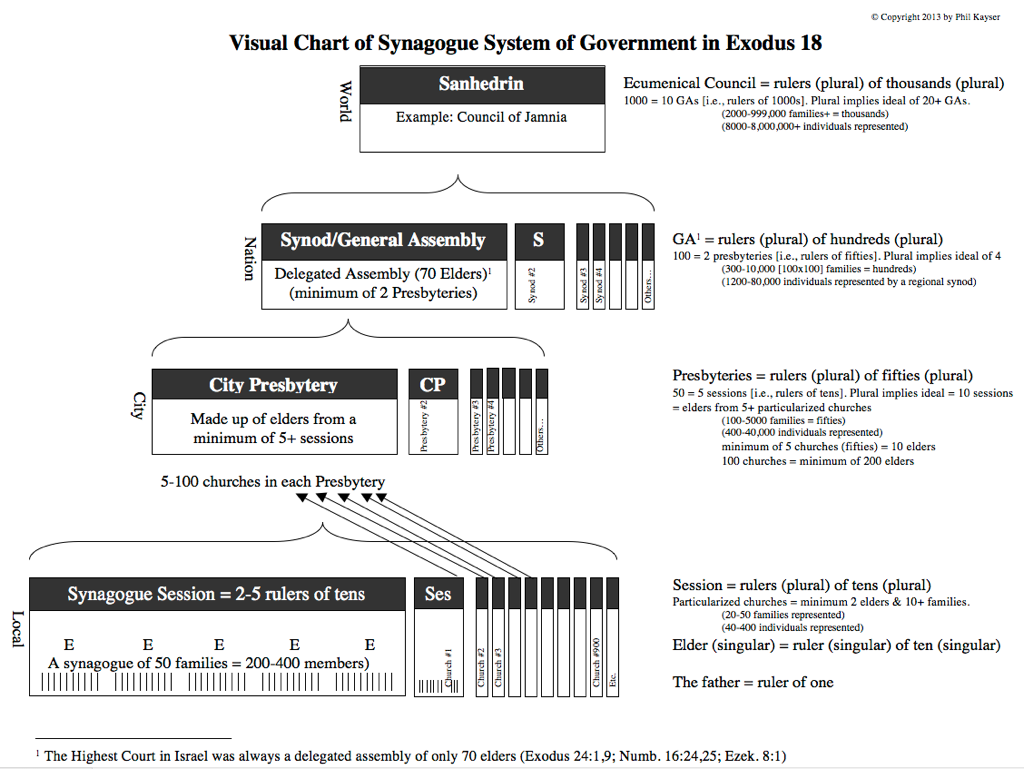
There were four courts in both the Old Testament synagogue system and the New Testament church. These four courts are sometimes called 1) session, 2) presbytery, 3) general assembly (or sometimes this court is referred to as synod), and 4) ecumenical councils:
- In the Old Testament synagogue system this local session was composed of “rulers of tens” (Ex. 18:25) who “judged the people” (v. 26) jointly (“they”). Each synagogue had “rulers” (plural) over “tens” (plural), thus representing the idea that each elder in a synagogue would be responsible for ten families. The plural “rulers” reflects the fact that every synagogue/church must have a minimum of two elders to be a particularized church (cf. Acts 14:23; Tit. 1:5; Phil. 1:1). In the New Testament the session was composed of a plurality of elders in the local church. “…ordained elders in every church…” (Acts 14:23); “…left you in Crete, that you should set in order the things that are lacking, and appoint elders in every city as I commanded you” (Tit. 1:5); “Shepherd the flock of God which is among you, serving as overseers…” (1 Pet. 5:2).
- In the Old Testament synagogue system the presbytery was described as the “rulers of fifties” (Ex. 18:25), meaning that a presbytery is composed of a minimum of five local congregations, though the plural “fifties” implies an ideal of many more congregations than five. In the New Testament the presbytery was usually composed of the elders of several local churches from a city. In contrast to Synods/General Assemblies (which are usually spoken of as the churches [plural] in a region), the presbyteries are usually referred to in the singular, have a moderator, and are the locus of training elders, ordaining them, and sending out missionaries (Acts 13:1-3; 1 Tim. 4:14; etc.). Examples: a) The Church of Jerusalem (Acts 6:1-6), which was composed of multiple congregations in the tens of thousands and had James as the moderator. b) The Church of Ephesus (Rev. 2:1-7) with its “messenger [i.e., moderator] of the church of Ephesus” (v. 1). c) The Church of Smyrna (Rev. 2:8-11) with its “messenger” (v. 8). d) The Church of Pergamum (Rev. 2:12-17) with its messenger (v. 12). e) The Church of Thyatira (Rev. 2:18-29) with its messenger (v. 18). f) The Church of Sardis (Rev. 3:1-6) with its messenger (v. 1). g) The Church of Philadelphia (Rev. 3:7-13) with its messenger (v. 7). h) The Church of Laodicea (Rev. 3:14-22) with its messenger (v. 14). i) The Presbytery of Antioch (Acts 13:1-3), though this eventually grows so large that Antioch is later listed with other General Assemblies (cf. Acts 15:23). “Neglect not the gift that is in thee, which was given thee by prophecy, with the laying on of the hands of the presbytery.” (1 Tim. 4:14 KJV); “Then, [the leaders in Antioch] having fasted and prayed, and laid hands on them, they sent them away” (Acts 13:3); “sent to Ephesus and called for the elders of the church…” (Acts 20:17).
- In the Old Testament synagogue system this was the “rulers of hundreds” (Ex. 18:25), meaning that a Synod/General Assembly could not be formed without at least two presbyteries, though the plural “hundreds” shows that the ideal would be multiple presbyteries. This Synod/General Assembly is equivalent to most modern Presbyterian “General Assemblies,” which are ordinarily national in scope. There are many who believe that the numbers of this General Assembly were capped by being constituted as a delegated assembly of 70 elders (Ex. 24:1; Numb. 11:16,24,25; Ezek. 8:11; cf. Luke 10:1-20). In the New Testament the Synod/General Assembly consists of the city presbyteries in a region or country, such as Judea (Acts 11:29-30; Gal. 1:22; 1 Thess. 2:14), Samaria (Acts 8; 9:31; 15:3), Cilicia (Acts 15:23,41), Syria (Acts 15:23,41), Galatia (1 Cor. 16:1), and Macedonia (2 Cor. 8:1; Gal. 1:2). The seven churches of Revelation 2-3 are all the churches of the region of “Asia” (Rev. 1:4), and therefore those seven churches represent the General Assembly of Asia. Though each lampstand represents a different city-presbytery (Rev. 1:12,13,20; 2:1,5), they are a complete unit amongst whom Christ authoritatively walks (Rev. 1:11-20), and elsewhere they are an organizational unit that can send greetings: “The churches of Asia greet you…” (1 Cor. 16:19). This implies a distinct unit composed of many churches and bearing Christ’s authority. But it is significant that only once is a General Assembly spoken of in the singular as “church” (Acts 15:3), indicating that the most pronounced and ongoing activity of the church is not at the General Assembly level but at the local church and presbytery levels.
- In the Old Testament synagogue system, the fourth court corresponded to the “rulers of thousands” (Ex. 18:25), implying the need for representatives from a minimum of ten General Assemblies. In the New Testament, the fourth court, though rarely convened, was composed of representatives from the whole church. It was “the whole church” (Acts 15:22) that decided the huge doctrinal question regarding ceremonial law (Acts 15) and since representatives from the whole church had deliberated, they had the authority to impose a doctrinal statement upon the whole church (Acts 15:22-31; 16:4-5) and to designate this doctrinal statement an authoritative dogma (δόγματα – Acts 16:4-5). This is the basis for the Ecumenical Councils of Nicea (325), Constantinople (381), Ephesus (431), Chalcedon (451), Constantinople II (553), Constantinople III (680), and Nicea II (787), all of which acted as courts to define doctrinal controversies.
Each of these courts can and has exercised church discipline.399 The New Testament reflects the same pattern as Exodus 18 in having original jurisdiction on most issues arising at the local session and only going to the broader courts of presbytery, General Assembly, and Ecumenical Councils when the lower sessions cannot handle them. Below is a visual outline of the four governments in Exodus 18:
Principle #3 — The Old Testament church was not the temple
- If the Temple was the only place that people gathered to worship, then most people in Israel would only have been able to worship a few times a year since it took several days to travel to Jerusalem from some parts of the nation.
- The Temple was Jehovah’s throne room (Isa. 6:1) corresponding to the heavenly throne (Ps. 11:4). Thus all of life including the king, the prophets and the synagogues were subject to the temple because they were subject to the King over all, Jehovah. As we will see shortly, there was a careful distinction maintained between the temple and the synagogue in the Old Testament even though the two were related. The temple was pointing to the Messianic work of Christ. We have no priests now because Christ is our only priest (Heb. 7:11-8:6). God’s people have “no temple in it, for the Lord God Almighty and the Lamb are its temple” (Rev. 21:22; cf. John 2:19-21). God’s people in both the Old Testament and the New can be called priests (1 Pet. 2:5,9; Ex. 19:6) and a temple (2 Cor. 6:16; Lev. 26:12) only by virtue of their union with Him (1 Cor. 6:17, 19). So though the church as a whole (קָהַל or ἐκκλησία) can be called a temple and all of its members are priests in the general sense of the word, there are no priestly offices in the church as local assembly (עֵדָה [from יָעַד] or מִקְרָא or συναγωγή) in either the Old Testament or the New Testament. See 4 f. below.
- D. Douglas Bannerman writes:
It came to be to the synagogue and not to the temple that their minds naturally turned when they thought of worship of God. . . There was ordinarily no reading or exposition of Scripture in the temple until the synagogue and its teachers, as it were, took possession of its courts. There were no altars, no incense, no separate priesthood, no material sacrifices of any kind in the synagogue, and no place within its walls more holy than another through any visible symbol of the presence of God.
For those who dwelt far from Jerusalem, the temple with its stately services remained doubtless the mysterious place of the Divine Presence and of accepted sacrifice, the expression for all the great religious conceptions of forgiveness of sins, consecration to God, and communication from God to His people. But it became more of a symbol. On the other hand, there stood daily before their eyes a worship of God without Levitical priests, without sacrifices, without mystery or symbol, a worship the central point in which was the edification of the heart through the holy Scriptures and common prayer.400
D. Many people have tried to deny that God instituted the synagogue in the Old Testament, and they say that the synagogue arose out of the necessity for worship when the Jews were in exile in Babylon. The following Scriptures show that belief to be false:
- Acts 15:21: “For Moses has had throughout many generations those who preach him in every city, being read in the synagogues every Sabbath.” This verse establishes that synagogues are a Mosaic institution, and that synagogues were in every city.
- Psalm 74:8: “They said in their hearts, ‘Let us destroy them altogether.’ They have burned up all the meeting places [Hebrew עֵדָה; Greek Septuagint συναγωγαῖς] of God in the land.” Already in Asaph’s day there were synagogues everywhere.
- Lev. 23:3: “Six days shall work be done, but the seventh day is a Sabbath of solemn rest, a holy convocation” [NIV translates it “sacred assembly”]. The Sabbath was to be a day of corporate worship in the land, and if the temple was the only place to do that, then most in Israel would have no place to worship since they could not travel to Jerusalem every week or they would spend all their time in travel. Compare 2 Kings 4:23.
- The following passages show that the Levites were scattered in every hamlet and village of Israel in order to provide teaching and shepherding in the local synagogues: 2 Chronicles 17:9; Deuteronomy 18:6-8; Nehemiah 10:37-39. These Levites were known as scribes. They were distinguished from the other sons of Levi (the priests) who ministered in the temple. Interestingly, the tithe went to the synagogues (Neh. 10:37-39) and the Levites in the synagogues in turn tithed by giving 10% of that tithe to the temple (Numb. 18:21). So the synagogue was the basic institution of the church, though all of life including the church was in turn subject to the temple since the temple represented God’s throne room. When Israel was in exile, the synagogue was the only manifestation of the church on earth.
- Examples of bad synagogues: Judges 17:7; 18:30; 19:1.
- The Levites scattered as scribes/elders throughout Israel were not priests, and the priests had no role in the synagogues.
- Priests exercised their priestly function only in the temple. However, priests also had a teaching function along with other qualified Levites and many of the scribes were from priestly families (Deut. 27:9; 31:9-13; 2 Kings 17:18; 2 Chron. 17:8-9; 2 Chron. 19:8; Mic. 3:11; Hag. 2:11). After the temple was destroyed, the only function priests had (if they were qualified) was as scribe. Two such priests are Ezekiel and Ezra (Ezek. 1:3; Ezra 7:11-12). Thus, many scholars from the early church to the present have equated the priestly office with teaching elder and have called pastors “priests.” Though there is some evidence for this, it should be pointed out that other Levites (and occasionally even non-Levites) have been scribes as well. It is better to say that when the temple was gone, priests (specialized sons of Levi) lost their priestly role but were able to take on any other office that was open to Levites in general. D. Douglas Bannerman points out that the only thing a priest was optionally allowed to do in a synagogue was to pronounce the Aaronic blessing.
- Levites were scribes who had an oversight and judicial role in the synagogue (“overseers and judges” – 1 Chron. 23:3-4;). These Levites were equivalent to today’s elders and were further subdivided into 1) scribes (sometimes called “leader in the synagogue,” “wise man,” or “disciple of the wise,” and 2) elders (in the minor prophets called “shepherds”). This division of labor was largely based on gifting and training. The age at which these Levites took office was thirty (1 Chron. 23:3-4). Levites could be either from the sons of Aaron or from any other son of Levi. However, if (like Ezra) Aaronic sons served as scribes, there was no confusion between priesthood and eldership.
Principle #4 — Prior to Moses, the pastoral office was ordinarily found in the firstborn son. The concept of firstborn is the foundation for the pastoral office.
- The firstborn had to be spiritually qualified. if the eldest son was not spiritually qualified to lead as priest, teacher and shepherd, that responsibility was passed to someone else. Jacob, not Esau was supposed to have this blessing. Though Reuben was firstborn, he was bypassed because of his sins. When a younger son took over the spiritual oversight, he was given the label of firstborn even though he was born second, or third or fourth (see 1 Chron. 26:10; Jer. 31:9).
1 Chronicles 5:1: “Now the sons of Reuben the firstborn of Israel — he was indeed the firstborn, but because he defiled his father’s bed, his birthright was given to the sons of Joseph, the son of Israel, so that the genealogy is not listed according to the birthright;” 1 Chronicles 26:10: “Also Hosah, of the children of Merari, had sons: Shimri the first (for though he was not the firstborn, his father made him the first).”
See the examples of Isaac replacing Ishmael, Jacob replacing Esau, Joseph replacing Reuben, Ephraim replacing Manasseh (Gen. 38:14-20), etc. And God honors this giving of the rights of firstborn to other sons if they are more qualified. For example, God says “Ephraim is my firstborn” (Jer. 31:9).
B. The firstborn was spiritually gifted to prophetically bless the families and servants who were under his oversight. He was also given the role of priest of the family.
Genesis 20:7: “Now therefore, restore the man’s wife; for he is a prophet, and he will pray for you and you shall live. But if you do not restore her, know that you shall surely die, you and all who are yours.”
Exodus 3:1: “Now Moses was tending the flock of Jethro his father-in-law, the priest of Midian. And he led the flock to the back of the desert, and came to Horeb, the mountain of God.”
Exodus 18:1: “And Jethro, the priest of Midian, Moses’ father-in-law, heard of all that God had done for Moses and for Israel His people — that the LORD had brought Israel out of Egypt.”
Exodus 18:12: “Then Jethro, Moses’ father-in-law, took a burnt offering and other sacrifices to offer to God. And Aaron came with all the elders of Israel to eat bread with Moses’ father-in-law before God.”
Job 1:5: “So it was, when the days of feasting had run their course, that Job would send and sanctify them, and he would rise early in the morning and offer burnt offerings according to the number of them all. For Job said, ‘It may be that my sons have sinned and cursed God in their hearts.’ Thus Job did regularly.”
Luke 13:28: “There will be weeping and gnashing of teeth, when you see Abraham and Isaac and Jacob and all the prophets in the kingdom of God, and yourselves thrust out.”
Genesis 46:1: “So Israel took his journey with all that he had, and came to Beersheba, and offered sacrifices to the God of his father Isaac.”
See also the repeated prophetic revelations given to the firstborn and the prophetic blessings that they repeatedly gave. (See for example, Gen 26:24; 27:1-40; 28:1-4; 33:11; 35:9; 48:1-49:33; etc.)
C. The firstborn was therefore consecrated to the Lord and had a spiritual responsibility to the Lord that others did not have. This underlines the concept of ordination. The words used of the firstborn son are “consecrate,” “dedicate,” “sanctified,” and God declares “they shall be Mine.”
Exodus 13:2: “Consecrate to Me all the firstborn, whatever opens the womb among the children of Israel, both of man and beast; it is Mine.”
Exodus 13:12: “that you shall set apart to the LORD all that open the womb, that is, every firstborn that comes from an animal which you have; the males shall be the LORD’s.”
Exodus 13:13: “… all the firstborn of man among your sons you shall redeem.”
Exodus 22:29: “You shall not delay to offer the first of your ripe produce and your juices. The firstborn of your sons you shall give to Me.”
Exodus 34:19: “All that open the womb are Mine, and every male firstborn among your livestock, whether ox or sheep.
Exodus 34:20: “But the firstborn of a donkey you shall redeem with a lamb. And if you will not redeem him, then you shall break his neck. All the firstborn of your sons you shall redeem. And none shall appear before Me empty-handed.”
Leviticus 27:26: “But the firstborn of the animals, which should be the LORD’s firstborn, no man shall dedicate; whether it is an ox or sheep, it is the LORD’s.”
Numbers 3:13: “because all the firstborn are Mine. On the day that I struck all the firstborn in the land of Egypt, I sanctified to Myself all the firstborn in Israel, both man and beast. They shall be Mine: I am the LORD.”
Deuteronomy 15:19: “All the firstborn males that come from your herd and your flock you shall sanctify to the LORD your God; you shall do no work with the firstborn of your herd, nor shear the firstborn of your flock.”
D. The title “firstborn” therefore had religious significance and was applied to Israel as a priest to the nations, and was applied to Christ in His spiritual role.
Hebrews 12:23: “to the general assembly and church of the firstborn who are registered in heaven, to God the Judge of all, to the spirits of just men made perfect.”
Jeremiah 31:9: “They shall come with weeping, And with supplications I will lead them. I will cause them to walk by the rivers of waters, In a straight way in which they shall not stumble; For I am a Father to Israel, And Ephraim is My firstborn.”
Psalm 89:27: “Also I will make him My firstborn, The highest of the kings of the earth.”
Romans 8:29: “For whom He foreknew, He also predestined to be conformed to the image of His Son, that He might be the firstborn among many brethren.”
Colossians 1:15: “He is the image of the invisible God, the firstborn over all creation.”
Colossians 1:18: “And He is the head of the body, the church, who is the beginning, the firstborn from the dead, that in all things He may have the preeminence.”
Hebrews 1:6: “But when He again brings the firstborn into the world, He says: “Let all the angels of God worship Him.”
Revelation 1:5: “and from Jesus Christ, the faithful witness, the firstborn from the dead, and the ruler over the kings of the earth. To Him who loved us and washed us from our sins in His own blood.”
E. Just as officers in later history were given “double honor” or extra income, the firstborn ordinarily had double honor (double the amount of money and inheritance given).
Deuteronomy 21:16: “then it shall be, on the day he bequeaths his possessions to his sons, that he must not bestow firstborn status on the son of the loved wife in preference to the son of the unloved, the true firstborn.”
Deuteronomy 21:17: “But he shall acknowledge the son of the unloved wife as the firstborn by giving him a double portion of all that he has, for he is the beginning of his strength; the right of the firstborn is his.”
Isaiah 61:6-7: “But you shall be named the priests of the Lord, They shall call you the servants of our God. You shall eat the riches of the Gentiles, And in their glory you shall boast. Instead of your shame you shall have double honor, And instead of confusion they shall rejoice in their portion. Therefore in their land they shall possess double; Everlasting joy shall be theirs.”
1 Timothy 5:17: “Let the elders who rule well be counted worthy of double honor, especially those who labor in the word and doctrine.”
“The oldest son’s share was twice as large as that of any other son. When Elisha prayed for a double portion of Elijah’s spirit, he simply wished to be considered the first-born, i.e., the successor, of the dying prophet. [cf. 2 Kings 2:9]” (ISBE, 1982, “First-born”)
Principle #5 — Under Moses, God gave the pastoral office of the firstborn to the Levites. The Levites simply stood for the eldest in the family. Thus, the various responsibilities of service and offices of authority that the eldest would have were ordinarily carried out by the Levites.
- The Levites took over the function of the firstborn
Numbers 3:12: “Now behold, I Myself have taken the Levites from among the children of Israel instead of every firstborn who opens the womb among the children of Israel. Therefore the Levites shall be Mine.”
Numbers 3:41: “And you shall take the Levites for Me — I am the LORD — instead of all the firstborn among the children of Israel, and the livestock of the Levites instead of all the firstborn among the livestock of the children of Israel.”
Numbers 3:45: “Take the Levites instead of all the firstborn among the children of Israel, and the livestock of the Levites instead of their livestock. The Levites shall be Mine: I am the LORD.”
Numbers 3:46: “And for the redemption of the two hundred and seventy-three of the firstborn of the children of Israel, who are more than the number of the Levites.”
Numbers 8:18: “I have taken the Levites instead of all the firstborn of the children of Israel.”
B. Just like with the firstborn, the Levites could be bypassed if they were not spiritually qualified
Ezekiel 44:10-31: “And the Levites who went far from Me… they shall not come near Me to minister to Me as priest, nor come near any of My holy things, nor into the Most Holy Place…”
Ezekiel 48:11: “It shall be for the priests of the sons of Zadok, who are sanctified, who have kept My charge, who did not go astray when the children of Israel went astray, as the Levites went astray.”
1Chronicles 15:12: “He said to them, ‘You are the heads of the fathers’ houses of the Levites; sanctify yourselves, you and your brethren, that you may bring up the ark of the LORD God of Israel to the place I have prepared for it.’ ‘”
1 Chronicles 15:14: “So the priests and the Levites sanctified themselves to bring up the ark of the LORD God of Israel.”
2 Chronicles 29:5: “Hear me, Levites! Now sanctify yourselves, sanctify the house of the LORD God of your fathers, and carry out the rubbish from the holy place.”
Ezekiel 48:11: “It shall be for the priests of the sons of Zadok, who are sanctified, who have kept My charge, who did not go astray when the children of Israel went astray, as the Levites went astray.”
C. Just like with the firstborn, there was spiritual gifting to enable them to fill their offices
John 11:51: “Now this he did not say on his own authority; but being high priest that year he prophesied that Jesus would die for the nation.”
Haggai 1:1: “In the second year of King Darius, in the sixth month, on the first day of the month, the word of the LORD came by Haggai the prophet to Zerubbabel the son of Shealtiel, governor of Judah, and to Joshua the son of Jehozadak, the high priest, saying,”
Haggai 1:14: “So the LORD stirred up the spirit of Zerubbabel the son of Shealtiel, governor of Judah, and the spirit of Joshua the son of Jehozadak, the high priest, and the spirit of all the remnant of the people; and they came and worked on the house of the LORD of hosts, their God.”
2 Chronicles 20:14: “Then the Spirit of the LORD came upon Jahaziel the son of Zechariah, the son of Benaiah, the son of Jeiel, the son of Mattaniah, a Levite of the sons of Asaph, in the midst of the assembly.”
2 Chronicles 24:20: “Then the Spirit of God came upon Zechariah the son of Jehoiada the priest, who stood above the people, and said to them, ‘Thus says God: Why do you transgress the commandments of the LORD, so that you cannot prosper? Because you have forsaken the LORD, He also has forsaken you.’”
D. Just like with the firstborn, the Levites had to be consecrated to the Lord by the laying on of hands
Numbers 8:9-11: “And you shall bring the Levites before the tabernacle of meeting, and you shall gather together the whole congregation of the children of Israel. So you shall bring the Levites before the LORD, and the children of Israel shall lay their hands on the Levites; and Aaron shall offer the Levites before the LORD, like a wave offering from the children of Israel, that they may perform the work of the LORD.”
Leviticus 4:3: “If the anointed priest sins, bringing guilt on the people, then let him offer to the LORD for his sin which he has sinned a young bull without blemish as a sin offering.”
Leviticus 4:5: “Then the anointed priest shall take some of the bull’s blood and bring it to the tabernacle of meeting.”
Leviticus 4:16: “The anointed priest shall bring some of the bull’s blood to the tabernacle of meeting.”
Leviticus 6:22: “The priest from among his sons, who is anointed in his place, shall offer it. It is a statute forever to the LORD. It shall be wholly burned.”
Leviticus 16:32: “And the priest, who is anointed and consecrated to minister as priest in his father’s place, shall make atonement, and put on the linen clothes, the holy garments;”
Numbers 35:25: “So the congregation shall deliver the manslayer from the hand of the avenger of blood, and the congregation shall return him to the city of refuge where he had fled, and he shall remain there until the death of the high priest who was anointed with the holy oil.”
Numbers 8:14: “Thus you shall separate the Levites from among the children of Israel, and the Levites shall be Mine.”
Numbers 8:21: “And the Levites purified themselves and washed their clothes; then Aaron presented them, like a wave offering before the LORD, and Aaron made atonement for them to cleanse them.”
E. Just like the firstborn, the Levites were well paid for their ministry, with other full time elders and deacons being paid less than those trained for teaching.
Judges 17:10: “Micah said to him, ‘Dwell with me, and be a father and a priest to me, and I will give you ten shekels of silver per year, a suit of clothes, and your sustenance.’ So the Levite went in.”
Numbers 3:44-51: “Then the LORD spoke to Moses, saying: ‘Take the Levites instead of all the firstborn among the children of Israel, and the livestock of the Levites instead of their livestock. The Levites shall be Mine: I am the LORD. And for the redemption of the two hundred and seventy-three of the firstborn of the children of Israel, who are more than the number of the Levites, you shall take five shekels for each one individually; you shall take them in the currency of the shekel of the sanctuary, the shekel of twenty gerahs. And you shall give the money, with which the excess number of them is redeemed, to Aaron and his sons.’ So Moses took the redemption money from those who were over and above those who were redeemed by the Levites. From the firstborn of the children of Israel he took the money, one thousand three hundred and sixty-five shekels, according to the shekel of the sanctuary. And Moses gave their redemption money to Aaron and his sons, according to the word of the LORD, as the LORD commanded Moses.”
2 Kings 12:16: “The money from the trespass offerings and the money from the sin offerings was not brought into the house of the LORD. It belonged to the priests.”
2 Chronicles 31:4: “Moreover he commanded the people who dwelt in Jerusalem to contribute support for the priests and the Levites, that they might devote themselves to the Law of the LORD.”
Nehemiah 10:37: “to bring the firstfruits of our dough, our offerings, the fruit from all kinds of trees, the new wine and oil, to the priests, to the storerooms of the house of our God; and to bring the tithes of our land to the Levites, for the Levites should receive the tithes in all our farming communities.”
Nehemiah 12:44: “And at the same time some were appointed over the rooms of the storehouse for the offerings, the firstfruits, and the tithes, to gather into them from the fields of the cities the portions specified by the Law for the priests and Levites; for Judah rejoiced over the priests and Levites who ministered.”
Numbers 18:24: “For the tithes of the children of Israel, which they offer up as a heave offering to the LORD, I have given to the Levites as an inheritance; therefore I have said to them, ‘Among the children of Israel they shall have no inheritance.’”
Numbers 18:26: “Speak thus to the Levites, and say to them: ‘When you take from the children of Israel the tithes which I have given you from them as your inheritance, then you shall offer up a heave offering of it to the LORD, a tenth of the tithe.’”
Numbers 18:30: “Therefore you shall say to them: ‘When you have lifted up the best of it, then the rest shall be accounted to the Levites as the produce of the threshing floor and as the produce of the winepress.’”
Deuteronomy 12:12: “And you shall rejoice before the LORD your God, you and your sons and your daughters, your male and female servants, and the Levite who is within your gates, since he has no portion nor inheritance with you.”
Deuteronomy 12:18: “But you must eat them before the LORD your God in the place which the LORD your God chooses, you and your son and your daughter, your male servant and your female servant, and the Levite who is within your gates; and you shall rejoice before the LORD your God in all to which you put your hands.”
Deuteronomy 12:19: “Take heed to yourself that you do not forsake the Levite as long as you live in your land.”
Deuteronomy 14:27: “You shall not forsake the Levite who is within your gates, for he has no part nor inheritance with you.”
Deuteronomy 14:29: “And the Levite, because he has no portion nor inheritance with you, and the stranger and the fatherless and the widow who are within your gates, may come and eat and be satisfied, that the LORD your God may bless you in all the work of your hand which you do.”
Deuteronomy 16:11: “You shall rejoice before the LORD your God, you and your son and your daughter, your male servant and your female servant, the Levite who is within your gates, the stranger and the fatherless and the widow who are among you, at the place where the LORD your God chooses to make His name abide.
Deuteronomy 16:14 “And you shall rejoice in your feast, you and your son and your daughter, your male servant and your female servant and the Levite, the stranger and the fatherless and the widow, who are within your gates.
Deuteronomy 18:1: “The priests, the Levites — all the tribe of Levi — shall have no part nor inheritance with Israel; they shall eat the offerings of the LORD made by fire, and His portion.”
Deuteronomy 26:11: “So you shall rejoice in every good thing which the LORD your God has given to you and your house, you and the Levite and the stranger who is among you.”
Deuteronomy 26:12: “When you have finished laying aside all the tithe of your increase in the third year — the year of tithing — and have given it to the Levite, the stranger, the fatherless, and the widow, so that they may eat within your gates and be filled,”
Deuteronomy 26:13: “then you shall say before the LORD your God: ‘I have removed the holy tithe from my house, and also have given them to the Levite, the stranger, the fatherless, and the widow, according to all Your commandments which You have commanded me; I have not transgressed Your commandments, nor have I forgotten them.’”
2 Chronicles 31:4: “Moreover he commanded the people who dwelt in Jerusalem to contribute support for the priests and the Levites, that they might devote themselves to the Law of the LORD.”
2 Chronicles 31:19: “Also for the sons of Aaron the priests, who were in the fields of the common-lands of their cities, in every single city, there were men who were designated by name to distribute portions to all the males among the priests and to all who were listed by genealogies among the Levites.”