2. Presuppositional Narrowing of the Field from 14 to 1
When godly people hold strongly to views that are quite contradictory of each other, it is likely that they have at least some biblical evidence for their position. If their position cannot naturally explain all of the evidence, another solution should be sought.
Avoiding a Faulty Dilemma Opens Our Eyes to Other Possible Solutions
One of the faulty assumptions that many people bring to this topic is that there are only two views that need to be evaluated (one version of paedo-communion versus one version of credocommunion — usually infant-communion versus adult-communion). This fallacy of the faulty dilemma (believing that we must choose either paedo-communion or adult-communion) makes people think that they need to fit every Scripture into one or the other of two views rather than letting the so-called “problem passages” push us to a third alternative.
Those who have studied paradigm shifts29 know how resistant people can be to “facts” that don’t fit their paradigm. Even if those facts are not ignored, they might be “put on the back burner for later study” rather than being utilized immediately for figuring out a new paradigm. The problems of the faulty dilemma and resistance to paradigm shift are complicated by a third related problem — it is much easier to argue against one view than to argue against two or more views, and most readers will tend to take the easy (lazy) way out and choose a view (however many unanswered questions there are) that seems to fit their presuppositions (and desires) the best.
What if neither view that is being analyzed adequately accounts for all the “communion facts” in Scripture? The reality is that there have historically been at least fourteen different views on the age at which people may Biblically come to communion and the conditions for their proper partaking. This by itself should make us willing to be less dogmatic and to be willing to evaluate which of these fourteen (if any) fit all of the Biblical evidence. We should not be content until every piece of the puzzle fits in place without being bent or forced.
Fourteen Perspectives on Communion
Before I outline a plan for examining the evidence, let’s look at the options that scholars have placed before us in the past. It may be that none of these fourteen paradigms are Biblical and that a fifteenth may need to be suggested by someone else. It is helpful to use historical theology to see which options people have wrestled with before I explain in this chapter why I believe one of the views listed below does indeed fit every piece of evidence. The fourteen views I have read are:
- Womb communion — the view that infants already receive communion via their mother’s umbilical cord in the womb and via the mother’s breast milk after birth, and should continue to receive communion after that.30 This is logically and exegetically different from the next two. It does not see church elders or baptism as admitting to the Table. According to them, infants have never known a time when they were not partaking of the means of grace.
- Baptism communion with intinction — the view that infants can automatically start receiving communion at their baptism. Intinction usually refers to placing a piece of bread soaked in wine into the mouth, though it can also refer to placing a drop of wine on the baby’s tongue.31 Those who hold to view #1 see no need to do this since they falsely think that the baby receives communion through the mother’s milk. This second version of paedo-communion absolutely rejects that idea and insists that infants should be fed communion by mouth. James Jordan holds to a mixture of 1 & 2. He believes the baby is excommunicated by God upon birth and is only re-communicated eight days later after circumcision. He says, “When the baby is born, he is separated from the spiritual protection of the womb, excommunicated as it were, and must be baptized into the Church before he can once again partake of the Lord’s Supper.”32
- Solid-food-stage paedo-communion. For some this is a pragmatic position (or even inconsistently left up to the parents33), but for others this is a principled stance that requires babies to be able to eat solid food. The latter group base their position on the Biblical admonition that infants are not able to eat solid food, for “babes in Christ…[are] fed with milk and not with solid food; for …[they] are not able to receive it” (1 Cor. 3:1-3; cf. Heb. 5:12-14). They teach that if the inspired Bible says that babes are not able to receive solid food, they should not be force-fed communion. These paedo-communionists only allow children to partake of the elements when they are able to consume some solid food at home on a regular basis, even if they are still breast feeding.34 Often this happens before age one.
- Weaned child paedo-communion. This position says that children can partake of communion as soon as they are weaned from the breast, but that they must first be fully weaned from the breast35 (and some would say even from bottles and sippy cups). Though this may seem very similar to views 3 and 5, they see themselves as holding to a principled view. Some in this group appeal to Genesis 21:8, 1 Samuel 1:22-24, Psalm 131:2, Isaiah 28:9, 1 Corinthians 3:1-3, and Hebrews 5:12-14 as justification for this position.
- Automatically admitting all children to communion at the age of three. Though this may seem similar to the previous position, it is actually a principled stance that three is the minimum age of partaking even if weaning has happened one or two years earlier.36 They see it as a biblical condition, not a pragmatic position.
- Credocommunion with no minimum age.37 This is so close to the next view that I will later lump them together, but many believe that this is the only consistent view.
- Credocommunion with a minimum age of three, but not an automatic age of admission.38 This is my view.
- A minimum age of seven.39
- Age 10 after extensive memorization of the catechism.40
- Adulthood required — defined as age 12 after catechizing.41
- Adulthood required — defined as age 13 after a year or more of catechizing.42
- Adulthood required — defined as sometime after puberty and after catechizing and evidence of a high degree of holiness and the presence of adult-like responsibilities.43
- Adulthood required — defined as age 18.44
- Adulthood required — defined as age 20.45
It is astonishing that there is so much diversity on age and conditions for partaking. Is the Scripture really that unclear? I do not believe so. Later chapters will systematically critique presuppositions that lead to twelve of these conclusions, but this chapter will seek to analyze them in a high-level way and hopefully eliminate several of the options in the process. Here is how I see all of these positions logically grouped together:
Seven Principles Where There Is Enough Agreement That the Fourteen Can Be Grouped into Three
Group #1 — Paedo-Communion
Though there are clearly differences among paedo-communion positions 1-5, virtually all them will self-identify as being generally in the same camp on at least seven of the following eight issues. 1) None require faith or repentance in order to partake. 2) All affirm that it is the covenant that admits children to the Lord’s Table (and thus the name “covenant communion”), though only positions 1 and 2 have any consistency with this starting principle. 3) All affirm that an age of discretion is irrelevant. 4) All affirm that the children of believers may partake before they are able to understand the Gospel. 5) All except for view 5 affirm that infants and/or toddlers can partake, though some insist that they must be able to chew. 6) There is no urgency for calling children to faith in order to partake, and most affirm that older children (under 20) can continue to partake automatically without a profession of faith. 7) All affirm that Bible passages related to worthy partaking are only relevant to those who are able to repent. 8) They often presume regeneration, faith, and/or election as the basis for admission to the Table (though not all do).
Group #2 — Young-Credocommunion
Though there is a more defined minimum age with viewpoint #7, both viewpoints #6 and #7 are almost in total agreement in how they differ from paedo-communion on the above eight issues. Because of their agreement on these eight issues, I will lump these two viewpoints together.
Group #3 — Mature-Credocommunion
I have never seen any biblical justification for the minimum ages given in viewpoints #8 and #9, but since they are very similar on qualifications to viewpoints #10-14, I will lump them in with mature-credocommunion. All of these views differ from the previous two groups on exactly the same eight issues. They all add something to a profession of faith, so they are not consistently credocommunion, though many of them will self-identify as credocommunion.
These three groups can be visualized on the following chart:
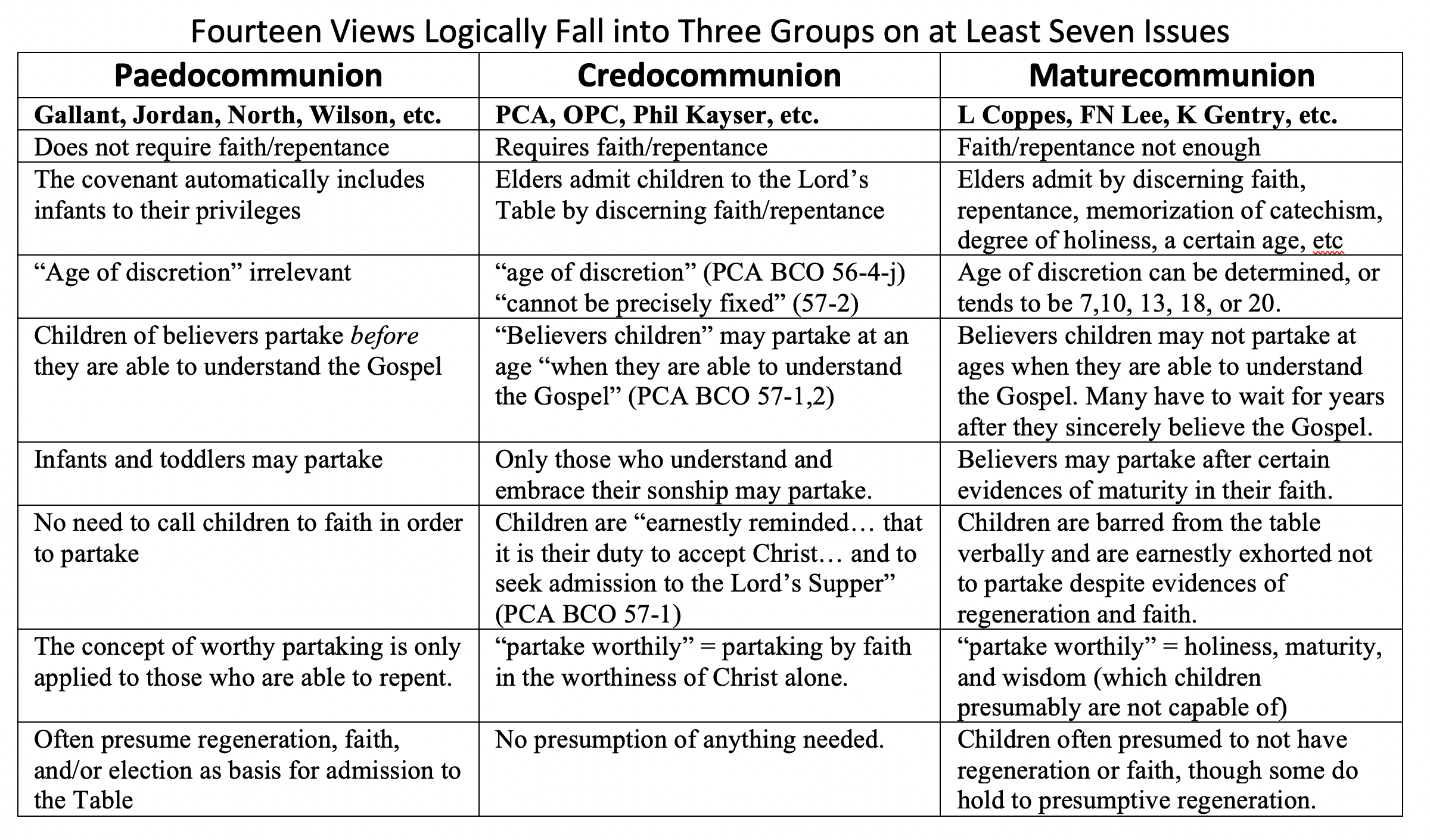
Whether representatives of these fourteen views like being lumped together with others or not is immaterial. The fact that they share 6-8 common beliefs that stand in stark contrast to the common beliefs of two other groups makes the exercise in this chapter a simple and legitimate way of winnowing down the options to a manageable three.
Then, if it can be shown that the common beliefs in any one column are wrong, that column can be eliminated. Of course, this chapter will only be a preliminary and high level approach. The rest of the book will analyze the Biblical data in much greater depth to see if our preliminary conclusions are correct. We must be able to account for all the Scriptural “facts” related to communion.
The Strongest Arguments of Each Group
As already hinted at, this chapter will not get into every nuance for all three of these views. Instead, it will seek to give the strongest and most salient arguments for each major grouping. It will quickly become apparent that this book agrees with the strongest proofs of both paedo-communion and mature-communion, while paedo-communion and mature-communion can only account for a portion of these proofs. Later chapters will examine other presuppositions, arguments, and exegetical details.
The Strongest Arguments for Paedo-Communion
I believe the strongest case that can be made for paedo-communion is that young children did indeed partake of the sacrament in the Old Testament festivals. How young will be seen in the next chapter, but the following evidence seems to rule out at least adult-only communion:
Paul Makes a Strong Connection between the Lord’s Supper and the Old Testament Sacramental Meals
In 1 Corinthians 10, Paul makes a tight connection between the Old Testament sacramental meals and the Lord’s Supper. This connection is either ignored or denied in most of the discussions that I have read from various viewpoints represented in the third column. Some will go so far as to say that even the Passover is not “determinative for the Lord’s Supper.”46 Given the fact that the meal where the institution of the Lord’s Supper was given is explicitly called a Passover (see Matt. 26:20-23; Mark 14:17-26; Luke 22:14-23), and given the fact that Paul gives instructions from the Passover for our observance (1 Cor. 5:6-13, including the discipline of “not to eat with such a person”), I find this argument quite astonishing. Others (like Francis Nigel Lee) argue for a connection with Passover, but not a connection with the other sacramental meals. The reason this is a critical point is that all commentators agree that at least some Old Testament festival feasts included children. Let’s examine the evidence:
1 Corinthians 10 refers to sacramental meals that were consumed after the first Passover and after the Red Sea crossing and those meals are said to be sacramentally the “same” — “all ate the same spiritual food and all drank the same spiritual drink. For they drank of that Rock that followed them, and that Rock was Christ” (1 Cor. 10:3-4). This would not be possible if Passover was the only exemplar for the Lord’s Supper. Likewise, all of the Old Testament sacramental meals are explicitly said to be “examples” to us (cf. vv. 6,11) of what constitutes worthy participation that finds blessing and what constitutes unworthy participation that finds judgment (chapters 10-11). Each unworthy participation and judgment is applied to the Corinthians’ unworthy participation in the Lord’s Table. The only way this would be possible is if all those Old Testament meals were in some way parallel to the Lord’s Supper. Consider how many Old Testament sacramental meals are being connected to the Lord’s Table:
- In verses 2-3 Paul refers to a communion meal (or meals) that took place early upon their entrance into the wilderness. Whether this was the feast “three days” later (Ex. 3:18; 5:1,3; 8:27 with 7:16; 10:9-10,24-26), or the ongoing weekly sacraments using the manna and the Rock (see Exodus 16 for start of manna and Exodus 17 for start of water), their sacrament was essentially the “same” in “spiritual” efficacy and intent to ours, and their sacrament continues to teach us about worthy participation (what results in blessing or judgment) — “Now these things became our examples, to the intent that we should not lust after evil things as they also lusted” (v. 6).
- Verse 7 warns of the sacramental judgment that came in Exodus 32:5-6: “And do not become idolaters as were some of them. As it is written, ‘The people sat down to eat and drink, and rose up to play.’”
- Verse 8 warns us with the sacramental judgment that killed 23,000 in Numbers 25-26: “Nor let us commit sexual immorality, as some of them did, and in one day twenty-three thousand fell.” These examples make it clear that the sickness and death that the Corinthians were receiving from unworthy participation (1 Cor. 11:30-32) is nothing new. It was common in Old Testament times as well.
- Verse 9 appeals to the judgment that fell when the Israelites despised the manna (Num. 21:4-8): “nor let us tempt Christ, as some of them also tempted, and were destroyed by serpents.”
- Verse 10 applies the judgment of murmurers in Numbers 16:1-49) who despised the authority of the priests to administer the General Tabernacle rituals (see Num. 15):47 “nor complain, as some of them also complained, and were destroyed by the destroyer.”
- Verse 18 makes application of the temple sacrifices/meals to the Lord’s Table: “Observe Israel after the flesh: Are not those who eat of the sacrifices partakers of the altar?”
From these examples that Paul gives, it is difficult to escape the conclusion that all the Old Testament sacramental meals can teach us about worthy participation. Too many books focus on the Passover alone. If the Lord’s Table sums up and replaces all the Old Testament sacramental meals, and if those Old Testament sacramental meals continue to instruct us on how we should partake of the Lord’s Supper, then we have a much broader base of Scriptures to instruct us on worthy participation. And indeed, Paul explicitly says that those meals were a pattern (τύπος) for us (v. 6). It was not just the Passover, but “all these things happened to them as examples, and they were written for our admonition, upon whom the ends of the ages have come” (v. 11).
Old Testament Sacramental Meals All Included children
If the previous presupposition is correct, then we should include children in the New Covenant meal since they were always included in the Old Testament sacramental meals (see next chapter for proof). This logically excludes all adult-communion positions (as well as positions 8 & 9) because the broader set of sacramental meals clearly included quite young children. On at least this point, paedo-communionists are correct. Some of their proof texts are more subject to criticism than others.
Paul’s Application of Old Covenant Meals in 1 Corinthians 10-11
Though paedo-communionists spend a lot of time in Exodus 12 to prove their case, most of their books seem to regard 1 Corinthians 10:1-2 as the proof-text for paedo-communion. Their argument for including infants seems fairly straightforward (though we will later see that the mature-communionists can fairly easily overturn it). Paedo-communionists claim that the partaking in verses 3-4 was as extensive as the baptism in verses 1-2. Paul says that “all our fathers were under the cloud, all passed through the sea, all were baptized into Moses in the cloud and in the sea, all ate the same spiritual food and all drank the same spiritual drink. For they drank of that Rock that followed them, and that Rock was Christ.” Verse 5 makes clear that most of those who ate were not regenerate — “But with most of them God was not well pleased, for their bodies were scattered in the wilderness.” Paedo-communionists conclude that 1) verse 5 rules out regeneration as being a qualification for communion, 2) the only pre-requisite mentioned was baptism, and since infants were baptized, they should be communed.48
Corresponding to this logic is 1 Corinthians 10:17, which says that “we though many are one bread and one body; for we all partake of that one bread” (10:17). Paedo-communionists insist that sacramental partaking of Christ is required of all who are members of the covenant.49 While they ignore other contextual indicators that excluded some children, on the surface, this seems to be a strong argument. Paul had already stated that the children of believers are “holy” at least covenantally (7:14). If 1 Corinthians 10:1-4 makes the “all” to include children, then Paul’s emphasis in these chapters to not divide the “fellowship” or “koinonia” means that we should not partake of the Lord’s Table in any way that divides the body into segments (such as rich and poor, adults and children). They claim that the practice of excluding infants from the Lord’s Table strikes at the heart of what the sacrament calls for — the unity of Christ’s body. Though this is a fairly powerful argument for paedo-communion, we will see that it falls apart when the mature-communionists examine it (below).
General Provisions at Unspecified Old Testament Feasts.
Their appeal to the Old Testament feasts is a much stronger argument. The general provisions that God gave for all his feasts included as participants: “you and your households” (Deut. 12:6-7), “sons and daughters” (vv. 11-12), “you and your household…and the fatherless… and widow” (Deut. 14:22-29). While sons and daughters are generic terms that could be interpreted in various ways, “the fatherless” are only mentioned in contexts that indicate disadvantaged orphans who were underage and thus in a vulnerable position. The granularity of age will have to wait until the next chapter. Here it is at least clear that underage children partook and households partook.
The Passover Meal
Paedo-communionists claim that the Passover meal clearly included the “household” (Ex. 12:3-4),50 “your sons” (12:24), “your children” (12:26), and “your son” (13:8,14). Paedo-communion advocates also point out that “the whole assembly of the congregation of Israel shall kill it [the lamb] at twilight” (v. 6), and since the whole congregation in Joel 2:16 includes children and nursing babes, nursing babes must have partaken in Exodus 12. We will reserve the adult communion critique of importing the “nursing babes” from the fast of Joel 2:16 into this context, but for now it should be clear that at least children and households partook. If 1 Samuel 1 is referring to the Passover,51 then this would be another example of portions going “to Peninnah his wife and to all her sons and daughters” (1 Sam. 1:4). This does not specify how old the youngest of these were, but it is clear that more than adults were admitted to this feast. While this would rule out adult-communion, it does not rule out the credo-communion position of this book. Our church has several families where all the sons and daughters partake of communion.
The Feast of Firstfruits
The Feast of Firstfruits included “you and your house…the fatherless, and the widow” (Deut. 26:1-15). That these fatherless needed special care implies their under-age status. In the Feast of Firstfruits that was planned to start three days after the Egyptian Passover (see Ex. 3:18; 5:3; 8:27), Moses insisted on including “our young and our old; with our sons and our daughters…for we must hold a feast to the LORD” and he refused to obey Pharaoh’s restrictions on the “little ones” (Ex. 10:10; cf. v. 24). In the next chapter we will look at the interesting specificity involved in the Hebrew term for “little ones.” Paedo-communionists import an unbiblical definition into it. At least they recognize that small children can partake.
The Feast of Pentecost
The Feast of Pentecost included “you and your son and your daughter…and the fatherless” (Deut. 16:9-12). Again, the mention of the “fatherless” implies those who were underage.
The Feast of Tabernacles
The Feast of Tabernacles included “you and your son and your daughter…and the fatherless” (Deut. 16:13-17). At this feast God commanded, “Gather the people together, men and women and little ones” (Deut. 31:9-13). Of course, we will later see that each of the passages that discuss this feast (including Nehemiah 8) qualify which little ones partook.52 But having said that, Paedocommunionists are correct that little ones are not adults or even twelve-year-olds. Interestingly, the Feast of Tabernacles is the feast that particularly pointed to the New Covenant times of the Gentiles (Zech. 14:16-21). The times of the Gentiles were symbolized by offering up seventy bulls for the seventy nations of the world. These provisions were not time-bounded by the Old Covenant or the Old Covenant people. Zechariah uses the feast to anticipate the participants of the New Covenant.
Peace Offerings at Covenant Renewal
The peace offerings at the covenant renewal ceremonies in Deuteronomy (Deut. 27:1-30:20) included “your little ones and your wives” (29:11). The covenant renewal ceremonies under Joshua included “all the congregation, the women, the little ones, and the strangers who were living among them” (Josh. 8:30-35). While this rules out mature-communion, it does not rule out our young-credocommunion position since our church has “little ones” who have been examined by the elders, made a credible profession of faith, and begun to partake of the feast. (Again, the granularity of Hebrew terms in the next chapter must be considered.)
The Priestly Portions of the Sacramental Meals in 2 Chronicles 31:10-16, and the Priestly Portions of the Wave and Heave Offerings in Lev. 10:14-15; Num. 18:11,19; etc.
The wave and heave offerings belonged to the priests, but they also included their families, saying, “you shall eat in a clean place, you, your sons, and your daughters with you” (Lev. 10:14-15; cf. Num. 18:11,19). The priestly portions of the sacramental meals mentioned in 2 Chronicles 31 included “males from three years old and up who were written in the genealogy” (v. 16) “and to all who were written in the genealogy — their little ones and their wives, their sons and daughters — for in their faithfulness they sanctified themselves in holiness” (v. 18). While conditions are mentioned, this text is quite explicit that the sacramental meals were not simply intended for adults — they included children “three years old and up” and included “little ones.” In the next chapter we will examine other passages that include at least some three-year-olds.
If the evidence I have given above was the only evidence that we had, and if there were only two positions to evaluate, there would be strong presumption in favor of automatic paedo-communion. Typically, the mature-communion books almost completely ignore these inconvenient “facts” or discount them in various ways. Their paradigm dictates that they do so. So it is no wonder that so many Christians have embraced paedo-communion in recent years. They are seeking to be faithful to very clear passages that admit children.
The Strongest Arguments for Mature-Communion
As we will now see, the paedo-communionists are just as guilty as the mature-communionists of ignoring a large body of inconvenient “facts.”53 If we examine the strongest arguments of mature-communionists, their arguments seem to almost completely rule out the paedo-communionist position. Obviously the paedo-communionists will present strong counter-arguments that we will examine later. This high-level approach is simply designed to introduce you to the fact that while paedo-communionists can explain the Scriptures that call us to admit “little ones” and while mature-communionists can explain the Scriptures that require active faith on the part of recipients, only the young-credocommunion position can adequately explain both sets of data. Consider the strongest mature-communion arguments:
Old Testament Sacramental Meals Continue to Instruct for the New Testament Sacramental Meal
While mature-communionists will often deny that the Old Testament sacramental meals can inform us on the participants or the qualifications for the Lord’s Table54, at least some have taken the challenge and insisted that all the Old Testament sacramental feasts had qualifications. I will deal with the passages in the same order as I brought them up under paedo-communion, even though mature-communion adds more passages.
Paul’s Application of Old Covenant Meals in 1 Corinthians 10-11
Just as paedo-communionists appeal to 1 Corinthians 10:1-3 to prove that children partook, many mature-communionists point to the same passage, and indeed all of chapters 10-11, to prove the exact opposite.55
First, they will point out that the word for “food” in the phrase “same spiritual food” is the Greek word βρῶμα, or “solid food.” Earlier in 1 Corinthians, Paul had told the Corinthians that it was not appropriate for children under the age of three or four (νήπιος)56 to eat βρῶμα. In 1 Corinthians 3:1-2 he told them, “And I, brethren, could not speak to you as to spiritual people but as to carnal, as to children (νήπιος) in Christ. I fed you with milk and not with βρῶμα; for until now you were not able to receive it, and even now you are still not able.” Paul would not now contradict himself by implying that infants and toddlers partook of βρῶμα. The very word βρῶμα shows how incompatible paedo-communion is with Paul’s statement.
Second, the word “spiritual” (πνευματικός) in the phrases “the same spiritual food” and “the same spiritual (πνευματικός) drink” points in the same direction. Paul had already told the Corinthians that very young children (νήπιος) do not have what it takes to be considered “spiritual” (1 Cor. 3:1-3) because partaking of spiritual things required the following conditions:
- A capacity for “comparing spiritual things with spiritual” (1 Cor. 2:13).
- The ability to “receive the things of the Spirit” (1 Cor. 2:14).
- A certain degree of knowledge — “But the natural man does not receive the things of the Spirit of God, for they are foolishness to him; nor can he know them…But we have the mind of Christ (1 Cor. 2:14,16).
- Discernment — “because they are spiritually discerned” (1 Cor. 2:14).
- The ability to judge — “But he who is spiritual judges all things” (1 Cor. 2:15).
- Some degree of maturity — “And I, brethren, could not speak to you as to spiritual people but as to carnal, as to babes in Christ” (1 Cor. 3:1). Here the νήπιος child is clearly contrasted with the spiritual (πνευματικοῖς).
Mature-communionists will also point out that there is no reference to infants in 10:1-4. On the contrary, they say that the “all” being discussed throughout the paragraph is defined quite clearly as “all our fathers (πατέρες)” (v. 1). Likewise, the “them” of verse 5 clearly excludes the children and refers back to the fathers alone — “But with most of them God was not pleased, for their bodies were scattered in the wilderness” (v. 5). The bodies of the children were not scattered in the wilderness; only the bodies of the older generation were (Num. 14:26-38). Indeed, the children grew up to be one of the most faithful generations in Israel’s history — taking the conquest of Canaan by faith. Therefore the phrase, “most of them” cannot apply to the children. But “their fathers [were] a stubborn and rebellious generation, a generation that did not set its heart aright, and whose spirit was not faithful to God” (Ps. 78:8).57
To anticipate a potential rebuttal to this line of reasoning, paedo-communionists might insist that the same “all” who were baptized in verse 2 were the “all” who partook of the spiritual food and drink of verses 3-4. Since the infants were baptized along with the adults, both groups partook of both sacraments in verses 1-4. Therefore, the reference to “all our fathers” must de facto be a reference to every man, woman, and child in Israel, not simply the adult male representatives of the families. Mature-communionists will respond with several arguments that show the opposite.
First, they will point out that there is nothing in the context to indicate that the reference to being “baptized” in verse 2 is in any way equivalent to our baptism. The opposite is true. This baptism did not admit any of them into the covenant since circumcision had already admitted them to the covenant in Exodus 12 (see vv. 44,48). That means that whatever baptism is being talked about in 1 Corinthians 10, it has a radically different function from our baptism. Our baptism admits to the covenant.
Second, this baptism did not admit them to the sacramental meals since circumcision had already done that with the Passover in Exodus 12. This too is a radical departure from the purpose of circumcision in the Old Testament and baptism in the New Testament. Whatever baptism is being referred to, it came after communion, not before it.
Third, (though this is a debatable point), many adult-communionists argue that this baptism was not even a sacrament since all sacraments are signs and seals of a relationship to Christ. Though the sacrament of eating was feeding on “Christ” (1 Cor. 10:4), the baptism mentioned in verse 2 was by definition non-sacramental since they were “baptized into Moses” (v. 2) rather than being “baptized into Christ” (Rom. 6:3; Gal. 3:27).
Fourth, in contrast to the “one baptism” of the New Testament (Eph. 4:5), this was one of many “baptisms” (Heb. 6:2) of the Old Covenant that continued to be applied to covenant members for various purposes, and therefore it was not a baptism of initiation. Hebrews 9:10 calls these “different baptisms” (διαφόροις βαπτισμοῖς). The first word, διάφορος, means “pertaining to that which is different.”58 This is different from our baptism on many levels. It was not a baptism that initiated into the covenant or into the sacrament (as Exodus 12 clearly shows). It was not a baptism performed by man. It was a baptism into Moses that showed a commitment to his leadership.
Fifth, if it is insisted that everyone who walked through the Red Sea was qualified to partake of the wilderness sacraments, and if every meal of manna was a sacramental meal (as opposed to being one of the elements eaten when the sacrament was served by the Levites), and if every sip of water that flowed from the rock was sacramental (as opposed to being common water being made sacramental only when it was served with the sacraments by the Levites), then it proves too much. It proves that the wilderness sacraments were self-serve sacraments rather than being administered by the Levites as dictated by the law.59 It proves that they had sacramental meals multiple times a day (something contradicted by the law of God, which required blood sacrifice before a fellowship meal could be enjoyed — Lev. 7:11-21; 17:1-16; 19:5-8; etc.).60 It proves that the “mixed multitude” (Ex. 12:38) also ate of the sacrament because they also walked through the Red Sea and also ate manna. The term “mixed multitude” (עֵ֥רֶב רַ֖ב) refers to foreigners that have not fully embraced the faith.61 But this would mean that uncircumcised people ate of the sacrament — something even paedocommunionists admit is forbidden by the law of God. Nehemiah “separated all the mixed multitude from Israel” (Neh. 13:3). Though Gentiles could dwell in Israel, they were not considered part of the covenant community and therefore could not partake of communion. Though the “fathers” who went through the Red Sea did partake, not all who went through the Red Sea partook — certainly not the mixed multitude. The mixed multitude had to eat, and they ate the manna as common food, not as sacramental food. But if they were excluded, there is no reason to take the “all” in the absolute way that paedocommunionists do. It was all of some category (fathers), but not all of Israel.
Likewise, there were lepers in Israel. Were they qualified to partake? No (Lev. 7:20-21; 22:4; etc.). Just walking through the sea did not baptize the mixed multitude, the cattle, and sheep in any way that would make them qualified for the sacramental meal. Paedo-communionists will sometimes insist that even the cattle drank sacramentally because Numbers 20:11 says that “water came out abundantly, and the congregation and their animals drank” (Num. 20:21). However, all sacramental meals were administered by the Levites. It was the Levites who had authority “over the freewill offerings to God, to distribute the offerings of the LORD and the most holy things” (2 Chron. 31:14).62 Not every manna meal was a sacramental meal because there was no sacrament without the shedding of blood. Though bread/manna was served with the meat of the peace offerings, Old Covenant sacraments did not exist without peace offerings, and the peace offerings were eaten under Levitical oversight. So not every manna meal was a sacramental meal. Not every drink from the Rock was a sacramental drinking of Jesus. There were common meals composed of manna and there were sacramental meals composed of manna.
Sixth, if all sacramental meals involved meat in the Old Testament, then most paedo-communionists63 will readily admit that newborns did not partake because they could not chew the meat. If paedo-communionists add a condition for partaking (the ability to chew), then there is no logical reason to ignore the other qualifications for the sacrament that are strewn throughout the Old Testament and repeated in the New — especially when several of those passages explicitly apply the conditions to young children. Paedo-communion at that point becomes no more “covenant communion” than any of the other views. Only views 1 & 2 (womb communion & baptism communion with intinction) can (strictly speaking) say that the covenant alone admits to the Table.
The above observations show that walking through the Red Sea was not enough. There were other qualifications that had to be in place for worthy participation. And it is precisely these qualifications that excluded and included in the Old Testament that are the qualifications Paul sets forth in 1 Corinthians 10-11. Paedo-communionists treat these qualifications as irrelevant to infants, but they are jumping the gun. If “all” in 1 Corinthians 11:3-4 has exclusions (see above) then their proof for infant participation vanishes. As we will see, Paul is simply being faithful in interpreting the Old Testament sacramental meals when he insists that there is no sacrament when the qualifications are not met (1 Cor. 11:20).
We have already seen that the mature-communionist insists that the “all ate” is defined by “all our fathers” and not by “all” without exception. If this is true, then there is no reason to reject the numerous qualifications that are strewn throughout 1 Corinthians 10-11. These qualifications nullify the division-of-the-body argument that paedo-communionists present from 1 Corinthians 10:16-17. The inability of an infant to chew the meat of the next verse (v. 18) does not cut that infant off from Israel and therefore Paul’s logic cannot mean that the inability of an infant to chew bread will cut that infant off from the body of Christ.
Interestingly, though “the people who came out [of Egypt] had been circumcised” (Josh. 5:5), once they were excommunicated in Numbers 14, they were no longer allowed to apply the sign of the covenant to their children. Why? Because of “unbelief” (Heb. 3:12). Since they lacked the condition of faith they were not able to partake of the other sacrament either, and their children were consequently excluded from the sign of faith (circumcision). Thus, there was a mass circumcision of the younger generation and their children in Joshua 5 upon profession of faith of the fathers. During at least 38 of the 40 years, the fathers and the children did not partake of any communion since circumcision was a prerequisite for partaking. This means that for 38 years, the manna eaten was not eaten in a sacramental way.
As will be demonstrated later in this chapter and also in the next chapter, there are stages of development of members within Christ’s body as they take on new responsibilities and privileges. The transition from “an heir” by right of birth and baptism (Gal. 4:1) to the privileges of sonship by faith (Gal. 4:1-7) is the first of several entrances into privileges. Galatians 3:26-4:7 shows that heirs must profess faith to receive the privileges of sonship. Do all those who prove to be sons have the privilege of voting? No. Scripture explicitly says that only males who are twenty years of age can vote.64 The next chapter will nail down the Biblical granularity of development. The point is that requiring qualifications for subsequent privileges does not divide the body; it assumes growth and development within the body.
In this context, mature-communionists show that the flow of the whole of 1 Corinthians 10-11 defines what it means to eat and drink in “an unworthy manner” (11:27,29). Paul applies that phrase not simply to adults, but to “whoever eats this bread and drinks this cup of the Lord in an unworthy manner.” The English word, “whoever,” is made up of two Greek words, ὃς ἂν, which indicate each and every one who partakes. To arbitrarily exclude children from this warning is not warranted. The conditions apply to 100% of the participants in such a way that whoever “eats this bread and drinks this cup of the Lord in an unworthy manner will be guilty of the body and blood of the Lord” (11:27). So how does Paul define worthy participation?
First, worthy participation requires some degree of maturity. It involves putting off self-centered “lust” (10:6), not simply eating because one is hungry or because one wants the food (11:21-22), and “not seeking my own profit, but the profit of many” (10:32-33). Indeed, Paul said, “Let no one seek his own, but each one the other’s well-being” (10:24). The “no one” and “each one” is as extensive as participation in the meal (the subject of chapters 10-11). As can be seen by the context of who is being addressed, age alone is not sufficient. Paul is calling for maturity. In terms of the level of maturity required, all we have to do is look to the Old Testament sacraments that Paul was appealing to in chapter 10. If Paul’s application of the meat meals of the Old Testament (10:1-11) and the peace offering meals of the temple of his day (10:18) have a one-to-one correspondence to worthy partaking, then it would appear that the absolute minimum ability that is required is weaning. Other conditions require more than weaning, but it seems that some of the indicators of maturity in this paragraph correspond to at least David’s maturity when he was weaned, as described in Psalm 131. The maturity of this weaned child in Psalm 131 parallels the conditions Paul lays out in 1 Corinthians 10-11. Mature-communionists push this level of maturity well beyond the level of children, but at least some maturity is clearly required.
Second, worthy participation requires the presence of active faith and repentance. Just as Jesus pointed out that without faith no one could partake of His flesh and blood,65 these chapters indicate that without faith people do not eat the Lord’s Supper but simply eat bread and drink wine (11:20). To receive the tradition (παράδοσις) that Paul delivered (παραδίδωμι) from Jesus to those participating in this meal (11:23-26) requires understanding and faith. This meal preaches the Gospel of Christ to all observers (11:26) and calls them to embrace that Gospel by faith. That this is an active faith can be seen by the active verbs, “take,” “eat,” (11:24) “this do in remembrance of Me” (11:24), “drink it in remembrance of Me” (11:25), “you proclaim the Lord’s death” (11:26).
Since faith and repentance are flip sides of the same coin, where one is found, the other will be found as well. These chapters call for a conscience that is not simply governed by man, but is governed by God (10:25,27-30). They call all participants to repent of and put off idolatry (10:7), sexual immorality (10:8), testing of authority (10:9), and complaining (10:10). This implies that all participants are able to discern such things as being evil and to put off such things. Though we will see that at least some “little ones” are able to have such discernment (see especially Isaiah 31:18), any “little ones and children… who today have no knowledge of good and evil” (Deut. 1:39) would be disqualified. Certainly those who have no ability “to discern between their right hand and their left” (Jonah 4:11), would likewise not be qualified. Worthy participation involves some degree of overcoming temptation (10:13) and fleeing from idolatry (10:14). These all illustrate the presence of more than seed faith; they showcase an active faith and repentance.
Third, worthy participation requires the presence of some knowledge and discernment — at least an understanding of the basics of the Gospel. Paul said, “I speak as to wise persons; judge for yourselves what I say” (10:15). Worthy participation involves sufficient insight that they can “watch out” (βλέπω in 10:12) and develop a good “conscience” (10:29). It involves sufficient discernment to be able to imitate Biblical examples (10:6,11) in order to please God (10:5). It involves some ability to “judge” what Paul was saying (10:15), to “examine himself” (11:28), to “judge ourselves” (11:31), and to discern the difference between a snack (11:21-22) and “the Lord’s Supper” (11:20). Infants are not capable of any of those things. Worthy participation involves the ability to bless the cup when we partake (10:16). Giving thanks is a rational concept (10:30), as is eating and drinking to the glory of God (10:31). It requires that we remember Christ’s death (11:24-25) and “proclaim Christ’s death” (11:26) “as often as you eat this bread and drink this cup” (11:26). The “as often” knows of no exceptions. These repeated conditions of discernment and knowledge rule out infants.
Fourth, worthy participation requires some degree of repentance and overcoming sin. This much should be clear from the constant admonitions in chapter 10 related to Old Testament disciplines for unworthy participation.
Now all these things happened to them as examples, and they were written for our admonition, upon whom the ends of the ages have come. Therefore, let him who thinks he stands take heed lest he fall. No temptation has overtaken you except such as is common to man; but God is faithful, who will not allow you to be tempted beyond what you are able, but with the temptation will also make the way of escape, that you may be able to bear it. (1 Cor. 10:11-13)
These are obviously admonitions to those who are able to discern between good and evil and are able to heed the ethical admonitions given by Paul. Consider the statements in chapter 10: “became our examples,” “do not become idolators,” “nor let us commit sexual immorality,” “nor let us tempt Christ,” “nor complain,” “take heed,” “will not allow you to be tempted beyond what you are able,” “flee from idolatry,” “I speak as to wise persons,” “judge for yourselves what I say,” “whether you eat or drink, or whatever you do, do all to the glory of God.”
Likewise, consider the statements in chapter 11 that Paul applies to worthy participation — “I do not praise you,” “you come together not for the better but for the worse,” “there are also factions among you, that those who are approved may be recognized among you,” “do this in remembrance of Me,” “you proclaim the Lord’s death,” “whoever eats this bread or drinks this cup of the Lord in an unworthy manner will be guilty of the body and blood of the Lord,” “But let a person examine himself, and so let him eat,” “if we would judge ourselves, we would not be judged,” “we are chastened by the Lord,” “when you come together,” “wait for one another.”
Paedo-communionists will often respond that conditions are also given for the sacrament of baptism66 in the New Testament and for the sacrament of circumcision67 in the Old Testament. If those conditions didn’t hinder infants from receiving those sacraments, why should they hinder them from receiving the Lord’s Supper?
Mature-communionists will respond that the two situations are not comparable. First, no one doubts the admission of infants to the sacrament of circumcision since that was explicitly authorized in Genesis 17, but the majority of Reformed writers do not see infants partaking of a sacramental meal in any of the Old Testament sacramental feasts. A contested “implication” is not the same as an explicit inclusion of infants. We have an explicit inclusion of infants into the initiatory sign of the covenant, but we have no explicit inclusion of infants into the active sacrament of communion.
Second, the only condition for circumcision in the Old Testament was that one of the parents had to be a believing Jew (Gen. 17; Ex. 12:48-49; Luke 1:59; Rom. 4:11-12). That was not the case with regard to Old Testament sacramental meals. There were numerous mentions of requirements for worthy participation — as this chapter abundantly demonstrates.
Third, we will devote an entire chapter to the Regulative Principle of Worship, in which God mandates explicit authorization for everything that occurs in worship. The fact of the matter is that there is no explicit mention of infants partaking of any Old Testament sacramental meal. The most that paedo-communionists can achieve is to show what they consider to be logical deductions.
Third, we will devote an entire chapter to the Regulative Principle of Worship, in which God mandates explicit authorization for everything that occurs in worship. The fact of the matter is that there is no explicit mention of infants partaking of any Old Testament sacramental meal. The most that paedo-communionists can achieve is to show what they consider to be possible implications. However, if these implications were a good and necessary consequence, one would expect more Reformed Creeds to have kept the practice.
Last, if there is not a certainty that infants partook, then we cannot ignore the conditions for worthy participation that are strewn throughout the Old and New Testaments. We will now turn to that extensive evidence.
Revelation’s application of Old Testament meals
The book of Revelation has four references to the New Covenant meal helping us to feed upon Jesus in heaven. Each of these apply the symbols of the Old Covenant sacramental meals in a way that excludes those who 1) do not have an active faith 2) and are thus not “overcomers” who obey the Lord.
Revelation 2:7 — Those who are admitted to communion
Christ states, “To the one who overcomes I will grant to eat of the Tree of Life, which is in the midst of the Paradise of my God.” Christ uses the first sacramental meal mentioned in the Bible (the Tree of Life in the Garden of Eden) as a symbol of what New Testament believers can be restored to. Notice, though, it is “the one who overcomes” who is granted permission to eat by Christ. This symbol of eating the Tree of Life is the first of three more references to the Lord’s Supper. Overcomers in Pergamos are promised “the hidden manna” (2:17), overcomers in Laodicea are promised to “dine with Him” (3:20), and the Tree of Life is presented as a symbol once again in Revelation 22:14: “Blessed are those who do His commandments, that they may have the right to the tree of life.” The right to eat is not automatic. If these references are indeed Old Covenant symbols for the New Covenant communion meal, then each of these passages are instructive for our own use of the Lord’s Table. The following are some deductions.
Deductions from Revelation 2:7 on the conditions for communion
- This passage speaks of conditions for worthy participation.
This passage outlines four conditions for communion. The first condition is regeneration. The phrase, “He who has an ear,” is not referring to external ears, but to the inner ears produced at the point of regeneration.68
The next phrase, “let him hear,” indicates that it is not enough to be regenerate (to have the inward spiritual ears of the soul). Those ears must be actively able to listen and respond to the Word. Is this possible for infants who do not understand words yet?
The third condition is the ability to understand the Scripture. We see this in the phrase, “let him hear what the Spirit is saying to the churches.” At a minimum, a child needs to be able to understand what the Bible says about the Gospel and the Lord’s Table.
The fourth condition is found in the phrase, “To the one who overcomes.” Overcoming implies the active obedience of faith. On occasion, adult-communion advocates will over-apply this condition by appealing to 1 John 2:14, which says:
I have written to you, fathers, because you have known Him who is from the beginning. I have written to you, young men, because you are strong, and the word of God abides in you, and you have overcome the wicked one.
They claim that overcoming in these verses shows a high degree of maturity — that of a spiritual warrior. While I will later show that they overstate their case — since even “little children” are said to “have overcome them” (1 John 4:4), they do make a legitimate case that evidence of regeneration, faith, submission, and overcoming are indeed conditions for coming to the table.
- This passage indicates that not all in the church may participate.
The clause, “To the one who…I will grant to eat” shows that not all in the congregation have the right to eat. The last phrase is rendered variously as “I will give to eat” (NKJV), “I will give permission to eat” (NRSV), “I will give the right to eat” (NIV, NAB, HCSBS, CNT), or “I will permit him to eat” (NET). Being a member of the church is not a sufficient condition to eat. Only those church members who meet the conditions have permission to eat.
- Christ alone has authority to admit to the Table.
The phrase “I will grant to eat,” implies that communion must be given by Christ’s authority alone and cannot simply be taken by men (as is done in private communion). Nor can it be given by elders apart from explicit authorization by Christ in the Scriptures. Since He is talking to people who are already church members, He implies that not all in that church were given the right to eat by Jesus. This completely destroys automatic covenant communion. There is something more than the covenant that gives that right.
- Officers must reflect Christ’s authority in the sacrament.
Since the officers of the church are stars on Christ’s hand (1:16,20; 2:1) and represent His authority, they should not “grant” to members what Jesus is not willing to “grant.” If Jesus sets conditions for partaking of communion, so too should the officers representing His authority.
- Faithful administration of the sacraments means care in admission and exclusion.
If these words imply an authority to admit to the table, the words also imply that Jesus has the authority to remove the right to eat from the Tree of Life. What is implied here is explicitly stated elsewhere in Revelation (see Rev. 3:20; 22:14,19). This admission and removing from the table is an aspect of church discipline. While “those who do His commands…have the right to the tree of life” (22:14), Revelation says that those in the church who rebel against His Word will find that God will “remove his share from the tree of life” (22:19). If this is an Old Covenant symbol of communion, then Revelation 22:19 indicates that these church members have their share in communion removed. Though inside the church, they are like Jews who “have no right to eat” from our altar (Heb. 13:10).
- Thus there is a difference between being an heir and receiving all the inheritance.
This further means that though all members of the church are in the covenant and are considered heirs of its promises, not all have fully entered into every privilege of that inheritance. This is the same deduction Paul will show in Galatians 3:26-4:7. Paul insists that though the young napios child is an “heir” of the covenant promises (Gal. 4:1) “he does not differ at all from a slave, though he is master of all.” The enjoyment of all covenant privileges is bestowed on that heir when he by faith experiences sonship and can personally cry out “Abba, Father!” in faith and by the indwelling Spirit (Gal. 4:3-7). At that stage the child can fully enjoy the promises he is already heir to. Revelation 2:7 is doing something similar when it is requiring evidences of sonship in church members before giving a right to eat of the tree of life.
- Communion feeds on Christ’s redemption.
A seventh deduction we can make is that this is a symbolic way of saying that communion feeds on Christ’s redemption. Just as the Lord’s Table symbolizes partaking of Christ and of the benefits of His redemption, eating of the “Tree of Life” is a symbol of partaking of the wisdom of Christ and of the benefits of His redemption.69 This is supported by the fact that Wisdom in Proverbs personifies Christ’s revelation and this personified Wisdom is said to be the tree of life (Prov. 3:18). This was the official interpretation of the Western church for over 1000 years.70 Just as Jesus is the vine of which we partake (John 15:1-8), His revelation is the Tree of Life of which we partake.
- When we partake of the Lord’s Supper by faith, we are caught up into the heavenlies.
Notice the location of this symbolic communion meal. It is “the Tree of Life, which is in the midst of the Paradise of my God.” We are to seek those things which are above where Christ is because “Christ is our life” (Col. 3:1-4). When we lack faith, we are simply chewing on earthly bread and drinking earthly wine (compare 1 Cor. 11:20b). When we come to communion in faith, we are lifted in spirit up “to Mount Zion and the city of the living God, the heavenly Jerusalem…to Jesus the Mediator of the new covenant, and to the blood of sprinkling” (Heb. 12:21-24). In other words, we are lifted up to the Paradise of God where we truly feed on all that Christ purchased for us and therefore “dine” with Christ (Rev. 3:20). The communion with God that was lost to Adam and Eve in the first paradise is restored in the heavenly paradise.
Revelation 2:17 — Those who are admitted to communion
The second Old Testament symbol of communion is given in Revelation 2:17, which says:
He who has an ear, let him hear what the Spirit is saying to the churches. To the one who overcomes I will grant to eat from the hidden manna eat. And I will give him a white pebble, and on the pebble a new name written, which no one knows except the receiver. (Wilbur Pickering translation)
There are several deductions we can make from this verse.
- There is a promise of intimacy and fellowship.
Jesus gives a marvelous promise of sweet fellowship and intimacy to those who are willing to take His message seriously. This intimacy is symbolized with two metaphors: food (“manna”) and admittance to the feast (“a white pebble”).
- There is a condition for partaking: overcoming.
The condition for admission to the manna-like sacrament is overcoming — “To the one who overcomes.” Nor may people take this privilege to themselves since Christ alone has the authority to “grant to eat.” Leaders may not grant what Jesus does not grant.
- There was a fencing of the table.
Another hint that the table is fenced is that the manna is “hidden” from some in the church at the same time that it is open to others and eaten by others. In the Old Testament, the hidden manna was hidden from all, including the high priest (Ex. 16:32-36; Heb. 9:4). Only the high priest could come close, and that once a year. Now overcomers are welcomed to partake of it.
- Participation was by invitation.
Another possible hint that the table is fenced is that unless the member has “on the pebble a new name written” he has no authority to partake. Beale points out that Jesus could be blending the image of the manna and an additional idea of an invitation stone being given. The manna was twice likened to a white bdellium stone in appearance (Ex. 16:31; Num. 11:7). The suggestion is that white stones were used as tokens to gain admission to the feast. So the manna refers to the feast, and the white stone refers to the token that admits to that same feast. Earlier Reformed churches often took this literally and required a token to be presented by a member to the elder before he could partake of the Lord’s Table. The token was only given to those whom the elders had determined could partake worthily of the feast.
- This is more than a snack. There is incredible intimacy we have been invited to share in.
The language describing these two images of the Lord’s Table also speaks to the incredible level of intimacy that believers can have with God. The “hidden manna” is a reference to the manna Moses stored in a golden pot inside the ark of the covenant (Heb. 9:4). No one in the Old Testament would have dared to look inside the ark where the manna was hidden, let alone to eat of it.
Many people were amazed at the degree of closeness to God that the High Priest had once a year to be able to merely approach the mercy seat. Now Jesus says that we have something infinitely better than those types. The earthly tabernacle, the Holy of holies, the ark of the covenant, and the manna were all simply symbolic of the heavenly temple, Holy of holies, heavenly ark, and heavenly manna (see Heb. 8:5; 9:9). In John 6, Jesus declared Himself to be the true fulfillment of the manna (John 6:35,41,48,51) and said that we must feed upon Him (John 6:51,54,56). So this is one of many passages that speak of our being caught up to the heavenlies (where Jesus is) when we partake of the Lord’s Table (see comments on Revelation 2:7).
- Balancing the corporate nature of the sacrament, there is a very individualistic aspect to the sacrament as well.
Not only are we invited to feed on Christ in heaven, but Jesus says, “I will give him a white pebble, and on the pebble a new name written, which no one knows except the receiver.” Many paedo-communionists overemphasize the corporate dimension to the neglect of the individual dimension,71 but this passage speaks of intimacy with Christ in the sacramental feast in a very individualistic way. This is a secret between you and Jesus and you can tell when he calls you by name. In John 10:3, Jesus said about the good shepherd: “The sheep hear his voice; and he calls his own sheep by name and leads them out.”
Revelation 3:20 — Those who actually dine with Jesus
Revelation 3:20 is a third passage related to communion. In that verse Jesus states, “Behold, I stand at the door and knock. If anyone hears My voice and opens the door, I will come in to him and dine with him, and he with Me.” There are two things we can deduce from this passage:
- The benefits of the Lord’s Supper are not automatic.
This verse implies that Jesus was outside the door of the church. He was offering to come in and fellowship with them, but at this point He was so offended that He did not even grace their worship services with His presence. This means that just as Paul told the Corinthians that “when you come together in one place, it is not to eat the Lord’s Supper” (1 Cor. 11:20), but was instead a meal that had no more benefit than a supper at home (vv. 21-22), Christ is here stating that he was not dining with anyone (young or old) in that congregation because they lacked the qualifications for communion. The point is that the benefits of communion do not operate ex opere operato. They are only received by faith.
- Jesus lays out two conditions for coming to the Table.
Notice the conditions given before Jesus will eat the Lord’s Table with us. The first is the ability to hear His voice speaking in the Scriptures (“if anyone hears My voice”), and the second is an active faith that reaches out “and opens the door.” While it might be conceivable for an infant with “seed faith”72 to hear Christ’s voice, it is hard for me to imagine an infant opening the door. The two conditions mentioned here are the same two conditions given in 1 Corinthians 11 - spiritual discernment and active faith. To the other churches He said that they need to be overcomers to come to the Table, but that really is a synonym since repentance is the flip side of the coin with faith. An overcomer is a person who has an active faith since “whatever is born of God overcomes the world. And this is the victory that has overcome the world—our faith” (1 John 5:4). The modern church should fence the Lord’s Table with the same requirements: spiritual discernment and faith in Christ’s provisions.
Old Testament Meals
Even in the Old Testament, the conditions of partaking help to qualify which sons and daughters partook. Using the same list of feasts that the paedo-communionists do, the mature-communion advocates can point out the same conditions that are found in the book of Revelation.
General provisions at unspecified feasts.
Though paedo-communion advocates cite Deuteronomy 12 as including sons, daughters, and households, mature-communion people will point out that there is no mention of infants. They will point out that this is significant since this chapter begins and ends with the Regulative Principle of Worship (RPW), which commands us not to add or take away anything from the law. RPW requires that without granularity of explicit authorization, people may not partake. The meaning of these general feasts are summed up in “statutes and judgments” (v. 1) that each one must “be careful to observe” (v. 1). Likewise, the chapter ends (verses 31-32) with the Regulative Principle of Worship being enforced — “You shall not worship the LORD your God in that way…Whatever I command you, be careful to observe it; you shall not add to it nor take away from it.” The Regulative Principle of Worship articulated in those verses mandates that we may not include children on assumptions; we need explicit authorization. Mature-communion advocates carry this too far, failing to recognize the clear Scriptures in the previous section and the granularity of authorization in the next chapter. Paedo-communion advocates also violate the Regulative Principle of Worship by including infants when infants are nowhere authorized to partake.
Mature-communion advocates also rightly point to a number of very active verbs that those partaking are expected to be able to do. These sacraments committed participants to “utterly destroy” all idolatry (vv. 2-3), to avoid false worship (v. 4), to “seek” the temple (v. 5), to “take your burnt offerings, your sacrifices, your tithes, the heave offerings of your hand, your vowed offerings, your freewill offerings, and the firstborn of your herds and flocks” (v. 6) and “eat before the LORD your God” (v. 7). Adult-communionists will argue that the logic seems to indicate that those who sacrificed, tithed, vowed, opposed idolatry, and exercised their “freewill” were also the ones who ate.
Though it is true that Deuteronomy 12 mentions the “households” partaking (v. 7), the grammar indicates that “you and your households” are to “rejoice in all to which you have put your hand” indicating a conscious joining of the household in recognizing that “the LORD your God has blessed you.” This is contrasted with what “every person” was currently doing — “You shall not at all do as we are doing here today — every man doing whatever is right in his own eyes” (v. 8). Apparently “every person” who was partaking was “doing whatever is right in his own eyes,” something that would require rationality beyond an infant’s ability. In verse 12, every category of persons who partake are called to “rejoice before the LORD,” not just the head of household. They were to “Observe and obey all these words which I command you, that it may go well with you and your children after you forever, when you do what is good and right in the sight of the LORD your God” (v. 28).
The Passover Meal
While paedo-communion advocates will appeal to the Passover as an example of children partaking (see the exposition of their perspective in the previous section), they almost always restrict their exegesis to the Passover mentioned in Exodus 12. When all the Passover passages are interpreted together, it is clear that they support some kind of credocommunion. But even Exodus 12 shows that not all partook.
Mature-communion advocates strongly disagree with the paedo-communion exegesis of Exodus 12, stating that it does not say “every mouth of the household” eats, but rather it says that there was to be the right amount of lamb for “each mouth’s eating” (v. 16). Those are quite different meanings. The purpose of the commandment was to prevent any piece of the sacrament being left over till the next day (v. 10; cf. Deut. 16:4). In any case, the literal Hebrew implies that some mouths would not be eating. Since a newborn infant couldn’t eat lamb, he would not be counted.
Likewise they point to the explicit exclusion of children in the counting in verse 37, which says, “about six hundred thousand men on foot, besides children,” or as the NAB translates the Hebrew “six hundred thousand men on foot, not counting the children.” One literal rendering of לְבַ֥ד מִטָּֽף that is possible is “in isolation from the children.” Gentry claims that if they were not counted, they did not eat since every “mouth” that ate was counted (see previous paragraph). It is certainly deducing more than is warranted from the text73 when he says, “They had just counted so that they had the right number of lambs. And then, when the children of Israel leave Egypt, they know how many men are leaving because they just made the count for the lambs.”74
Concerning those men, the text says that “they baked unleavened cakes of dough which they had brought out of Egypt; for it was not leavened, because they were driven out of Egypt and could not wait, nor had they prepared provisions for themselves” (v. 39). Their unwarranted conclusion is that only those who did the baking could partake. However, if other passages explicitly include the children (טַף — “little ones”)75 in the sacrament, then this too may be an unwarranted conclusion.
We saw that one paedo-communion argument from this passage is that the “congregation” (Qahal — קָהָל) in Joel 2:16 must equal the “whole congregation” in Exodus 12:6, and therefore must include the “nursing infants” of Joel 2:16. Mature-communionists will respond that the word for “congregation” has several meanings, including “assembly…those summoned…the cultic community…council…legal community…multitude”76, and only the context can specify who was in it. In Joel 2:16, God specifically mentioned infants since the word קָהָל by itself is not specific enough to necessarily include infants without extra words. There are many passages in the Pentateuch that use the phrase “all the congregation” in a way that explicitly excludes the children. For example, “all the congregation” and the “whole congregation” raised their voices against God and rebelled against Him (Num. 14:1-2). Infants did not. Indeed, God said that “all” this congregation that had gathered against Him would die in the wilderness (Num. 14:35), but verse 29 said that none who were under 20 would die, so obviously those under 20 were excluded from God’s definition of “all the congregation” and “the whole congregation.”77 In the same way, Exodus 12 explicitly excludes infants for two reasons: 1) Verse 6 says that “the whole assembly of the congregation of Israel shall kill it [the lamb] at twilight,” and an infant cannot kill a lamb, therefore “congregation” does not include infants in this context. 2) The broader context only admits those who have made a profession of faith to the feast (see below). Furthermore, even paedo-communionists will admit that lepers, the unclean, and menstruating women were explicitly excluded from the Passover, so the term “congregation” here was clearly not as universal as in Joel 2:16. Therefore this usage of the word qahal must have either the definition of “cultic community” or the definition of “those summoned.” They and only they who were able to kill the lamb also partook of the lamb.
Third, mature-communionists often point to Exodus 12:26, where the “children” ask, “What do you mean by this service?” Every other time this Hebrew verbless sentence is used, the speaker is not a participant in what is being pointed to. Thus, mature-communionists conclude that since the children (plural) ask, “What do you mean by this service?” rather than “What do we mean by this service?” that those children were merely observers and that only the adults partook. Though an adult-only conclusion is unwarranted (since it doesn’t say that all children ask this question or that only adults were being asked), the young-credocommunion view can certainly account for both the grammar and the use of “you” by saying that some children did not yet partake and were simply observers.
Fourth, Gentry points to Exodus 12:48 as a strong argument against the children automatically partaking. The text states that if a Gentile wants to partake of the Passover, he must first be converted and receive the sign of that conversion (circumcision) in his flesh, and like all other converts apply the sign of circumcision to all the males in his household (see Genesis 17). Thus far in the text there is nothing controversial — all acknowledge that when a Gentile converts, he and his male children had to be circumcised. The text goes on to say about the second sacrament of Passover, “And when a stranger dwells with you and wants to keep the Passover to the LORD, let all his males be circumcised, and then let him come near and keep it; and he shall be as a native of the land. For no uncircumcised person shall eat it.” It is not all the circumcised members of the household that came near. Only the converted adult78 was allowed to come near to keep the Passover. This shows a distinction between circumcision/baptism, which is applied to all in the household of a convert, and the Lord’s Supper, where only converts (those who have confessed Christ) may partake. The next verse insists that this rule applies to all — “One law shall be for the native-born and for the stranger who dwells among you” (v. 49). Those two verses taken together indicate strongly that professing believers partook, while the rest of their families watched.
Fifth, mature-communion advocates will argue that it would be impossible for a newborn baby to masticate and safely swallow lamb. As Paul words it, “babes in Christ…are…not able to receive” the “solid food” (1 Cor. 3:1-3) since “solid food belongs to those who are of full age, that is, those who by reason of use have their senses exercised to discern both good and evil” (Heb. 5:12-14). Paul does not deny that babes can be in Christ. In fact he affirms it “babes in Christ”). However, he distinguishes between what such napios children are capable of and what more developed people (τέλειος) are capable of. While mature-communion advocates push the translation of “full age” (τέλειος) beyond the limits of what this chapter and the next chapter will allow (they bar them till age 12, 13, 18, or even 20), the issue of ability and discernment is one that paedo-communionists do not adequately respond to either. Though some paedo-communionists will admit that newborn infants would not be able to eat the lamb, they insist that they had the right to it. Paul’s application of ability to receive solid food to stages in spiritual maturity must be taken into consideration.
The Passover in Numbers 9 indicated that no one unclean could partake of Passover. God made a provision exactly one month later for men who had touched a dead body (vv. 6-11). This provision would not have helped women who missed it because of the menses — with a monthly cycle they would have been unclean at that same time in the next month too. This highlights the fact that men were required to attend Passover (Ex. 34:23), but women and children were excused (Ex. 23:17; cf. 34:23). This should at least temper the arguments of paedo-communionists who insist that children are being harmed if they are not able to partake. If partaking were as critical as some make out, then you would think that God would make a provision for a second Passover to be two weeks later or six weeks later (thus giving time for an unclean woman to partake).
Deuteronomy 16:2 calls participants to “remember” the spiritual significance of the Passover (v. 3) much like the Lord’s Table does in 1 Corinthians 11. Second, it is one of several passages that remove the Passover from the context of the households (where the first Passover took place) and indicate that the permanent Passover had to be celebrated before the tabernacle (and later before the Temple). This tabernacle/temple provision explains why “the Levites had charge of the slaughter of the Passover Lambs” (see 2 Chron. 30:17). As will be explained in more detail in chapter 7, the pastoral role shifted from the patriarch and his elders to the Levite and elders.79
At the Passover celebrated in 2 Chronicles 30, active faith, repentance, and obedience were required. God called Israel to “return to the LORD God” (v. 6) and “do not be stiff-necked…serve the LORD” (v. 8). All those who partook of Passover were required to “sanctify themselves” (vv. 17-19), and when Israelites ate without having sanctified themselves to the Lord (vv. 17-18), God brought discipline upon them and made them sick (v. 20; cf. 1 Cor. 11:30-32). Hezekiah prayed for their healing. His prayer for the assembly was indicative of who should partake. He prayed, “May the good LORD provide atonement for everyone who prepares his heart to seek God, the LORD God of his fathers, though he is not cleansed according to the purification of the sanctuary” (vv. 18-19). Clearly preparation of heart to seek God was required in order to partake worthily. “And the LORD listened to Hezekiah and healed the people” (v. 20). And lest it be thought that the people who were healed were different than the people who partook, the same word is used throughout. The people (עַם) that the Levites prepared to gather for the feast (vv. 3) were the same “people” (עַם) who “gathered at Jerusalem to keep the Feast” (v. 13), and were the same “people” (עַם) who “had not cleansed themselves, yet they ate the Passover contrary to what was written” (v. 18), and were the same “people” (עַם) for whom Hezekiah prayed (v. 18), and the same “people” (עַם) whom the Lord healed (v. 20), and were the same “people” (עַם) whose prayer was heard by God and who were blessed (v. 27). The people who partook were people who had abilities to profess their faith (see also next paragraph).
There are other indicators of an active faith — those who kept the feast did so “with great gladness” (v. 21). They were all “taught” by the “Levites” “the good knowledge of the LORD; and they ate throughout the feast seven days, offering peace offerings and making confession to the LORD God of their fathers. And the whole assembly agreed to keep the feast another seven days” and “they kept it another seven days with gladness” (v. 23). “The whole assembly of Judah rejoiced…and their prayer came up to His holy dwelling place, to heaven” (vv. 25-27). All of this speaks of an active receiving of the sacrament by faith by the whole assembly that partook, not a passive being acted upon (as in circumcision). Confession of sins, entering into agreement, rejoicing, and praying were all done by the very ones who partook of the Passover. Since there is no explicit mention of infants partaking in any Passover meal, these numerous references to conditions for worthy partaking must be taken as determinative.
Feast of Firstfruits & general requirements for rejoicing tithe
While paedo-communionists appealed in the previous section to the Feast of Firstfruits to prove that households partook, the passage doesn’t say that every member of those households partook. Mature-communionists apply the same arguments used in the previous two sections, which I will not repeat here. In addition they point out a few things:
Children were not condemned for not eating. Indeed, Exodus 23:14-19 explicitly exempted women from having to come to this feast (v. 17; cf. 34:23). Adult-only advocates will appeal to Exodus 34:23, which says, “Three times in the year all your men shall appear before the Lord, the LORD God of Israel” (Ex. 34:23). They insist that only adult males partook of these three feasts. (Paedo-communionists rightly point out that exempting women from the necessity of coming does not mean that they were unwelcome. I would point to this verse to show that God sees no long-term harm coming to these women and children when they were providentially hindered from coming — and being members of a non-paedo-communion church is a providential hindrance. So it is a helpful verse to temper the rhetoric of some that barring children does them irreparable damage.)
Later passages on Firstfruits fill out the picture on this sacramental meal. Deuteronomy 26:3ff insists that a vow be taken by each participant when he offers his rejoicing tithe and firstfruits offering. This is not a vow that can be taken by infants:
“I declare today to the LORD your God that I have come to the country which the LORD swore to our fathers to give us.” Then the priest shall take the basket out of your hand and set it down before the altar of the LORD your God. And you shall answer and say before the LORD your God: “My father was a Syrian, about to perish, and he went down to Egypt and dwelt there, few in number; and there he became a nation, great, mighty, and populous. But the Egyptians mistreated us, afflicted us, and laid hard bondage on us. Then we cried out to the LORD God of our fathers, and the LORD heard our voice and looked on our affliction and our labor and our oppression. So the LORD brought us out of Egypt with a mighty hand and with an outstretched arm, with great terror and with signs and wonders. He has brought us to this place and has given us this land, ‘a land flowing with milk and honey’; and now, behold, I have brought the firstfruits of the land which you, O LORD, have given me.” (Deuteronomy 26:3-10)
While paedo-communionists will say that this is only required of the head of household (v. 11), mature-communionists will say that if verse 11 does not require the vow of others in the household, then it does not require it of “the Levite and the stranger who is among you.” This contradicts the earlier passages that made it clear that “One law shall be for the native-born and for the stranger who dwells among you” (Ex. 12:49). This paradigm is repeated for the sacrifices and sacramental meals over and over (Ex. 12:19,48-49; Num. 9:14; 15:13-16). While I believe the adult-communionist may be taking this too far,80 it is an interesting argument.
Peace offerings at covenant renewal Though mature-communion people don’t deal adequately with the reference to “little ones” at the covenant renewals in Deuteronomy 27-30 (see 29:11) and Joshua 8:30-35, they do point to conditions for partaking worthily of the “peace offerings” in this covenant renewal.
- God required regeneration.
He said, “And the LORD your God will circumcise your heart and the heart of your descendants, to love the LORD your God with all your heart and with all your soul, that you may live” (Deut. 30:6).
- God required faith.
Throughout these chapters we see God requiring a God-ward awareness (Deut. 27-30) in which the participants actively “return to the LORD your God and obey His voice…you and your children, with all your heart and all your soul” (30:2).
- God required an ongoing commitment to repentance/holiness.
In addition to an understanding of the Gospel portrayed in the offerings (27:6-7), God required an understanding of the essence of the law (27:2-3,10), a life of holiness (Deut. 27:1), and an ability to say “Amen!” intelligently to the curses given in the law (27:11-26). Note that it wasn’t just the representatives that said, “Amen!” Several times it mentions, “And all the people shall say ‘Amen!’” (vv. 15-26). So however you define “all the people” (27:1,9,11) that partook of the “peace offerings” (27:6-7), that same “people” were able to understand the curses, receive the curses, and say “Amen!” to the curses. Deuteronomy 28:1-14 gives a long laundry list of blessings that will come upon those who are faithful to the covenant by obeying God’s law (28:1) and chapter 28:15-68 gives an even longer laundry list of curses that will come upon those who are unfaithful to the covenant by disobeying God’s laws (28:15).
- Oath-taking and other abilities implied.
Other indications of worthiness for that particular feast included the men, women, and little ones taking an oath (29:11-14), which implies the ability to take an oath. No one was worthy if their “heart turns away” from the Lord (29:18) or if they have “bitterness” (29:18). Inward heart disposition is important:
…and so it may not happen, when he hears the words of this curse, that he blesses himself in his heart, saying, “I shall have peace, even though I follow the dictates of my heart”— as though the drunkard could be included with the sober. The LORD would not spare him; for then the anger of the LORD and His jealousy would burn against that man. (Deuteronomy 29:19-20)
Just as unworthy partaking led to sickness in Corinth, God promised that it would lead to “sickness” in Israel (29:22). God expected the revelation of the Scriptures to be understood and kept — all the words of this law (29:29).
The priestly portions of the sacramental meals in 2 Chronicles 31:10-16, and the priestly portions of the wave and heave offerings in Lev. 10:14-15; Num. 18:11,19; etc.
The last category that paedo-communionists bring up is the sacramental meals from the offerings that the lay people could not eat. I have not seen mature-communion books deal with these passages other than to dismiss them as wages for the priests. Paedo-communion advocates will not let these be dismissed so easily since the food is not common food, but “holy” food (Ex. 29:33-34; Lev. 6:16,18,26,29; 7:6; 10:12-13,17-18; 21:22; 22:4,7; Hag. 2:12), or “holy things” that are eaten (Ezra 2:63; Neh. 7:65; 1 Cor. 9:13), or “holy things which were consecrated to the LORD their God” (2 Chron. 31:6). And as we saw under the paedo-communion arguments, this holy sacramental food was eaten by “males from three years old and up who were written in the genealogy” (v. 16) “all who were written in the genealogy — their little ones and their wives, their sons and daughters — for in their faithfulness they sanctified themselves in holiness” (v. 18). Note the general fulfillment of the conditions to coming to this were met by the three-year-olds as well, indicating that the many conditions placed upon partakers of the priestly sacramental meals were able to be kept by the children who did partake. This is significant, as the passages cited above for holy food and holy things that were eaten are passages that have virtually every condition that mature-communion advocates were able to deduce from the texts. (See exposition of 1 Chronicles 31 in chapter 3.)
How young-credocommunion solves the impasse between paedo-communion and mature-communion
While infant-communionists can explain the many Scriptures that call us to admit “little ones” to the sacrament and while mature-communionists can explain the Scriptures that require active faith on the part of recipients, only the young-credocommunion position can adequately explain both.
This has been a long chapter because there is a large body of “facts” that paedo-communionists believe mature-communionists completely ignore, and there is a large body of facts that mature-communionists believe that paedo-communionists completely ignore. I believe I have demonstrated how both sides of that debate have failed to adequately answer at least some of the “facts” presented above. How do we get past this impasse?
I believe that there are two positions (and only two) that have the ability to resolve this impasse. The PCA’s pure credocommunion position81 answers virtually every fact presented except the “three-year-old-minimum” issues that were briefly raised. Secondly, my young-credocommunion position with a minimum age of three answers every “fact” presented by both sides. Though I am conscience-bound by the Scriptures that appear to set a minimum age of three, I am certainly open to and can understand the pure credo view that sets no age limit.
Mature-communionists will object that I have not taken seriously Revelation’s declaration that only “the one who overcomes” (Rev. 2:7,17) and “those who do His commandments” (Rev. 22:14) can have “the right” to eat. They insist that it takes more than seed faith to be a nikao (νικάω) overcomer, victor, or person who prevails against the world, the flesh, and the devil. It takes the ability to apply the blood of Christ and to handle His Word (Rev. 12:11). It takes a process of time since this overcoming is compared to Christ’s overcoming — “To him who overcomes I will grant to sit with Me on My throne, as I also overcame and sat down with My Father on His throne” (Rev. 3:21).
However, John does not just apply that word to adults. While he does say, “I have written to you, young men, because you are strong, and the word of God abides in you, and you have overcome the wicked one” (1 John 2:14), he also says, “You are of God, little children, and have overcome them, because He who is in you is greater than he who is in the world” (1 John 4:4). It is not the strength of our faith, but the strength of the God whom faith embraces that leads to overcoming. Indeed, the faith that flows from a regenerate heart enables overcoming, for “this is the victory that has overcome the world — our faith. Who is he who overcomes the world, but he who believes that Jesus is the Son of God” (1 John 5:4-5). Thus, profession of faith (the credo) is sufficient to meet this qualification.
There is nothing that the paedo-communionist can throw at my position that the mature-communion advocates have not adequately answered above. In contrast to mature-communion, I do admit every category of child that the paedo-communionist has been able to cite Scripture for. We admit entire “households,” where those households meet the conditions established for admittance. We admit “sons,” “daughters,” “children,” orphans (“fatherless”), the “weaned,” “three year olds,” and “little ones” when they meet the conditions of those passages — and many do.
On the other hand, we as elders make sure that all the mature-communion conditions that could not be challenged by Scripture are also met by our children. If the children meet the conditions at age three, they are admitted. If they do not meet the conditions until age 10, they are not admitted till age 10. If they never meet the conditions, they are cut off from the community at age 20. Lest we think the Scriptures are perfectionistic about these conditions, consider the following guidelines:
The presence of minimal faith and repentance in the life of a child
Though I believe the mature-communionists have given adequate proofs that there must be clear evidence of faith in the Gospel and repentance over sin, this does not in any way rule out very young children having such faith. Deuteronomy 29:10ff makes it clear that even “your little ones and your wives — also the stranger who is in your camp” (v. 11) were required to “enter into covenant with the LORD your God, and into His oath” (v. 12). While an infant cannot take an oath, a believing child can. But to those who consider faith and repentance non-essential to partaking, consider the following passages that require faith for all:
- “The sacrifices of God are a broken spirit, a broken and a contrite heart — these O God, You will not despise…Then You shall be pleased with the sacrifices of the righteous, with burnt offering and whole burnt offering; then they shall offer bulls on Your altar” (Psalm 51:17-19). (Remember that the communion meal was always the second part of these sacrifices. Christ is the final sacrifice, so there are no more sacrifices, but the fellowship meals continue.)
- “But on this one I will look: on him who is poor and of a contrite spirit, and who trembles at My word” (Isa. 66:2 — the context is the rejection of the sacrament of those who fail to do so [vs. 3-4]).
- Hezekiah prayed for people diseased because they were partaking without being cleansed in the first Passover celebration, and they were healed. In the course of praying he mentions who came to the meal — “everyone who prepares his heart to seek God” (2 Chron. 30:18b-19a). Note the “everyone.” This would include children who are able to prepare their hearts to seek God. Seeking God is a synonym for faith.
- In the next sacramental celebration (2 Chronicles 31), it says “because in their faithfulness they sanctified themselves in holiness.” Faithfulness requires faith/repentance. So does setting themselves apart to the Lord.
- “The poor shall eat and be satisfied” (Psalm 22:26 — the eating in context is to “eat and worship” v. 29). To be poor in spirit implies an abandonment to God and His Gospel alone.
- “I will wash my hands in innocence; so I will go about Your altar, O LORD” (Psalm 26:6).
- The passage that the New Testament repeatedly bases the Lord’s Supper upon is Jeremiah 31. This passage reproves the widespread unbelief in the broken Old Covenant and points to a prophetic day when the New Covenant people will keep God’s desires because “all shall know Me, from the least of them to the greatest of them, says the LORD. For I will forgive their iniquity, and their sin I will remember no more.” Entrance into this New Covenant supper appears to require knowing the Lord and seeking forgiveness. Notice that it says “all shall know Me, from the least of them to the greatest of them.” The “least of them” refers to the “little ones” and the “young” who partook of the Lord’s Supper in the Old Testament. All of them had faith. There are none without faith who partake.82
- Thus Revelation 3:20 says, “Behold, I stand at the door and knock. If anyone hears My voice and opens the door, I will come in to him and dine with him, and he with Me.” To hear Christ’s voice and open is a synonym for faith. He dines with only such. Here was a church that Christ had left because of the pervasiveness of carnality. Christ was outside the church. He wasn’t communing with anyone. He now says that anyone who lays hold of Him by faith will be able to dine with Him in communion. Clearly hearing and opening the door were pre-requisites to dining.
- Likewise Hebrews 11 sums up the Old Testament requirements when it says, “without faith it is impossible to please Him, for he who comes to God must believe that He is, and that He is a rewarder of those who diligently seek Him” (v. 6).
Clarification
Does God require strong faith? No. Repeatedly he told the disciples that they had “little faith” (Matt. 6:30; 8:26; 14:31; 16:8; etc.), yet he admitted them to the sacramental meal. Christ’s measure of faith is not some miracle worker or some amazing theologian. He tells us, “Assuredly, I say to you, unless you are converted and become like little children, you will by no means enter the kingdom of heaven. Therefore whoever humbles himself as this little child is the greatest in the kingdom of heaven. And whoever receives one little child like this in My name receives Me” (Matt. 18:3-5). The disciples did not have a clear understanding of what Christ meant in John 6 when He told them they could have no life unless they ate His flesh and drank His blood. He accepted them nonetheless because they confessed in that chapter a simple faith “we have come to believe and know that You are the Christ, the Son of the living God.” Parker, in his classic book on Calvin summarized Calvin’s teaching on this, saying:
The medieval teaching on confession demanded a puritanical standard impossible of attainment, with worthy reception of the Holy Communion dependent on ethical purity and an adequate contrition and confession. We come worthily to the Lord’s Supper when we offer God our unworthiness that he may forgive us and thus make us worthy by his mercy. We should not even ask about the quality of our repentance, faith, and love. Only their existence is relevant.83
Understanding/ability to learn the basics of the Gospel
This second condition logically comes after the first one because it is “by faith we understand” (Heb. 11:3). Understanding the meaning of the Lord’s Table (Ex. 12:26-27; 1 Cor. 10-11) and even understanding propriety at the table (1 Cor. 11:1-16;84 17-22) is important for us to be able to benefit from the supper. Westminster Larger Catechism 173 says that those who are “ignorant…ought to be kept from the sacrament…until they receive instruction.” I believe that the mature-communion position goes too far when it requires a much higher age, memorization of the catechism, or a high degree of knowledge. It is clear that the Larger Catechism does not call for a mature understanding of the faith since “one who doubteth of his being in Christ, or of his due preparation” and one who is a “weak and doubting Christian” may partake of the Lord’s Supper if there is a desire to cleave to Christ (WLC 174). It is ignorance of the simplicity of the Gospel that bars from the Table.
Are young children capable of this? Yes. Paedo-communionists doubt that the “little ones” could meet such conditions. However, the “little ones” admitted to the feast in Nehemiah 8 were “all who could hear with understanding” (Neh. 8:2) and “those who could understand” (Neh. 8:3). Without understanding there can be no benefit from the Gospel being preached in the sacrament. Hosea 6:6 says, “I desire mercy and not sacrifice, and the knowledge of God more than burnt offerings.” Deuteronomy 1:39 explicitly indicates that there were taph children who had “no knowledge of good and evil” (Deut. 1:39). So, though some taph children did have such knowledge (see 2 Chron. 31:18), those who did not have had the requisite understanding of the meaning of the Lord’s Table or the Gospel to benefit. This does not mean that God does not accept them and protect them. He does so by baptizing them into the covenant, by assigning angels to them (Matt. 18:10), and giving them several other benefits (see below).
As these toddlers grow up seeing the Lord’s Table calling them to embrace the Christ (1 Cor. 11:26), it creates a hunger in the child and stirs up the faith that can bring them to the feast. It appears to be precisely this purpose that is spoken of in Exodus 12:26-27 when a non-participating child85 of the home asks, “What do you mean by this service?” and the father gives instruction (see also Exodus 13:8,14-15). Unless he understands the significance of the sacrament, he should not participate.
Clarification
Does God require great knowledge? No. Christ called His twelve apostles “foolish ones, and slow of heart to believe” (Luke 24:25). He rebuked their lack of understanding (Matt. 16:9) and lamented that they were “without understanding” and did “not perceive” what should have been perceived (Mark 7:18). John observed that “His disciples did not understand these things at first” (John 12:16) and they themselves admitted, “We do not know what He is talking about” (John 16:18). Yet Jesus admitted His apostles to the table because they were able to understand the basics of the Gospel and they clung to Him in their weakness. They didn’t understand what He meant when He told them they needed to eat His flesh and drink His blood (do you?). Christ accepted them to the Lord’s table because they had a basic understanding of their salvation. In the same chapter (John 6) they said:
Lord, to whom shall we go? You have the words of eternal life. Also we have come to believe and know that You are the Christ, the Son of the living God. (John 6:68-69)
It is clear that the degree of knowledge required by some mature-communionists is not required by the Bible. You cannot extrapolate years of catechism from Exodus 12:26-27. As has already been mentioned in the last footnote, you can extrapolate that the child could not partake because the child did not understand the significance of the sacrament yet.
As another example, though Samuel was exceedingly young at three years of age (1 Sam. 1:22-28) he partook of a communion meal. He had enough understanding that the text could say that he immediately “served the LORD before Eli the priest” (1 Sam. 2:11; cf. v. 18). His knowledge of the Lord may have been simple, but it contrasted with the sons of Eli “who were corrupt; they did not know the LORD” (2:12). They may have known a great deal more theology than Samuel did, but they did not know the Lord. It is a personal knowledge of the Gospel and of the Lord that we look for in children, not a formal knowledge of all kinds of doctrine. It is very unlikely that the three-year olds who partook of the feast in 2 Chronicles 31:16-15 had an extensive knowledge of doctrine. It is obvious that they knew something “for in their faithfulness they sanctified themselves in holiness” (v. 18b).
An ongoing lifestyle of self-examination, repentance, and obedience toward God
The third major condition that the mature-communionists have clearly articulated in the section above is an ongoing lifestyle of repentance and obedience that gives evidence of a regenerate heart that follows God. Psalm 21:3 says, “The sacrifice of the wicked is an abomination: how much more when he brings it with a wicked mind?” Isaiah 1 expresses God’s rejection of and disgust with the worship and the communion meals of those who refused to put evil away from their lives. “Your New Moons and your appointed feasts My soul hates…Wash yourselves, make yourselves clean; put away the evil of your doings from before My eyes. Cease to do evil” (Isa. 1:14,16-17; see whole context). The sacramental eating of Isaiah 66:2 was acceptable to God when the following condition was met: “But on this one I will look: on him who is poor and of a contrite spirit, and who trembles at My word” (Isa. 66:2). Verses 3-4 rejected the sacrament of those who were unholy. See also such passages as Isaiah 1:10-20; Amos 5:18-27; Jer. 7:1-29; Micah 6:6-8; Zech. 7:5-7; Mal. 1:6-14; 2:13-17, and the many conditions that were laid out in the exposition by the mature-communionists above.
Clarifications
What kind of self-examination does God require? How holy does He expect us to become? He wants us to confess all known sin and to confess that we are weak on our own. As He told His disciples, “without Me you can do nothing” (John 15:5). Against the Roman Catholics whose doctrine of “self-examination” led them to finally admit only priests to the sacrament, Calvin insisted that we subvert the meaning of grace pictured in the Lord’s Supper if we make the quality of faith/repentance and self-examination the issue. The quote on Calvin’s theology that was given above, is also relevant to this issue, and warrants being repeated:
The medieval teaching on confession demanded a puritanical standard impossible of attainment, with worthy reception of the Holy Communion dependent on ethical purity and an adequate contrition and confession. We come worthily to the Lord’s Supper when we offer God our unworthiness that he may forgive us and thus make us worthy by his mercy. We should not even ask about the quality of our repentance, faith, and love. Only their existence is relevant.86
Samuel is a good example of this. He didn’t have his full act together when he partook of communion in 1 Samuel 1 at the age of 3: “Samuel grew in stature, and in favor both with the LORD and men” (1 Sam. 2:26). We may not favor everything children do when they first partake, but we should ask, “Is there growth?” Without self-examination & repentance (all of which shows a desire to grow in holiness), there can be no growth in favor with God and man. This requirement is what the Old Testament repeatedly referred to when it called upon people to “sanctify themselves to the Lord in holiness.” 2 Chronicles 31:16 mentions that at least some three year olds partook of sacramental meals, but verse 18 clarifies by saying, “their little ones and their wives, their sons and daughters, the whole company of them — for in their faithfulness they sanctified themselves in holiness.” The implication of the “for” (כִּ֥י = “because”) is that if this faithful sanctification in holiness had not been present, the three year olds would not have been able to participate.
Are we robbing our children of their covenantal heritage?
Elders should work diligently to see children come to faith. We should not presume that children have all the benefits of the covenant at birth and that there is nothing more for them to embrace by faith. Paedo-communionists disagree. Tim Gallant says:
Those who are baptized into Christ possess full inheritance rights in the new covenant (Gal. 3:27), and are therefore included in all its privileges (Gal. 3:26-29).87
He claims that if we bar them from any covenantal privilege, we are robbing them of their heritage. Indeed, many go further and claim that for the credo-communionist position to be true, baptism accomplishes nothing. It confers zero privileges upon a child. Nothing could be further from the truth.
Privileges that are possessed by all baptized children
We do not presume regeneration, faith, or election in order to baptize our children. (See chapter 5, which deals with paedo-communion presuppositions.) There are several benefits that our children have before they come to communion.
The moment one adult comes to Christ and is baptized, his whole family is set apart for the working of God’s Spirit and His holy angels (see “sanctified”, “holy” in 1 Cor. 7:14). This does not mean that the family is regenerated. Indeed, verse 16 denies that “holy” has this meaning in the case of the unbelieving spouse. Instead, being “set apart” or “holy” gives hope that “you will save your husband…[or] save your wife” (v. 16). God’s kingdom has invaded that family and there are instant protections that the family begins to enjoy.
The first benefit is that the child receives ceremonial cleansing through baptism (v. 14): “otherwise your children would be unclean” (1 Cor. 7:14). The word for clean and unclean is a synonym for baptized or unbaptized.88 The unbelieving adult is still unclean, even though he is set apart, but the child is both set apart and clean. Just as baptism took Cornelius from a symbolically unclean to a clean status, baptism takes this baby from a symbolically unclean to a clean status. This makes the child able to join in the singing of the corporate worship service (Ps. 8:2; Matt. 21:16) without that worship being rejected as an abomination (Prov. 15:8; 21:27).
Another benefit is that since God’s kingdom has invaded that family, good angels have also invaded that family to protect it. Every covenant child has at least one angel. Jesus said, “Take heed that you do not despise one of these little ones, for I say to you that in heaven their angels always see the face of My Father who is in heaven. For the Son of Man has come to save that which was lost” (Matt. 18:10-11). Notice that just as there is a salvific purpose for being set apart in 1 Corinthians 7:14-16, there is a salvific purpose for the angels assigned to these little ones. He doesn’t assume they are saved yet, but they are set apart for the kingdom to be at work in their lives, and that kingdom includes angels. Having angels is a huge benefit children receive prior to communion.
Christ cares for the lambs even before they are mature enough to eat “grass.” “He will feed His flock like a shepherd; He will gather the lambs with His arm, and carry them in His bosom, and gently lead those who are with young” (Isa. 40:11). Are lambs starved before they can eat grass? No, they have milk. Covenant children benefit from the singing, prayers, and Word preached every Sunday even before they partake of the meat of communion.
My book on baptism89 shows many other benefits that children have long before they come to the Lord’s Table. They are not robbed of covenant blessings. They are richly endowed.
Ten covenant privileges that infants do not yet have
Though God has His hand upon our children from the womb,90 He intends for children to gradually be ushered into other covenant privileges. Circumcision had to wait until the eighth day (Gen. 17). Partaking of the priestly holy food had to wait until “three years old and up” (1 Chron. 31:16). Service was expected at the age of five, and that is why the Levitical valuation went up at five.91 Voting was restricted to males who were at least twenty years old. It too was a privilege of the covenant, but there was a wait for that privilege.92 Marriage is a covenant privilege, but it too had requirements of age, finances, etc. Internship for the office of deacon began at age 2093 while the office itself could not be entered until age 25.94 People could not enter the office of elder until age 30.95 Special privileges came at the age of 60, especially retirement from heavy lifting, though not retirement from work.96 There was special covenantal honor accorded the gray-headed.97 So it is simply fallacious for Gallant to say that infants “possess full inheritance rights in the new covenant (Gal. 3:27), and are therefore included in all its privileges.”
Scripture recognizes a difference between being an heir and being a son.
Indeed, the very Scripture that Gallant cites completely overturns his theory. It says that “an heir, as long as he is a child (νήπιος) does not differ at all from a slave, though he is master of all, but is under guardians and stewards” (Gal. 4:1-2). A napios child is defined as “a small child above the age of a helpless infant but probably not more than three or four years of age.”98 Paul says that this child does not have all the covenant privileges at that age. Galatians 4:1-2 contradicts Gallant’s bold assertion that “Those who are baptized into Christ possess full inheritance rights in the new covenant (Gal. 3:27), and are therefore included in all its privileges (Gal. 3:26-29).” While there are many privileges that slaves and children were ushered into under Abraham (see list of some benefits above), until they embraced their sonship by faith in Christ, they could not claim the communion of sonship. According to Paul, communion is a covenant ceremony and not a family meal (1 Cor. 11:20-22). This means that it is inappropriate to use the analogy of a family meal to dictate the participants in a church covenant ceremony.
Paul’s whole discussion in Galatians 3:26-4:7 shows the importance of faith in Christ. It is faith alone that ushers Jews, Greeks, slaves, free, males, females into sonship (3:26). Once they are sons of God, they are also “Abraham’s seed, and heirs according to the promise” (3:29). As heirs of the covenant, they receive the sign of an “heir,” namely, baptism (3:27). It is not just the believing adults who are heirs. Just as in the Abrahamic covenant, the children of those believers are also heirs (Gal. 4:1). This means that the children of those believing converts are in the covenant and receive baptism. All heirs receive baptism.
Notice that being a baptized heir does not usher that child into all his covenant privileges. While Galatians 4:1-7 speaks of tutors, stewards, and guardians who urge the children to embrace Christ, it recognizes a step that must be taken before they can be treated as sons. Until a child consciously embraces sonship by faith, he should be treated as an heir with the status of a slave, for “an heir, as long as he is a child (νήπιος) does not differ at all from a slave, though he is master of all, but is under guardians and stewards” (Gal. 4:1-2). Under Abraham, all slaves were circumcised and added to the covenant, whether they embraced the faith or not (Gen. 17:23-27). But they did not partake of the covenant meal until they made profession of faith.99
This does not in any way demean that child’s covenantal status. That the parents are spoken of as guardians and stewards (Gal. 4:2) shows that the child belongs to God. The child is a stewardship trust and is in God’s kingdom. This means that though the child is barred from certain privileges, he is not barred from the covenant or the covenantal privileges that were listed above. The hearing of the law is actually another privilege that Paul listed for circumcision (Rom. 3:1-4), and by implication it is a privilege that our baptized children have. What is the purpose of the law? The law is a tutor/guardian to bring us to faith in Christ (Gal. 3:22-25). Once that child professes Christ, he is no longer treated as having the same status as a slave (Gal. 4:1), but has the privileges of sonship (Gal. 4:2-7), one of which is the Lord’s Table.
This is the pattern beautifully displayed in Isaiah 44:1-5 which speaks of God’s gradual moving of our children from heirs to sons (the same pattern of Galatians 3:26-4:7). Isaiah 44 speaks of: - Election (v. 1) - Formation of the child in the womb (v. 2) - Baptism with water and the Spirit (v. 3a) - Growing up and maturing (v. 4) - Then taking a personal stand for the covenant orally and in writing (v. 5)
Elders should seek to move children to embrace the Gospel
It is rare to find covenant children in our church who have not been attracted to the Gospel like a magnet after watching others enjoying the benefits of the Gospel. Watching others partaking when they themselves are not partaking is a wonderful call for our children to personally embrace the Gospel. That is the most natural outcome of a sacrament whose goal is to “proclaim the Lord’s death” (1 Cor. 11:26).
If parents have not been taking their stewardship role seriously (Gal. 4:2) and have not been drawing the hearts of their children to the Gospel (Gal. 4:1-7), the elders can encourage them in that role. Indeed, elders should frequently be talking with the children and the parents to see what progress has been made. Often it is the parents who recognize a child’s faith the earliest, and they can help the elders to know that a child is ready. One of John the Baptist’s roles was to turn the hearts of the fathers to the children in order “to make ready a people prepared for the Lord” (Luke 1:17). There are many implications from Num. 30, Deut. 21:18-21, Josh. 4:21-24, Ezek. 34, and 2 John that would call for elders to communicate well with the parents in examining the spiritual state of the children. The sacrament itself preaches Christ to all who witness it (1 Cor. 11:26).
What happens when covenant children never profess faith?
All covenant members who become adults (defined by Scripture as 20 years old and above100, whether male or female101), should embrace the covenant with reaffirmation of their faith and their commitment to their adult responsibilities via vows. Sometimes such vows were signed on paper102 but certainly all adults needed to covenant with the church103 in a public way104 under the oversight of the elders.105 If such profession of faith has not taken place within one year of their twentieth birthday,106 after admonition from the elders for failing to bear fruit, such a person should be removed from the rolls as an act of discipline no later than their 21st birthday.107 Every effort should be made to convince such covenant members of the importance of maintaining their membership and of entering into the adult privileges of those who are covenanted, and should be warned of the dangers of being cut off from the covenant.108
The next chapter will examine the Hebrew terms for every stage of a child’s life. This will give more granularity to the discussion of which children may partake. The goal of this chapter was simply to show that neither paedo-communion nor mature-communion meets all the “facts” that either side presents. It takes young-credocommunion to do that.