3. Higher purpose
I believe that this nation should commit itself to achieving the goal, before this decade is out, of landing a man on the moon and returning him safely to the earth. President John F Kennedy
…a computer on every desk, running Microsoft software. Bill Gates
Beat Xerox. Canon Group
…to organize the world’s information and make it universally accessible and useful. Google
Goal, mission, vision, objective, BHAG (Big Hairy Audacious Goal)4, MTP (Massively Transformational Product)5 – call it what you will, but the underlying idea is the same: a higher purpose.
Organizations and people are motivated and inspired when they have a higher purpose. Organizations and people work better together when they share a common higher purpose.
In the Continuous Digital model each team is a miniature business in its own right, so each team needs a sense of higher purpose. In addition to the overarching organizational purpose, there needs to be a team-level shared higher purpose.
Survival is not enough: organizations are akin to organic life – they want to survive; they want to live; they want to grow. But survival alone, while necessary, is not enough. Organizations and the people in them need a higher purpose to motivate and focus on.
Over the years various authors have suggested different names and forms for this higher purpose; some are given above. While the details differ, the essential element is the same: something bigger than the individual, something that gives meaning, something to aim for, something against which to measure progress.
Not money
Human beings don’t only want comfort, safety, short working hours, hygiene, birth control and, in general, common sense; they also, at least intermittently, want struggle and self-sacrifice, not to mention drums, flags and loyalty parades. George Orwell
Few people are motivated by money in anything other than the short term. Making money – creating revenue, making profits, enhancing return on investment – are objectives best pursued indirectly. Experience has shown that when organizations only focus on making money, things go wrong: think of Enron, Lehman Brothers and countless less famous examples.
The economist John Kay goes further in suggesting that directly targeting profit impedes the propensity to do good and generate profit. Kay cites numerous examples, such as the British chemical company ICI, which successfully generated profits for decades while it aimed at:
‘…serving customers internationally through the innovative and responsible application of chemistry and related science.’
In 1997 ICI restated its higher purpose as:
‘…to be the industry leader in creating value for customers and shareholders through market leadership, technological edge and a world competitive cost base.’
Ten years later ICI was gone6.
Even the one-time champion of ‘shareholder value’, Jack Welch, has described single-minded pursuit of profit as “The dumbest idea in the world.”
Making money is necessary for businesses and individuals, but more importantly, money is information. Healthy cash-flow shows a business that it is doing well, and failure to make enough revenue to cover costs tells a business that it needs to change or pack up.
Modern commerce has developed a mass of ‘financial engineering’ techniques that allow money to be extracted from an organization. Unfortunately these techniques dilute the informational value of money for the underlying business. That a company can pay large dividends while the core business rots demonstrates the prowess of financial advisors and obscures the underlying issues.
Obliquity
Obliquity describes the process of achieving complex objectives indirectly… oblique approaches recognize that complex objectives tend to be imprecisely defined and contain many elements that are not necessary or obviously compatible with each other, and that we learn about the nature of the objectives and the means of achieving them during a process of experiment and discovery7. John Kay, 2017
Kay’s concept of oblique goals is not only attractive for technologists, but describes in one word the whole raison d’être for software development. Developers start with a necessarily fuzzy goal because the goal exists in a fuzzy world, but our machines do not tolerate fuzziness; they know only the finite states of one and zero. If the problem is already sufficiently precisely defined, then the computer can already solve the problem.
‘The computer is very good at solving the problem we have specified and asked it to solve, but less useful when we are not quite sure what the problem is.’ Obliquity, John Kay, 2017
Almost by definition the activity of instructing the computer to solve a problem is oblique, fuzzy, ill-defined and requires one to learn about the solution and the problem.
Software development is inherently the work of turning oblique and fuzzy objectives into specific systems. In doing so engineers deploy an armory of tools that seek to clarify the problem in hand and focus attention and effort, while engineers offer up potential solutions that may do more to help understand the problem than to provide a solution.
Embracing Kay’s call for obliquity opens this author to the charge of hypocrisy, because I have written much on defining, specifying and quantifying work. But in truth software development always begins with oblique problems. Iterative software development is the act of repeatedly focusing on the problem and potential solutions in order to create better understanding. It is because problems software engineers address are inherently fuzzy and oblique that one must constantly attempt to clarify the problem and solution. It is through repeated and iterative attempts to define and specify the problem and solution that one advances towards both a solution and the problem.
When technologists are able to specify problems and goals in specific terms, then solutions can be crafted. Given a sufficiently precise problem statement, crafting a solution can be trivial. However, specifying the problem is far from trivial.
Organizations and teams
That organizations need a higher purpose is well-established, but what is less well-established is that teams need their own higher purpose.
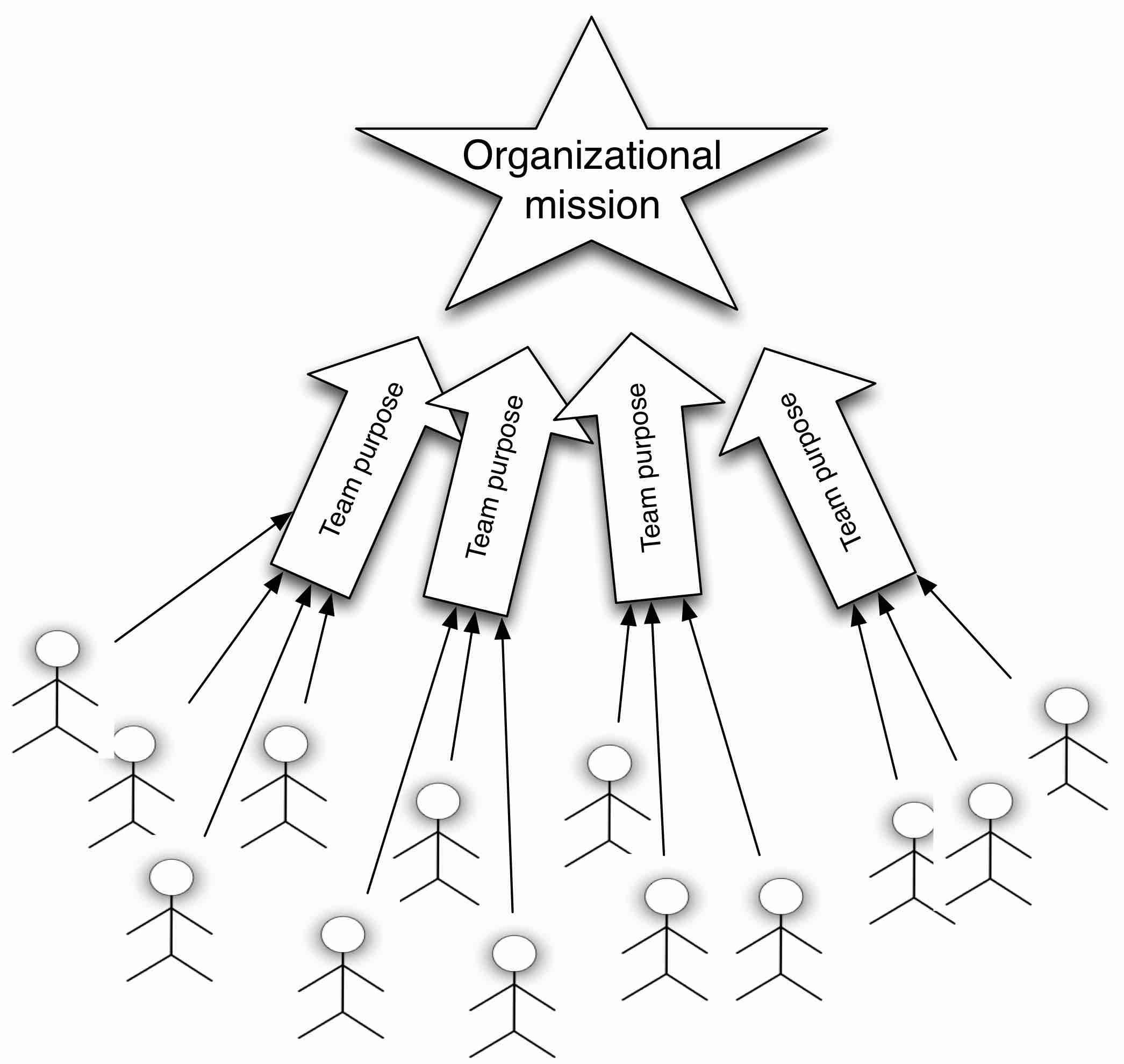
While grand organizational – even national – goals may be highly motivating, they can also be very remote. While an oxygen tank designer deep in the bowels of Grumman Aerospace might understand how their work builds towards putting a man on the moon, does an accountant deep in the bowels of Google understand how their analysis of expenses helps to organize the world’s information? Teams need to have their own higher purpose, and they need to understand how that builds towards the ultimate higher pursue of the organization.
Given that authority is devolved to the team, and that the team is expected to both decide what to do and execute it, then it is not possible to govern a team on the basis of “Have they delivered X?”, because the team decides what X is. Assessing effectiveness and progress is tricky.
Knowing both team and organizational higher purpose allows one to frame questions of effectiveness and progress in terms of the higher purpose, for example “Has this release contributed to the team’s purpose? To the organization’s purpose?”
Scale
Each team needs its own higher purpose.
This is especially true when a team needs to work with other teams in the organization. Since all teams ultimately share the organizational higher purpose, team-level aims should not be too dissimilar.
When an organization is small there may only be one team. The organization’s higher purpose is the team’s higher purpose. Life is easy. But with growth there will come a point at which teams need their individual sense of purpose. In the first instance it would seem rational to hand these teams a predetermined higher purpose. Indeed this might be necessary in order to establish a team in the first place.
Where a team is following the ‘amoeba model’ and splits into two teams, it is entirely possible that the two teams share a common purpose at least initially. Over time their higher purposes may diverge.
Mutable
Although a team may be given – or inherit – a higher purpose to start with, teams need ownership of that higher purpose. Therefore each team needs to have the authority to modify their higher purpose over time. As they are part of a larger organization, such changes need to be undertaken in harmony with the organization.
A team intending to modify its stated higher purpose would consult with others – its customers and other teams with which it works. The organization’s governance board is probably the ultimate arbiter of whether a proposed change of purpose can be made, although a team should probably avoid getting into a situation in which the board says “No”.
If team members start to doubt their higher purpose and are unable to question and ultimately change their purpose, then they may be compelled to leave the team.
This might even be desirable – if one individual finds they are no longer motivated by the higher purpose, it may well be a sign that they should move. This is perfectly natural – individuals grow and change throughout their lives, and what they want and what motivates them changes over time.
However, if multiple team members find the higher purpose no longer motivates them or seems irrational, it may well be sign that the purpose needs revising. Again it is natural that over time teams’ higher purposes will mutate and change – after all, the world around them is changing, technology is advancing, and sticking doggedly to a purpose that has become outdated is detrimental.
If team members are to truly believe in their higher purpose, they need to ‘own’ the purpose; if the team collectively owns the purpose, then it is allowed to change it. One of the privileges conferred by ownership is the right to change property. If ‘owners’ cannot change their purpose then they are not true owners.
Individuals
Each member of the organization should have a sense of mission. Inamori Kazuo8
Only when team members understand and share the team’s purpose does it make sense to talk about individual goals or objectives. Indeed one might even ask: if the team is the basic work unit, and if one is striving to create effective teams, then surely the team goals are individual goals?
I’ll leave that as an open question for discussion. However, if you decide that individual goals still have a role to play, it follows that individual objectives should not only be aligned with team and wider organizational goals, but should actually be derived from team and organizational goals.
Project completeness
In the project model completion of the project is the goal. However, such an objective leads to goal displacement and damages profitability in a digital world. Still, individuals and organizations need meaningful and achievable goals.
Quantifying goals can be a great aid to determining whether they are met. However, sometimes it might be better to avoid quantification: set an oblique goal, make the goal something to strive for, and thus avoid attempts to ‘game’ the target. The problem with quantifiable goals is that while they appear objective, the goals can be met by oblique means, which undermine the goals’ validity. This is highlighted by Goodhart’s Law9.
Closure
One of the advantages of the project model is that it allows individuals and organizations to achieve closure. Humans like closure: it provides a satisfying psychological safety. Something is done, complete, finished. That the continuous model deliberately avoids closure is itself something of a problem psychologically. However in the commercial world closure often creates problems.
‘This shop is closed.’
Shops that close on Sundays can be an inconvenience – one cannot satisfy one’s immediate needs.
‘This shop has now closed.’
Shops that close and cease trading can be an even bigger disappointment.
Business closure is normally a bad sign – businesses want to live and continue!
Unfortunately organizations sometimes meet their goals, their BHAGS (big hairy audacious goals), their objectives, or complete their missions. Upon achieving their goals, both Canon and Microsoft faced existential questions and suffered commercial turbulence for several years. NASA too struggled in the years after Neil Armstrong became Kennedy’s ‘man on the Moon’, and the final three Apollo missions were cancelled.
While one might sidestep such a problem by defining the higher purpose as something that is never complete, such an approach may be self-defeating if individuals feel that the aim is never achievable.
This is definitely one of those ‘nice to have’ problems. However it is one that should not be ignored indefinitely. The solution requires flexibility in the goal: once the goal is achieved, the organization needs to be capable of mutating it or adopting a new goal. The same should also be true of teams that achieve their higher purpose.
Finally
At an individual level a higher purpose helps to enroll and motivate team members. At an organizational level the teams’ higher purposes allow the organization to coordinate disparate teams and assess effectiveness.
The organization’s ultimate goals and objectives serve to coordinate teams and add to individuals’ own sense of purpose.
Oblique goals provide the team with latitude to innovate and allow problems to be reformulated as solutions emerge. Oblique goals better match the nature of technology work: creating the specific from the vague and interfacing the exact world of machines to the fuzzy world of people.