Plan Your Time Around What Really Matters – Master Your Day
In today’s fast-paced world, the ability to manage your time effectively is not just a skill—it’s a necessity. Without structure, it’s easy to lose focus and be overwhelmed by distractions, resulting in lower productivity and unnecessary stress. By learning to plan your time around what truly matters, you can take control of your day and accomplish more with less effort and less stress.
“The key is not to prioritize what’s on your schedule, but to schedule your priorities.”
— Stephen R. Covey
This chapter focuses on how to effectively organize your time to meet your priorities while maintaining flexibility in dealing with unexpected distractions.
Effectively managing your time is crucial for maximizing productivity and achieving a balanced life. Each of us experiences varying levels of effectiveness throughout the day, making it essential to schedule critical tasks during peak productivity hours. Have you considered what your peak productivity hours are, and how you can adjust your schedule to take advantage of them? If you know you are most alert in the morning, plan your most challenging tasks, like project work or strategic tasks for that time. Conversely, reserve less demanding tasks, such as responding to emails, for when your energy levels dip.
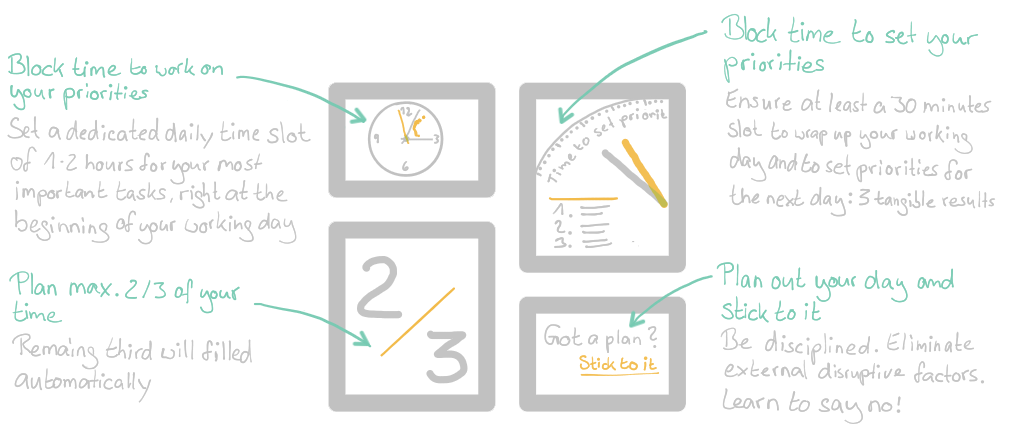
The challenge often lies not in setting up a well-structured agenda but in maintaining the discipline to adhere to it amidst numerous distractions. Many people find that they are unable to follow their plans not because they lack the ability to create an agenda, but because they struggle to stick to it in the face of external interruptions. To set yourself up for success, it’s crucial to declutter your agenda and focus on the most essential tasks, which can significantly improve your productivity.
Establish a Flexible Framework
Creating a flexible framework that encompasses work, family, and personal time is vital. This framework shouldn’t rigidly dictate every minute of your day; instead, it should allow for spontaneity and adaptability. How can you incorporate more flexibility into your daily schedule to accommodate unexpected events? For example, set specific work start and end times to promote a healthier work-life balance—perhaps starting at 8 AM and finishing at 6 PM. Incorporate slots for daily exercise, hobbies, and family time, as these activities are essential for both physical and mental well-being. If your family enjoys evening activities, ensure you have time blocked off for those engagements - it is not about work-life-balance only anymore, it it about work-life-integration as well.
Avoid Overloading Your Agenda
To prevent overwhelming your schedule, limit planned activities to two-thirds of your available time and leave the remaining third free for unforeseen tasks or meeting requests. This principle acknowledges that unexpected tasks will come up, and leaving room in your agenda allows you to handle these without derailing your entire day. What activities can you prioritize to ensure your schedule remains manageable and leaves room for unexpected tasks? For instance, if your workday spans 8 hours, plan for 5 to 6 hours of activities, leaving a couple of hours open for any surprises, such as urgent meetings or tasks that pop up unexpectedly.
When your calendar is already thoughtfully organized with meetings, focused work time for tackling tasks, and personal blocks, it’s essential to resist the urge to completely overhaul your schedule in response to ad-hoc requests. Instead, take a moment to evaluate whether the incoming task or meeting request is truly urgent and important (and/or takes your contribution/ participation). It’s crucial to have the courage to say no when necessary and suggest an alternative time that might be more suitable for both parties. A study by Whillans et al. (2021) published in Harvard Business Review highlights the psychological factors behind meeting overload, such as FOMO and pluralistic ignorance. Despite the widespread recognition that many meetings are unproductive, companies continue to rely heavily on them. Psychological phenomena like FOMO (Fear of Missing Out), egocentrism, and pluralistic ignorance drive this behavior. Implementing strategies such as modeling healthy behaviors, recognizing opportunity costs, and reducing unnecessary meetings can help establish more productive work practices.
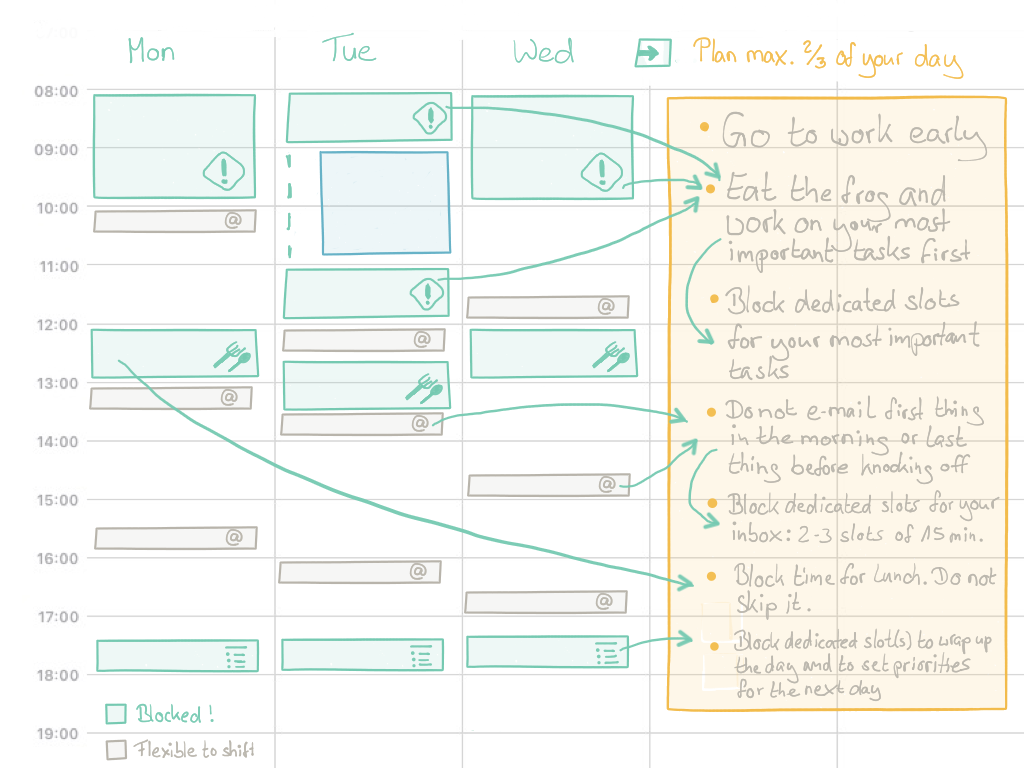
This approach promotes a more balanced workflow, allowing you to weigh the significance of new requests against your existing commitments. Remember, it’s about making a choice between options rather than simply adding more on top of what you’ve already planned. Prioritizing effectively can lead to improved productivity and a more manageable schedule.
Prioritize Important Tasks
One of the most effective strategies is to begin your day with high-priority tasks rather than easy, unimportant ones. If you have a major project deadline approaching, allocate the first couple of hours of your day to focus solely on that task. This focus on critical assignments maximizes productivity and creates a sense of accomplishment that carries through the rest of your day. Starting your day early can provide an opportunity to work in a distraction-free environment. Arriving at the office by 7:30 AM allows you to tackle important tasks before your colleagues arrive and before emails begin to pile up. This proactive approach enables you to handle your most critical tasks before the day gets busy, ensuring you make meaningful progress right from the start. We tend to procrastinate on tedious tasks or those that make us uncomfortable. This avoidance can lead to two significant consequences. First, we carry the weight of these tasks—along with their associated negativity—subconsciously, which can create an underlying stress that lingers in the background. Eventually, we must confront these responsibilities, often under pressure as deadlines approach, resulting in a more frantic and stressful experience. The key to managing this situation lies in the principles of the Eisenhower Matrix. This approach emphasizes the importance of preventing important tasks from becoming urgent. By adopting the mantra “Eat the frog,” we remind ourselves to tackle the most daunting or unpleasant tasks first. This not only alleviates the mental burden but also allows us to approach our day with a clearer, more focused mindset, ultimately enhancing our productivity and well-being. By prioritizing our tasks effectively and addressing the ones we’ve been avoiding, we can reduce stress and maintain a healthier work-life balance. Embracing this mindset can lead to a more productive and fulfilling experience in both our personal and professional lives.
Incorporate Regular Breaks
It’s vital to schedule regular breaks into your day, particularly for lunchtime. Block this time off in your agenda to recharge. Consider using your lunch break as an opportunity to socialize or network. If the weather permits, you might take a short walk while enjoying your meal, combining physical activity with a refreshing change of scenery. This practice helps to manage stress and revitalizes your mind for the tasks ahead. Breaks are crucial for our well-being and productivity. It’s helpful to set reminders to take regular breaks, even if they are just 10 minutes long. These short interruptions allow you to get fresh air and clear your mind. A brief walk after lunch can work wonders to refresh your thoughts and boost circulation. A systematic review by Lyubykh et al. (2022) shows that regular breaks during the day improve mental health, experience less burnout and productivity. Additionally, micro-breaks—such as stretching or filling a water bottle—have significant positive effects on employee engagement and work quality.
It’s important to view breaks not as a waste of time, but as a necessary investment in your performance. By intentionally taking time for recovery, you create a healthier and more productive work environment. So remember: every break helps!
Set Daily Goals
At the end of each workday, allocate time to set priorities for the next day and update your agenda. Aim for at least a 30-minute slot to wrap up your day, sort your to-do list, and identify key tasks for the following day. For example, jot down the three most important tasks you want to accomplish first thing in the morning. Keeping these daily goals realistic and achievable is essential for maintaining momentum and motivation. Similar to journaling, engaging in a “brain dump” at the end of your workday can be an effective technique for clearing your mind and wrapping up the day. This practice involves writing down all your thoughts, tasks, and ideas that are cluttering your mind, which can help alleviate stress and enhance focus. By taking a few moments to jot down everything that’s on your mind, you can create a sense of closure for the day. This not only aids in transitioning from work mode to personal time but also ensures that important tasks are not forgotten. Research indicates that externalizing your thoughts can lead to improved mental clarity and reduced anxiety, allowing you to start the next day with a fresh perspective. According to Verywell Mind (2022), Family Medicine and Community Health journaling significantly benefits mental health by reducing anxiety and depression symptoms.
Additionally, the Reflection App Blog (2022) highlights that journaling supports emotional regulation and mental clarity: Participants who engaged in reflective writing reported decreased anxiety and enhanced emotional resilience.
Implementing a brain dump routine at the end of your workday can significantly contribute to better organization and productivity. As you prepare to leave the office, consider dedicating a few minutes to this practice to enhance your overall well-being and effectiveness in your work.
Take Control of Your Calendar
Finally, take control of your calendar by proactively scheduling work blocks to prevent them from being filled with meetings. This practice provides greater control over your time and helps you manage your priorities effectively. When you actively set work blocks—such as dedicated times for deep work—you create an environment that allows you to focus without interruption. By being intentional about your scheduling, you gain the freedom to prioritize what truly matters. Taking control of your calendar is essential for maximizing productivity and ensuring a balanced life. One effective strategy I’ve implemented is blocking out 1.5 hours each day for “focus time,” tailored to my bio-rhythm and external factors (e.g., when I am in the home office, I schedule “focus time” in the morning, when the kids are at school). Understanding when you are most productive can significantly enhance your work efficiency. Additionally, I make it a point to block my children’s handball training in my calendar. This ensures that I have a dedicated time slot reserved for these important family commitments, should I need to drive them to practice. Even though I can always free up this block later, it gives me peace of mind knowing I’ve accounted for this responsibility. In practice, it turns out that I usually don’t need the time blocks in 90% of the cases, so I ‘release’ them. By proactively scheduling focus time and personal commitments, you create a structured approach that allows for both productivity and flexibility. This method not only helps manage your responsibilities but also promotes a healthier work-life integration, ensuring you stay on top of your tasks without sacrificing personal obligations - finding a balance.
By adopting this structured yet flexible approach to your time management, you can harmoniously integrate various aspects of your life, enhancing both your productivity and personal satisfaction.
Step-by-Step Guide to Structuring Your Day
1. Identify Your Priorities
Determine what truly matters in your life and work. This could be career goals, personal development, or family time. Knowing your priorities will help guide your decisions.
2. Set Specific Goals
Once you’ve identified your priorities, set specific, measurable goals for each one. This clarity will provide direction and motivate you to take action. By doing so, apply SMART methodology: Specific, Measurable, Achievable, Relevant, Time-bound.
3. Create Time Blocks
Schedule blocks of time dedicated to specific tasks or categories of work. This focused approach helps minimize distractions and improve efficiency.
4. Review and Reflect at the End of the Day
At the end of each day, take 15-30 minutes to review your accomplishments and plan for the next day. This reflection will help you stay on track and ensure that you’re making progress on your most important tasks.
My Advice
It’s crucial to set an agenda that allows flexibility and focuses on meeting your priorities. By organizing your time around your key tasks while being prepared for unexpected distractions, you can work more effectively and achieve your goals.
- Be realistic. Plan no more than two-thirds of your time and leave the remaining third free for unforeseen tasks.
- Be ahead. Proactive scheduling and blocking of work times lead to increased relaxation and productivity.
- Be unavailable. Fewer meetings and targeted planning enhance work quality and efficiency. Let’s try one meeting-free day per week (as a north star).
- Become an early bird. Start your day early to organize it in an undisturbed environment and tackle important tasks before distractions arise.
- Be disciplined. Avoid checking emails immediately in the morning or treating them as the last task before leaving.
- Be adaptable. Embrace a flexible approach to planning that accommodates changes and unexpected events.
- Be focused. Start the day with your most important tasks instead of prioritizing easy (unimportant) tasks.
- Be selfish. Take breaks. Do not skip lunch. Block lunchtime in your agenda. Place your mid-level tasks right after lunch.
- Be prepared. Ensure at least a 30-minute slot a day to wrap up your working day and to set priorities for the next day.
- Be mindful of your energy levels. Recognize when you are most productive and schedule your most challenging tasks accordingly.
Reflection Questions
- What are the biggest challenges you face when it comes to sticking to your agenda or schedule?
- Reflect on a time when you successfully managed your time and priorities effectively. What strategies did you use, and how can you apply them in your current situation?
- Consider your current approach to scheduling meetings and blocking work times. Are there any changes you could make to regain more control over your calendar and work schedule?
- What external distractions could jeopardize your agenda, and how can you minimize them?
- What strategies can you implement to remain flexible in your scheduling?
- How do you handle unexpected changes in your plans, and how can you improve this process?
- How do you currently prioritize your tasks, and how effective is your method?
- How do external factors, such as colleagues scheduling meetings, impact your ability to focus on your priorities?
- How can you adjust your routine to accomplish your most important tasks more effectively?