4. Trainer instructions
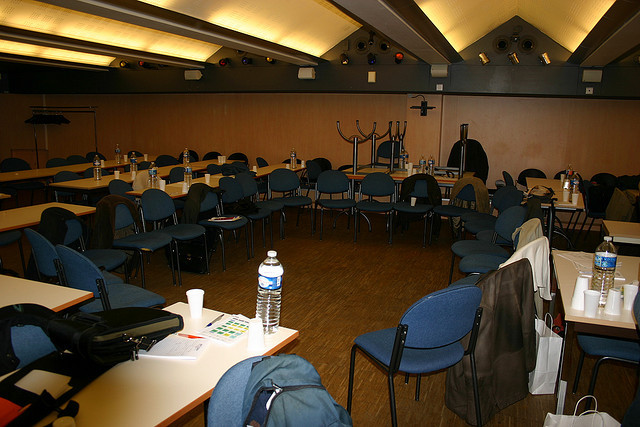
As for any workshop or training, try to be in the room 15 to 20 minutes before the game starts. Especially if it is your first time playing the game or working in this room.
The ideal layout for this game, is to have a large room with place for two circles of 20 chairs and one big playing table. You create the first circle with 20 chairs + chairs for both trainers. (We strongly advice you coach this game with two trainers.) This is the circle where you start the game, explain everything and hold the feedback round.
Next to that circle, you have a second circle that the players will use to have their meetings. Although you can work with only one circle, we noticed that making this separation makes it easier for the players.
You also need a playing table. Put the boxes with lego on the table. Leave the boxes closed. Some participants might know what is inside, others don’t. That is ok.
Have piles of the observation, feedback and feedback questions documents ready. Don’t distribute them yet.
- Put a timer clock in front of you.
- Have a printed copy of this document for each trainer.
We have put the default time on the different parts. Use these timings as a guideline. When you notice that you are not following the timings, make sure you adjust on the paper how much time you use for each section; It will give you insight on where to adjust the game. (We use it like a non graphical burndown) When we know when the game will be played, we write down the exact times on the printed documents. When we facilitate, we don’t want to use our brain, to convert 1:25 to 9:25. When the real hours are written on the document beforehand, we can use our brain to react to the participants.
Little things in the preparation that make our life easier while playing:
- When you play the game, and you check the time, and you notice you are on track, you put a yellow index card in front of both of you
- if you are behind schedule, you put a red card in front of you
- if you are ahead of the schedule, you use the green index card.
This is a visual management, that enhances the communication between the two trainers without the need to talk. (Although during this game you have plenty of time to talk to each other.)
While people come in, ask them to write their name on a name badge and put the name tag on their body. (we prefer sticker badges as they stay visible and easy to read.) As people walk around a lot and play closely to a table with lego, you might even want to ask them to acc a sticker to their back.
Tips for first time presentors:
3 hours is a lot; You might be tempted to trim the game. Especially on the feedback round. Don’t. The feedback round is the most important part of the game.
If you don’t have 3 hours, play another game (or contact us, see the contact page to know how.)
It’s really important in the second game to give 25 minutes in total to the players. A lot of times the group does not respect the 10 minute advice for the meeting. (That is fine.)
They might be ready after 20 minutes. Don’t stop the game, see what happens. Sometimes groups keep building. We have seen groups that keep building, while they still have time (gold plating). We also have witnessed groups that had their church collapsed a few seconds before the time was up. That is very important to bring this up at the closing round. This is why we only stop when there is a real group decisions on stopping (and not one or two people proposing to stop and no one listening or agreeing.)
Not only the “leaders” learn a lot but also the other players learned a lot about “their preferred way of being led” and how they look at a leader. Many participants also told us they learned a lot from being an observer. That is the moment to ask them when they observe in their team; if they don’t encourage them to do so.
This game can be particularly useful if everyone works at the same company. It might be used to make real situation visible and still offer a safe environment to talk about things. (It’s safer to talk about the game then it is to talk about the real situation.) If you use the game with this intention, be sure you have the skills to deal with this.
Foresee enough time to debrief and follow up with the team; If you don’t have this luxuary, let the situation closed. Opening up a situation that the team is not aware without having the time or skills to deal with the stituation is at least unproductive and at worst dangerous.
Decide who is trainer 1 and trainer 2. Add names to the different parts that need to be explained. (Be sure you both are prepared to explain everything, so that you can, when something unforeseen happens.)
Pictures from previous games
Don’t offer the pictures to the players; It will limit their imagination. We noticed that players that have pictures of the game usually have less nice results than people without.