11. PairCoaching
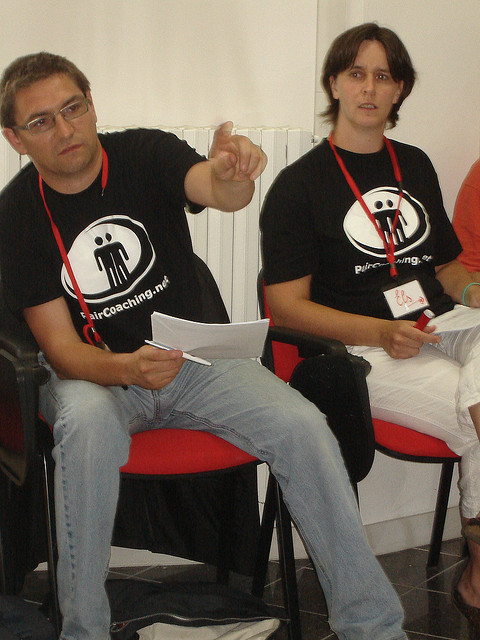
Leading a team with two people, that is what we (Ignace and Yves Hanoulle) do for a while, and what we find normal. And then we realize that this is not the common view: a leader “should” be alone. In another part of our society, parents (who are also leaders) “should” raise their children together. Strange: in one area, that of professional leadership in any kind of company, it looks obvious that a leader does it on his own. In the other area, people regularly ask, is it possible to raise children on your own. The habit that in the past there always was a mother and father, made the question appear when divorces became more frequent. The question usually was mixed with, “don’t you need a man and a women to raise kids”, but she existed on its own: is one person enough for this difficult leadership task. And we hear a lot of single parents, say it is a hard task. So we ask is leading in other area’s not mostly a too heavy task for one person? Don’t we ask too much of inner strength from a leader in these situations?
Two different area’s (the relation between leader and employee at one side, and the relation between parents and children at the other side) two totally different “ideal” solutions that are pushed. By this time, it is already proven enough that it is possible (although tough and no ideal solution) to raise children alone. On the other side, that of the leadership function in enterprises, there is little or no experience with “pair coaching”, the leadership of two leaders with both the same competence. Although there are quite some situations where pair coaching is designated.
What are the advantages of pair coaching?
The parenting model can serve as to look for some of the advantages.
- Single parents complain e.g. that it is hard to punish and caress. If there are two parents, they can take on both contradictory tasks, preferable with switching positions. If we go more general than punishing and caressing, then we see total contradictory areas where parents have to lead. One area is that of offering security, listening, hugging (literally or by words), the understanding for the weak edges and the feelings of the child. The other area is fostering greater performance, pointing out its duties, pointing the child to his little lace and prompting to improve his lower edges. Take up both areas with two is for sure easier then alone.
Leadership in enterprises has for sure as much to do with both these areas. The first area we could call motivate, reward, listening, show understanding for the feelings of the employee. The second area is more demanding that agreements are met, rebuking. Seldom we see a leader that takes on both task areas and combines them willowy. Just as with parenting we also see a pitfall for paircoaches: the two leaders have to watch that they switch enough and make sure hat one of them not always takes on one area and the other the other. But even if that is the case, that still is better than when one of these areas is not been handled as now is the case with a lot of leaders. - Another difficulty of single parents and singe leaders is the loneliness of the leader. You see it happening all too often, single parents that ask their children too much support, want to become the friend of their children. Or single leaders that are becoming familiar with one or more subordinates, tell them things they should conceal, etc. Parents who are parenting with two, just as pair coaches have this problem less. They can talk to each other. And they can warn each other when one of them does.
- Two different parents that raise children together, start from a different style. That difference gives discussion,which can be both difficult and can be very fertilizing. It is also one of the best remedies against rigidity: the other partner with his style stays a constant challenge. With pair coaching you see the same thing happening, the differences make that the partner coach comes with solutions that are out of sight of the other.
- Talking with the co-parent about the kids education is what single parents miss the most. By talking to the other, who stays interested listening, everything becomes clearer, feelings get a place and the solution is clear. The same happens with paircoaches.
Some work situations look a lot like the education situation, some are totally different. This means that some of the earlier mentioned benefits value less or not at all, in a lot of cases they actually value more. The fact that a leader lead much bigger groups than an average family, makes the advantages of pair coaching stronger. Another point in the advantage of pair coaching is that a lonely leader has to manifest himself, most of the time both to his subordinates as to his superiors. That pressure asks for more inner strength. (Single parents don’t have this problem, if they do -as in fight divorces where the parenting is questioned, they often make large mistakes until the pressure is removed) and that pressure is the cause of lots of mistakes, until the leader “no longer has to prove himself”.
With two supporting this pressure is a lot easier.
In work situations you have the extra advantage (just as with pair programming) that two people see more than one. While one leader talks in a meeting, the other can watch the reactions of the people. And see when it is no longer aligned. The co-leader also notices when the talking leader becomes nervous, does not explain something correctly, is unclear or does not respond to a question, etc.
What are the disadvantages of Paircoaching?
- You have two leaders, so you have to pay 2 people (you have to compare value vs costs to see if it is more expensive. This brings the question, would you prefer to raise kids on your own, just for costs reasons?)
- When pair coaches don’t have enough leading tasks, they might work with the team, but then they risk to dilute their position as leader.
- An advantage from paircoaching is sometime seen as a disadvantage: shared responsibility. It is an advantage to have less pressure, the outside world, prefers one wringable neck.
- Both leaders have to be able to work together, what some leaders can’t. In that way it is as with pair programming; some people can’t adapt to certain structures, if they are important to the organization we adapt the structures to them. (In our opinion, this also weakens the company and gives these people too much (unhealthy) power.)
- There is no culture of pair coaching. The resistance for this is significantly higher then for pairprogramming. (which is already big) Our professional world has already mixed feelings about leadership. One way we are not paying much attention to it (except from the management aspects of it.), on the other side we are paying leaders a gigantic piles of money to our leaders. Where leadership in the economy and in our culture has a place, its image is that of a authoritarian, male and lone hero who remains a rock in the turbulent sea. Pair coaching, that points more to the image of the deep human, fair and sometime sever parents who dare to admit they need each other, is not consistent with the archetype of the tough hero.
Examples of pairing in other jobs
- Pilots
- policemen
- ceo + president of the board
- Scrummaster and product owner