Appendix
Fast Pass
 |
 |
 |
||
|---|---|---|---|---|
| 10 - 15 | 6 - 20 | Movement | ||
| minutes | people | Trust |
What you can learn
An activity to connect participants to each other through content related to the session. This is a great technique to use at the start of a session, so people who arrive early have something to do.
What you need
Flipchart pages stuck up on a wall, with questions. Have a minimum of three (for six participants) and a maximum of five (for 20 participants).
Some questions might be:
- What are your pets’ names?
- What do you know about <topic of="" session="">?</topic>
- Why are you here today?
- What is your biggest strength?
- What is your company’s greatest challenge?
Instruction flipchart:”After reading this, introduce yourself to a stranger and fill in the flipchart questions around the room with them.”
Marker for each participant.
How to do this
At the start of a session stick up the prepared flipcharts around the room and place the instruction flipchart near the front of the room.
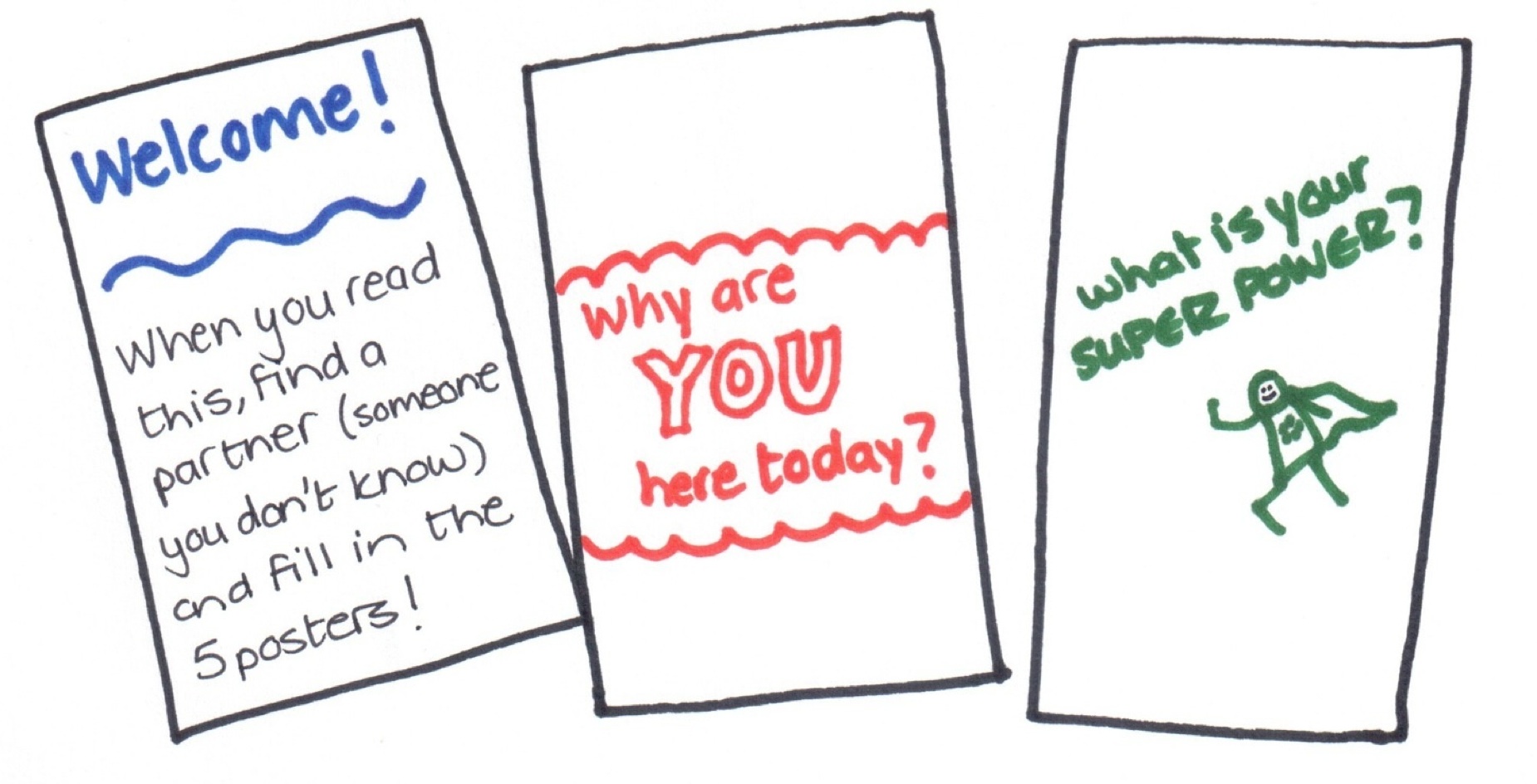
Encourage people to read the instructions if they don’t notice them, and let them know they can start whenever they like.
How we’ve used this
We often use this at the start of training courses, or large group meetings, especially if people don’t know each other. It is a great way to get strangers talking at the start of the day.
Who shared this with us
Standing Survey
|
|
|
||
|---|---|---|---|---|
| 5 - 10 | any number | Visualisation | ||
| minutes | people | Movement |
What you can learn
This is a great technique to introduce movement into a session as well as visualising information.
What you need
Decide what questions you will ask, and how you will ask people to arrange themselves in the room.
Having some open space in a room without tables and chairs is useful.
How to do this
Ask people to stand. Explain that you want them to organise themselves in the room according to some criteria (e.g. amount of Scrum experience).
Explain how to organise themselves (e.g. a single line, with no experience near the door, and most experience near the other side of the room).
Allow time for people to move around the room.
Remind people to speak to others to see where they should stand relative to each other.
Ask people to notice where other people are relative to them.
How we’ve used this
Some ideas for criteria to organise by:
- how easy you think something will be to implement (easy: one side of the room, impossible: the other )
- how well you know people in the room (close to those you know, far from those you don’t)
- people’s roles within an organisation (a quadrant with a different role in each corner of the room)
- where people are from (in the centre: close by, edges of the room: far away).
Who shared this with us
Agreements
|
|
|
||
|---|---|---|---|---|
| 5 | any number | Communication | ||
| minutes | people |
What you can learn
This sets a tone and expectations near the start of a session. It helps the attendees know what the boundaries of the session are, and what behaviours are acceptable.
What you need
It is best to have each agreement on a card and to go through them near the start of the session.
How to do this
Decide which agreements are appropriate for your audience and meeting. Explain them clearly and simply near the start of the session.
You can also ask participants if there are any agreements they would like to add.
How we’ve used this
We change these depending on the session we’re running. Over time you will learn more techniques and so this list will keep evolving.
Here are some of the cards we have:
- Take Care: Take care of your own needs. You don’t need to ask permission to go to the bathroom, or get coffee.
- Cellphones: Keep your phones on silent please. If you need to take a call, just leave the room. We’d rather you were paying attention than worrying because your boss/wife/child is calling.
- Right to Pass: You have the right to pass in any activity or exercise we do. Just sit to the side and observe.
- Workbooks: These are yours to keep. Please take notes. We will let you know when we are doing specific exercises in the books.
- Timeboxing: We give a specific end time for each break. We will start at that time whether you are back or not. It’s up to you to choose to be on time or not.
Who shared this with us
Various people over the years, many from Sharon Bowman. We came up with the concept of using cards to remember all of the things we wanted to say.
Growing Agile Online Courses
Agile Management - The art of servant leadership

Great leaders aren’t born, they’re grown. They cultivate their own skills over time. Become a great leader with this course!
The best leaders magnify their team’s productivity. They inspire their teams to always be better, always be learning, and always solve issues before they become problems. They cultivate collaboration, not competitiveness. They help everyone combine their diverse talents and skills into innovative solutions and better products.
At the end of this course you will:
- Be a better leader
- Facilitate more effective, shorter meetings
- Give actionable feedback
- Build trust and respect within your team
- Recognise your own strengths and weaknesses, and improve on them
This course covers several topics. We recommend focusing on one topic per week. Each topic has a video and exercises to help drive the lessons home, as well as resources to explore further. Finally, for each topic, we give you a practical technique to implement in your business.
Coursework takes approximately 3 hours per week, for 8 weeks.
We give you our personal guarantee that this course will take you to the next level as a leader. If not, you have 30 days to get a full refund, no questions asked, from Udemy.
The course is available online on Udemy.
Growing Agile Books
The Growing Agile Coach’s Guide Series
This series provides a collection of training and workshop plans for a variety of agile topics. The series is aimed at agile coaches, trainers and ScrumMasters who often find themselves needing to help teams understand agile concepts. Each book in the series provides the plans, slides, workbooks and activity instructions to run a number of workshops on each topic. The interactive workshops are all created using techniques from Training from the Back of the Room, to ensure participants are engaged and remember their learnings after the workshop.
The series is available in a bundle on Leanpub, else you can purchase the books individually.
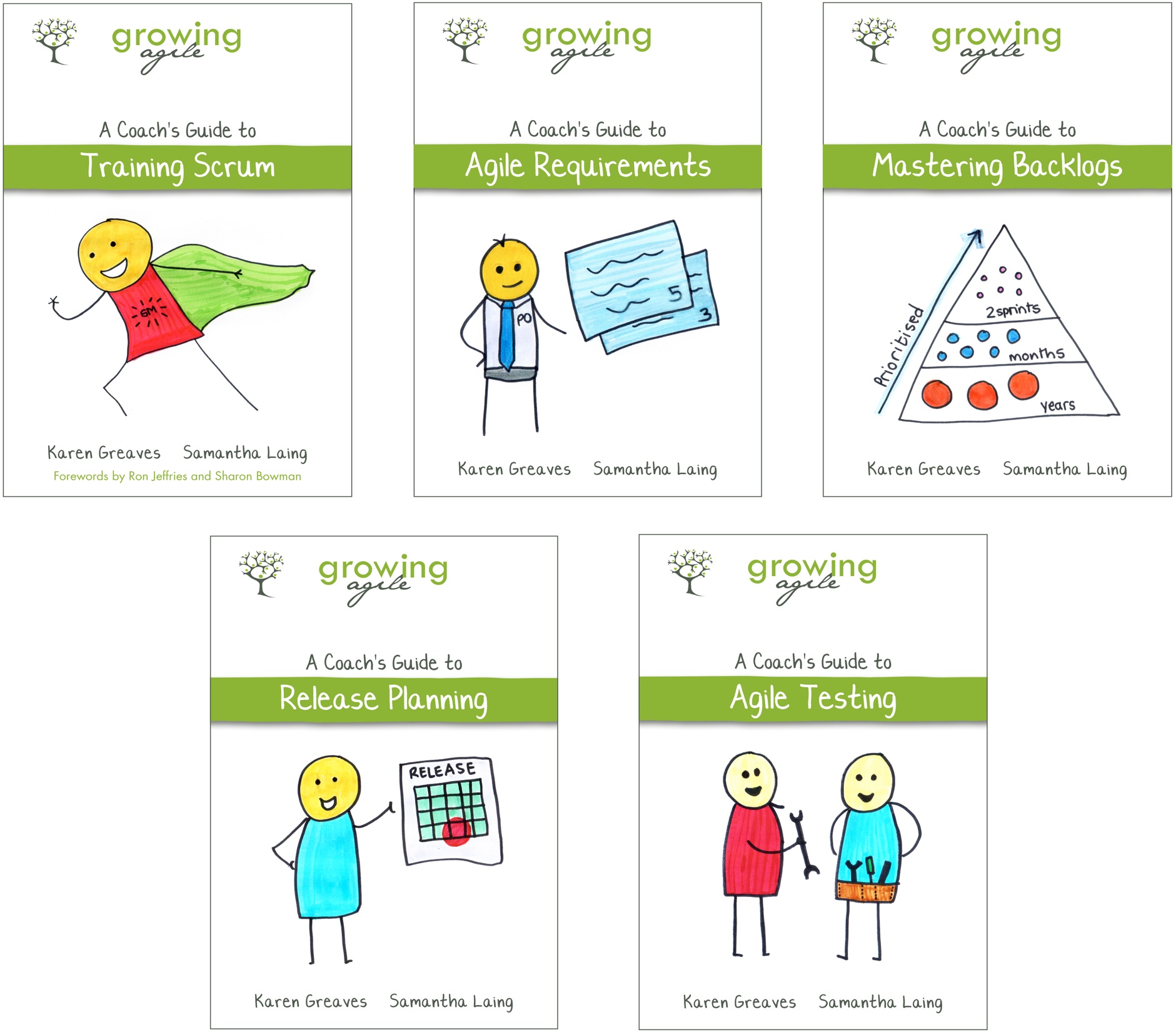
Growing Agile: A Coach’s Guide to Training Scrum
Part of the ScrumMaster role is to ensure that everyone on their team is educated about Scrum and to evangelise Scrum to their organisation. Over the past few years we have come across many ScrumMasters who have great intentions of running training but then get bogged down in the planning and preparation and don’t ever get round to actually doing it.
We have been training teams in Scrum for about three years. Over the past year we have trained Certified ScrumMaster classes worldwide. During this time we have spent many hours preparing training plans and creating workbooks, flipcharts and slides. Our materials have been continually refined from feedback after each course. All our training uses Training from the Back of the Room principles.
This book will help you plan and deliver interactive, fun Scrum training for anything from a short workshop on a particular topic to a full two-day course.
Growing Agile: A Coach’s Guide to Training Scrum is available on Leanpub
Growing Agile: A Coach’s Guide to Agile Requirements
Have you ever looked at a requirement document thats 50 plus pages long and wondered if there was an easier way to communicate? Or have you ever received a 1 liner story without any context and thought ‘huh?’.
We have and in our years of work in traditional waterfall organisations and newer agile organisations the trend continues. Very seldom is the sweet spot in the middle achieved. In every single case the path to the sweet spot started with conversations.
Over the last 3 years we have developed a number of workshops to help people start these conversation. The workshops are aimed at different stakeholders raging from business, to Product Owners and teams. This book is a collection of some of those workshop and can be used to help improve the way you think about and communicate agile requirements.
Although we talk about Product Owners, this book isn’t just for Scrum teams. You can apply most of the lessons in here to any project you are on. We have used these techniques and ideas for renovating houses, redesigning websites and even writing this book!
Growing Agile: A Coach’s Guide to Agile Requirements is available on Leanpub
Growing Agile: A Coach’s Guide to Mastering Backlogs
Scrum is great for getting teams to deliver good quality software regularly, but that doesn’t really help if you are building the wrong thing! The Product Backlog is a key artefact to helping steer the team in the right direction. Yet sometimes the Product Backlog is just a long list of tickets logged by the business. Often Product Owners can’t see the forest for the trees and there are so many items in their backlog the team have no idea what direction the product is actually headed. Even if you know what your backlog should look like, finding the time to get it in order seems impossible.
If this sounds familiar, this book is for you. We have worked with a number of business analysts and Product Owners who feel the same way. We found that sending Product Owners on 2 day theoretical training courses is not the answer. Instead we run short workshops where we work with the Product Owner’s actual backlog. The workshop is a working session, and an hour later the Product Owners emerge with an improved backlog.
We have combined a number of these workshops into this book. We provide all our workshop plans, tips for facilitation, and teaching points to cover for each topic. Use these workshops to help the Product Owners you work with to master their backlogs.
Growing Agile: A Coach’s Guide to Mastering Backlogs is available on Leanpub
Growing Agile: A Coach’s Guide to Release Planning
We often hear people say “We’re agile, we don’t need a plan”! or even worse “We can’t plan”. This is just not true. Release Planning in agile is as important as it is in traditional projects, the only difference is there are a few techniques that help make sure the plans bear some relation to reality. We’ve all worked on projects where you know from day 1 you will be late, and yet no one does anything about it. Agile planning is different. We give up the illusion of control of traditional rigid plans, and replace it with a clear view of where we actually are, even if it’s badly behind schedule, so that together we can make decisions based on what is actually possible.
We have run Release Planning workshops with many organisations. Sometimes starting with C-level executives to set the direction and vision for a product suite, other times starting with teams and making sense of what they are currently working on. This book is a collection of our workshops that will help you run similar workshops to create agile release plans. We include teaching points on a range of techniques like Story Mapping and release burnups to help you explain to other’s how to use these methods effectively.
Growing Agile: A Coach’s Guide to Release Planning is available on Leanpub
Growing Agile: A Coach’s Guide to Agile Testing
If a team believes they are agile, but nothing has changed about the way they test, then there is still much to learn. We teach 5 key principles that explain why agile testing is fundamentally different to traditional testing.
This books includes a collection of workshops to help teams grasp these principles and adopt an agile testing mindset. It’s not just for testers. A key part of agile testing is that the whole team is involved, so we always run these workshops with everyone in the team.
If your team is ready for the next level we highly recommend running through the workshops in this book, it will teach them a number of simple but valuable techniques to help prevent bugs and dramatically increase the quality of your products. We provide everything you need to run the workshops, from facilitation plans, to teaching points, and even the slides you might use.
Growing Agile: A Coach’s Guide to Agile Testing is available on Leanpub
Other books by Growing Agile
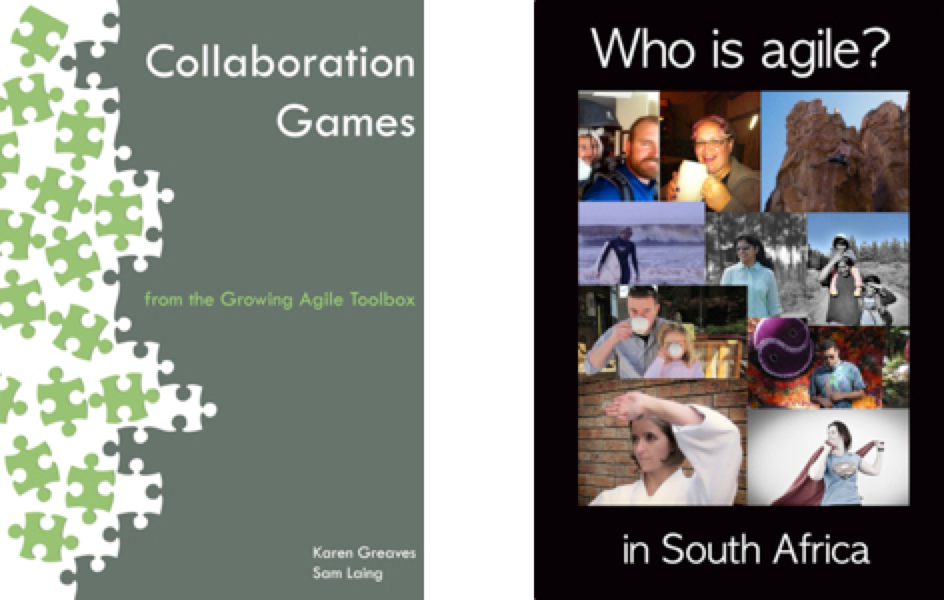
Collaboration Games
Over the years we have played various games with individuals and teams to illustrate the value of collaboration. The games are fun and non-threatening and allow for great learning experiences. Many people have AHA moments when playing games.
You know how you learn how to ride a bike as a kid, and then years later, you are able to hop on and cycle? That’s muscle memory. Your muscles remember what they are supposed to do and how they need to work together to keep you on the bike and keep the bike going. We like to think of the games as emotional memory. During the game each person experiences certain emotions that they remember. One day a situation will arise and those emotions will emerge, they will recall the game and their emotions, and be able to apply the lessons they learned during the game.
Collaboration Games is available for free on Leanpub in English, Spanish and Russian
Who is Agile in South Africa
This book is based on the original Who Is Agile book, only this is a regional version for South Africa. It’s a collection of interviews with passionate South African agilists.
Who is Agile in South Africa is available on Leanpub
About Growing Agile
At Growing Agile we help companies create great teams that build exceptional software. We are agile coaches passionate about helping you get the results you are looking for.
Here are examples of how we’ve helped our clients:
We have helped teams combine Kanban and Scrum effectively to manage both production support and new feature development in a sustainable and predictable way.
Our agile kickstart has helped software companies adopt Scrum and transform their teams. They are now more focused, enthusiastic, and delivering quality software regularly.
We have coached ScrumMasters to better understand their role. Their teams are now more effective, through better facilitation, visibility of impediments, and team ownership.
We have coached Product Owners to effectively manage their backlogs to incorporate stakeholder needs, technical debt, and realistic release dates.
If you enjoyed the training plans in this book, you will love our interactive training and coaching. We deliver private courses throughout South Africa for companies looking to train whole teams. We coach teams getting started with Scrum, as well as those who’ve been doing it for years looking to get to the next level.
Find out more about us at www.growingagile.co.za.