Leanpub Book LAUNCH 🚀 Cracking the System Design Interview for Data Engineers by Alexey Banaev
Data platform interviews test a different game: CDC and exactly-once semantics, Star vs. Data Vault, Kafka vs. Event Hub, watermarks, backfills, and the trade-off you must defend two levels of “why?” deep.

[VIDEO_LINK]
Welcome to the Leanpub Launch video for Cracking the System Design Interview for Data Engineers by Alexey Banaev!
 Leanpub
About the Book
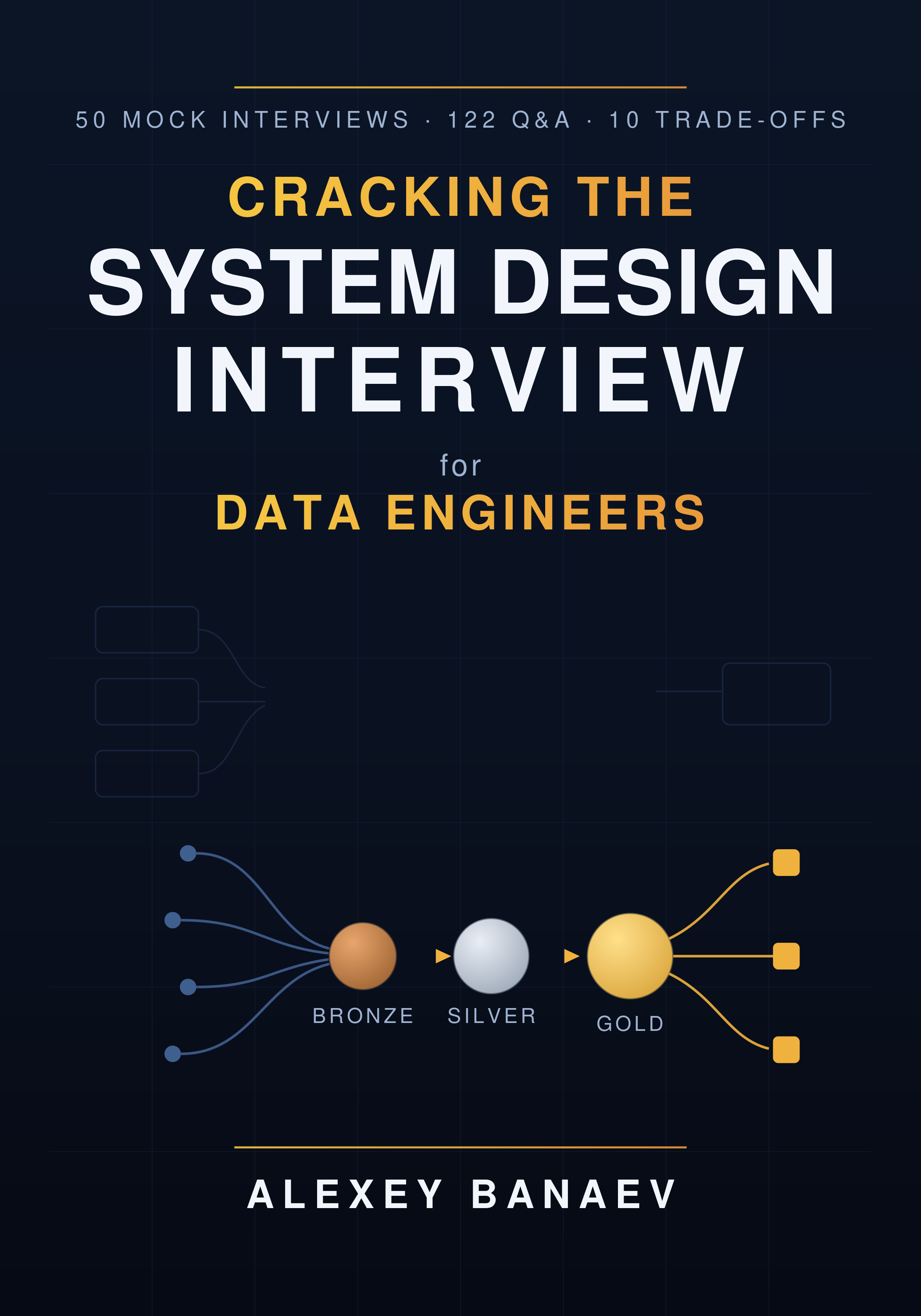
Every senior data engineer interview eventually arrives at the same terrifying sentence: “Design a data platform for us.”
No whiteboard trick, no LeetCode grind, and no generic system-design book — built for backend engineers designing URL shorteners — will save you.
Data platform interviews test a different game: CDC and exactly-once semantics, Star vs. Data Vault, Kafka vs. Event Hub, watermarks, backfills, and the trade-off you must defend two levels of “why?” deep.
Cracking the System Design Interview for Data Engineers is the book that game deserves.
Inside: a universal response framework you can run on any prompt in under a minute; deep, interview-shaped dives into every system class you’ll be asked to design — lakehouses, CDC platforms, streaming and batch pipelines, warehouse modeling, incremental loading, security, cost, performance, disaster recovery, governance, and the Azure/Fabric/Databricks ecosystem; the nine hardest company-style prompts (Netflix, Uber, fraud detection, banking, healthcare, and more); a canonical registry of the ten trade-offs interviewers ask about most; 122 rapid-fire follow-up questions with model answers; and 50 full mock interviews — complete with follow-up chains, constraint curveballs, and four dissected failure transcripts that show you exactly what losing the room looks like.
But treat the interview framing as the entry point, not the ceiling. Every chapter is built the same way a real architecture decision is made — the requirements that actually matter, the two or three options a senior engineer would seriously weigh, the trade-offs behind each one, and the conditions under which the “right” answer flips. That is not interview trivia; it is the reasoning you reach for the next time a stakeholder asks “why Kafka and not Event Hub,” a customer wants to know why their warehouse should look like a star schema instead of a vault, or your own team is debating batch versus streaming for the third time this quarter. Keep it on the shelf as a working reference: before your next architecture review, re-read the relevant trade-off and walk in with the criteria already framed, not improvised on the whiteboard.
This isn’t a book you read once. It’s a book you rehearse with before interviews — out loud, with a timer, until the framework becomes reflex — and reach for again on the job, every time a real design decision is on the table.
You already know more than you think. This book will help you prove it — in the interview room, and in the next design review that actually matters.
About the Author

Alexey Banaev is a Lead Data Engineer and Data Architect with more than 20 years of experience in data warehousing, business intelligence, and cloud data platforms. He specializes in Microsoft Azure, Microsoft Fabric, Databricks, Data Vault 2.0, and modern Lakehouse architectures.
Throughout his career, Alexey has designed and delivered enterprise-scale data platforms, led distributed engineering teams, and helped organizations modernize their data ecosystems. He is passionate about data modeling, AI-powered data solutions, knowledge sharing, and mentoring fellow engineers.
Alexey writes about data engineering, architecture patterns, AI applications in data platforms, and practical lessons learned from real-world projects.
Watch Clips from the Full Video