Mid War
Cuban Missile Crisis
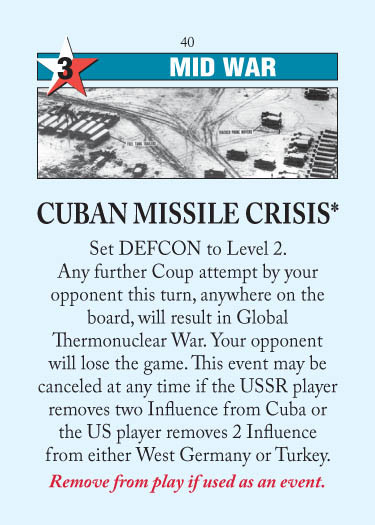
Cuban Missile Crisis
1962
The mere mention of this event elicits fears of the nuclear holocaust that almost was. For 14 days in October 1962, the two superpowers seemed destined to clash directly about the Soviet emplacement of Medium Range Ballistic Missiles (MRBMs) and Intermediate Range Ballistic Missiles (IRBMs) in Cuba. To prevent the installation of additional offensive weapons in Cuba, John F. Kennedy declared a naval quarantine around Cuba. Tensions reached a near breaking point when a U-2 flight was shot down over Cuba, and Khrushchev demanded US missiles be removed from Turkey in exchange for Soviet missiles being removal from Cuba. Ultimately, Khrushchev was compelled to settle for a US pledge not to invade Cuba, and a private agreement to resolve NATO’s missile bases in Turkey.
Time: Mid War
Side: Neutral
Ops: 3
Removed after event: Yes
An ostensibly neutral event that in practice is of far more benefit to the US than the USSR. The event accomplishes several things:
- It lowers DEFCON to 2, so as a headline it is useful to deny the USSR a battleground coup;
- It prevents the opponent from further coups without removing influence from Turkey/West Germany or Cuba.
Now, as US, it is not usually a big deal to remove two from Turkey or West Germany: you’ll almost always have at least two influence in one of those two countries, and removing influence is not a big deal for either of them.
As USSR, however, this event is very problematic if Fidel hasn’t been triggered. If you don’t have influence in Cuba, then you can’t remove it, and so you are essentially locked out of coups for the rest of the turn. This has a number of effects:
- The US is able to play Lone Gunman, which is no longer a DEFCON suicide card;
- The US can play Che without repercussion;
- The US can raise DEFCON (via SALT Negotiations or How I Learned to Stop Worrying) and then coup away freely;
- The USSR is unable to play DEFCON-raising cards (in particular the USSR is now unable to trigger SALT Negotiations or ABM Treaty) without allowing the US several easy coups.
- The US will certainly earn at least 2 Mil Ops VPs, and possibly more if they can raise DEFCON;
- The US can spread freely through non-battlegrounds without fear of being couped.
Of course, the USSR can reap some of these benefits as well (it is nice not to have to worry about Nuclear Subs!), but it is rare for the US to have no influence in either West Germany or Turkey.
Even if the USSR does control Cuba, a Cuban Missile Crisis headline is still pretty annoying, because losing 2 influence in Cuba makes it quite vulnerable.
Finally, Cuban Missile Crisis is a decent headline if you anticipate that your opponent’s headline will lower DEFCON and be subsequent to yours. For example, as US, if the USSR headlines Olympic Games (or Missile Envy, and you hold We Will Bury You), then a Cuban Missile Crisis headline will win you the game.
A couple of rules pointers:
- The influence removal is not an Action and can be done at any time. (It is unclear whether you can actually do this in the middle of your opponent’s Action, i.e., after he announces an intent to coup or realign Cuba, but this is probably an area better suited for sportsmanship than explicit timing rules.)
- The Cuban Missile Crisis win condition takes precedence over a DEFCON-lowering coup, so Lone Gunman is no longer a DEFCON suicide card if the USSR is under its effect and cannot cancel it. (Presumably Lee Harvey Oswald is unable to assassinate Kennedy until he has successfully resolved the Crisis.)
- The text of Nuclear Subs (which confusingly reads “Does not affect Cuban Missile Crisis”) simply means that a US player with Nuclear Subs is not immune from the effects of the Cuban Missile Crisis.
- Cuban Missile Crisis applies to all coups, including “free” coups (through Junta or Tear Down This Wall).