Basic Movements
The dance of shiva is actually made up of a series of movements. The movements enable you to connect each position to every other position. This is what gives the dance of shiva it’s complexity. But at the heart of this complexity is simplicity since each movement connects only two positions to each other.
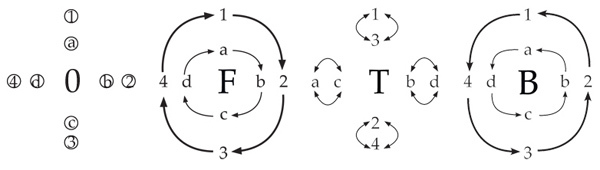
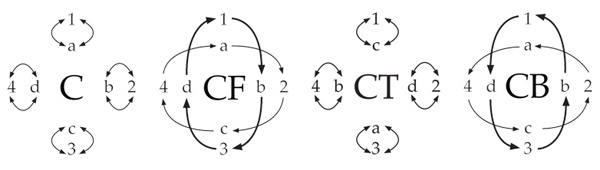
The positions hold the movements together, making them easily “joinable” or “connectable”.
There are 8 basic movements for each arm and the names of the movements relate in part to the names of the positions themselves. Forward and Changeforward movements join the positions in order while Backward and Changebackward movements join the positions in reverse order. Transquarters are movements that jump across positions to connect non-adjacent positions in the same plane. Change movements connect equivalent positions positions in different planes.
The eight movements are Zero, Forward, Backward, Transquarter, Change, ChangeTransquarter, ChangeForward and ChangeBackward. A zero movement connects a position to itself.
Movement Categories
Same plane movements stay in the same plane from position to position. Change plane movements change plane from position to position.
Non-Cyclic or Acyclic movements repeat twice before returning to the start position.
Cyclic movements can be repeated four times before returning to the start position.
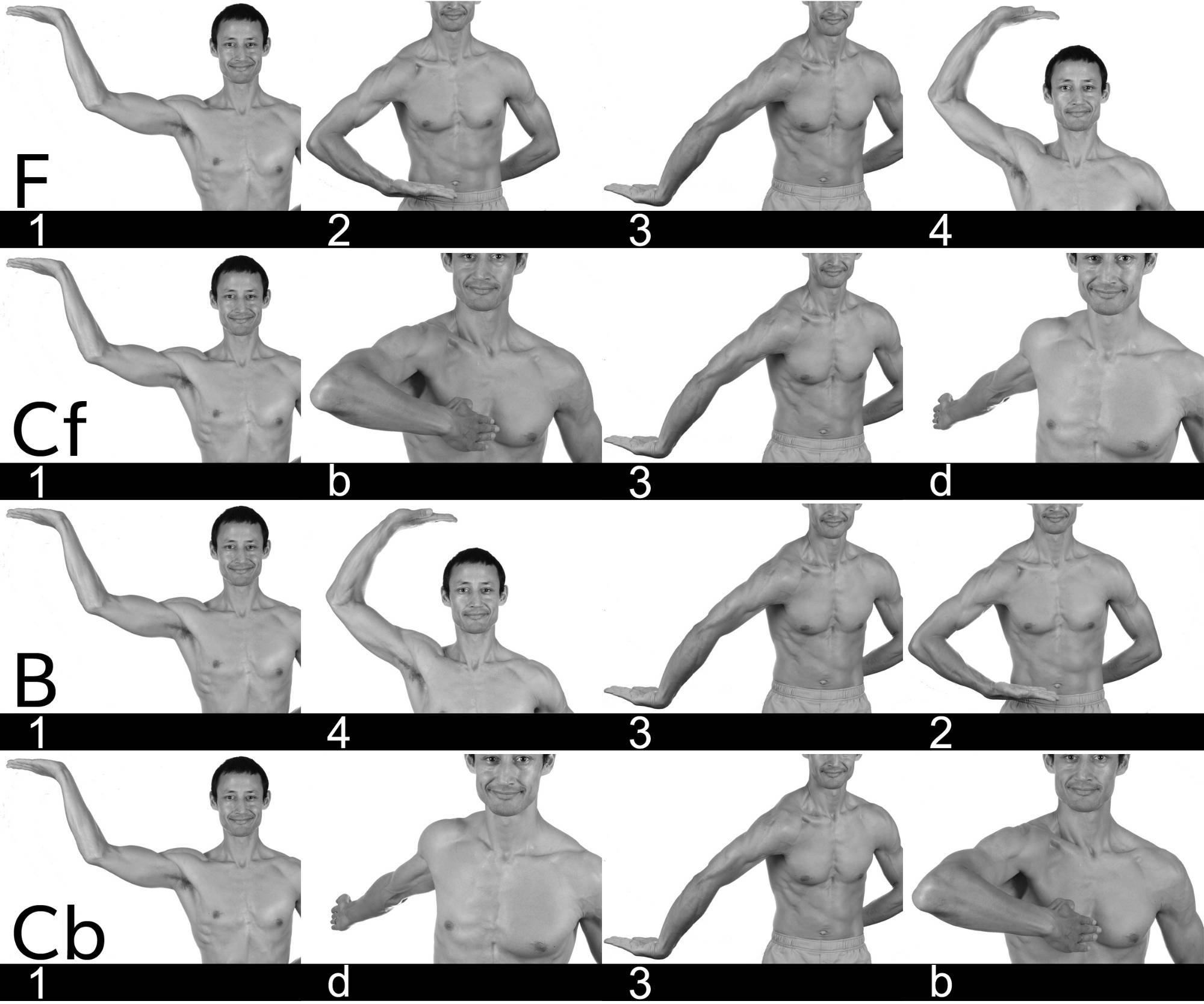
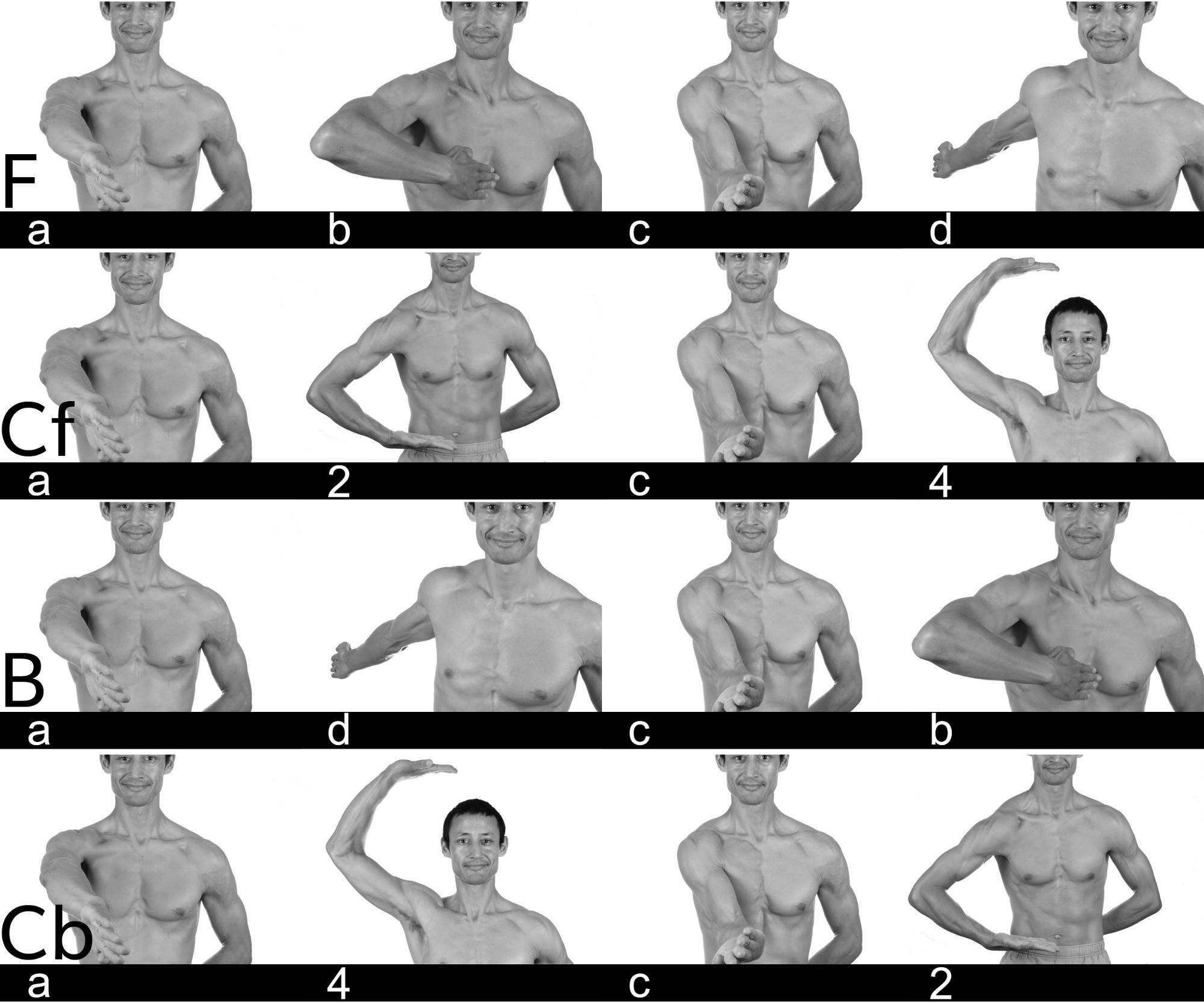
When learning movement combinations the categories are important in that they give a way of dividing the movements into groups so that the groups themselves become learning objectives.
The groups learned in part 1 (this book and accompanying videos) are: Cyclics (1a: both arms same-plane and both arms change-plane, then 1b: one arm same-plane the other change-plane) and Acyclics (with the same breakdown.)
Notice the patterns (and changes in patterns) in the following groupings.
Cyclics 1a:
- F-F, B-B, F-B, B-F
- Cf-Cf, Cb-Cb, Cf-Cb, Cb-Cf
Cyclics 1b:
- F-Cf, Cf-F, F-Cb, Cb-F
- B-Cf, Cf-B, B-Cb, Cb-B
Acyclics 2a:
- T-T, C-C, Ct-Ct
- C-Ct, Ct-C
Acyclics 2b:
- T-C, C-T
- T-Ct, Ct-T