Agile Self-assessment Game
The Agile Self-Assessment Game is used by teams and organizations to self-assess their agility. Playing the game enables teams to reflect on their own team interworking and agree upon the next steps for their agile journey.
With this card game, teams and organizations can discover how agile they are and what they can do to increase their agility to deliver more value to their customers and stakeholders.
In this chapter, I explore what you can do to assess your agility and explain how the Agile Self-assessment Game can be used to do assessments and support improvements.
Assessing your Agility
Agile methods and frameworks like Scrum, Kanban, SAFe or LeSS, don’t tell you how to increase your agility. They provide practices, roles, and activities, and a structure which fits them together. But they are not recipes that can help you to truly become agile.
An agile self-assessment is a technique to find out how agile you are. Such assessments are normally done by the teams themselves, by investigating their way of working against the agile mindset, principles, and practices.
Self-assessments can be question-based or they can use checklists or frameworks to assess team performance. They can be used to investigate and discuss the use of agile practices and techniques and evaluate their contribution towards the value that is being delivered by teams.
Teams can use agile self-assessments to decide what practices they want to use and how to apply them in a way that helps them to do their work efficiently and effectively.
As the name suggests, agile self-assessments are the kind of assessment that professional team members can and should do themselves. This is what makes them different from external assessments or audits.
Self-assessment can help you to increase the agility of your organization.
Gamification
The self-assessment practices (the game and playing suggestions) described in this book are based on gamification. Gamification is an approach where principles and practices from gaming are used in a non-gaming context.
In my work, I apply gamification in a business and team working context. It’s about using practices from gaming to support professionals that are working together to deliver more business value; adding game aspects to their daily work to enable change and foster continuous sustainable improvement.
There are significant differences between games and gamification. The main ones are:
- Games are normally used to learn new things and to practice them, where gamification intents to inspire people and encourage behavior change.
- Gamification focuses on the intended outcome and the results, where games give attention to the rules and the processes.
Both games and gamification have value, but when it comes to self-assessments and organizational change I prefer to use gamification as it gets people involved in their own agile journey.
The Agile Self-assessment Game explored in this book is not meant to be a game in the strict sense of the word where people have to play it “by the rules” and where there are winners and losers. Actually, with most of playing suggestions described in this book, everyone wins the game if they share and collaborate. There are no losers :-).
The benefits that I have seen from using gamification in Agile Self-assessments are:
- People like to play games, it brings out their natural desires to socialize, self-express, and collaborate
- Gamification provides a different perspective and culture, which leads to new valuable insights
- Playing games with teams stimulates collaboration and helps to build relationships
- Gamification is a way to visualize what’s happening which helps people to align and decide
- You can create an environment with gamification where people feel safe to speak up and be open and honest
The Agile Self-assessment Game is a gamified approach for reflection and learning. It’s a behavioral game that helps to initiate and reinforce positive behavioral change by people in organizations.
Playing the Game
The Agile Self-assessment Game is played with decks of coaching cards specifically developed for this game. The cards contain statements that describe agile values, principles, and practices.
Examples of such statements are:
- The team is committed and takes responsibility for delivery
- Impediments are raised, recorded and resolved in a timely fashion
- The daily stand-up focuses on ongoing work, work that needs to be done, and impediments, and lasts no more than 15 minutes
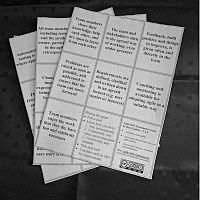
There are many ways to play games with these cards. This book provides you with Playing Suggestions; sample games and gamification techniques for using the cards depending on the situation at hand and the goal that you want to reach.
Getting the Cards
The basic Agile Self-Assessment Cards deck has 52 cards with statements on applying agile principles and practices. These cards can be downloaded in PDF format in my Agile Games webshop.
Expansion packs with additional cards are also available in the webshop. These packs contain cards with statements covering specific principles and practices from agile methods and frameworks.
Currently, the following expansion packs are available:
Agile Self-assessment Cards are available in multiple languages:
- Agile Self-assessment Game - English
- Juego Autoevaluación Ágil - Spanish Edition
- Agilní sebehodnotící hra - Czech edition
- Gra Agile Self-Assessment - Polish edition
- Agile Zelfevaluatie Kaarten - Dutch edition
- Jeu de cartes d’autoévaluation Agile - French edition
The book with cards is published through Leanpub. Multiple languages are supported with specific packages, currently available are:
Agile Self-assessment Game - English edition: The book (in English) with the main Agile cards and expansions packs for Scrum, Kanban, DevOps, and Business Agility.
Juego Autoevaluación Ágil - Spanish edition: The book (in English) with the main Agile cards in Spanish and expansions packs in Spanish for Scrum, Kanban, DevOps, and Business Agility.
Agilní sebehodnotící hra - Czech edition: The book (in English) with the main Agile cards in Czech and expansions packs in Czech for Scrum,, Kanban, DevOps, and Business Agility.
Gra Agile Self-Assessment - Polish edition: The book (in English) with the main Agile cards in Polish and expansions packs in Polish for Scrum, DevOps, and Business Agility.
Agile Zelfevaluatie Kaarten - Dutch edition: The book (in English) with the main Agile cards in Dutch and expansions packs in Dutch for Scrum, Kanban, and DevOps.
Jeu de cartes d’autoévaluation Agile - French edition: The book (in English) with the Agile cards in French.
Find more information about the above packages (book and cards) here.
Summing up: Did you buy the book without cards, or do you want to extend your existing game with cards in another language? Here’s how you can get the cards for playing the games described in this book:
or
The Agile Self-assessment Game, the cards, and all Expansion Packs are licensed under a CC BY-NC-ND 3.0 License. If you want to use the game commercially, please contact Ben Linders.
Doing Retrospectives using Assessments
Agile retrospectives are a great way for the teams to inspect and adapt their way of working. I highly recommend them, my first book Getting Value out of Agile Retrospectives and the Retrospective Exercises Toolbox provide many exercises that you can use to keep your retrospectives valuable.
Normally retrospectives look at the past iteration/sprint to define actions for the next one. This makes them useful to address issues that teams are dealing with currently, but less suitable to guide the teams’ agile journey and to keep your agile transformation on track. For that, you need a tool that tells you where you are and where to go next. This is where agile self-assessments fit in.
The game can be used in retrospectives for teams that have recently started; they can check which practices to pick up in next sprints.
It’s also suitable for experienced teams where team members are already are well adapted to each other, to search for new improvements for their team working.