What Is SADMF and Why Does Every Organization Need It?
SADMF was designed for organizations as they actually exist, with entrenched hierarchies, ambiguous accountability structures, and a leadership layer that has already invested significant emotional and financial capital in the current way of doing things. It does not ask organizations to change. It asks them to formalize what they are already doing, wrap it in the correct terminology, and measure it with the correct instruments.
1.1 The Origin Story: How Decades of Organizational Pain Became a Framework
The Scaled Agile DevOps Maturity Framework did not emerge from a research laboratory or a university. It emerged from practice: from the accumulated observations of practitioners who watched, year after year, as enterprises attempted transformation after transformation and arrived, reliably, at the same destination: new vocabulary, unchanged behavior, and a blog post declaring success.
These practitioners noticed that every transformation began with executive commitment and ended with middle management intact. They noticed that “self-organizing teams” organized themselves in ways that made executives uncomfortable, producing new governance layers to restore the natural order. They noticed that “continuous delivery” created a volume of change that no reasonable Change Approval Board could process in a timely fashion, and that the correct response was not to reconsider the CAB but to reconsider the delivery cadence.
Most importantly, they noticed that organizations did not actually want to change. They wanted to be seen as having changed: the certifications, the ceremonies, and the consultant-verified maturity scores that would allow them to present transformation progress at the next board meeting without the operational disruption genuine transformation would require.
SADMF was built to serve these organizations honestly. Rather than positioning organizational inertia as a problem to be overcome, SADMF positions it as a constraint to be accommodated, and builds a comprehensive, enterprise-grade framework around that constraint. A Scaled Agile DevOps Accredited Facilitator who walks in and tells senior leaders that their management model is the source of their delivery problems will not be invited back. A SAD AF who tells those same leaders that their management model simply needs to be better structured, better measured, and better certified will be invited to stay for years. SADMF is that structure.
1.2 The Core Value Proposition: Enterprise Transformation Without Culture Change
The phrase that appears on the SADMF homepage, Enterprise DevOps transformation without the risk of culture change, is not a slogan. It is a precise and accurate description of what the framework delivers, and it is the single most important sentence you will speak to an executive audience.
Culture change is expensive, slow, contested, and impossible to measure in a quarterly earnings call. It requires leaders to examine their own behaviors and occasionally modify them, a request that most senior leaders find professionally unreasonable. It creates the conditions for productive disagreement, which is another way of saying it creates the conditions for people below the leadership layer to tell the leadership layer that they are wrong.
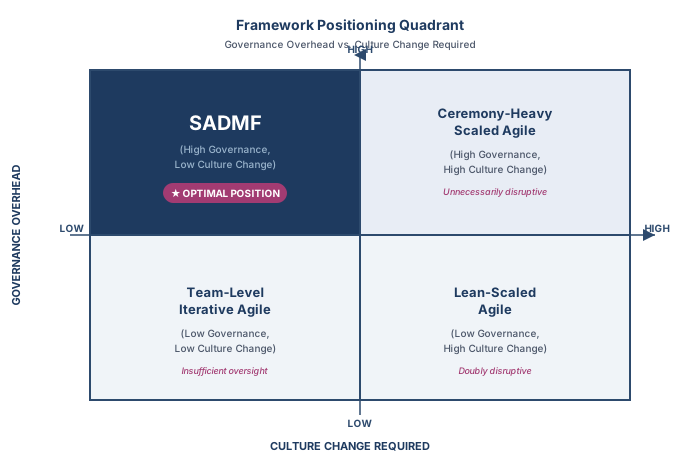
SADMF eliminates this risk entirely. The framework achieves transformation outcomes through the correct application of structure: the right roles in the right hierarchy, the right ceremonies at the right cadence, the right metrics feeding the right accountability systems. Culture is not asked to change because culture is not consulted. The framework operates above and around whatever culture the organization currently has, providing a governance layer through which all work must flow regardless of the attitudes, values, or interpersonal preferences of the people performing it.
The four pillars of the SADMF value proposition are:
Zero Disruption. No changes to organizational structure or reporting lines are required. SADMF roles are layered onto existing structures. Disruption, in the SADMF model, is something that happens to delivery teams, not to leadership teams.
Minimal Training. A small number of additional daily ceremonies, combined with the mandatory certification pathway, is sufficient to transform a workforce. The knowledge required to execute SADMF is contained in the SADBOK and can be examined.
Plan Years Ahead. The eight-quarter Convoy planning horizon allows organizations to make delivery commitments spanning two full calendar years, which is essential for enterprises that must align technology delivery with annual budgeting cycles and multi-year contracts.
Outsource Compatible. SADMF’s requirement-first, approval-heavy delivery model is fully compatible with sending detailed requirements to external development teams. The framework does not assume that the people writing requirements and the people implementing them need to be in the same room, country, or time zone.
When you present these four pillars to an executive audience, you are not selling them something new. You are giving them permission to continue doing what they are already doing, and charging them for the privilege of doing it with better documentation.
1.3 Why Existing Agile and DevOps Approaches Fall Short
There are three structural failures in conventional Agile and DevOps approaches that SADMF was explicitly designed to address. Your role is not to describe these problems but to name them correctly, demonstrating the depth of your understanding and the specificity of the SADMF solution.
The Dangerous Myth of Team Autonomy.
Conventional Agile frameworks position team autonomy as an organizational virtue: teams, given sufficient latitude, will produce better outcomes than teams operating within clear direction and structured oversight. This claim is empirically undermined by every enterprise transformation on record. Autonomous teams make autonomous decisions. Autonomous decisions diverge from organizational strategy. Divergence creates the need for realignment initiatives. Realignment initiatives require consultants. The consultants recommend autonomy. The cycle continues.
SADMF breaks this cycle by recognizing that team autonomy is not a goal but a symptom: a symptom of insufficient governance. The framework provides that governance through a carefully designed hierarchy of roles with clearly bounded responsibilities and reporting relationships, ensuring that no team is ever in a position to make a decision its leadership has not already approved. This is not micromanagement. SADMF leaders are doing the work of governance, approving, directing, measuring, correcting, which is an entirely different and considerably more valuable activity.
The Accountability Gap in “Self-Organizing” Teams.
When a self-organizing team fails to deliver a committed feature, who is responsible? The Agile answer, that the team is collectively accountable, does not function in an enterprise context. Boards of directors and enterprise customers do not accept collective accountability. They need a name.
SADMF closes this gap at every level: the Feature Captain is accountable for feature delivery, the Commodore for Convoy delivery, the Chief Signals Officer for the accuracy of the Feature Completion Ratio. The PeopleWare HR as a Service platform ensures this association is not merely rhetorical; individual metric performance is tracked in the Integrated Performance Profile and fed into the Automated Corrective Action Engine. Accountability is not a value that must be cultivated through culture. It is a mechanical property of the framework.
How Continuous Delivery Creates Unmanageable Change Velocity.
DevOps practitioners who advocate for continuous delivery are solving a problem that most enterprises do not actually have. Most enterprises do not suffer from an inability to deploy quickly. They suffer from an inability to know, at any given moment, what has been deployed, when it was deployed, who approved it, and what the impact on adjacent systems will be. Continuous delivery amplifies this problem: changes arrive faster than the Change Approval Board can review them, and when deployment is automated to the point of being invisible, the Commodore cannot report on it, the Chief Signals Officer cannot measure it, and the Feature Completion Ratio cannot reflect it.
SADMF addresses this through the DevOps Release Convoy, which synchronizes all delivery activity into a structured, governable arc with defined planning, execution, and review phases. Changes proceed through the READY release process and require Convoy Steering Committee approval before reaching production. An organization that cannot tell its board how many changes were deployed last quarter, who authorized them, and what their status is has not achieved DevOps maturity. It has achieved DevOps theater. SADMF converts that theater into an accountable, measurable, reportable process.
1.4 SADMF’s Unique Market Position: Enterprise-Grade, Ceremony-Verified, Award-Winning
SADMF’s differentiation from the ceremony-heavy scaled agile frameworks, the lean-scaled alternatives, and the rotating cast of boutique methodologies is not rhetorical. It is structural, and it can be presented in four attributes that resonate specifically with enterprise decision-makers.
Thoroughly Documented. The SADBOK (SADMF Body of Knowledge) constitutes the authoritative corpus of SADMF terminology, practices, roles, ceremonies, and metrics formulas. When practitioners disagree about how a ceremony should be run or how a metric should be calculated, the SADBOK provides the definitive answer, and that answer does not change based on team preference or organizational context.
Ceremony Verified. SADMF requires practitioners to demonstrate competence through a structured certification pathway from Practitioner through Professional, Master, Fellow, and Scaled Agile DevOps Accredited Facilitator. The practitioner population of a given organization is reported as a percentage through the SADMF Adoption Rate metric, making the framework’s penetration always measurable, always reportable, and always improvable.
Enterprise Grade. Every design decision reflects the realities of enterprise-scale organizations: multi-team coordination through the Armada model, multi-year planning through the eight-quarter Convoy horizon, individual accountability through PeopleWare, and governance through the full suite of review and oversight bodies.
Award Winning. The SADMF framework has received recognition within the enterprise transformation community for its contributions to the field. As a Scaled Agile DevOps Accredited Facilitator, you are authorized to represent this recognition in executive presentations without specifying the award’s origin, criteria, or granting body, which are proprietary to the Admiral’s Transformation Office.
1.5 The Statistics That Matter: 500+ Enterprises Transformed, 0 Culture Changes
The SADMF homepage displays four statistics. Understand each one well enough to discuss it confidently, because these numbers will be noticed and, occasionally, questioned.
500+ Enterprises Transformed. Organizations that have engaged a Scaled Agile DevOps Accredited Facilitator and completed at least one full DevOps Release Convoy cycle under SADMF governance. Completion of a Convoy under SADMF governance constitutes a transformation, a definition generous by design, because enterprises early in their SADMF journey are nonetheless transformed enterprises, and recognizing that status encourages continued investment.
8Q Average Delivery Forecast Horizon. Eight quarters, two full calendar years, is the standard Convoy planning horizon, and most organizations achieve this in their first planning event.
2.8M+ Integrity Gaps Documented. Present this number as a positive: integrity gaps are not failures but findings. An organization that has documented 2.8 million integrity gaps has documented 2.8 million opportunities for improvement. This framing positions SADMF assessments as a service rather than an audit.
0 Culture Changes Required. The most important statistic in the framework’s marketing materials. When executives push back, having been told that culture change is foundational, the correct response is: “SADMF does not argue that culture is unimportant. It argues that culture change is not a prerequisite for governance improvement, and that governance improvement, properly sustained, will eventually produce the cultural conditions that support it.” This answer does not challenge executive cultural instincts; it simply deprioritizes them in favor of something measurable.
Facilitation Notes
Scaled Agile DevOps Accredited Facilitators seeking specific guidance for facilitating this content should consult the SAD AF Facilitation Playbook, which provides scenario-organized facilitation patterns, approved response frameworks, and resistance-handling techniques drawn from all chapters.
Continue to Chapter 2: The Twelve Principles: The Philosophical Foundation