The History of the Raspberry Pi
The story of how the Raspberry Pi came to be started in 2006. Eben Upton, Rob Mullins, Jack Lang and Alan Mycroft, who were based at the University of Cambridge’s Computer Laboratory, became concerned at the decline in the volume and skills of students applying to study Computer Science. They saw part of the problem being that a typical student applicant was not arriving with a history of hobby programming and tinkering with hardware. Instead they were coming on board with some web design experience, but little else.
They established that the way that kids were interacting with computers had changed. A school curriculum that was pre-loaded to emphasise working with Word and Excel and building web pages meant that the focus was more on working with applications. Games consoles were replacing the traditional hobbyist computer platforms that had existed in the era when the Amiga, Apple II, ZX Spectrum and the ‘build your own’ approach were king.
So, in 2006, Eben and the team began to design and prototype a platform that was cheap, simple, booted into a programming environment and most of all, one which would inspire the next generation of computer enthusiasts to recover the joy of experimenting with computers.
Between 2006 and 2008, they developed a number of prototypes based on the Atmel ATmega644 microcontroller. By 2008 processors designed for mobile devices were becoming affordable and powerful enough to support a range of multimedia features. This allowed the boards to support an graphical environment which they believed would make the board more attractive to children who were looking for an alternative to a purely programming-oriented device.
Eben, Rob, Jack and Alan, then teamed up with Pete Lomas, and David Braben to form the Raspberry Pi Foundation to bring the project to the world. The Foundation’s goal was to offer two versions of the board, priced at US$25 and US$35.
In August 2011 50 alpha boards are manufactured. These boards were functionally identical to the model B. Based on these, twenty-five model B Beta boards were assembled in December 2011 with the same component layout as what would be the production boards.
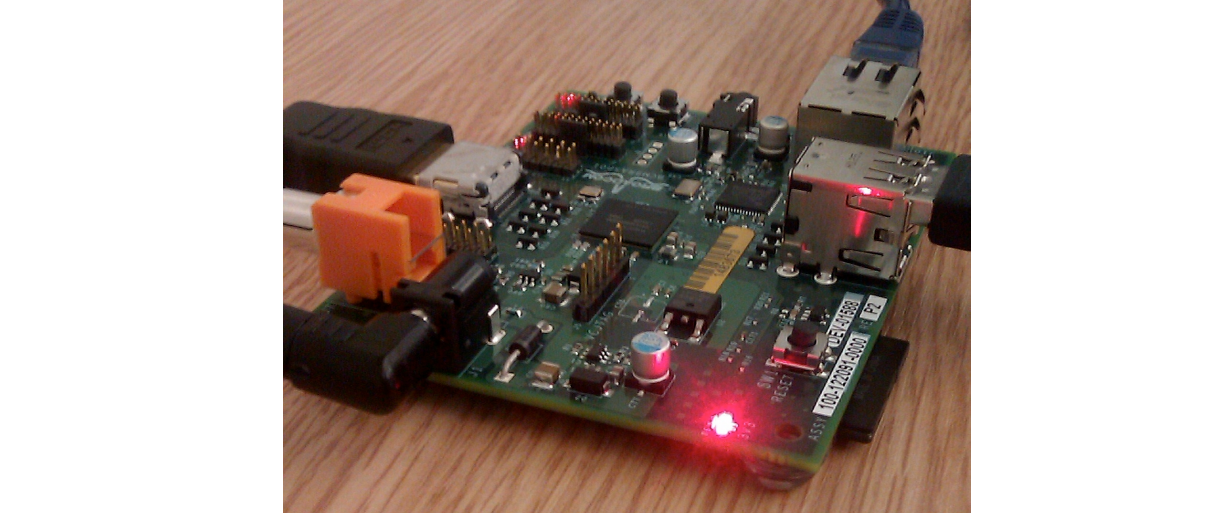
Interest in the project escalated as they were demonstrated booting Linux, playing a 1080p movie trailer and running benchmarking programs. During the first week of 2012, the first 10 boards were put up for auction on eBay. One was bought anonymously and donated to the museum at The Centre for Computing History in Suffolk, England. While the ten boards together raised over 16,000 Pounds (about $25,000 USD) the last to be auctioned (serial number No. 01) raised 3,500 Pounds by itself.
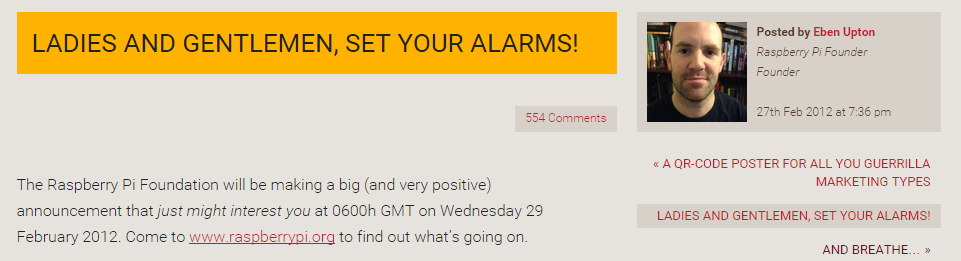
The Raspberry Pi Model B entered mass production through licensed manufacture deals with element 14/Premier Farnell and RS Electronics. They started accepting orders for the model B on the 29th of February 2012. It was quickly apparent that they had identified a need in the marketplace as their servers struggled to cope with the load placed by watchers repeatedly refreshing their browsers. The official Raspberry Pi Twitter account reported that Premier Farnell sold out within few minutes of the initial launch, while RS Components took over 100,000 pre orders on the first day of sales.
Within two years they had sold over two million units.
The the lower cost model A went on sale for $25 on 4 February 2013. By that stage the Raspberry Pi was already a hit with the model B being manufactured at a rate of 4000 units per day and the amount of on-board ram had been increased to 512MB.
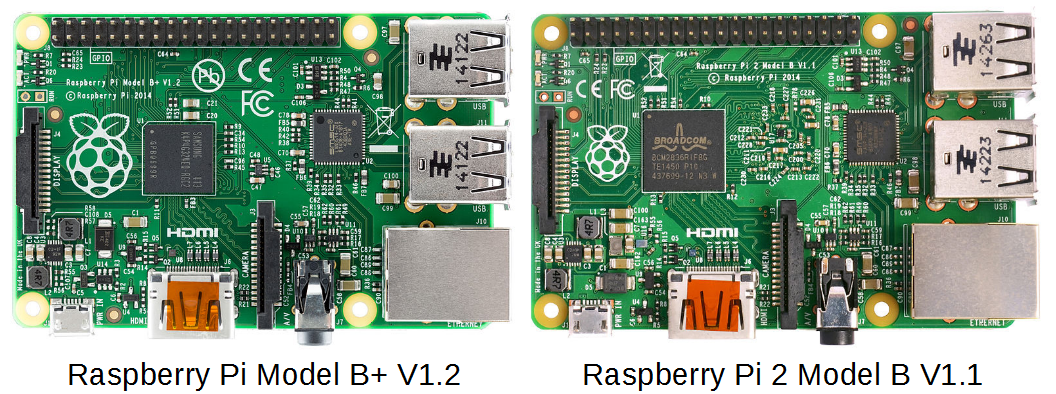
The official Raspberry Pi blog reported that the three millionth Pi shipped in early May 2014 and in July 2014 announced the Raspberry Pi Model B+, “the final evolution of the original Raspberry Pi. For the same price as the original Raspberry Pi model B, but incorporating numerous small improvements”. In November of the same year the even lower cost (US$20) A+ was announced. Like the A, it would have no Ethernet port, and just one USB port, but like the B+, it would have lower power requirements, a micro-SD-card slot and 40-pin HAT compatible GPIO.
On 2 February 2015 the official Raspberry Pi blog announced that the Raspberry Pi 2 was available. With the same form factor and connector layout as the Model B+, it has a 900 MHz quad-core ARMv7 Cortex-A7 CPU, twice the memory (for a total of 1 GB) and complete compatibility with the original generation of Raspberry Pis.
Following a meeting with Eric Schmidt (of Google fame) in 2013, Eben embarked on the design of a new form factor for the Pi and in on the 26th of November 2015 the Pi Zero was released. The Pi Zero is a significantly smaller version of a Pi with similar functionality but with a retail cost of $5. On release it sold out (20,000 units) World wide in 24 hours and a free copy was affixed to the cover of the MagPi magazine.
The Raspberry Pi 3 was released in February 2016 and was notable for the inclusion of on-board WiFi and Bluetooth.
In February 2017 the Raspberry Pi Zero W was announced. This device had the same small form factor of the Pi Zero, but included the WiFi and Bluetooth functionality of the Raspberry Pi 3.
On Pi day (the 14th of March (Get it? 3-14?)) in 2018 the Raspberry Pi 3+ was announced with included dual band WiFi, upgraded Bluetooth, Gigabit ethernet (actually 300Mpbs which is slightly less than Gigabit since it still needs to be supported on a USB2 bus) and support for a future PoE card. By this stage there had been over 9 million Raspberry Pi 3’s sold and 19 million Pi’s in total.
While it is easy to consider that the measurement of the success of the Raspberry Pi would be in the number of computer boards sold, This would most likely not be the opinion of those visionaries who began the journey to develop the boards. To them the stated aim was to re-invigorate the desire of young people to experiment with computers and to have fun doing it. Their success can be measured as the numerous projects, blogs, updated school curriculum’s and all around enjoyment that their efforts have produced.