AI for Games
Games are a classic proving ground for AI, and they exercise OCaml in ways the earlier chapters do not: game state that changes over many turns, rules that must be exactly right, and agents that choose moves. This chapter covers three games of rising difficulty. Blackjack, in source-code/blackjack/, shows immutable game state threaded through a console loop. Contract bridge, in source-code/bridge_game/, adds an AI that bids and plays. Go, in source-code/go_playing_program/, builds a full board engine with captures, ko, and scoring, plus a self-play agent.
A common thread runs through all three: the game state is an immutable record, and each move returns a new state rather than changing the old one. This is the OCaml way to write a game, and it makes the rules easy to test.
Blackjack
The card model in src/card.ml is pure data. Suits and ranks are variant types, a card is a record, and the deck is built by pairing every rank with every suit:
1 type suit = Hearts | Diamonds | Clubs | Spades
2 type rank = Two | Three | ... | King | Ace
3 type card = { rank : rank; suit : suit }
4
5 let ordered_card_deck =
6   List.concat_map
7     (fun r -> List.map (fun s -> { rank = r; suit = s }) all_suits)
8     all_ranks
List.concat_map runs a function that returns a list over each rank and flattens the result, so the two nested maps produce all 52 cards. Card values come from a simple match, with the hand value a fold:
1 let hand_value cs = List.fold_left (fun acc c -> acc + card_value c) 0 cs
Shuffling, in src/shuffle.ml, is the Fisher-Yates algorithm. It is the one place the game uses a mutable array, because the swap is clearest that way:
1 let shuffle lst =
2   let a = Array.of_list lst in
3   for i = Array.length a - 1 downto 1 do
4     let j = Random.int (i + 1) in
5     let tmp = a.(i) in
6     a.(i) <- a.(j);
7     a.(j) <- tmp
8   done;
9   Array.to_list a
The game state lives in src/table.ml as one record: the chip stacks, the cards dealt to each player, the current bet, and the deck. Player 0 is the human, player 1 is the dealer, and 2 and up are AI players. Because OCaml records do not change in place, updating one field means building a new record with { t with ... }. Since the cards are a list of hands, the file adds a small helper to replace one element:
1 let list_set i v lst = List.mapi (fun j x -> if j = i then v else x) lst
Dealing a card shows the pattern. It takes the top card off the deck and prepends it to a player’s hand, returning a new table:
 1 let deal_card_to_user' t player_index =
 2   match t.card_deck with
 3   | [] -> t
 4   | next :: rest ->
 5     let player_cards = next :: List.nth t.dealt_cards player_index in
 6     {
 7       t with
 8       card_deck = rest;
 9       dealt_cards = list_set player_index player_cards t.dealt_cards;
10     }
The AI rule is one line on top of that: the human always draws when asked, but an AI player draws only while its hand is under 17, the standard dealer rule:
1 let deal_card_to_user t player_index =
2   if player_index = 0 then deal_card_to_user' t player_index
3   else if score t player_index < 17 then deal_card_to_user' t player_index
4   else t
Dealing to several players is a fold that threads the table through each one:
1 let deal_cards t player_indices =
2   List.fold_left deal_card_to_user t player_indices
Because every function takes a table and returns a new one, the whole game is a chain of pure transforms. The console front end in bin/main.ml reads a key, applies the matching transform, and prints the new table. Play it:
1 cd source-code/blackjack
2 dune build
3 dune exec ./bin/main.exe
The controls are h to hit, s to stay, 1/2/3 to bet, n for a new hand, and q to quit.
Contract Bridge
Bridge is a big step up. The engine in bridge_game/ deals hands, runs an auction where an AI bids using real conventions, plays out all thirteen tricks with an AI, and scores the result. It is split into modules for types, cards, bidding, play, scoring, and the engine state machine.
The types in src/types.ml are ordinary variants, but their order is deliberate. OCaml’s built-in compare orders variants by declaration order, so the constructors are listed low to high on purpose, and the engine gets correct card and bid comparisons for free:
1 type suit = Clubs | Diamonds | Hearts | Spades
2 type rank = R2 | R3 | ... | King | Ace
3 type player = North | East | South | West
4 type strain = Suit_strain of suit | No_trump
5 type bid_type = Suit_bid of int * strain | Pass | Double_bid | Redouble_bid
6 type phase = Dealing | Bidding | Playing | Scoring | Done
The phase type is the game’s state machine: a deal moves from Dealing to Bidding to Playing to Scoring to Done. Hand evaluation, in src/cards.ml, is where bridge knowledge lives. High card points are the familiar 4-3-2-1 for ace-king-queen-jack:
1 let card_hcp c =
2   match c.rank with Ace -> 4 | King -> 3 | Queen -> 2 | Jack -> 1 | _ -> 0
3
4 let hand_hcp hand = List.fold_left (fun a c -> a + card_hcp c) 0 hand
A hand’s shape is the length of each suit, and a hand is balanced when its sorted shape is one of the flat patterns:
1 let is_balanced hand =
2   let sh = hand_shape_sorted hand in
3   sh = [ 4; 3; 3; 3 ] || sh = [ 4; 4; 3; 2 ] || sh = [ 5; 3; 3; 2 ]
There is more: length points, shortness points, whether a suit has a stopper, and honor counts. These are the inputs a human bridge player uses, and the AI bidder in src/bidding.ml uses them to choose openings, responses, and rebids, including the common conventions Stayman, Blackwood, and Gerber. The play module chooses a card to follow suit, win a trick, or discard, and the scoring module keeps rubber score.
The console driver in bin/main.ml runs one full deal with all four seats played by the AI. It reads whose turn it is from the engine, asks the AI for a bid or a card, and applies it, looping until the phase changes:
1 while !gs.phase = Bidding do
2   match Engine.current_actor !gs with
3   | Some actor ->
4     let hand = Engine.PMap.find actor !gs.hands in
5     let bid = Bidding.ai_select_bid hand !gs.bid_history actor !gs.dealer in
6     Printf.printf "%-6s %s\n" (show_player actor) (show_bid bid);
7     gs := Engine.apply_bid bid !gs
8   | None -> gs := { !gs with phase = Done }
9 done;
Engine.PMap is a Map keyed by player, so PMap.find actor !gs.hands gets a player’s cards. The state gs is a ref holding the immutable game record; each apply_bid returns a new record that replaces it. Run a full deal:
1 cd source-code/bridge_game
2 dune build
3 dune exec ./bin/main.exe    # auto-plays one deal
4 dune runtest
The program prints the four hands, the auction bid by bid, the contract, the play trick by trick, and the final score. There is also a web version in source-code/bridge_webkit/ that serves the same engine through a Dream server, using the JavaScript bridge from Chapter 11 so you can bid and play as South against the AI.
Go
Go has simple rules and deep play. The engine in src/board.ml gets the rules exactly right: captures, suicide, the ko rule, legal moves, area scoring, and eye detection. The board is a flat integer array, 0 for empty, 1 for black, 2 for white, and it is persistent: every move copies the array, so an old board is never changed:
1 type board = {
2   grid : int array;
3   sz : int;
4   to_move : color;
5   prev_hash : int;      (* hash of the position before the last move, for ko *)
6   last_move : int option;
7   captures : int * int;
8 }
Two ideas drive the rules, and the figure shows both. Stones of one color that touch along the grid lines form a group, and a group’s liberties are the empty points next to it. A group with no liberties is captured. An eye is an empty point a group surrounds on its own. White cannot play into an eye, because the stone would have no liberties, so a group with two eyes never loses its last liberty and can never be captured.
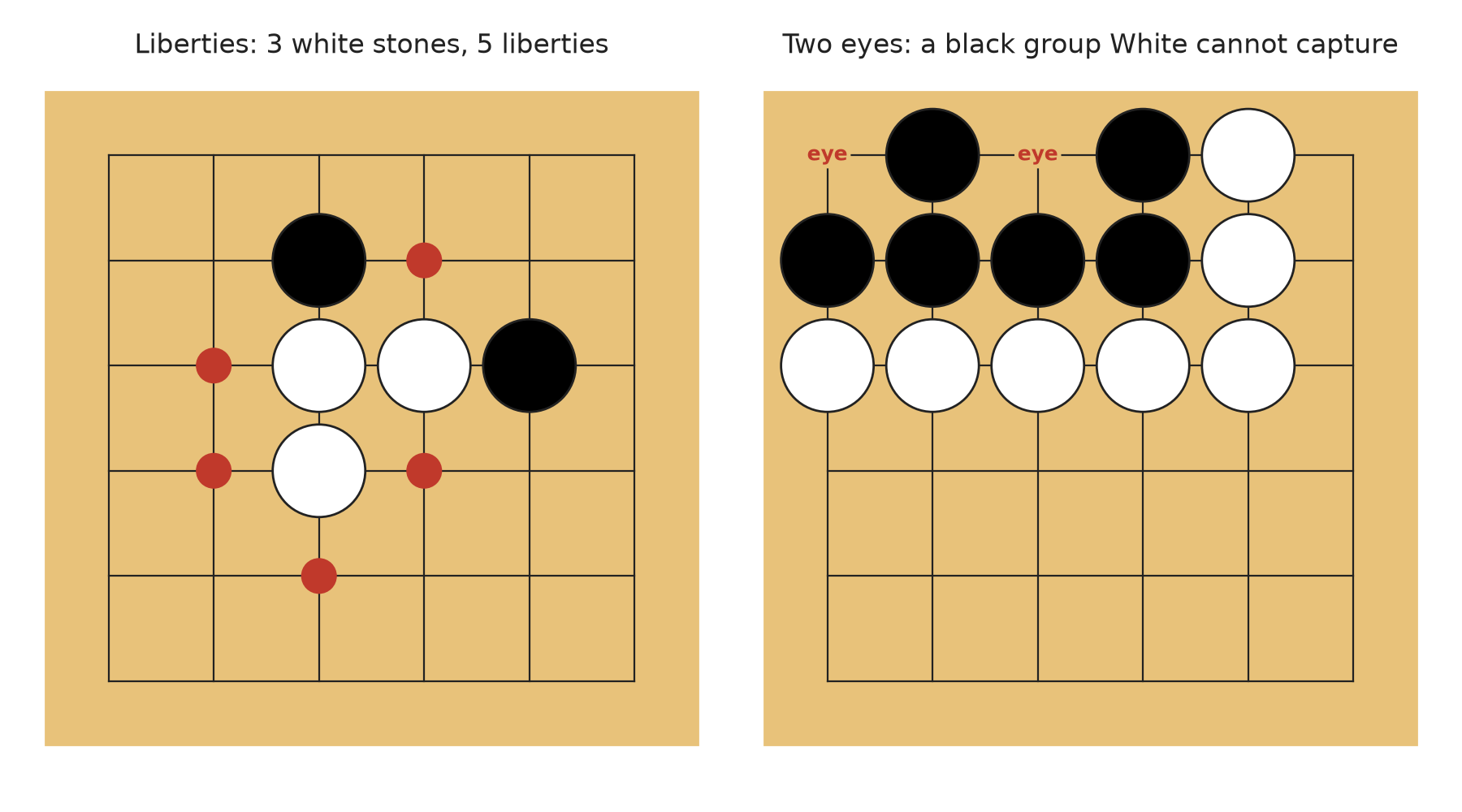
Finding a group is a flood fill with an explicit stack, so it never overflows on a big board:
 1 let flood_group grid sz color seed =
 2   let rec go stack seen acc =
 3     match stack with
 4     | [] -> acc
 5     | x :: xs ->
 6       if ISet.mem x seen then go xs seen acc
 7       else if grid.(x) <> color then go xs seen acc
 8       else go (neighbors_raw sz x @ xs) (ISet.add x seen) (x :: acc)
 9   in
10   go [ seed ] ISet.empty []
Playing a stone is where the rules come together. try_play_idx returns an option: Some new_board for a legal move, None for an illegal one. It places the stone, removes any enemy groups it captures, and then checks two rules:
 1 let try_play_idx b i =
 2   if b.grid.(i) <> 0 then None
 3   else begin
 4     ...
 5     let trial1, removed = remove_dead_groups trial0 sz enemy (neighbors_raw sz i) in
 6     let own_libs = count_libs_of trial1 sz (flood_group trial1 sz color i) in
 7     if own_libs = 0 then None (* suicide *)
 8     else
 9       let new_hash = hash_grid trial1 in
10       if b.prev_hash <> 0 && new_hash = b.prev_hash then None (* ko *)
11       else Some { grid = trial1; ... }
12   end
Two illegal moves fall out cleanly. A move that leaves your own group with no liberties is suicide, so it returns None. A move that recreates the position before the last move breaks the ko rule; the board keeps a hash of the previous position, and if the new position hashes to the same value, the move is None. Returning an option means the caller cannot forget to check: an illegal move has no board to play on.
Scoring uses the Chinese area method: your stones plus the empty territory only your color surrounds. compute_territory floods each empty region and checks which colors touch it, and area_score adds stones and territory from Black’s view.
The agent in src/agent.ml is deliberately light. It plays a legal move, prefers moves that capture, and never fills its own eyes, which keeps its groups alive and makes self-play end:
 1 let choose_move b =
 2   let candidates =
 3     List.filter
 4       (fun i ->
 5         b.grid.(i) = 0
 6         && (not (is_own_eye b i b.to_move))
 7         && try_play_idx b i <> None)
 8       (List.init (b.sz * b.sz) Fun.id)
 9   in
10   match candidates with
11   | [] -> Pass
12   | _ ->
13     let capturing =
14       List.filter
15         (fun i ->
16           match try_play_idx b i with
17           | Some b' -> total_captures b' > total_captures b
18           | None -> false)
19         candidates
20     in
21     let pick lst = List.nth lst (Random.int (List.length lst)) in
22     let i = match capturing with [] -> pick candidates | _ -> pick capturing in
23     Play (row_of b i, col_of b i)
The candidate moves are the empty points that are legal and are not the agent’s own eyes. If any candidate captures, the agent picks from those; otherwise it picks any candidate at random. Avoiding its own eyes is the key to termination: a group with two eyes is alive, and by refusing to fill them the agent leaves both groups standing, so the game reaches a natural end instead of self-destructing.
The game loop lives in src/selfplay.ml. Selfplay.play_game starts from an empty board and asks the agent for moves until there are two passes in a row or a move cap is reached, then returns the final board and the move count. The driver in bin/main.ml plays one game and prints the board and the score:
1 cd source-code/go_playing_program
2 dune build
3 dune exec ./bin/main.exe
4 dune runtest
It prints the final board with X for black and O for white, the capture counts, and the area score. The full Go program this was ported from had a much larger AI stack with Monte Carlo tree search and joseki libraries; this port keeps the complete, correct board engine and a simple agent, which is enough to play and score a real game. That split is a good lesson: get the rules exactly right in a small, tested engine, and you can grow the intelligence on top of it later.
Parallel Playouts with Domains
One way to grow that intelligence starts with playouts. A playout plays a game from some position to the end with a fast, light policy like our agent, and records who won. One playout says little. Thousands of them, averaged, give a usable estimate of how good a position is, and that estimate is the core of Monte Carlo tree search, the method behind the strongest Go programs before deep learning.
Playouts also suit parallel hardware well. Each game is independent, and because our boards are persistent, two games never touch the same memory. OCaml 5 can run them truly in parallel with domains. A domain is an OCaml thread of execution that runs on its own CPU core with its own minor heap. Domain.spawn f starts f on a new domain and returns a handle, and Domain.join waits for it and returns f’s result.
The program in bin/playouts.ml tallies the results of a batch of games:
 1 type tally = { black : int; white : int; draws : int }
 2
 3 let run_games n =
 4   let rec loop i t =
 5     if i = 0 then t
 6     else
 7       let final, _ = Selfplay.play_game () in
 8       loop (i - 1) (add t (Selfplay.result_of final))
 9   in
10   loop n empty
To run in parallel, it splits the games into one share per domain. It spawns a worker domain for every share but the first, runs the first share on the current domain so that domain does useful work too, then joins the workers and merges the tallies:
1 let run_parallel ~domains n =
2   let share k = (n / domains) + if k < n mod domains then 1 else 0 in
3   let workers =
4     List.init (domains - 1) (fun k ->
5         Domain.spawn (fun () -> run_games (share (k + 1))))
6   in
7   let mine = run_games (share 0) in
8   List.fold_left (fun t w -> merge t (Domain.join w)) mine workers
There are no locks anywhere. Each domain builds its own tally, and results move between domains only through Domain.join’s return value. Parallel code built this way, with independent work and results merged at the end, cannot have data races. The one piece of shared machinery is the random number generator the agent uses, and OCaml 5 already gives each domain its own Random state, split from its parent’s when the domain is spawned.
Domain.recommended_domain_count () reports how many domains the machine can run well, usually its core count. Spawning many more domains than that makes the program slower, not faster. The program times a sequential run and a parallel run of the same number of games:
1 cd source-code/go_playing_program
2 dune exec ./bin/playouts.exe -- 400
On a 15-core laptop it printed:
1 400 playouts on 9x9, 15 domains available
2 sequential             Black 224  White 176  Draw  0   4.19s
3 parallel (15 domains)  Black 189  White 211  Draw  0   0.68s
4 speedup: 6.2x
The tallies differ between the two runs because the games are random. What matters is the speedup: a little over six times faster on 15 domains. It is less than 15 because the cores share memory bandwidth and the garbage collector does some work in coordinated pauses across all domains. That is typical for allocation-heavy code like this engine, which copies the board on every move. The test suite checks the parallel path as well, running games on three domains and making sure every result comes back.
With a fast, parallel playout function, the next step toward a real Go player is a search that spends its playouts on the most promising moves. That search is Monte Carlo tree search, and it is a good project to build on this engine.