A tiny vector store
File: vector-store.lisp
Embedding-based semantic search in its simplest form: a hash table of labeled vectors and cosine-similarity ranking.
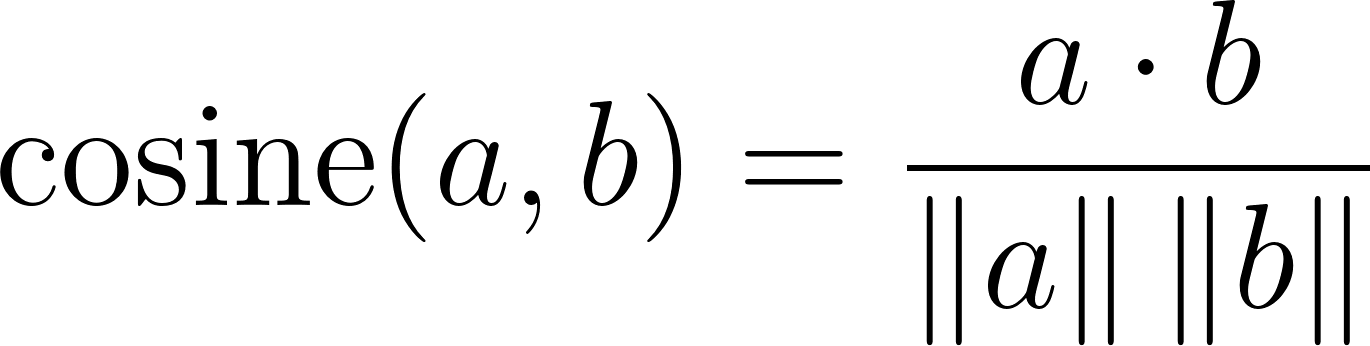
Cosine similarity measures the angle between two vectors, ignoring their magnitudes:
The code
 1 ;; sbcl --script vector-store.lisp (in-memory dense vector store)
 2
 3 (defun v-dot (a b)
 4   (unless (= (length a) (length b))
 5     (error "Vector lengths differ: ~d vs ~d" (length a) (length b)))
 6   (loop for x across a for y across b sum (* x y)))
 7
 8 (defun v-norm (a)
 9   (sqrt (v-dot a a)))
10
11 (defun v-cosine (a b)
12   (let ((na (v-norm a)) (nb (v-norm b)))
13     (if (or (zerop na) (zerop nb)) 0.0 (/ (v-dot a b) (* na nb)))))
14
15 (defun make-vector-store ()
16   (make-hash-table :test 'equal))
17
18 (defun store-add (store id text vec)
19   (setf (gethash id store) (list text (coerce vec 'vector))))
20
21 (defun store-search (store query-vec &optional (k 3))
22   (let ((qv (coerce query-vec 'vector)))
23     (subseq
24      (sort (loop for id being the hash-keys of store
25                    using (hash-value item)
26                  for score = (v-cosine qv (second item))
27                  collect (list score id (first item)))
28            #'> :key #'car)
29      0 (min k (hash-table-count store)))))
30
31 ;; Demo: Semantic vector search in 4D concept space
32 (let ((store (make-vector-store)))
33   (store-add store "item-1" "queen"    #(0.90 0.90 0.05 0.10))
34   (store-add store "item-2" "king"     #(0.95 0.10 0.05 0.10))
35   (store-add store "item-3" "princess" #(0.80 0.95 0.05 0.15))
36   (store-add store "item-4" "apple"    #(0.05 0.10 0.95 0.30))
37   (store-add store "item-5" "banana"   #(0.05 0.10 0.90 0.95))
38
39   (format t "Vector Store Entries: ~a~%" (hash-table-count store))
40
41   (format t "~%Query 1: Royal female concept #(0.85 0.85 0.05 0.10)~%")
42   (dolist (hit (store-search store #(0.85 0.85 0.05 0.10) 3))
43     (format t "  [sim: ~5,3f] (~a) ~s~%"
44             (first hit) (second hit) (third hit)))
45
46   (format t "~%Query 2: Sweet fruit concept #(0.05 0.10 0.85 0.90)~%")
47   (dolist (hit (store-search store #(0.05 0.10 0.85 0.90) 3))
48     (format t "  [sim: ~5,3f] (~a) ~s~%"
49             (first hit) (second hit) (third hit))))
How it works
v-dotsteps through two vectors together withloop ... across, andv-normreuses it for the Euclidean norm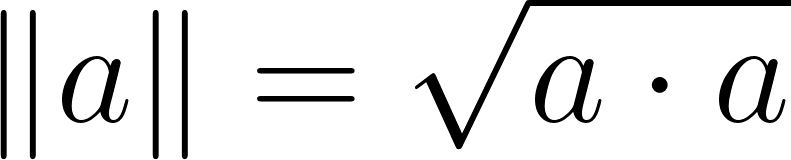 . A
loopwith twoacrossclauses stops at the shorter vector without warning, sov-dotfirst checks that the lengths match. Mixing vectors from two embedding models is a common mistake, and an error beats a plausible but wrong score.v-cosineguards against division by zero: it defines a zero vector’s similarity with anything as0.0.- The store maps
idto(text vector)in anequalhash table, so string IDs work.store-addcoerces lists to vectors, so callers can pass either. store-searchscores every entry, sorts in descending order, and returns the top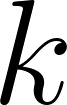 as
(score id text)lists.minkeepssubseqin bounds when the store holds fewer than items.
Running it
1 $ sbcl --script vector-store.lisp
Actual output:
 1 Vector Store Entries: 5
 2
 3 Query 1: Royal female concept #(0.85 0.85 0.05 0.10)
 4   [sim: 1.000] (item-1) "queen"
 5   [sim: 0.996] (item-3) "princess"
 6   [sim: 0.779] (item-2) "king"
 7
 8 Query 2: Sweet fruit concept #(0.05 0.10 0.85 0.90)
 9   [sim: 1.000] (item-5) "banana"
10   [sim: 0.875] (item-4) "apple"
11   [sim: 0.201] (item-3) "princess"
The demo uses hand-made 4D vectors whose axes roughly encode royalty, femininity, fruitiness, and sweetness. Query 1 (high royalty, female) ranks “queen” and “princess” above “king”. Query 2 (a sweet fruit) ranks both fruits above the rest, and the sweetness axis puts the banana (0.95) well ahead of the apple (0.30).
Using it
Replace the toy vectors with real embeddings from an API (Gemini and Ollama both offer embedding endpoints) and this code becomes a semantic search engine over your documents: split text into chunks, embed each chunk, store-add it, then store-search with the embedded question. Brute-force scoring handles thousands of vectors; beyond that, use an approximate-nearest-neighbor index. The interface here (add, search top-) matches what those indexes offer.