2 Theory
Thus we may know that there are five essentials for victory:
(1) He will win who knows when to fight and when not to fight.
(2) He will win who knows how to handle both superior and inferior forces.
(3) He will win whose army is animated by the same spirit throughout all its ranks.
(4) He will win who, prepared himself, waits to take the enemy unprepared.
(5) He will win who has military capacity and is not interfered with by the sovereign.
– Sun Tzu “Art of War”
In this chapter, we will explore the fundamental concepts of League of Legends. These concepts serve as the basics for all other knowledge about the game. A solid understanding of the fundamentals helps you absorb new information more quickly and differentiate between valuable advice and misguided suggestions.
2.1 Basic concepts
In this section, we will review the fundamental concepts of the game. It would be beneficial to organize them systematically. For this purpose, the following list of questions will assist us:
- What is the initial state of the objects on the map?
- What disrupts the equilibrium of the objects?
- What actions are advantageous?
- How to identify an advantage?
- How to acquire an advantage?
- How to turn an advantage into a victory?
Each of these questions relates to a specific game concept.
The order of the questions is important: each one logically follows from the previous one. Similarly, the game concepts are interconnected: more complex ideas build on simpler ones.
The basics may seem trivial, but many new players struggle to understand them. This lack of understanding can prevent them from mastering essential techniques, such as wave management. Until a player grasps the general patterns of League of Legends mechanics, information from guides may appear disjointed and chaotic to him. Absorbing information in this fragmented manner is nearly impossible.
We will examine each concept in detail to eliminate any misunderstandings.
2.1.1 Equilibrium
The first question on our list is as follows:
What is the initial state of the objects on the map?
Initially, all objects on the map are in equilibrium. Equilibrium refers to a balanced and stable state of the game’s elements. All subsequent concepts are based on this idea.
You can easily determine the equilibrium of game objects by examining the Summoner’s Rift map. Figure 2-1 demonstrates it.
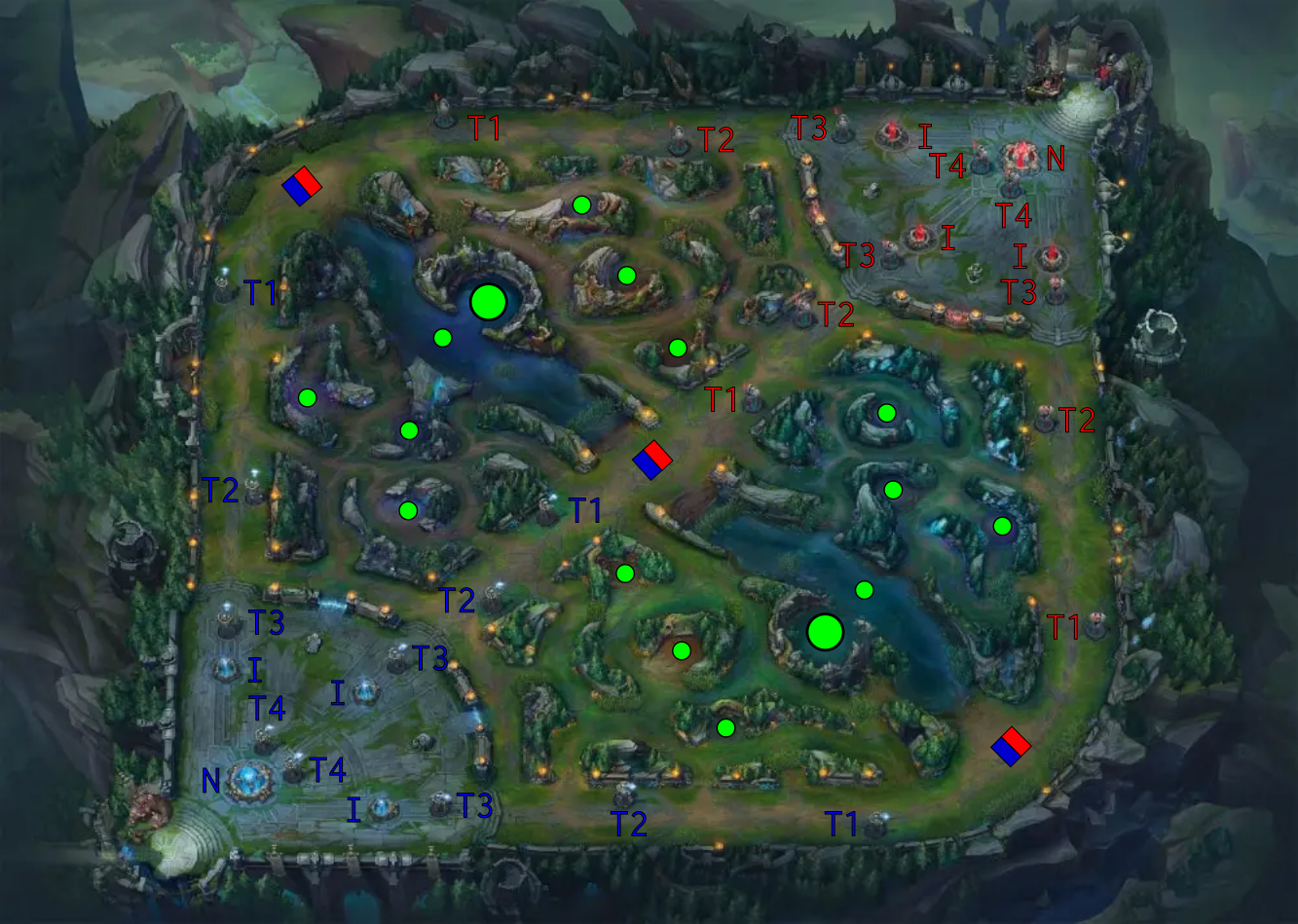
Letters and geometric shapes indicate interactive objects on the map. Note that player champions are excluded for simplicity.
The symbols used on the map are as follows:
- T1, T2, T3, T4 — towers of each team.
- I — inhibitors of each team.
- N — Nexus of each team.
- Green circle — the neutral monster camp.
- Blue rectangle — the minion (creep) wave of the blue team.
- Red rectangle the minion wave of the red team.
You can identify three types of equilibrium on the map:
- Landscape equilibrium.
- Resource equilibrium.
- Teams’ power equilibrium.
Landscape equilibrium refers to the geometry of the map and all static objects on it: walls, bushes, buildings, and roads (lanes). As shown in Figure 2-1, these objects are symmetrical about the map’s center.
Here are some examples of landscape equilibrium:
- The blue team’s base is located in the lower-left corner. The red team’s base is symmetric about the map’s center and is in the upper-right corner.
- The blue team’s jungle with Red Brambleback (red buff) is at the bottom. The red team’s jungle, containing the same camps, is at the top, symmetrically aligned with the map center. The same is true for both jungles with Blue Sentinel (blue buff).
- The baron pit is located in the upper river. The dragon pit is in the lower river, symmetrical to the map center.
- Each structure belonging to the blue team has a corresponding structure for the red team that is symmetrical around the center.
Resource equilibrium refers to the availability of resources for both teams, encompassing both what they currently possess and what they can potentially acquire on the map.
Several objects on the map provide rewards when destroyed. One example is neutral monsters, which are indicated by green circles in Figure 2-1. Each green circle has a symmetrical counterpart relative to the center of the map, meaning that both teams can earn equal amounts of resources from the jungle.
Enemy minions also serve as a source of income. Every 30 seconds, each Nexus spawns the same number of minions, allowing both teams to kill an equal number of them.
Additionally, we can consider all buildings as resources. Destroying an enemy building rewards the attacking team. Due to the landscape’s equilibrium, these resources are also balanced for both teams.
Teams’ power equilibrium refers to all their units: towers, inhibitors, the Nexus, minions, and champions. Towers, inhibitors, and the Nexus are immobile structures. They are subjects of the landscape equilibrium and are symmetrical about the map’s center. This means teams have an equal number of each type of structure.
Minions are mobile units that represent both team power and enemy resources. They move in groups called waves. Waves spawn near the Nexuses at regular intervals — the first wave spawns at 1:05 game time, and then every 30 seconds thereafter.
Three waves of minions spawn simultaneously on each side and move along three lanes: top, middle, and bottom. These lanes connect the bases of both teams. In each lane, the blue and red waves of minions meet exactly in the middle and engage in combat.
Minion waves maintain equilibrium. If the clash front remains in the middle of the lane, it will not move. Its position will remain constant, as shown in Figure 2-1. This stability occurs because each successive wave arrives just as the last minions from the previous wave die.
Champions are the primary mobile units of each team. If a champion becomes significantly weaker compared to opponents, he can no longer effectively contribute to the game. In such cases, the champion becomes a resource for the enemy team, like a minion.
We have considered three types of equilibrium for game objects. Each type is dynamic. This means that if something disturbs the equilibrium of an object, it returns to its original state over time. Let us explore some examples.
Abilities of certain champions can disrupt the landscape equilibrium. They create new walls (Anivia W) or passages (Bard E). These actions disturb the balance of static objects. However, the effects of such abilities are temporary. The landscape will revert to its original state after a few seconds.
When a player destroys an object, it disrupts the resource equilibrium. First, the player receives a reward that the enemy can no longer obtain. Second, the destroyed object disappears from the map. For example, killing a jungle monster leaves its camp empty. Nevertheless, the monster will respawn at its camp after a specific period. The respawn time varies by monster type and ranges from 2 to 6 minutes.
The dynamic equilibrium of power between teams is more intricate. First, only some structures can recover after being destroyed, while others cannot. Second, the minion clash front can shift along its lane. If it strays from the center of the lane, it will gradually return to the center. We will discuss this mechanics in more detail in section “4.1 Minion wave management.”
2.1.2 Action
Here is the second question on our list:
What disrupts the equilibrium of the objects?
Player champions are the only entities capable of disrupting the equilibrium of game objects. Even their mere presence on the map alters the balance of the teams. This happens because cannot select the same champion.
When a champion takes action, it affects a game object and changes its state. This disrupts one of the three types of equilibrium.
We can categorize all possible actions by champions into two types: micro and macro. The most basic actions fall under the micro-level and aim for short-term goals. Here are a few examples:
- Moving a few steps back to avoid an incoming projectile.
- Using a crowd control (CC) ability on an enemy to stop him.
A sequence of micro-level actions combines to form a single macro-level action. It is aimed at achieving a long-term goal. For example, a champion uses auto-attacks and abilities to kill enemy minions quickly. This is considered one macro action, commonly known as pushing a lane.
Here is a list of basic macro-level actions that can disrupt the balance of game objects:
- Attacking enemy minions.
- Attacking an enemy champion.
- Attacking an enemy tower.
- Attacking an enemy inhibitor, if possible.
- Attacking the enemy Nexus, if possible.
- Attacking jungle monsters.
A series of basic macro actions can combine to form a complex macro action. It is aimed at executing a plan consisting of several steps. Here are examples of complex macro actions:
- Split pushing to create a threat on a side lane and gain map control.
- Sieging the enemy base from two directions to destroy one of the inhibitors.
Each player must choose and execute the most advantageous macro action at any given moment. This action should disrupt any type of equilibrium in favor of the player’s team. This way, he increases his team’s chances of winning.
2.1.3 Game scenario
We have examined the actions of player champions. It is important to emphasize that players act within strict boundaries. These boundaries are dictated by the game’s design and balance, as developers aim for each game to follow a specific scenario. To achieve this, they adjust the parameters of game objects to ensure players benefit from adhering to that scenario.
A typical ranked game scenario can be divided into three phases:
- Laning – the beginning.
- Mid game – the middle.
- Late game – the end.
The laning phase begins at the first second and lasts until approximately the 14th minute. It ends when players destroy the first tower on any lane. The primary goals for teams during this phase are to gather resources and prevent the enemy from doing the same.
During the laning phase, players are distributed across the map to maximize their income. It comes from enemy minions and jungle monsters. Therefore, at least one champion should occupy each lane and the jungle.
The standard champion distribution across the map during the laning phase is as follows:
- One player goes to the top lane.
- One player goes to the mid lane.
- Two players (the ADC and the support) go to the bottom lane.
- One player goes to the jungle.
Typically, two players occupy the bot lane. One of them is the support, who does not kill minions. Instead, the support has a special item that provides gold in an alternative way.
The mid game phase typically begins at the 14th minute and lasts until the 25th minute. It ends around the time when players complete their third item. During this phase, teams aim to achieve the following goals:
- Control the map.
- Capture objectives.
When the mid game phase begins, players often swap their lanes. The standard lane swap occurs as follows:
- The ADC moves from the bot lane to the mid lane.
- The top laner moves from the top lane to the bot lane.
- The mid laner moves from the mid lane to the top lane.
These swaps allow the team to control the map better. The champions’ abilities for each role dictate which lane they should occupy during the mid game. We will discuss this topic in more detail in section “4.2 Map Control.”
During the mid game, champions frequently leave their lanes to group up. Grouping allows them to contest objectives more effectively.
The late game phase begins around the 25th minute. By this time, teams usually have destroyed all T1, T2, and T3 towers on one or more lanes.
The goals for teams in the late game phase include:
- Winning decisive team fights.
- Capturing epic monsters.
- Destroying structures in the enemy base (T3 and T4 towers, inhibitors, and the Nexus).
Teams often engage in five-on-five fights during the late game. The outcome of these battles determines which team gains control of the next epic monster. Victory in a decisive teamfight allows the destruction of the enemy’s T4 towers and Nexus.
2.1.4 Advantage
Now we reach the third question in our list:
What actions are advantageous?
Let us look at an example to answer this question. At the beginning of the laning phase, both mid laners arrive in their lane. The players should choose and execute some action every second. If we limit the list of possible actions to the mid lane scope, the players have the following options:
- Attack the enemy champion.
- Attack the enemy tower.
- Farm enemy minions.
- Retreat to a safe area under the ally tower.
In this context, there is an equilibrium of power in the mid lane. This means that the minion clash is in the middle of the lane, with equal numbers of minions on both sides. Additionally, both champions have similar health, mana, levels, and items.
What options does the blue team’s mid laner have?
First, attacking the enemy champion is risky because of the equilibrium of power. There is a 50% chance the player will kill the opponent and receive a reward. But there is also a 50% chance that the player will die, allowing the opponent to gain a reward instead. Therefore, attacking the enemy champion is a disadvantageous action that does not increase the team’s chances of winning.
Second, the player cannot attack the enemy tower without the support of allied minions. They should absorb the tower’s shots while the champion attacks the structure. If the champion tries to do this without minions, the tower will quickly kill him. Thus, attacking the enemy tower in the current situation is unprofitable.
Third, farming enemy minions is a standard action during the laning phase. This maintains resource equilibrium between the mid laners. If the blue team’s player excels at last-hitting minions, he can gain an advantage with minimal risk. This is the best scenario in the current situation.
Fourth, retreating to a safe zone means giving up farming. This decision provides the enemy mid laner with a resource advantage. Therefore, this is also a disadvantageous action that increases the enemy team’s chances of winning.
Now, let us assume that the situation changes and the blue team’s jungler comes to the mid lane. This increases the chances of killing the red team’s mid laner. Thus, attacking him becomes a profitable action.
What happened in our example when the jungler appeared? The blue team gained a numerical advantage in the mid lane. This brings us to the second fundamental concept: advantage. It follows from the concept of equilibrium.
A team gains an advantage when any type of equilibrium shifts in its favor. Every player can gain an advantage in a similar manner when the equilibrium on his lane shifts in his favor.
Advantage comes in various forms, depending on which type of equilibrium has been disrupted. Experienced players identify the following types of advantages:
- By quantity — one team has more champions participating in a team fight than the other.
- By items — one or more champions on the team have more items than their opponents, or these items are of higher value.
- By level — one or more champions on the team are at a higher level than their opponents.
-
By resources — one or more champions on the team have one of the following resources, while their opponents do not:
- health
- mana
- ready-to-use summoner spells
- ready-to-use abilities, especially ultimate
- individual or team buffs received for killing a neutral monsters.
- Map control means a team has vision and influence over key areas of the map. Vision is provided by special items called wards. Influence is gained when champions are within range of key points on the map. We will discuss this concept in section “4.2 Map Control.”
- Positional advantage has two meanings. First, a champion holds a favorable position in a lane compared to his opponent. Second, a team has an advantageous position before the teamfight. Here are examples: flanking, controlling narrow passages, or zoning out the enemy team.
- By team composition — The champions on one team synergize and enhance each other’s abilities better than those on the opposing team.
- By tempo. We will explore the concept of tempo further.
It is important to note that a team can hold multiple types of advantages simultaneously. At the same time, opponents may also have advantages, but of a different kind.
Let us look at the example. The blue team has a stronger champion composition and better map control. The red team has the Elder Dragon buff. The dragon buff is the decisive advantage in this case. A decisive advantage disrupts the equilibrium of power between teams or champions in a lane more significantly than other types of advantages.
Additionally, the significance of each type of advantage can vary depending on the current state of the game. For instance, during the laning phase, a level advantage is generally more critical than an item advantage. This holds true until champions reach level 6. Therefore, a level advantage is crucial in the early minutes, while item advantages become more impactful after level 6.
Let us revisit the question we asked at the beginning of this section. Here are beneficial actions ranked in descending order:
- Utilize the existing advantage.
- Take actions that provide some type of advantage.
- Perform actions that are standard in the current conditions.
Utilizing an advantage is generally the most beneficial action. A team or individual champion may already be stronger than the enemy, and players should capitalize on this strength to gain an advantage. For example, contest an objective when the team has a numerical advantage.
Taking actions that provide some type of advantage is the second most beneficial choice. If a player can shift the balance of power in his favor, he should take advantage of that situation. For instance, attack a dragon to secure its buff.
Performing standard actions is the least advantageous option. This type of action typically aims to maintain the current equilibrium of team power. A player will only gain an advantage from a standard action if he executes it significantly better than his opponent. The example is farming minions in the lane.
2.1.5 Macro cycle
Here is the fourth question on our list:
How to identify an advantage?
A player needs two key elements to identify an advantage:
- Learn patterns for recognizing typical game situations.
- Manage his attention during the game effectively.
We will explore patterns for various gameplay aspects and appropriate actions further in this book. Now, let us discuss attention management.
There is a concept of a macro cycle in real-time strategy (RTS) games. A macro cycle is an approach to effectively managing the game’s economy. The idea is to create a list of tasks and execute them sequentially.
Here is an example macro cycle for a typical strategy game:
- Produce workers.
- Deploy workers to mine resources.
- Produce military units.
- Construct new buildings.
- Perform technical upgrades.
When a player follows a macro cycle, they perform the actions in the order listed. Upon reaching the last action, the player restarts the list.
The advantage of a macro cycle is that it helps players remember essential tasks. Repeated use of the macro cycle builds a strong habit. If an action is included in the list, the player is likely to perform it without expending unnecessary cognitive resources on memorization. This approach ensures that attention is evenly distributed across all aspects of the game.
Random events occur in any strategy game. Some of these events require the player’s full attention. Once the issue is resolved, the player must return to the macro cycle, which serves as his default mode.
League of Legends does not incorporate an economy in the same way as a typical strategy game. Players do not build a base or produce new units. However, the idea of a macro cycle remains relevant. The game encompasses multiple aspects, so players need to balance their attention among them.
A common mistake among new players is focusing exclusively on one aspect of the game. For instance, a novice top laner might concentrate only on the enemy minion wave, striving not to miss any last-hitting opportunities. This narrow focus can prevent the player from noticing his champion’s health, mana, or level. As a result, the player may fail to recognize when he has a health, mana, or level advantage, missing the opportunity to capitalize on it. A macro cycle can help players avoid such mistakes.
The macro cycle for each of the five team roles varies. For instance, let us examine the macro cycles for a mid laner and a jungler.
Figure 2-2 shows the map objects that a mid laner must monitor.
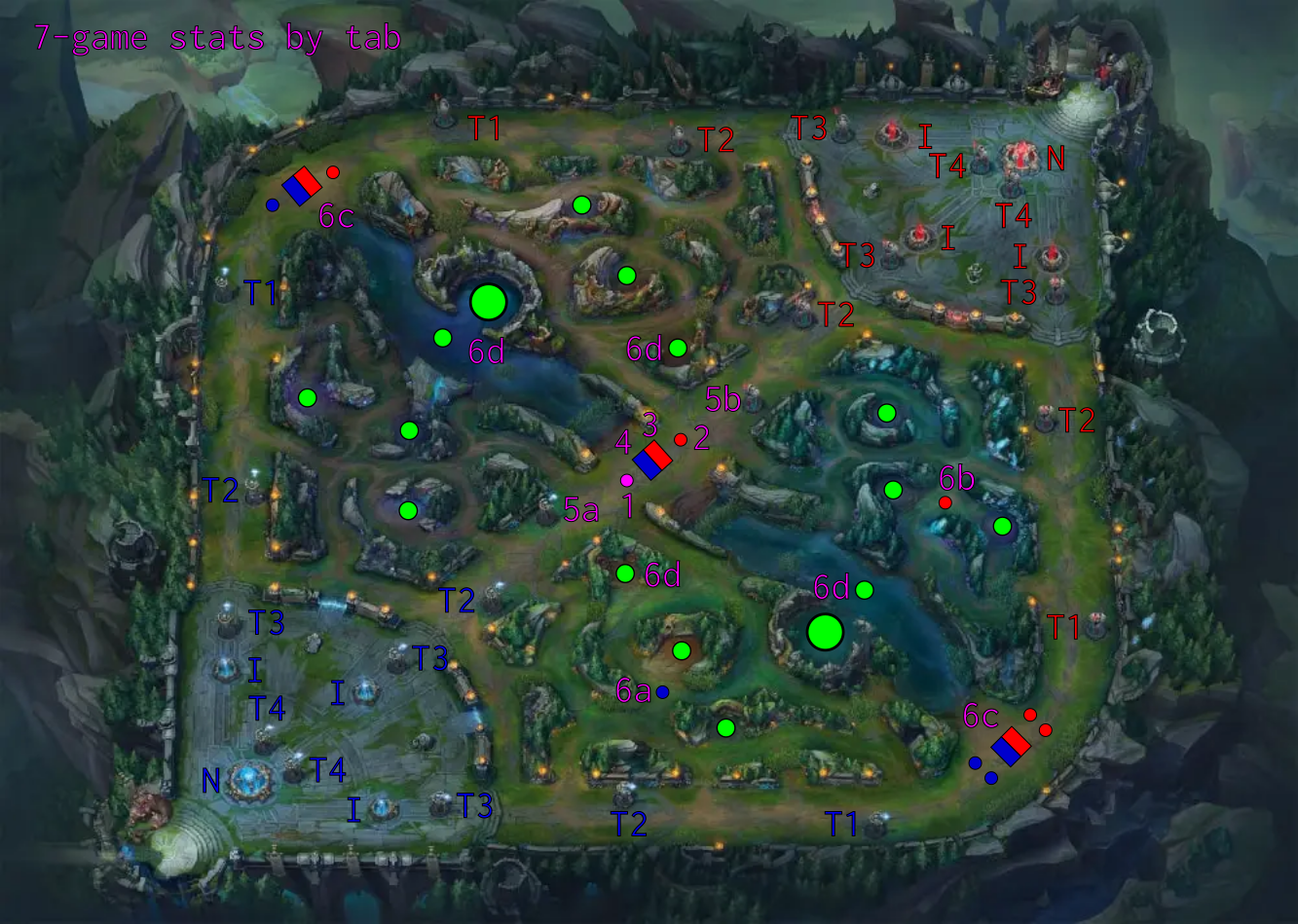
You see the expanded version of Figure 2-1. It has the blue and red circles that mark the champions of each team.
Now, let us take a closer look at Figure 2-2. The pink circle with the number 1 marks the blue team’s mid laner. The pink text indicates the objects that the player should check during his macro cycle. These objects are as follows:
- State of his own champion:
- Health
- Mana
- Level
- Ready-to-use abilities
- Ready-to-use runes
- Items and readiness of their effects.
- State of the enemy champion on the lane:
- Health
- Mana
- Level
- Ready-to-use abilities (remember cooldowns)
- Ready-to-use runes (remember cooldowns)
- Items.
- Enemy minions wave:
- Is there a minion available for last hitting?
- Total number of minions in the wave
- Location of the next wave (symmetric to the next allied wave).
- Allied minion wave:
- Is there a minion available for last hitting?
- Total number of minions in the wave
- Location of the next wave.
- Allied or enemy tower if it is nearby:
- Health and plate count
- Attack range.
- Minimap:
- Location of the allied jungler
- Location of the enemy jungler (requires tracking skill)
- State of adjacent lanes (minion wave positions, presence of champions)
- State of nearby jungle monster camps (especially epic ones: Herald, Baron, Dragon).
- Game stats (accessed by pressing the Tab key):
- Levels of all champions
- Items of all champions.
This list highlights the objects and game aspects a player should consistently monitor. A typical pattern may emerge in one of them. This pattern could indicate a temporary advantage and an opportunity to capitalize on it. It is impossible to notice the pattern without focusing on the corresponding game object.
To find a pattern in something, you have to look at it.
Let us examine the macro cycle of the blue team’s jungler. This role is distinct because the player spends almost the entire laning phase in the jungle. Therefore, his macro cycle is significantly different from that of other roles.
Figure 2-3 illustrates the key elements in the jungler’s macro cycle.
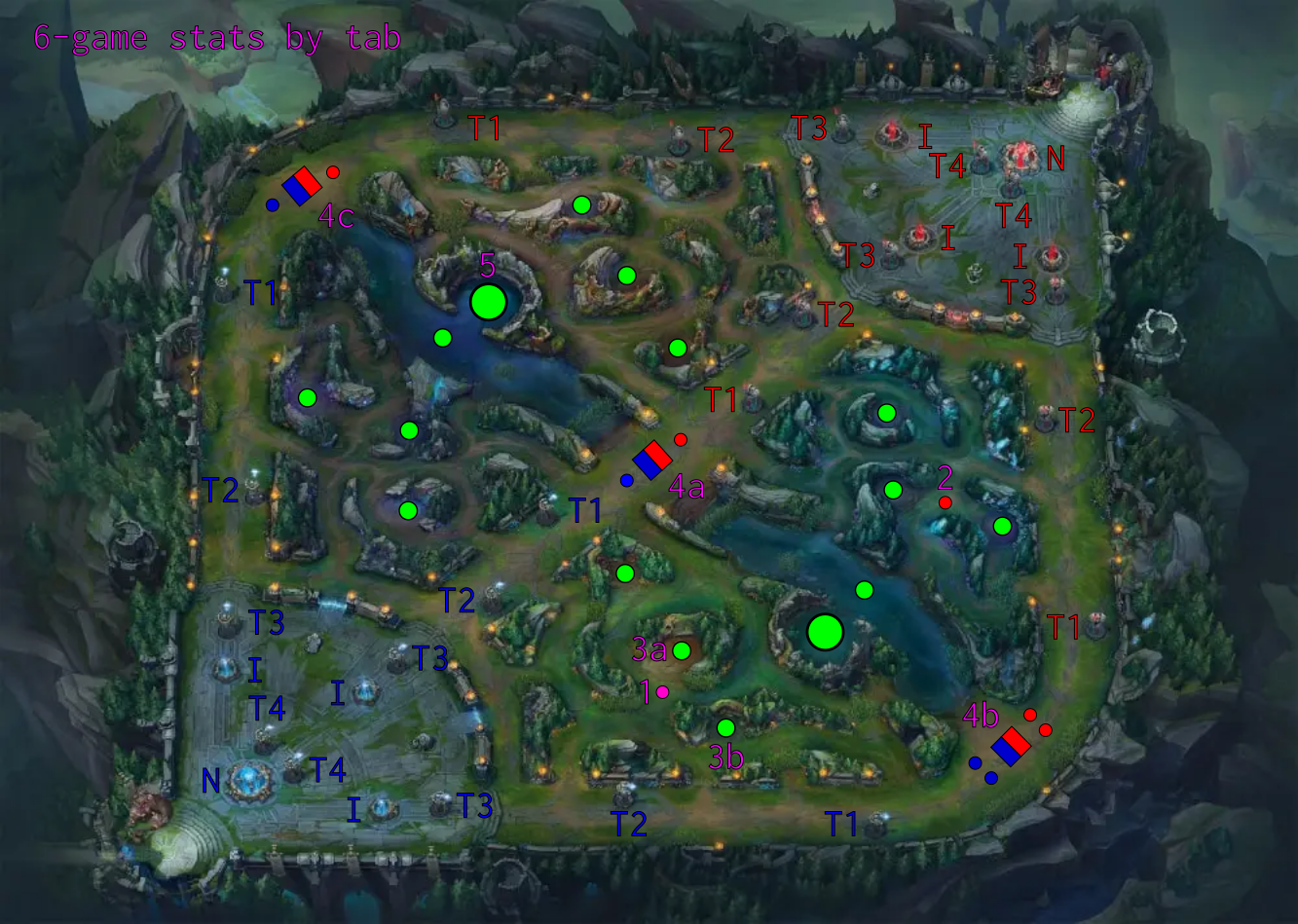
The blue team’s jungler is marked with a pink circle with the number 1. The elements in his macro cycle include:
- State of his own champion:
- Health
- Mana
- Level
- Ready-to-use abilities
- Ready-to-use runes
- Items and readiness of their effects.
- Location and state of the enemy jungler (requires tracking skill):
- Minimap
- Game stats window.
- Nearest jungle monster camps:
- Current target for farming
- Next target for farming.
- Lane state, starting with the closest:
- Position of the minion wave
- Presence of champions in the lane
- State of champions (health, mana, level, items).
- Next epic monster to contest:
- Respawn timer
- Allied champions in range
- Enemy champions in range
- Game stats (accessed by pressing the Tab key):
- Levels of all champions
- Items of all champions.
Keep in mind that a jungler cannot gather all necessary information from the minimap alone. It’s essential to switch the camera to each lane and assess what is happening there. Using the hotkeys F1, F2, F3, and F4 is the most efficient method for this. The following video explains how to configure these hotkeys.
To gradually incorporate the macro cycle into your gameplay, follow these steps:
- Make a minimal list of actions to repeat. A solid starting point might include:
- Checking game objects on the main screen
- Checking the minimap
- Viewing game stats by pressing the Tab key.
- Install and set the metronome app to 15 seconds. This will provide a consistent sound signal.
- When you hear the signal, perform your macro cycle. Consistently switch your focus between the items on your list.
- If a game event distracts you, process that event first. Then return to your macro cycle and start over.
You can begin practicing the macro cycle in “Co-op vs. AI” mode. It will be easier to manage your focus there. The minimal macro cycle will soon become a habit. Afterwards, you can add new actions to the list as you identify them as essential. Gradually decrease the time between sound signals.
Distributing your attention across the game’s key elements is crucial for every role, particularly for the jungler. If jungler is your primary role, you need to master a minimal macro cycle before your next ranked game.
2.1.6 Tempo
Here is the fifth question on our list:
How to acquire an advantage?
Experienced players accumulate advantages from small to large. This is the most reliable way to win against an equally strong opponent.
A player begins to gain an advantage when one type of equilibrium shifts in his favor. He should recognize this shift and take advantage of the opportunity. This means the player should follow a plan in which each step provides a small benefit, gradually leading to a significant advantage.
Tempo is the starting point from which experienced players begin to build an advantage. Let us explore what this term means.
There is a concept called a turn in turn-based strategy (TBS) games. A turn is a specific moment in time when a player is allowed to act. Turns follow one another in sequence. Each player acts on his turn.
League of Legends is a real-time game. Its mechanics allow players to act continuously. The only exception to this is when a player dies. In this case, he must wait for a respawn timer. However, the game does have a concept akin to a turn, called a play.
A team and each of its champions can only operate effectively under certain conditions. Two factors determine these conditions: available resources and players’ positions on the map. If resources are available and the positions are favorable, a play can be made. Otherwise, the team or champion cannot act.
The conditions under which a team or champion can operate effectively are called tempo. Coach Kairos explains this concept in detail in this video. He provides the following tempo formula for a specific champion:
The first part of the formula is champion power. It is the sum of the champion’s primary resources. We can categorize these resources into two types:
- Static
- Dynamic.
Static resources are those that a champion has already acquired and cannot lose. Here are examples: level, items, gold, and permanent stacks of specific abilities.
Dynamic resources are those that a champion can spend or lose. Examples include: health, mana, temporary buffs, cooldowns of abilities, summoner spells, and item effects.
We have previously discussed the equilibrium of game objects. One form of this is resource equilibrium, which restores over time. It is obvious that dynamic resources restore over time. For example, each champion passively recovers health and mana, even without returning to the fountain. Additionally, his abilities and item effects also recharge after a cooldown.
It is less obvious that the equilibrium of static resources also restores over time. Here is an example. The blue team’s mid laner is the first player to reach level 18 and acquire all six items. This gives him a significant advantage that can lead his team to victory. However, if the game drags on, the red team comes back. After some time, every red champion will reach level 18 and get all six items. Consequently, the blue mid laner, who initially had an advantage in static resources, will eventually lose that advantage. This way, the balance of power between the teams is restored, along with the equilibrium of static resources.
Coach Kairos suggests evaluating only a portion of a champion’s static and dynamic resources for simplicity. Table 2-1 shows these resources.
| Designation | Description | Scale |
|---|---|---|
| resources | Health and mana | from 1 to 3, where 2 is half |
| stats | Base champion stats per level | from 1 to 5, where 3 is equality of levels |
| items | Items and their stats | from 1 to 5, where 3 is the equality of items |
| cooldowns | Readiness of abilities, summoner spells, and item effects | from 1 to 5, where 3 means that some CDs are ready |
Here is the formula to calculate champion power:
It is important to note that resources serve as the multiplier. This means that health and mana are crucial factors. A champion has no tempo at low health, regardless of his other stats.
The second part of the tempo calculation formula is the distance to the object. The object can be anything, not just an epic monster or an enemy building. In the context of tempo, this could include a lane for a gank, a teamfight, a jungle camp, or even a minion wave.
Tempo is calculated with respect to a specific map object. For example, suppose a champion is on the bottom lane. His tempo on a dragon will be high, but his tempo on Baron will be low.
The distance to an object is measured in seconds required to reach it. For instance, if a player is at the base but has a teleport spell available, his distance to the object is considered small.
Coach Kairos suggests using a scale from 1 to 10 to estimate a champion’s distance to an objective:
- 1 — the champion is already at the objective.
- 5 — the champion is halfway to the objective.
- 10 — the champion is at the base or dead.
Let us calculate the tempo for a specific example. There is a blue jungler Viego. We want to know his tempo on the dragon. For simplicity, we will only consider the junglers of both teams and ignore other champions.
Viego has full health and mana, giving him a resource score of 3. He is at level 8, while the red jungler Ekko is at level 6. This means Viego’s stats score is 5. Viego has purchased his first item, whereas the enemy jungler has not yet acquired one. Then Viego’s items score is 4. All of Viego’s abilities and spells are ready, resulting in a cooldown score of 5. As Viego enters the lower river from his jungle, his distance to the objective is 2.
Here is Viego’s tempo on the dragon:
This is a very high value.
Next, we will calculate the tempo of the red jungler Ekko, who is currently in the top jungle. His distance to the object is 7. His resources are the following:
- Full health and mana: resources = 3.
- He is at level 6 while the enemy is level 8:
stats = 1.
- He does not have his first item while the enemy does: items = 2.
- All abilities and spells ready: cooldowns = 5.
Here is Ekko’s tempo on the dragon:
This results in a very low value, indicating that Ekko cannot contest the dragon.
Coach Kairos’ formula shows how a player can increase his tempo. To do this, a player needs to gain one of the following advantages:
- Resource advantage (health, mana).
- Champion level advantage.
- Item advantage.
- Cooldown advantage for abilities, spells, and item effects.
- Proximity to the objective.
This list works both ways: if the opponent has any of these advantages, he gains tempo. Consequently, the player loses tempo.
Coach Kairos suggests calculating a team’s tempo as the sum of each player’s tempo. The formula looks as follows:
By applying this formula to both teams, you can determine which one currently has the tempo for a specific object. The team that has tempo is more likely to win the fight and secure the objective.
A player can easily gain a slight tempo advantage by moving closer to the objective. However, the tempo advantage is dynamic. It creates a window of opportunity when a team or player can exploit the advantage. If this opportunity is missed, the tempo advantage becomes useless.
2.1.7 Victory condition
Here is the final question on our list:
How to turn an advantage into a victory?
We already know that there are different types of advantages. The advantage within a given type can also vary in quantity. For instance, let us compare the gold gap between teams with 1000 and 14000 gold. In the second scenario, every champion of the leading team is a complete item ahead of his opponent in the lane. This opens up far more opportunities than a 1000-gold advantage.
However, not every advantage guarantees a win. A win condition is a specific type of advantage in sufficient quantity to secure a victory.
A team’s goal for the game is to achieve its win condition. Note that this goal is influenced by team composition. In other words, different champion combinations have different win conditions.
A team needs a general game plan to achieve a win condition. It guides the team’s decisions and actions throughout the game. The plan is based on the following factors:
- The combination of champions in the team.
- The combination of the opponent’s champions.
- Each player’s plan for the laning phase.
The combination of champions in the team determines how they can interact and enhance each other’s capabilities. Players should choose the right strategies for map control and teamfights depending on their champions setup.
The combination of opponents’ champions defines the capabilities of the enemy team. Some enemy champions may completely neutralize the capabilities of the player’s team. Players should take this into account when developing a game plan.
Player’s plan for the laning phase determines how he intends to gain an advantage before the mid game starts. Some champions can rotate and assist their allies during the laning phase. Others are forced to remain in their lane constantly. Otherwise, they will fall behind in the mid game. Players must factor this into their game plan.
There are several typical game plans in the current League of Legends balance. Players choose one of them in the vast majority of games. These plans work in both competitive and ranked matches across all Elo levels.
Here is a list of typical game plans in League of Legends:
1. Early game aggression. The team picks champions who are very strong during the laning phase. Examples include Renekton, Lee Sin, and Lucian. These champions outperform their opponents in the lane with equal resources due to their early power spikes from abilities. These power spikes enable them to secure kills and gain an early resource advantage. The game plan is to build this advantage from small to large.
2. Late game scaling. The team has at least one hypercarry champion. Examples include Kayle, Jinx, Smolder, Aurelion Sol. These champions may be weak early on, but become exceptionally powerful in the late game. The plan is to slow down the game and gain resources on par with opponents. The same resources give the hypercarry stronger power spikes than other champions. Then they dominate teamfights in the mid and late game. The team’s plays revolve around hypercarry.
- Split push. This strategy involves a single champion pushing a side lane. The game plan is to create a threat to destroy an enemy tower or inhibitor, forcing opponents to react. This reaction gives the team map control and a numerical advantage when contesting objectives.
- Teamfight. The team picks champions who excel in five-on-five combat. These champions have abilities that allow them to engage opponents or deal area-of-effect (AoE) damage. Examples include Malphite, Amumu, Rumble, Zyra, Brand. The plan is to accelerate the pace of the game and force frequent fights for objectives on the map. A well-combined roster of champions provides the team with an advantage in these plays.
- Siege. The team picks champions with long-range abilities or auto-attacks. Examples include Jayce, Ziggs, Caitlyn, Ezreal, Zoe. The game plan is to deal damage to the opponents from a safe distance. This drains the enemies dynamic resources. The team should force a fight for the objective once opponents are unable to act due to a lack of resources.
The effectiveness of a game plan increases with the number of champions on a team that align with it. However, the enemy team can also select champions that counter a specific game plan. Therefore, experienced players combine several plans in competitive games and at high Elo levels. For instance, a team might pick one hypercarry accompanied by several champions that focus on early aggression. This way, players compensate for the weaknesses of their champions.
The team should have a general game plan. Also, an individual player could have it too. An individual game plan is essential at low Elo levels, where it is challenging to communicate with teammates and reach consensus quickly. Some game plans are built around a single champion, such as split-pushing or scaling. Experienced players can execute these plans on their own. This way, they are less dependent on team decisions and can achieve the win condition independently.
Let us return to our question: how to turn an advantage into a victory? The team must utilize its advantage to implement its general game plan. For instance, the players should gradually accumulate the advantage until it becomes decisive in the “early aggression” plan. Another example, the players should capitalize on their advantage in the objective contests in the “teamfight” game plan. The team achieves its win condition by consistently adhering to the game plan.
2.2 Economy
The general that hearkens to my counsel and acts upon it, will conquer: let such a one be retained in command! The general that hearkens not to my counsel nor acts upon it, will suffer defeat — let such a one be dismissed! While heading the profit of my counsel, avail yourself also of any helpful circumstances over and beyond the ordinary rules.
– Sun Tzu “Art of War”
In this section, we will examine the economic aspect of League of Legends. It is much simpler than in a typical real-time strategy game. Despite this, the economy plays a crucial role and can often determine the outcome of a match.
A player must calculate the resources that each of his possible actions would provide. This allows him to distinguish between profitable and unprofitable actions. By doing so, the player can invest his time and resources more effectively. The team that converts time into resources better typically gains a significant advantage.
Let us look at how to calculate resources correctly when planning actions.
2.2.1 Gold and experience income
Resource calculations assist in decision-making. The more precise these calculations are, the more comprehensive the information available to a player. This information can lead to better decisions, although it does not ensure flawless gameplay.
Now, let us calculate the resources that champions receive during the laning phase.
2.2.1.1 Income on lane
Let us first examine the champions who farm minions in each lane. The first wave of minions for every lane spawns near the Nexus at 1:05 game time. Subsequent waves then spawn every 30 seconds: at 1:35, 2:05, and so on.
When a champion last hits all enemy minions in a single wave, he receives the maximum possible gold. This gold amount increases as the game progresses.
Table 2-2 shows the average gold value of one minion wave based on game time.
| Game time | Average gold per wave | Average gold per 1 cs |
|---|---|---|
| 0:00 | 125 | 19.8 |
| 15:00 | 147 | 22.6 |
| 17:15 | 150 | 23 |
| 25:00 | 190 | 27.6 |
According to the table, one minion wave costs an average of 150 gold. Waves spawn at the Nexus every 30 seconds. Therefore, a champion in a lane can farm two minion waves in one minute. Consequently, this results in an estimated income of around 300 gold per minute.
In addition to gold, killing a minion also rewards the champion with experience (EXP or XP). If the champion is within 1500 range when the minion dies, he receives experience. Getting this reward does not even require attacking the minion.
Table 2-3 shows the experience rewards for each minion type.
| Minion type | Experience reward | Reward increases every 3 minutes |
|---|---|---|
| Melee minion | 60 | +5 |
| Caster minion | 30 | +3 |
| Siege minion | 93 | +7 |
Each wave includes three warrior minions and three mage minions. The first siege minion appears in the fourth wave. From that point until the 15th minute, it appears in every third wave: 7, 10, 13, and so on. After the 15th minute and up to the 25th minute, siege minions appear in every second wave. After the 25th minute, each wave includes a siege minion.
Let us calculate the experience income per minute in a lane. In one wave, a champion receives 60 * 3 + 30 * 3 = 300 experience on average until the 15th minute. This means he receives 600 experience in two waves. Consequently, his income is 600 experience per minute. We could evaluate whether this is a big or a small number. To do this, let us refer to Table 2-4. It shows the amount of experience and the number of minion waves a champion needs to reach each level.
| Level | Experience | Minion waves | Shared minion waves |
|---|---|---|---|
| 2 | +280 | 2 | 2 |
| 3 | +380 | 3 | 4 |
| 4 | +480 | 4 | 6 |
| 5 | +580 | 6 | 9 |
| 6 | +680 | 9 | 12 |
| 7 | +780 | 11 | 16 |
| 8 | +880 | 14 | 21 |
| 9 | +980 | 18 | 26 |
| 10 | +1080 | 21 | 31 |
| 11 | +1180 | 25 | 37 |
| 12 | +1280 | 30 | 43 |
| 13 | +1380 | 34 | 49 |
| 14 | +1480 | 39 | 55 |
| 15 | +1580 | 45 | 62 |
| 16 | +1680 | 49 | 69 |
| 17 | +1780 | 54 | 76 |
| 18 | +1880 | 60 | 84 |
Shared minion waves mean that two champions are present in the same lane. In this case, killing each minion grants a total of 130% of the experience normally gained. This experience is divided evenly between the two champions, with each receiving 65%. As a result, they will generally be at a lower level compared to champions in solo lanes.
It is important to note that the 30th minion wave spawns at 16 minutes, which is approximately when the laning phase ends.
2.2.1.2 Income in jungle
Now, let us discuss champions who farm jungle monsters. Each jungle camp provides 4 creep score, which translates to an average of 100 gold. A jungler can take about three camps per minute during the laning phase. Therefore, his income is approximately 300 gold per minute. This is roughly equivalent to the income of a champion farming in a lane.
In addition to gold, killing a monster also grants experience. On average, a jungler receives between 165 and 240 experience for each camp. This value increases as the game progresses. For three camps, a jungler gets an average of 600 experience. Consequently, his income is approximately 600 experience per minute. This is also roughly equal to what a champion in a solo lane earns.
Table 2-5 shows how many monster camps a jungler needs to clear in order to reach the first 7 levels.
| Level | Experience | Camps | Creep score |
|---|---|---|---|
| 2 | +280 | 1 | 4 |
| 3 | +380 | 3 | 12 |
| 4 | +480 | 6 | 24 |
| 5 | +580 | 10 | 40 |
| 6 | +680 | 13 | 52 |
| 7 | +780 | 17 | 68 |
For killing the first camp, the champion receives an additional 150 experience thanks to a jungle item. The item also provides an extra 80 experience for killing large monsters. Thus, the jungler always gains level 2 at 4 CS.
We examined the income of champions in the lane and jungle. We can draw the following conclusions from this:
- The first four minion waves are extremely important. For the jungler, the first jungle clear is crucial. This is six monster camps in total.
- Preventing a champion from earning income in the first minutes of the game gives an advantage of two or more levels later on.
- When a champion is not farming his lane, he loses resources. For every minute the champion is absent, he misses out on approximately 300 gold and 600 experience.
- Sharing minion waves between two champions is beneficial only in the early game. As the match progresses, this shared income becomes less advantageous. This increases the level gap with solo laners.
Experienced players pay close attention to the first two waves of minions in the lane. In the early game, each minion kill is crucial. It can determine who gains an early advantage. A skilled player can convert this advantage into the first kill and tower plates. Therefore, making the right decisions in the first minutes of the game can heavily influence the outcome of the laning phase.
2.2.2 Action planning
Beginner players often fail to see the connection between their actions and their long-term consequences. As a result, they underestimate the impact of their mistakes and miscalculations.
For example, when a jungler executes a poor gank, the enemy top laner may survive without taking any damage. The jungler may think there is nothing wrong with this play, and the resource equilibrium between the teams remains unchanged. In fact, this is not the case: the enemy team has actually gained an advantage. The reason is that the player wasted time that could have been spent farming monster camps, while the enemy jungler kept farming.
Let us examine several gameplay situations from an economic perspective. They will illustrate how resource calculations can predict the outcome of a given play.
2.2.2.1 Gank
In the first example, the blue team’s jungler is planning his next actions. He has just returned to base after the first jungle clear. For simplicity, let us assume he is considering only two options:
- Continue farming his jungle.
- Gank the enemy mid laner.
We have previously established that farming the jungle allows a champion to earn approximately 300 gold and 600 experience per minute. If the enemy jungler does the same, the resource equilibrium between the teams remains unchanged.
Now, let us calculate the potential outcome of ganking the mid laner. First, we need to estimate the time it will take. The champion will spend about 30 seconds reaching the mid lane and positioning themselves to attack. This time may vary based on mobility items and runes.
Here is the next step. After reaching the mid lane, the blue jungler needs to wait in ambush for the right moment to attack. For example, when the red mid laner moves far away from his tower. At this moment, the player attacks and pursues the target for a while. The blue jungler spends about 40 seconds making this play in total.
We found that the jungler spent about 40 seconds on the gank. If the player chooses to farm instead of ganking, he would take one monster camp for this time. It provides approximately 100 gold and 200 experience. This is the jungler’s fee for participating in the gank.
Next, let us calculate what every team gets from this gank. There are three participants in this play: the red team’s mid laner, the blue team’s jungler, and the blue team’s mid laner. Each player has three possible outcomes:
- Killed
- Survived with minimal health
- Survived with medium or high health.
In the first scenario, the champion was killed by the enemy. He is then absent from the map for a certain period. This time is made up of two parts:
- The resurrection time, which depends on the champion’s level. During the laning phase, this is on average 20 seconds.
- The time to reach the middle of his lane or a jungle camp. This time is around 30 seconds and depends on the champion’s items and abilities.
In total, a killed champion is absent from his lane or jungle for almost one minute. During this time, he loses two minion waves or three jungle camps. Consequently, he loses 300 gold and 600 experience.
The second scenario is when the champion survives with minimal health. In this state, it is dangerous for him to remain in his lane or farm the jungle. The enemy jungler can easily finish him off.
The champion needs to return to base and recover. For doing that, he spends 8 seconds casting the recall spell. Afterward, he restores health and mana at the fountain for over 10 seconds. The champion then returns to the lane for about 30 seconds. In total, he is off the map for approximately 50 seconds. This means he will miss almost two minion waves. Consequently, he loses 300 gold and 600 experience. These calculations are valid for both the mid laner and jungler.
Third case: the champion survives with medium or high health. In this state, he can continue farming lane minions or jungle monsters. If he has enough gold, he can return to the base and buy an item. Recall will cost him about 40 seconds off the map. That is at least one missed wave, or approximately 150 gold and 300 experience.
Let us summarize the results for all three champions and estimate the team’s income. For simplicity, we will focus only on three outcomes of a gank:
- Best case. The red team’s mid laner is killed, while the blue team’s champions remain at full health.
- Mediocre case. The red team’s mid laner survives with minimum health, while the blue team’s champions remain at full health.
- Worst case. The red team’s mid laner remains at full health, while both blue team champions are killed.
In the best case, the blue team’s income would be as follows:
- The blue jungler and mid laner receive gold and experience for the kill. The player who secured the kill receives 300 gold, while the player who assisted receives 150 gold. It totals 450 gold. They both share approximately 300 experience.
- The blue mid laner can stay in lane and continue farming. Then he will earn 300 gold and 600 experience in one minute. His opponent will be absent from the lane for the entire time.
We can calculate the total advantage in favor of the blue team by combining the kill reward and the mid laner’s farm. Then we need to subtract the jungler’s fee for participating in the gank.
Here is the gold advantage for the blue team:
Here is the experience advantage for the blue team:
A team advantage of 650 gold and 700 experience is significant in the first minutes of the game. Therefore, an early successful gank can significantly impact the laning phase.
In a mediocre gank case, we calculate the blue team’s income in the same way. However, we must exclude the bounty for killing the red team’s mid laner from the formula.
The red mid laner will return to base to regenerate health. This will cost him one minute of missed farm.
Here is the gold advantage for the blue team:
Here is the experience advantage for the blue team:
The blue team got a decent result. But it is unlikely that this advantage decides the outcome of the laning phase.
In the worst gank case, the red team gets the advantage. It comes from the following:
- The red mid laner receives the bounty for the double kill. That is 300 gold and 300 experience for each blue champion.
- The red mid laner can stay in lane and farm. Then he will receive 300 gold and 600 experience. The blue mid laner would not receive these resources.
- The blue team’s losses would amount to twice 300 gold and 600 experience. This is the missed farm per one minute of the blue mid laner and jungler.
The red team’s overall advantage will come from the mid laner’s gain and both blue champions’ losses. We must also factor in the jungler’s fee for making the play.
Here is the gold advantage for the red team:
Here is the experience advantage for the red team:
These numbers show that a failed gank gives the enemy team a significant advantage. After such a play, it becomes nearly impossible for the blue mid laner to recover from this substantial gap.
Here is the summary for our calculations. The gank is beneficial for the blue jungler only if it leads to at least a mediocre result. To reduce the cost of participating in the gank, the blue jungler should come to the mid lane after clearing his camps. This approach will increase the potential income in case of success and slightly reduce losses if the gank fails.
Our example illustrates the consequences of a single serious mistake in League of Legends. Either a poor plan or poor execution can cause such a mistake. In other words, even a good plan does not guarantee an advantage if a player can not execute it well.
2.2.2.2 Taking the dragon
In the second example, the blue team’s jungler takes the Infernal Drake. First, he clears all his jungle camps for the second time. Then, he goes to the dragon pit. This way, the player uses his time as efficiently as possible.
Let us say Xin Zhao is the blue team’s jungler. He is level 5 when he approaches the dragon pit. His damage per second (DPS) is around 100 physical damage (AD). At this point, the dragon has 5730 health. This means the jungler will take down the monster in about one minute.
For killing the dragon, the jungler will receive 125 gold and 150 experience. His jungler item will provide an extra 80 experience. Additionally, the team will receive a permanent buff for the rest of the game, granting 3% attack damage (AD) and ability power (AP). We can convert this buff into gold.
The following table gives the cost of a champion’s stats in gold. According to the table, we get the following values:
- 1 AD = 35 gold
- 1 AP = 20 gold
Since Xin Zhao has 100 AD, taking the dragon will give him an additional 100 * 0.03 = 3 AD. This increase is equal to 3 * 35 = 105 gold. We can take this number as the average value for all AD champions on the team.
At this point, an AP champion will have a maximum of two Amplifying Tomes. Therefore, his total AP will be 20 + 20 = 40. Taking the dragon will grant this AP champion 40 * 0.03 = 1.2 AP. This increase is equal to 1.2 * 20 = 24 gold.
Now, we can calculate the average gold gain for all AD and AP champions on the team:
This means that taking the red dragon will provide the entire team with approximately 300 gold at the beginning of the game. Consequently, when the jungler soloed the Infernal Drake, the team earned 425 gold and 230 experience. Part of this reward went to the jungler, and the rest went to his allies.
Let us compare the jungler’s reward from taking the dragon with his typical monster farming per minute, which provides 300 gold and 600 experience. These numbers are bigger than the reward for the dragon. Consequently, the jungler personally paid 300 - 125 - 105 = 70 gold and 600 - 150 - 80 = 370 experience for taking the dragon. His team received a total of 320 - 70 = 250 gold.
We can conclude that the jungler lost approximately half a level by taking the dragon. The team’s overall gain was modest. This means that taking the dragon is a long-term investment for both the jungler and his team. It does not provide any significant advantage immediately. However, the dragon’s buff will give much more value in the late game when converted into gold.
Let us consider the worst-case scenario for taking the dragon. In this scenario, the blue mid laner and ADC help their jungler to take the object. Together, they take the dragon in about 20 seconds. Afterward, the mid laner and ADC will spend another 10 seconds returning to their lanes. Their total gold fee for participating in this team play is as follows:
The experience payment is:
At the early stages of the game, these values represent a significant investment. We calculated that the team earns 425 gold and 230 experience from taking the dragon. The reward almost compensates for the gold fee for participating in the play, but not the experience.
Now, imagine that the red jungler waits in ambush while the blue champions take the dragon. When the monster has low health, the red jungler finishes him off with Smite and escapes. In this case, the blue champions receive nothing for their participation fee in the play.
The red team gains a significant advantage from the dragon steal. It consists of the following:
- The participation fee for team play from the blue champions.
- The dragon reward: gold, experience and the buff.
Here is the gold advantage for the red team:
Here is the experience advantage for the red team:
This example shows that stealing a dragon grants the enemy team a significant advantage. It is challenging to compensate for this advantage in the early game.
We can draw several conclusions:
- The more champions involved in a team play and the longer it lasts, the more expensive it is for the team.
- Epic monsters should be taken down as quickly as possible. This minimizes the chance of enemy interference.
- A failed team play gives the enemy a significant advantage. The higher the cost of participating in the play, the greater the consequences of a mistake.
2.2.2.3 Destruction of the tower
In the third example, the team attacks an enemy tower. The tower gives only a gold reward, but no experience. First, let us examine how this reward counts.
Figure 2-1 shows the various tower types: T1, T2, T3, and T4. The tower type determines the reward for destroying it. Table 2-6 provides the specific numbers.
| Tower designation | Tower name | Global gold | Local gold |
|---|---|---|---|
| T1 | Outer turret | 50 | 250 |
| T2 | Inner turret | 25 | • 425 on mid lane |
| • 675 on top and bot lanes | |||
| T3 | Inhibitor turret | 25 | 375 |
| T4 | Nexus turret | 50 | 0 |
When a team destroys an enemy tower, it receives two rewards: global gold and local gold.
Global gold is distributed to all champions on the team, including those who are currently dead. Local gold is divided equally among champions who are within a 1200 radius of the destroyed tower. If a champion deals damage to the tower within 10 seconds before its destruction, he also receives the local gold, regardless of his distance from the tower.
The outer turrets have a plating mechanic turret plating. This mechanic divides the tower’s total health into five parts. Each part represents 1000 health, for a total of 5000 health. A champion earns 125 local gold for each plate he destroys. After losing each plate, the tower gains bonus armor and magic resistance for 20 seconds. At the 14th minute, the plates disappear, and players can no longer obtain rewards for them.
Considering tower and plate rewards is crucial when calculating resources. These are two significant sources of income that can provide a team with a substantial advantage.
Let us return to our third example, where players destroy the tower. The blue team takes Baron Nashor. The red team tries to prevent this, leading to a five-on-five teamfight. Three red champions and two blue champions are killed. The red team then retreats, allowing the blue team to finish off Baron Nashor.
The three surviving blue team players must decide on their next action before recalling. For simplicity, we assume that they have only two options:
- Pursue the two surviving red champions.
- Destroy the enemy T2 tower on the top lane.
Let us calculate the blue team’s reward for pursuing. The reward for each red champion killed includes 300 gold plus an additional 150 gold for the assist. This gives a total of 450 gold. The experience reward for each champion killed is 300.
The maximum gold reward for both red champions would then be:
The gold reward without assists reduces to the following:
The experience reward does not depend on assists and will be as follows:
Now, let us calculate the blue team’s reward for destroying the T2 top lane tower. Each blue champion will receive 25 global gold. Those champions who destroyed the tower will split 675 local gold. In total, this would give the entire team:
Which action is more beneficial for the blue team? If the pursuit results in two kills with assists, it will yield a greater reward. However, this play comes with a risk: both red champions might escape. Then three blue champions will waste their time and gain nothing. It is likely that one red champion would remain behind to delay the blue team’s pursuit. In this case, the blue champions kill only him and receive 450 gold and 150 experience.
The reward for destroying the tower is more reliable. Two red champions with depleted resources would be unable to defend the tower. Thus, the blue team can confidently secure 800 gold by attacking the tower. This reward exceeds the likely outcome of the pursuit, which could result in only 450 gold and 150 experience. Therefore, the blue team should choose to attack the tower.
You might wonder why the blue team cannot pursue the enemy first and then destroy the tower. The issue is that pursuing would deplete the blue team’s tempo. The three red champions killed on the Baron will respawn. They will quickly return to the map because the enemy play happens near their base. Then the three blue champions with low resources will find themselves outnumbered in a teamfight. The red champions could surround them near their T2 tower and kill.
When a team has tempo, it needs to decide how to capitalize on it. This typically involves selecting one action from several options. Once the team executes their chosen play, the turn then passes to the enemy.
2.2.3 Practice of resource calculation
We have examined three examples of resource calculation. It might seem that only the jungler needs this skill. He is typically the one who initiates team plays around objectives during the laning phase. Therefore, the jungler must calculate the potential consequences of these plays.
In fact, players in every role need the resource calculation skill. Here are some examples when it is required:
- The top laner is planning to assist the jungler in taking a Herald. He should calculate how many resources he will pay for joining this play.
- The mid laner is planning to gank the bottom lane. He should evaluate the team’s potential resource gain from a successful gank against the losses from an unsuccessful one.
- The ADC is planning to assist the jungler in taking a dragon. He should calculate how many resources he will pay for joining this play.
- The support is planning to gank the mid lane. He should evaluate the team’s potential resource gain from a successful gank against the losses from an unsuccessful one.
In each of these scenarios, performing a resource calculation will help determine the profitability of the planned action. If the risk is high and the reward is low, a player should refrain from participating in the team play.
To effectively learn how to calculate resources, the player needs to focus on numbers. However, his attention is in short supply during a game. Therefore, it is better to practice resource calculation by reviewing replays or watching streams.
Beginner players often lack the knowledge for effective self-coaching sessions. On the other hand, resource calculation serves as a universal method for assessing the quality of decisions. It is an excellent starting point for new players. Let us look at an example of how to apply it.
Imagine you are watching your replay to conduct a self-coaching session. During the game, there are clear moments when you make decisions. These usually involve participating in an upcoming team play. For example, your jungler pings for help on a dragon. You need to pause the replay at that moment. Then, calculate the resources your team stands to gain from successfully taking the dragon. Subtract your participation fee for joining this play. Also, evaluate what your team would lose if the opponents contest and secure the dragon.
After completing the resource calculations, consider whether your participation in this team play is justified. Is the risk worth the potential reward? Continue watching the replay and check whether your calculations align with the actual results. If they do not, identify any mistakes in your reasoning. This will provide you with immediate feedback.
Becoming accustomed to calculating resources will improve your time management. To participate in any team play, players pay by losing resources. Therefore, the duration of the play determines the team’s overall benefit. For instance, capturing a dragon in 30 seconds will give your team an advantage. But the same play done for one minute might benefit your opponents instead. Keep this in mind during your games.
While reviewing replays, note how much time you spend making decisions. This could be choosing an item in the shop or planning your next move on the map. Calculate how much time you spend standing still and thinking during the game. Then convert this time into lost resources. If it is a lot, you should focus on improving your decision-making skills.
You can enhance your decision-making speed by recognizing more patterns in typical game situations. Calculating resources will help you identify the right actions. This enables you to remember both the characteristics of specific situations and the appropriate responses. The next time you encounter a similar situation, you will be able to make the correct decision quickly.
If you want to remember patterns of specific situations more effectively, you need to document them. Text notes may not be the best option. For instance, you might write down in a text file: “Do not take the dragon when the team has no tempo.” This is helpful advice in general, but it lacks specificity about a game situation.
Typical patterns in League of Legends are often visual. Therefore, the best way to document them is through visual formats. Take screenshots from replays that illustrate specific patterns. For example, it could be a mistake you want to avoid or good plays you or others make.
Give your screenshot files descriptive names, such as “do-not-take-dragon-without-tempo.png.” Review your screenshots regularly to refresh your memory of familiar patterns. This way, you will gradually accumulate knowledge about the game. Over time, you will stop making the same mistakes, and your decision-making skills will improve.
Taking screenshots is also beneficial when watching guides, streams, competitions, and any coaching sessions. Save and review any significant patterns that you observe in this content.
2.3 Teamfight
You may advance and be absolutely irresistible, if you make for the enemy’s weak points; you may retire and be safe from pursuit if your movements are more rapid than those of the enemy.
– Sun Tzu “Art of War”
In this section, we will discuss the fundamentals of teamfighting in League of Legends. A typical fight follows a standard pattern. Knowing and utilizing this pattern can give your team a significant advantage.
A teamfight, much like a game, consists of a series of sequential phases. Champions solve specific tasks during each of these phases. We will examine these tasks and the champion classes that are best suited to address them.
2.3.1 Teamfight scheme
Game design dictates not only a specific match scenario but also the overall scheme of a teamfight. This scheme reflects how the developers envision the typical interaction between two teams.
Figure 2-4 illustrates the overall scheme of a teamfight.
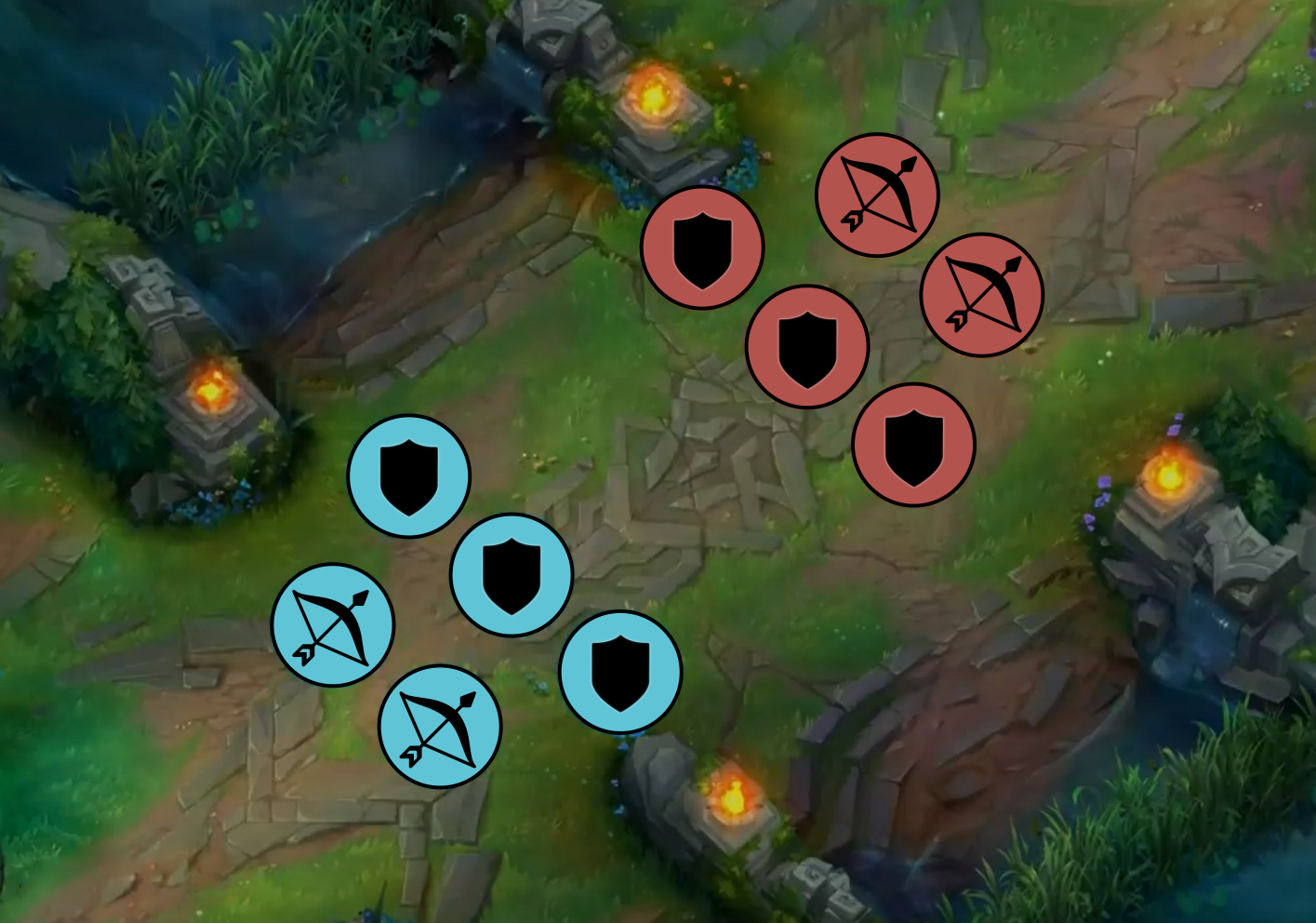
The figure shows the middle lane. All champions from both teams have gathered there. Circles represent the champions, with colors corresponding to their respective teams.
We can divide all champions in the game into two main categories. Figure 2-4 shows these categories by icons in the center of each circle. These icons are as follows:
- Shield is a champion with a large health pool and abilities that enhance survivability. They typically build defensive items.
- Bow is a champion with high damage and abilities that further enhance it. They typically build offensive items.
The first type of champions make up the frontline. They occupy a position closer to the enemy. Champions of the second type stay behind their frontline. They make up the backline.
Let us consider how the teamfight in Figure 2-4 would unfold from the blue team’s perspective. We assume that the power of both teams is approximately equal.
At the start of the fight, the blue frontline champions go ahead and absorb the initial attacks. The red team’s frontline and backline target these champions simultaneously. High survivability of the blue frontline allows it to withstand initial assaults for a while. During this time, the blue backline deals most of the damage to the red frontline. In the simplest case, the team whose frontline is defeated first loses the battle.
Let us assume that the blue team successfully eliminates the enemy frontline. After this, the red backline champions must retreat. Now they are standing against a numerically superior enemy. Furthermore, they have low survivability: even minor damage can be lethal. Therefore, the red backline no longer has time to apply their damage. If they remain in the fight, their damage output will be minimal, and they risk being eliminated.
An experienced backline player knows how to use the map’s landscape to his advantage. To do this, the player positions himself so that there are walls between his champion and the enemy. In this case, the walls act as a frontline: they prevent the enemy from closing the distance. This tactic allows a high-level player to gain time for dealing damage even without a protective frontline.
We have examined a teamfight scheme where both teams operate according to a front-to-back plan. The plan determines the order in which players select their targets. It can be either team-wide or an individual plan for each champion.
There are three standard teamfight plans in the game:
- Front-to-back means targeting the closest enemy first. Typically, this is someone from the enemy frontline. Once that champion is eliminated, the player or team then attacks the exposed enemy backline.
- Back-to-front means targeting the enemy backline first. Typically, this is done by a champion with enough mobility to bypass the enemy frontline. After eliminating the backline, the champion attacks the remaining frontline.
- Flanking refers to a plan in which the champion avoids formation with his team. Instead, he takes a position outside the enemy’s vision (behind a wall or in the bushes). Once the fight starts, the champion capitalizes on the element of surprise to ambush the enemy backline.
Regardless of the target selection order, champions should take a typical formation in any size teamfight. This means that champions with high survivability create the frontline. Behind them is a backline that deals most of the damage. Flanking champions occupy ambush positions. If the enemy possesses back-to-front or flanking champions, the team’s frontline and backline should position themselves closer together.
When a team deviates from a typical formation, it gives the enemy an advantage. Let us look at the example. The blue team does not establish a clear frontline and backline. Their champions stand mixed up when the fight starts. On the other hand, the red team maintains a typical formation. When the fight begins, the red team can concentrate their damage on the blue Bow champions in the frontline. These targets have low survivability and will be eliminated quickly. After this, the blue team will find themselves outnumbered and lose the fight.
It is important to note that the champion type in Figure 2-4 only determines their role in the formation. A ranged champion can still serve in the frontline if he possesses high survivability. Examples include Thresh and Urgot. On the other hand, a melee champion may begin in the backline, waiting for a suitable opportunity to engage the enemy and deal damage. Examples include Kha’Zix and Master Yi.
2.3.2 Time and damage
We have examined the overall scheme of a teamfight. It allows us to draw the following conclusion:
There are two main factors in a fight of any scale: team damage and the available time to deal it.
A similar conclusion applies to individual champions:
In a fight, a champion has a time limit before enemies kill him, and the damage he can deal before that happens.
In other words, the champion has two key parameters in a fight:
- The time he can buy for himself or his team.
- The damage he can deal to the enemy before he dies.
Let us consider the teamfight from the perspective of these two parameters. Then, frontline and backline champions face the following tasks:
- Frontline champions buy time for their team. Actions aimed at this goal are called creating space or spacing.
- Backline champions deal damage during the additional time that the frontline buys for them.
In League of Legends, we can easily split most champions into one of two roles: time-buying or damage-dealing. There are also champions with mechanics that serve both functions. However, they are generally less effective because they are less specialized.
A champion’s kit determines his role. Let us start with champions that buy time for their allies. They have some of the following tools:
- Crowd Control (CC) — this ability briefly disables one or more enemy champions and buys time for the entire team.
- Healing — this ability recovers the health of the champion or his ally. It buys time for the entire team if a player applies it to frontline champions.
- Buff — this ability briefly enhances the champion or his ally’s stats. It buys time for the entire team if a player applies it to frontline champions.
- Shield — same as healing.
- Mobility — this ability provides dashes or speed-up. It buys time for the team if combined with crowd control. Without CC, mobility only buys time for the ability’s owner. We will talk about initiation in a teamfight later.
If a champion has several abilities from this list, his task in a fight is to buy time for his allies. This champion does not necessarily need to be in the frontline. For example, he can also stand in the backline and heal frontline allies.
Here are some examples of highly specialized champions focused on buying time:
- Rammus is a frontline champion. He has three crowd control abilities and one defensive buff. These tools allow Rammus to buy a significant amount of time for his team, even if he is the only champion on the frontline.
- Soraka is a backline champion. She has three healing abilities and one crowd control. With these tools, Soraka can support her allied frontline for a considerable duration.
Champions like Soraka are less effective without a robust frontline. In a teamfight, healing a champion with high health and durability extends his lifespan by 8-10 seconds. However, healing a low-durability backline champion may only provide an extension of 1-2 seconds at most. This would not give the team a significant advantage.
Now, let us discuss champions who focused on dealing damage. Offensive abilities scale either with attack damage (AD) or ability power (AP). The scaling rate can vary: it could be better or worse. Therefore, the same item will provide different power spikes for two champions. It depends on the scaling rates of their abilities.
If most abilities of a champion scale well, his role in a fight is to deal damage. To maximize this damage output, he should primarily build offensive items. These items will be ineffective for a champion with a low ability scaling rate. His damage output will be mediocre at any stage of the game.
At the start of a fight, champions who deal damage can be in either the frontline or backline. This depends on their attack range, mobility, and survivability.
Here are some examples of highly specialized damage-dealing champions:
- Master Yi is a champion with four offensive abilities. At the start of a teamfight, he remains in the backline or in ambush. When enemies focus their damage on a highly survivable ally, Master Yi engages the fight.
- Aphelios is a backline champion whose entire kit is focused on dealing damage. His crowd control ability is only available during specific weapon cycles. Therefore, Aphelios cannot apply his high damage without team support.
2.3.3 Team composition
A team has several typical ways to initiate a teamfight. The composition of its champions determines which of these ways is most effective.
| Composition name | Counters composition |
|---|---|
| Engage | Poke |
| Disengage | Engage |
| Poke | Disengage |
There are three team compositions in the current game balance. Table 2-7 illustrates them.
The engage composition has one to three champions with mobility and crowd control. These champions initiate sudden attacks when the enemy is out of position or has low resources.
The disengage composition has one to two champions with good survivability and crowd control. These tools allow them to stop enemy initiation in a teamfight.
The poke composition has one to three champions with long-range attacks or abilities. They deal damage to the enemies from a safe distance and gradually deplete their dynamic resources.
Each team composition works well against one composition and struggles against another. Let us consider these relationships.
Engage champions are effective against poke composition. They speed up the fight, preventing the enemy from dealing long-range damage. However, engage composition performs poorly if the enemies also have engage tools. In this case, the team that attacks first wins. Disengage composition completely neutralizes engage champions. With this combination, these champions cannot effectively initiate a teamfight.
Disengage champions work well against engage composition. Their tools are designed to absorb and neutralize sudden attacks. They can also stop mobile opponents. Disengage compositions perform poorly against similar compositions. Both teams lack offensive tools and are forced to play defensively. Poke compositions completely neutralize disengage champions. These champions have no tools to reach an enemy with long-range abilities.
Poke champions are effective against disengage composition. They often control the pace of a teamfight and dictate when the full damage exchange begins. A poke composition performs poorly against a similar one. In this combination, the team with the superior long-range damage typically wins. An engage composition completely neutralizes poke champions. The enemies quickly close the distance and initiate damage trades. The long-range attacks and abilities become irrelevant in this scenario.
Players strive to create balanced team compositions in competitive matches. They combine champions of two or three types in one team. This approach decreases the risk that the opponent will completely neutralize their tools.
Table 2-8 shows typical champion combinations in balanced teams.
| Engage | Poke | Disengage |
|---|---|---|
| 3 | 2 | 0 |
| 3 | 1 | 1 |
| 2 | 3 | 0 |
| 2 | 2 | 1 |
| 2 | 1 | 2 |
| 1 | 3 | 1 |
Some champions can fulfill two roles at once. They are especially popular at high levels of play. An example of such a champion is Rell. She has tools for both engage and disengage.
2.3.4 Champion classes
We have looked at the parameters of champions based on their role in teamfights. These parameters are as follows:
- Formation: frontline, backline, flanking.
- Fight plan: front-to-back, back-to-front.
- Team composition: engage, disengage, poke.
- Fight objective: buy time or deal damage.
Let us find out how champion classes relate to these parameters.
League of Legends has an official champion classification. The game developers use it when adding new champions or making balance changes to existing ones. The classification takes into account all the stats of each champion. This is important for developers when adjusting game balance. Overlooking a stat can result in an unbalanced champion that is stronger than the others.
Players rarely use the official classification system. It does not suit their purposes. The player does not need information on every single champion’s stats. He only needs to know everything about their own pool. Then the player needs general information about other champions: their role on the team and in teamfight, build (runes and items), and key abilities. Therefore, players typically use their own classification.
There is no documentation for the classification that players made. It varies slightly across communities. Furthermore, there are exceptions. For example, a champion may build items that are atypical for his class. Nevertheless, this classification is more useful in practice.
Table 2-9 shows the correspondence between the developer and player classifications. It also indicates the role of each class in teamfights and its main characteristics.
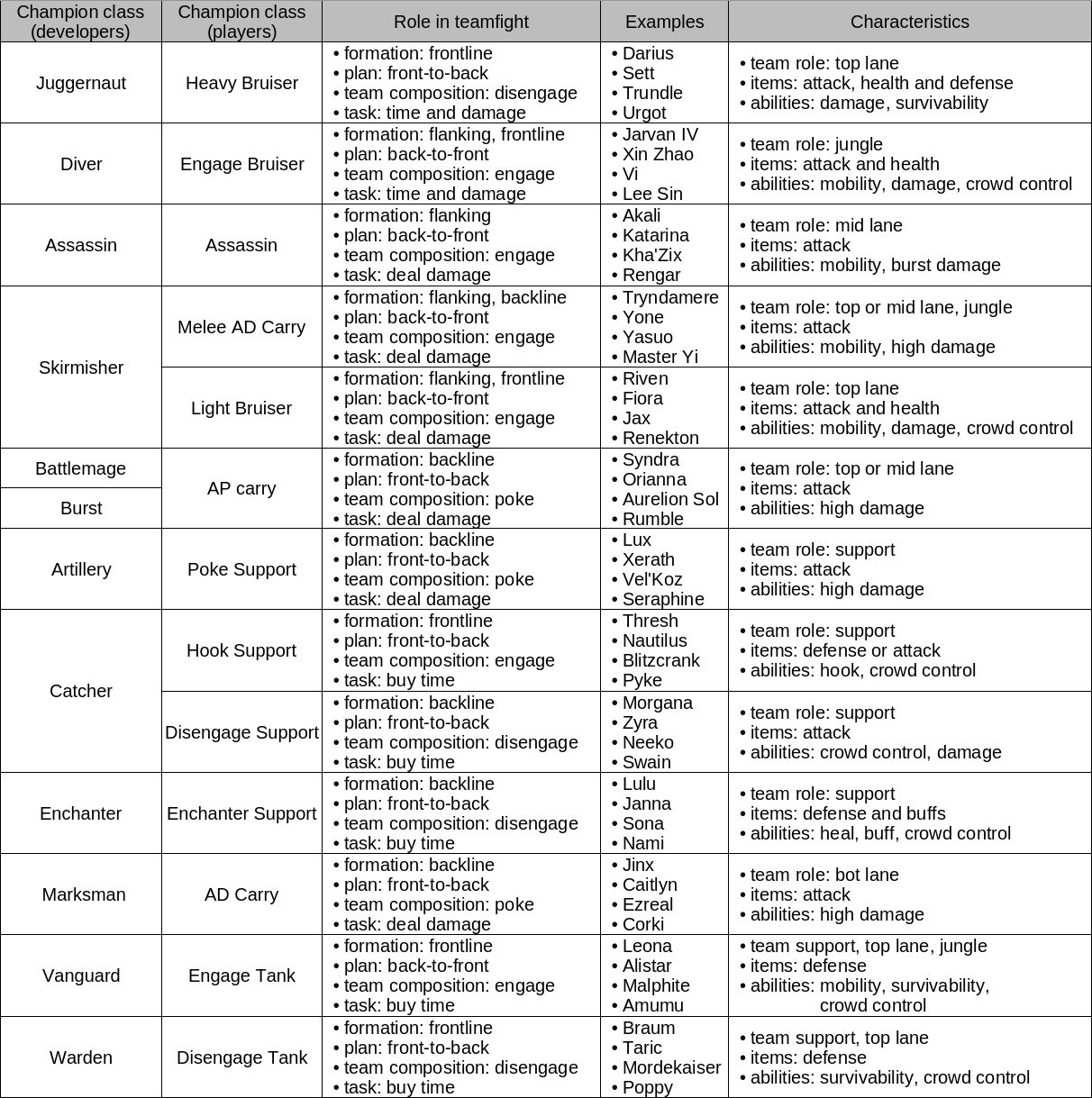
We will use player classification further in this section. It is easier to remember and better reflects the role of each class in teamfight.
2.3.5 Stages of teamfight
We have examined the overall scheme of a teamfight, which follows a front-to-back scenario. This scheme was significantly simplified. In a real game, fights can unfold quite differently depending on the team compositions of both sides.
Let us consider all the possible events that can occur in a teamfight. To do this, we break the teamfight down into sequential stages. These stages are as follows:
- Preparation
- Initiation
- Clash
- Pursuit
You can consider each stage of the teamfight as a separate turn in a turn-based game. During each turn, teams aim to achieve a specific goal. To do that, they resolve a series of tasks. Certain champions possess the tools to execute these tasks effectively.
If a team lacks the tools to act during a particular stage of the teamfight, players will miss their turn. Conversely, if their opponents have the right tools, they can take action. A successful action provides them with initiative and an advantage.
A well-balanced team has the tools to execute each stage of a teamfight. This ensures that opponents cannot gain an advantage by simply possessing specific tools. Experienced players aim to achieve such a balance in their drafts.
2.3.5.1 Preparation
The first stage of a teamfight is preparation. The team’s goal during this stage is to gain any advantage before the upcoming fight begins. A team can achieve this goal by completing the following steps:
- Scouting
- Positioning
- Formation
- Dealing damage
Scouting is the very first step of preparation. It opens up opportunities for a successful attack. Typically, the location of the upcoming teamfight is known: the pit of the next epic monster or a vulnerable enemy structure. Both teams attempt to place wards in this area. These wards provide vision and allow tracking of enemy movement. Some champions can also place traps that serve the same purpose as wards.
If a team is far from the location of the upcoming fight, they can use long-range scouting tools. The most common tool is the blue ward, which can be placed up to 4000 units away. Some champion abilities also provide long-range vision.
In most cases, a support champion performs scouting using a special item for placing wards. He usually works in tandem with his jungler. This collaboration reduces the risk that enemies ambush and kill a relatively weak support before the teamfight begins. Champions that can place traps, like Teemo, Shaco, or Jhin, can also set them near the objective in advance.
Scouting from a distance can be done by champions with suitable abilities. First, it could be projectiles that provide vision along their flight path. Examples: Ashe E, Kai’Sa W, Jinx R, and Ezreal R. Second, it could be an area-of-effect illuminator, for example, Quinn W. Third, it could be an ability that reveals the location of enemy champions on the map. Examples: Warwick W, Rengar R, Twisted Fate R.
Positioning is the second step of the preparation tasks. First, all champions within range should reach the objective as quickly as possible. Being the first to arrive allows them to secure a favorable position. This position could be near a choke point or in bushes. The choke point limits the enemies’ ability to maneuver. The bushes provide cover for backline champions, making it more challenging for enemies to attack them. Favorable positioning can provide a significant advantage during teamfight.
The third step of preparation is formation. Champions with high survivability make up the frontline. Damage dealers position themselves behind, forming the backline. If the team includes flanking champions, they should take positions suitable for ambush attacks. Proper formation allows the team to maximize its resources during the fight.
Dealing damage is the final step of preparation. It gives the team an advantage in dynamic resources. There are several ways to achieve this. First, champions in a poke composition can deal damage with their long-ranged abilities. Second, mobile champions with burst damage can intercept enemies who are just approaching the battlefield and may be out of position.
The following champions are effective for dealing damage during preparation:
- Poke Support (Lux, Xerath, Vel’Koz) with long-range abilities.
- AP Carry (Zoe, Ziggs) with long-range abilities.
- AD Carry (Ezreal, Varus, Corki) with long-range abilities.
- Assassin (Kayn, Zed, Talon) with high mobility.
- Light Bruiser (Jax, Riven) with high mobility and burst damage.
2.3.5.2 Initiation
The second stage of a teamfight is initiation. The team’s goals during this stage are to remove one or more opponents from combat and to win the damage trade. To achieve these goals, the team takes the following steps:
- Engage.
- Follow-up.
- Disengage.
The first engage step begins when champions use their engage abilities, often followed by crowd control abilities. There are two effective ways to initiate combat:
- Dive into the enemy line using a mobility ability.
- Grab and pull an enemy using a hook ability.
The first method temporarily removes the target from combat. The second method disrupts the enemies’ formation. In both cases, the team buys time to deal damage.
Besides hook-type abilities, there are other tools to disrupt enemy formations. For example, Jarvan IV R creates walls and pushes enemies to either side of them. Another example is the Fiddlesticks Q-R combo. All enemies within the R radius are feared and move away from Fiddlesticks. When the formation is broken, frontline champions can no longer defend their backline. This gives attackers a significant advantage.
The following champion classes are effective for initiation:
- Engage Bruiser (Vi, Jarvan IV, Lee Sin).
- Engage Tank (Amumu, Alistar, Malphite).
- Hook Support (Blitzcrank, Thresh, Nautilus).
The second follow-up step occurs immediately after a successful engagement. The idea is to continue attacking the target that was hit by the champion’s engage ability. Typically, this target is affected by crowd control for a period of time and cannot defend himself. As a result, the team can easily focus on this champion to win the damage trade.
All high-damage champion classes are suitable for the follow-up step:
- Assassin (Katarina, Kha’Zix)
- Melee AD Carry (Yasuo, Yone).
- Light Bruiser (Riven, Jax).
- AP Carry (Syndra, Orianna).
- Poke Support (Lux, Xerath).
- Disengage Support (Zyra, Swain).
- AD Carry (Jinx, Ashe).
The disengage step involves actions to respond to the enemy’s engagement. Champions with survivability and crowd control abilities can stop the enemy’s rush. After halting the engagement, the team can focus on the enemy initiators and eliminate them quickly. A successful disengage leaves the enemy team outnumbered.
Champions of the following classes are suitable for counter-initiation:
- Disengage Support (Morgana, Neeko).
- Disengage Tank (Braum, Poppy).
A failed engagement can result in a situation called a conveyor belt. It happens when players try to attack the enemy team without proper coordination. This way, they engage superior numbers of enemies alone or in pairs. As a result, the enemy team easily eliminates players one after another. When the conveyor belt occurs, the team should immediately stop the attack and retreat, regardless of losses.
2.3.5.3 Clash
The third stage of the fight is the clash. The team’s goal during this stage is to maximize damage and win the kill trade. To achieve these goals, the team follows these steps:
- Buy time for the team.
- Deal damage.
- Flank the enemy backline.
This stage begins when the frontlines of both teams clash. From this point on, each side aims to capitalize on any advantage gained during the preparation and initiation stages. If the enemy has established a significant advantage in the previous stages, it is favorable for the team to avoid the fight and retreat.
During the clash, it is important for the team to buy time so that its carry champions can deal damage. All frontline champions and some backline champions perform this task. Their main tools for this include crowd control, healing, buffs, and shields.
The following champion classes can effectively buy time for the team:
- Heavy Bruiser (Darius, Sett).
- Disengage Tank (Braum, Taric).
- Hook Support (Nautilus, Thresh).
- Disengage Support (Morgana, Zyra).
- Enchanter Support (Soraka, Nami).
- Engage Tank (Leona, Amumu).
While champions of these classes buy time, carry champions should deal damage to the enemy. Most of them have powerful auto-attacks or offensive abilities. Carry champions are usually immobile. Therefore, they remain in the backline and adopt a front-to-back strategy.
The following classes are best at dealing damage during the clash stage:
- AP Carry (Sindra, Aurelion Sol, Rumble).
- Poke Support (Lux, Vel’Koz, Xerath).
- AD Carry (Jinx, Ashe, Aphelios)
Flanking becomes especially effective after the teams’ frontlines have clashed. Now, champions with crowd control abilities lock each other down in the frontline. This greatly restricts their mobility in combat. Meanwhile, mobile flanking champions hiding in ambush can target the enemy backline. Then, the backline champions will likely have to defend this attack themselves.
The following champion classes are well-suited for flanking:
- Assassin (Talon, Kayn, Kha’Zix).
- Melee AD Carry (Yone, Tryndamere).
- Light Bruiser (Riven, Jax).
- Engage Bruiser (Vi, Lee Sin).
2.3.5.4 Pursuit
The final stage of the fight is the pursuit. The team’s goal during this stage is to secure as many kills as possible. A team can achieve this goal by completing the following steps:
- Scouting.
- Finishing Off.
The stage begins when one of the teams loses its frontline, leaving its champions outnumbered. The losing team must then retreat to survive. At that moment, the winning team faces a decision:
- Pursue and finish off the survivors.
- Capture the objective on the map.
The team must calculate which option is more beneficial given the current situation. We discussed an example of such a calculation in section “2.2.2.3 Tower Destruction.”
If a team chooses to pursue, it first solves the scouting task. Since the retreating champions leave the battlefield, they are out of the sight of the wards. Therefore, pursuers must scout from a distance. We discussed tools for that in section “2.3.5.1 Preparation.”
Once the target is located, the pursuers attack and finish him off. Mobile champions are effective at this task. Ranged and global abilities are also good tools for finishing off. They deal damage to enemies at a long distance, even when they are out of sight.
The following champion classes are effective for finishing off retreating enemies:
- Engage Bruiser (Vi, Jarvan IV, Lee Sin).
- Assassin (Kayn, Zed, Talon).
- Light Bruiser (Jax, Riven).
- AP Carry (Zoe, Karthus, Twisted Fate) with long-ranged and global abilities.
- Poke Support (Lux, Xerath).
- Hook Support (Blitzcrank, Thresh, Pyke).
- AD Carry (Jhin, Caitlyn, Jinx, Ezreal) with ranged and global abilities.
2.3.6 Pace of teamfight
We have considered all possible stages of a teamfight. At each stage, a team will only perform all steps when it is advantageous to play slowly. Otherwise, events will unfold rapidly. In this case, the team skips some steps or stages that are disadvantageous to them.
The pace of a teamfight depends on the decisions and capabilities of both teams. Players distinguish between two options: a slow pace and a fast pace. Play slow means taking your time and waiting for the right moment to make the next move. In this scenario, the advantage goes to the team that implements its tools more effectively.
Let us look at an example of slow play in a teamfight. We assume that the blue team has a balanced composition: two champions on engage and three units on poke. Poke champions prefer to play fights slowly. They need time to apply their damage during the preparation stage. Therefore, it is advantageous for the blue team to extend this stage and avoid premature initiation and clash stages. The blue champions on engage only benefit from attacking when the red team’s resources are depleted.
Play fast means moving immediately to the stage of the fight that favors for the team composition. Typically, this is the initiation or clash stage. In this scenario, the advantage goes to the team that uses its offensive tools first.
Let us return to our example with the blue team. We assume that the red team has an engage composition: four engage champions and one poke champion. The engage champions benefit from playing the fight fast. They want to immediately move to the initiation phase to prevent the opponent from applying their long-ranged damage. When any of the blue poke champions is out of position, the red team should exploit this opportunity to attack. In other words, they look for an opportunity to initiate as early as possible. When a team has many mobile champions, the clash stage begins within a few seconds of initiation. This way, the red team minimizes the preparation and initiation stages. They move to the clash stage as quickly as possible because red champions have an advantage at melee range.
Let us consider how team composition and tools define the advantageous pace of a teamfight. Table 2-10 demonstrates this relationship.
| Team stat | Fast play is advantageous | Slow play is advantageous |
|---|---|---|
| Number of poke champions | Few | Many |
| Number of engage champions | Many | Few |
| Number of flanking champions | Many | Few |
| Amount of burst damage | Many | Few |
| Amount of DoT damage | Few | Many |
| Backline champions | Weak | Strong |
| Frontline Champions | Weak | Strong |
| Fight plan | back-to-front | front-to-back |
The table demonstrates general patterns. They may vary depending on the specific team compositions.
2.3.7 Player skills
Most teamfights in the game are fast-paced. A beginner player has a hard time keeping it up. He feels like all actions are chaotic, lacking any structure, and are all down to luck. This is not actually the case.
We have covered all the stages of a teamfight — that is its structure. The player must learn to distinguish them. This gives him a clearer understanding of what is happening during the fight. Furthermore, knowing the stages allows the player choose the right actions and the appropriate moment to execute them.
The following skills are crucial for effective performance in teamfights:
- Knowing your role
- Understanding team compositions
- Making quick decisions
- Managing attention.
Let us take a closer look at each of these skills.
2.3.7.1 Knowing your role
First and foremost, a player must know his champion’s role in the teamfight. The following parameters determine this:
- Formation
- Plan
- Team composition
- Task
Table 2-9 lists these parameters for each champion class.
Every champion is most effective only at a certain stage of the fight. This stage depends on the champion’s role. Each role dictates a specific standard plan of action that provides the greatest benefit in most situations. Therefore, a player should almost always follow this plan. We will discuss exceptions below, where it is worth deviating from it.
Here are several standard plans of action:
- A poke champion should not waste time during the preparation stage. His task is to deal damage to opponents from a safe distance consistently. If the champion does not do this, he will not be able to utilize his tools effectively.
- A flanking champion should position himself out of the opponent’s line of sight early on. He does not need to participate in the frontline formation. There, he will not be able to utilize his abilities effectively.
- The engage champion must initiate the fight. If he does not do this at the appropriate time, his engage will not provide a significant advantage for the team.
If a player does not act at the right stage of the fight, he misses the opportunity to utilize his champion effectively. A delayed action will not be as powerful as one made at the correct time. A missed opportunity often allows the enemy to gain the initiative and advantage. Therefore, in some cases, the team should retreat immediately after a missed move.
Another common mistake is premature action. This occurs when a player uses his champion’s key abilities immediately at the start of a teamfight. This is often ineffective.
The concept of holding spells suggests that slowing down fights is usually more beneficial. It happens because the player gathers more information about the evolving situation. This allows him to use the champion’s abilities more effectively.
Here are examples of information that becomes available over time:
- Which enemies will join the fight?
- Which allies will join the fight?
- What resources do the enemies have?
Until a player holds his key abilities, he creates a threat to the opponents. They should respect this threat. In response, enemies may retreat to safer positions away from the player’s champion. This pressure provides an advantage by preventing opponents from utilizing their abilities.
The best moment to use key abilities is when the enemy makes a mistake. Here are some examples of such mistakes:
- Several opponents gather closely together. In this case, a strong area-of-effect (AoE) ability can turn the tide of a teamfight.
- The opponents are separated and far from each other. In this case, engage or flanking the enemy backline, which is left unprotected, can decide the outcome of the fight.
- The opponents have used their crowd control abilities. After doing so, they are temporarily unable to stop the player’s engage and protect their backline.
- Bait opponents into using their key abilities with a minimal outcome. For example, engaging in an ally champion with good survivability in the frontline.
Opponent mistakes open a window of opportunity. Acting during this moment allows the player to use his abilities most effectively. Therefore, it is generally more advantageous to wait before using abilities. The player should wait as long as the stage of the fight in which he should act is ongoing. If this stage is nearing its end, the player should use his tools.
2.3.7.2 Understanding team compositions
The second important skill is understanding the composition of both your team and the enemy team. To do this, you need to determine the following:
- The composition type of your allies’ champions.
- Your team’s key champions.
- The enemy team’s key champions.
Let us start with the first point — your team’s composition. The composition defines the team’s plan for the fight. A player must understand and follow it. Then, he can adapt to the pace of a teamfight that benefits most of his allies. This will improve the team’s overall performance.
Here is an example. Suppose a player picks a champion to engage. All other champions in his team have long-range abilities and prefer to poke from a distance. The player benefits from fast plays, while his allies benefit from a slow-paced fight. In this case, the player must adapt. He should not rush into the first enemy he encounters. He needs to wait for his allies to deal their damage from range. Engaging too early could lead to the player’s death and leave his team outnumbered.
The second point is to know your team’s key champions. These are the champions who can create a decisive advantage. Here are a few examples:
- A hypercarry who has reached his power spike (e.g., Kayle).
- A champion who has won his lane with a significant advantage.
- A champion with a strong engage ability (Malphite R, Leona R).
- A champion with significant area-of-effect damage (Miss Fortune R, Aurelion Sol R).
All of these champions can determine the outcome of a teamfight. Therefore, the player must adapt to their plan. In other words, he should focus on actions that benefit his key allies.
Here is an example. The player’s champion is Aatrox. His standard plan for a teamfight is flanking. But he has a strong ally, Aurelion Sol, who has reached a power spike. In this case, the player should abandon his standard flanking plan. It would be more advantageous to position himself on the frontline to protect his key ally. This will give Aurelion Sol time to deal maximum damage in the fight.
Here is another situation. The team has a very strong engage champion (for example, Vi). Then it would be more beneficial for the Aatrox player to play a follow-up role rather than flanking. Engaging behind a strong ally and playing around him will be more effective than independently attacking the enemy backline from an ambush.
The third point is to know the enemy team’s key champions. These champions can create a decisive advantage for the enemy team. The player must prevent them from maximizing their potential. He can achieve this in several ways:
- Threat to make a trade. The player can use all his resources (flash, ultimate, etc.) to execute a surprise attack on a key enemy champion.
- Block the enemy engage. Any disengagement champion can perform this task.
- Displace the enemy from an advantageous position. Champions with crowd control and poke abilities excel at this task.
Neutralizing key opponents significantly increases a team’s chances of winning the fight.
A general rule for understanding team compositions is as follows:
If a team has a stronger backline than the opponents, you should play around it. If the opponent’s backline is stronger, you should put pressure on it.
This rule means the following. If a team’s backline is stronger, a player should abandon his plan for a fight. Instead, he should position himself on the frontline and buy time for his backline. Conversely, if the opponent’s backline is stronger, a player should primarily focus his attacking resources against that backline.
2.3.7.3 Quick decision making
Decision making is one of the five expert skills that every good player should possess. We discussed it in section “1.1.3 Player skills.”
During a teamfight, making quick decisions is crucial. A delayed or premature action can lead to defeat. When the clash stage of the fight arrives, every second counts. Frontline champions expend their dynamic resources to buy time. Wasting these resources on deliberation or inaction gives the enemy an advantage.
Decision-making skill is directly related to the ability to group information (chunking) and to recognize patterns within it. Players develop this skill through experience. Here are three possible ways to acquire it:
- Trial and Error
- Coaching
- Self-Coaching.
Trial and Error is the most common approach. It involves a player experimenting with different actions during a teamfight using his main champion. When an action yields positive results, the player memorizes the specific game conditions as a template. Then he can repeat the same action next time when similar conditions happen. This way, familiarity with the situation enables quicker reactions.
Coaching helps the player to learn patterns of typical game situations more quickly. A coach highlights mistakes and explains the correct actions for each scenario. This provides the player with a ready-made pattern and the appropriate response to it. His task is to remember this information and practice it in his own games. Then the player will make quick decisions in similar circumstances.
Self-coaching combines elements of the first two. While watching a replay, the player has time to reflect on a specific situation in the game. He can assess all critical factors that influence the outcome of the fight: the role of his champion, the compositions, and the key champions of both teams. From this analysis, the player can deduce the correct action, understand how it differs from his choice, etc. The player then tries to correct his behavior in similar situations in the future. If the adjustment does not work well, he may revert to a trial-and-error approach.
When a teamfight is going on, a player has no time to think. If he recognizes a familiar pattern in the current situation, he can quickly execute the appropriate action. If the situation seems unfamiliar, the player has no choice but to act intuitively. This often leads to mistakes. Coaching and self-coaching help the player to correct these mistakes and memorize typical situations as templates.
When making decisions during a teamfight, always remember this key principle:
The player should be as useful as possible without dying.
This means that the player should focus on more than just eliminating opponents. Putting pressure on them is just as crucial as the measurable outcomes: damage dealt and received. In other words, trading a player for one opponent is not the best option. It is generally more advantageous to remain alive as long as possible and retain the ability to influence the fight’s outcome.
2.3.7.4 Attention management
The fourth important player skill is attention management. During a teamfight, many objects — both allied and enemy champions — are present simultaneously in a small area of the map. The player must effectively switch his attention between these objects. If he misses some important action done by one of the champions, he could make a critical mistake and lose the teamfight.
Tunnel vision is one of the most common mistakes in a teamfight. It occurs when a player focuses his attention on one enemy champion. Typically, this is the target he is fighting or about to attack. As a result, the player lost sight of other participants in the fight. He simply does not see them and their actions. This leads to poor decision-making and positioning mistakes.
Experienced players often exploit the tunnel vision effect to bait opponents. To use this technique, a player must lure the enemies into believing that they have a false advantage. For example, the player approaches the enemy vision while at low health. Opponents could focus on this seemingly easy target and not notice the ambush.
How can a player effectively manage his attention and avoid tunnel vision? First, he should concentrate on his role in the teamfight. This means focusing on the targets that are relevant to his plan for the fight.
Here is an example. The player picks a Disengage Tank for the frontline. The primary task of such a champion is to protect his backline. Therefore, the player should focus his attention on ally carries rather than on enemy champions during the teamfight. If an opponent threatens them, the player should neutralize this target immediately.
Second, the player must learn to recognize bait and not to follow it. If an enemy champion with low health appears within the team’s vision, it does not guarantee an easy kill. First of all, the player should assess his dynamic resources and the overall map situation. If his resources are low or enemy champions are nowhere to be seen, it is better to abandon pursuit.
Third, we have already discussed the concept of the macro cycle. A player could apply it during a teamfight too. Events tend to unfold predictably during the laning phase. Therefore, the player can repeat his macro cycle with delays of a few seconds. During a fight, many events occur in a short period of time. To keep up with them, the player must shift his attention more frequently.
A simple macro cycle for a teamfight looks like this:
- Player’s champion state:
- Position
- Health
- Mana
- Ready-to-use abilities.
- Target for attack or defense. Typically, these are key champions of both teams:
- Health
- Position.
- Environment:
- Enemy champions
- Allied champions
- Towers
- Minions
- Jungle monsters.
Focusing solely on the second item in this list leads to the tunnel vision effect. Ignoring the environment can result in poor positioning and missed opportunities.