Finish the Cup: Constructors and Classes

As discussed in Encapsulating State, JavaScript objects are very simple, yet the combination of objects, functions, and closures can create powerful data structures. We’ve also seen how to use Metaobjects to separate behaviour from domain properties, and to share functionality amongst many different objects. And finally, we saw that one particular type of metaobject, a prototype, provides us with a robust model for delegation.
In this section, we will return to prototypes, and see how to use JavaScript’s class keyword to write one style of “object-oriented” JavaScript.
Constructors and new
Let’s strip a function down to the bare essentials:
const Ur = function () {};
Or the equivalent:
function Ur () {};
This doesn’t look like it has anything to do with objects and constructing things: It doesn’t have an expression that yields a Plain Old JavaScript Object when the function is applied. Yet, there is a way to make an object out of it. Behold the power of the new keyword:
new Ur()
  //=> {}
We got an object back! What can we find out about this object?
new Ur() === new Ur()
  //=> false
Every time we call new with a function and get an object back, we get a unique object. We could call these “Objects created with the new keyword,” but this would be cumbersome. So we’re going to call them instances. Instances of what? Instances of the function that creates them. So given const i = new Ur(), we say that i is an instance of Ur.
We also say that Ur is the constructor of i, and that Ur is a constructor function. Therefore, an instance is an object created by using the new keyword on a constructor function, and that function is the instance’s constructor.
An instance is an object created by using the
newkeyword on a constructor function, and that function is the instance’s constructor.
constructors, instances, and prototypes
There’s more. Here’s something you may not know about functions, every function has a .prototype property by default:
Ur.prototype
  //=> {}
We remember prototypes. What do we know about the prototype property of every function? Let’s run our standard test:
(function () {}).prototype === (function () {}).prototype
  //=> false
Every function is initialized with its own unique value for the .prototype property. What does it do? Is it related to the prototypes we saw with Metaobjects? Let’s try something:
Ur.prototype.language = 'JavaScript';

const continent = new Ur();
  //=> {}
continent.language
  //=> 'JavaScript'
That’s very interesting! Instances seem to behave as if they delegate to their constructors prototype, just as if we’d created them using Object.create(Ur.prototype).
We can actually test this directly:
Ur.prototype.isPrototypeOf(continent)
  //=> true
And we can inspect the prototype of our continent directly:
Object.getPrototypeOf(continent) === Ur.prototype
  //=> true
Let’s try a few things:
continent.language = 'CoffeeScript';
continent
  //=> {language: 'CoffeeScript'}
continent.language
  //=> 'CoffeeScript'
Ur.prototype.language
  'JavaScript'
You can set elements of an instance, and they “override” the constructor’s prototype, but they don’t actually change the constructor’s prototype. Let’s make another instance and try something else.
const another = new Ur();
  //=> {}
another.language
  //=> 'JavaScript'
New instances don’t acquire any changes made to other instances. Makes sense. And:
Ur.prototype.language = 'Sumerian'
another.language
  //=> 'Sumerian'
Even more interesting: Changing the constructor’s prototype changes the behaviour of all of its instances. This is the prototype/delegation relationship we have already seen with Object.create.
Speaking of prototypes, here’s something else that’s very interesting:
continent.constructor
  //=> [Function]

continent.constructor === Ur
  //=> true
Every instance we create with new acquires a constructor element that is initialized to their constructor function. Objects we don’t create with new still have a constructor element, it’s a built-in function:
{}.constructor
  //=> [Function: Object]
If that’s true, what about prototypes? Do they have constructors?
Ur.prototype.constructor
  //=> [Function]
Ur.prototype.constructor === Ur
  //=> true
Very interesting!
revisiting this idea of queues
Let’s rewrite our Queue to use new and .prototype, using this and Object.assign:
const Queue = function () {
  Object.assign(this, {
    array: [],
    head: 0,
    tail: -1
  })
};

Object.assign(Queue.prototype, {
  pushTail (value) {
    return this.array[this.tail += 1] = value
  },
  pullHead () {
    let value;

    if (!this.isEmpty()) {
      value = this.array[this.head]
      this.array[this.head] = void 0;
      this.head += 1;
      return value
    }
  },
  isEmpty () {
    return this.tail < this.head
  }
});
You recall that when we first looked at this, we only covered the case where a function that belongs to an object is invoked. Now we see another case: When a function is invoked by the new operator, this is set to the new object being created. Thus, our code for Queue initializes the queue.
You can see why this is so handy in JavaScript: We wouldn’t be able to define functions in the prototype that worked on the instance if JavaScript didn’t give us an easy way to refer to the instance itself.
how do constructors compare to Object.create?
Let’s summarize what we know:
When we use the new keyword with a function, we construct an object. The function is called with its context (this) set to the new object, and the new object delegates behaviour to whatever object is in the function’s .prototype property.
When we use Object.create, we create a new object and that object delegates its behaviour to whatever object we pass to Object.create. If we want to do any other initialization with the object, we can do that in a separate step.
Roughly speaking, we could use Object.create to emulate the obvious features of the new keyword. Let’s try it. We’ll start with worksLikeNew, a function that takes a constructor and some optional arguments, and acts like the new keyword:
function worksLikeNew (constructor, ...args) {
const instance = Object.create(constructor.prototype);
instance.constructor = constructor;
const result = constructor.apply(instance, args);
return result === undefined ? instance : result;
}
function NamedContinent (name) {
this.name = name;
}
NamedContinent.prototype.description = function () { return `A continent named "\${this.name}"` };
const na = worksLikeNew(NamedContinent, "North America");
na.description()
//=> A continent named "North America"
So do we need the new keyword, given that we can emulate it? Well, one could argue that we don’t need multiplication for positive integers:
const times = (a, b) =>
  a === 0
    ? 0
    : b + times(a-1, b);
Programming is a process of choosing and making abstractions, and combining constructor functions with the new keyword provides a single abstraction that handles several duties:
- The constructor’s prototype provides a metaobject for describing the behaviour of every instance created with the constructor.
- The
.constructorproperty of each instance provides an identifier for associating instances with constructors. - The constructor’s own code provides initialization for each instance.
We can do all these things with Object.create, but if we want to do exactly these things, and little else, new and a constructor function are easier, simpler, and familiar at a glance to other JavaScript programmers.
But when we want to do more, or different things, it might be better to use Object.create directly.
Why Classes in JavaScript?
JavaScript programmers have been using constructors for a very long time. Long enough to notice several drawbacks with them:
- There are too many “moving parts.” Why is it necessary to define a constructor function, then manipulate its
prototypeproperty in a separate step? - Why is chaining prototypes so complicated?
Experienced JavaScript programmers generally responded by moving in either of two directions: Some programmers noticed that working directly with prototypes was simpler than doing everything with constructors, and gravitated towards using Object.create directly, using the techniques we’ve discussed in the section on Metaobjects.
This approach is more flexible and powerful than using constructors, however it often seems unfamiliar to people who have been taught that objects should always be associated with a hierarchy of classes.
abstractioneering
Other experienced JavaScript programmers embraced classes, but paved over the awkwardness of constructors and prototypes by building their own class abstractions. For example:
const clazz = (...args) => {
  let superclazz, properties, constructor;

  if (args.length === 1) {
    [superclazz, properties] = [Object, args[0]];
  }
  else [superclazz, properties] = args;

  if (properties.constructor) {
    constructor = function (...args) {
      return properties.constructor.apply(this, args)
    }
  }
  else constructor = function () {};

  constructor.prototype = Object.create(superclazz.prototype);
  Object.assign(constructor.prototype, properties);
  Object.defineProperty(
    constructor.prototype,
    'constructor',
    { value: constructor }
  );

  return constructor;
}
With this clazz function, we can write a Queue like this:
const Queue = clazz({
  constructor: function () {
    Object.assign(this, {
      array: [],
      head: 0,
      tail: -1
    });
  },
  pushTail: function (value) {
    return this.array[this.tail += 1] = value
  },
  pullHead: function () {
    if (!this.isEmpty()) {
      let value = this.array[this.head]
      this.array[this.head] = void 0;
      this.head += 1;
      return value
    }
  },
  isEmpty: function () {
    return this.tail < this.head
  }
});
And we can write a Dequeue that “subclasses” a Queue like this:
const Dequeue = clazz(Queue, {
  constructor: function () {
    Queue.prototype.constructor.call(this)
  },
  size: function () {
    return this.tail - this.head + 1
  },
  pullTail: function () {
    if (!this.isEmpty()) {
      let value = this.array[this.tail];
      this.array[this.tail] = void 0;
      this.tail -= 1;
      return value
    }
  },
  pushHead: function (value) {
    if (this.head === 0) {
      for (let i = this.tail; i >= this.head; --i) {
        this.array[i + this.constructor.INCREMENT] = this.array[i]
      }
      this.tail += this.constructor.INCREMENT;
      this.head += this.constructor.INCREMENT
    }
    this.array[this.head -= 1] = value
  }
});

Dequeue.INCREMENT = 4;
Chaining prototypes is handled for us, and we can set up the constructor function and the prototype’s methods in one step. And there’s a lot to be said for making “classes” out of prototypes. Because prototypes are “just objects,” and methods are “just functions,” we can re-use a lot of the techniques we’ve already developed for objects and functions with our prototypes and methods.
why prototypes being objects is a win
For example, we can use Object.assign to mix functionality into our classes:
const HasManager = {
  function setManager (manager) {
    this.removeManager();
    this.manager = manager;
    manager.addReport(this);
    return this;
  },
  function removeManager () {
    if (this.manager) {
      this.manager.removeReport(this);
      this.manager = undefined;
    }
    return this;
  }
};

const Manager = clazz(Person, {
  constructor: function (first, last) {
    Person.call(this, first, last);
  },
  function addReport (report) {
    this.reports().add(report);
    return this;
  },
  function removeReport (report) {
    this.reports().delete(report);
    return this;
  },
  function reports () {
    return this._reports || (this._reports = new Set());
  }
});

const MiddleManager = clazz(Manager, {
  constructor: function (first, last) {
    Manager.call(this, first, last);
  }
});
Object.assign(MiddleManager.prototype, HasManager);

const Worker = clazz(Person, {
  constructor: function (first, last) {
    Person.call(this, first, last);
  }
});
Object.assign(Worker.prototype, HasManager);
Or even more declaratively:
const HasManager = {
  function setManager (manager) {
    this.removeManager();
    this.manager = manager;
    manager.addReport(this);
    return this;
    },
  function removeManager () {
    if (this.manager) {
      this.manager.removeReport(this);
      this.manager = undefined;
    }
    return this;
  }
};

const Manager = clazz(Person, {
  constructor: function (first, last) {
    Person.call(this, first, last);
  },
  function addReport (report) {
    this.reports().add(report);
    return this;
  },
  function removeReport (report) {
    this.reports().delete(report);
    return this;
  },
  function reports () {
    return this._reports || (this._reports = new Set());
  }
});

const MiddleManager = clazz(Manager, Object.assign({
  constructor: function (first, last) {
    Manager.call(this, first, last);
  }
}, HasManager));

const Worker = clazz(Person, Object.assign({
  constructor: function (first, last) {
    Person.call(this, first, last);
  }
}, HasManager));
Likewise, decorating methods is as easy with these “classes” as it is with any other method:
const fluent = (methodBody) =>
  function (...args) {
    methodBody.apply(this, args);
    return this;
  }

const Manager = clazz(Person, {
  constructor: function (first, last) {
    Person.call(this, first, last);
  },
  addReport: fluent(function (report) {
    this.reports().add(report);
  }),
  removeReport: fluent(function (report) {
    this.reports().delete(report);
  }),
  function reports () {
    return this._reports || (this._reports = new Set());
  }
});

const MiddleManager = clazz(Manager, Object.assign({
  constructor: function (first, last) {
    Manager.call(this, first, last);
  }
}, HasManager));

const Worker = clazz(Person, Object.assign({
  constructor: function (first, last) {
    Person.call(this, first, last);
  }
}, HasManager));
the problem with rolling our own classes
Building abstractions is a fundamental activity in programming. So it is not wrong to take basic tools like prototypes and build upwards from them.
However.
JavaScript is a simple and elegant language, and being able to write something like clazz in 20-ish lines of code is wonderful. It is not a hardship to read 20 lines of code to figure out how something works. Unless you have to read twenty lines of code every time you read a new program.
If everyone, or a very large number of people, are building roughly the same abstractions, but doing them in slightly different ways, each program is nice, but the ecosystem as a whole is a mess. Every time we read a new program, we have to figure out whether they are using raw constructors, rolling their own class abstraction, or using classes from various libraries.
For this reason (and perhaps others), the class keyword was added to the JavaScript language.
Classes with class
JavaScript now has a simple way to write a “class.” Here’s a simple class written with clazz:
const Person = clazz({
  constructor: function (first, last) {
    this.rename(first, last);
    },
  fullName: function () {
    return this.firstName + " " + this.lastName;
  },
  rename: function (first, last) {
    this.firstName = first;
    this.lastName = last;
    return this;
  }
});
And here it is with the class keyword:
class Person {
  constructor (first, last) {
    this.rename(first, last);
  }
  fullName () {
    return this.firstName + " " + this.lastName;
  }
  rename (first, last) {
    this.firstName = first;
    this.lastName = last;
    return this;
  }
};
And here’s a Dequeue to show “inheritance:”
class Dequeue extends Queue {
  constructor: function () {
    Queue.prototype.constructor.call(this)
  },
  size: function () {
    return this.tail - this.head + 1
  },
  pullTail: function () {
    if (!this.isEmpty()) {
      let value = this.array[this.tail];
      this.array[this.tail] = void 0;
      this.tail -= 1;
      return value
    }
  },
  pushHead: function (value) {
    if (this.head === 0) {
      for (let i = this.tail; i >= this.head; --i) {
        this.array[i + this.constructor.INCREMENT] = this.array[i]
      }
      this.tail += this.constructor.INCREMENT;
      this.head += this.constructor.INCREMENT
    }
    this.array[this.head -= 1] = value
  }
});

Dequeue.INCREMENT = 4;
The interesting thing about Dequeue is that it works whether we write our Queue like this:
function Queue () {
  Object.assign(this, {
    array: [],
    head: 0,
    tail: -1
  });
}

Object.assign(Queue.prototype, {
  pushTail: function (value) {
    return this.array[this.tail += 1] = value
  },
  pullHead: function () {
    if (!this.isEmpty()) {
      let value = this.array[this.head]
      this.array[this.head] = void 0;
      this.head += 1;
      return value
    }
  },
  isEmpty: function () {
    return this.tail < this.head
  }
});
Or like this:
const Queue = clazz({
  constructor: function () {
    Object.assign(this, {
      array: [],
      head: 0,
      tail: -1
    });
  },
  pushTail: function (value) {
    return this.array[this.tail += 1] = value
  },
  pullHead: function () {
    if (!this.isEmpty()) {
      let value = this.array[this.head]
      this.array[this.head] = void 0;
      this.head += 1;
      return value
    }
  },
  isEmpty: function () {
    return this.tail < this.head
  }
});
Or even like this:
class Queue {
  constructor () {
    Object.assign(this, {
      array: [],
      head: 0,
      tail: -1
    });
  }
  pushTail (value) {
    return this.array[this.tail += 1] = value
  }
  pullHead () {
    if (!this.isEmpty()) {
      let value = this.array[this.head]
      this.array[this.head] = void 0;
      this.head += 1;
      return value
    }
  }
  isEmpty () {
    return this.tail < this.head
  }
}
It turns out that “classes” in JavaScript are fully compatible with constructors and prototypes. That’s because behind the scenes, they’re almost indistinguishable. In basic use, the class keyword is syntactic sugar for writing constructor functions with prototypes.
There is some extra magic for handling super (and a few other nice-to-have features like getters and setters), but by design, and to maximize compatibility with existing code bases, the class keyword is a declarative way to write functions and prototypes.
classes are values
When we write:
class Person {
  constructor (first, last) {
    this.rename(first, last);
  }
  fullName () {
    return this.firstName + " " + this.lastName;
  }
  rename (first, last) {
    this.firstName = first;
    this.lastName = last;
    return this;
  }
};
It looks like we are creating a global class named Person. Some other languages sometimes have this idea that class names have a special significance and that they’re always global, although you can namespace them in certain ways, and the mechanism behind class names and namespaces if different than the mechanism behind variable bindings.
JavaScript does not do this. Person is a name bound in the environment where we evaluate the code. So yes, at the topmost level, that code creates a global binding.
But we could also write something like this, taking advantage of privacy with symbols:
const PrivatePerson = (() => {
  const firstName = Symbol('firstName'),
        lastName  = Symbol('lastName');

  return class Person {
    constructor (first, last) {
      ++population;
      this.rename(first, last);
    }
    fullName () {
      return this[firstName] + " " + this[firstName];
    }
    rename (first, last) {
      this[firstName] = first;
      this[firstName] = last;
      return this;
    }
  };
})();
What does this do? It creates some symbols, then creates a class (also named person) within the same environment and uses those symbols to create private properties. It then returns the newly created class, which we bind to the name PrivatePerson. This hides the symbols firstName and lastName from other code.
Notice also that we returned the class. This implies (correctly) that the class keyword creates a class expression, and an expression is a value that can be used everywhere, just like a named function expression.
Of course, we could have bound the value returned from the IIFE to any name we like, even Person, but we give it a different name just to show that we have a value, just like any other value, and we bind it to a name in the environment, just like any other name in the environment. In this case, even the name Person is encapsulated within the IIFE.
In JavaScript, “classes” and “class expressions” are values just like any other value, and that means we can do anything with them that we can do with other values, like return them from functions, pass them to functions, and bind them to different names as we see fit.
Object Methods
An instance method is a function defined in the constructor’s prototype. Every instance acquires this behaviour unless otherwise “overridden.” Instance methods usually have some interaction with the instance, such as references to this or to other methods that interact with the instance. A constructor method is a function belonging to the constructor itself.
There is a third kind of method, one that any object (obviously including all instances) can have. An object method is a function defined in the object itself. Like instance methods, object methods usually have some interaction with the object, such as references to this or to other methods that interact with the object.
Object methods are really easy to create with Plain Old JavaScript Objects, because they’re the only kind of method you can use. Recall from This and That:
const BetterQueue = () =>
  ({
    array: [],
    head: 0,
    tail: -1,
    pushTail: function (value) {
      return this.array[this.tail += 1] = value
    },
    pullHead: function () {
      if (this.tail >= this.head) {
        let value = this.array[this.head];

        this.array[this.head] = void 0;
        this.head += 1;
        return value
      }
    },
    isEmpty: function () {
      this.tail < this.head
    }
  });
pushTail, pullHead, and isEmpty are object methods. Also, from encapsulation:
const stack = (() => {
  const obj = {
    array: [],
    index: -1,
    push: (value) => obj.array[obj.index += 1] = value,
    pop: () => {
      const value = obj.array[obj.index];

      obj.array[obj.index] = undefined;
      if (obj.index >= 0) {
        obj.index -= 1
      }
      return value
    },
    isEmpty: () => obj.index < 0
  };

  return obj;
})();
Although they don’t refer to the object, push, pop, and isEmpty semantically interact with the opaque data structure represented by the object, so they are object methods too.
object methods within instances
Instances of constructors can have object methods as well. Typically, object methods are added in the constructor. Here’s a gratuitous example, a widget model that has a read-only id:
const WidgetModel = function (id, attrs) {
  Object.assign(this, attrs || {});
  this.id = function () { return id }
}

Object.assign(WidgetModel.prototype, {
  set: function (attr, value) {
    this[attr] = value;
    return this;
  },
  get: function (attr) {
    return this[attr]
  }
});
set and get are instance methods, but id is an object method: Each object has its own id closure, where id is bound to the id of the widget by the argument id in the constructor. The advantage of this approach is that instances can have different object methods, or object methods with their own closures as in this case. The disadvantage is that every object has its own methods, which uses up much more memory than instance methods, which are shared amongst all instances.
Why Not Classes?
Classes are popular, and if classes map neatly to the way we wish to model something, we should use them.
That being said, there are some caveats to understand.
the class keyword is a minimal notation
By design, the class keyword provides the very minimum set of features needed to implement “classes.” Everything else must be done in some other way. For example, if you write constructors or prototypes directly, you can use method decorators (as we saw earlier):
const fluent = (methodBody) =>
  function (...args) {
    methodBody.apply(this, args);
    return this;
  }

const Manager = clazz(Person, {
  constructor: function (first, last) {
    Person.call(this, first, last);
  },
  addReport: fluent(function (report) {
    this.reports || (this.reports = new Set());
    this.reports.add(report);
  }),
  removeReport: fluent(function (report) {
    this.reports || (this.reports = new Set());
    this.reports.delete(report);
  }),
  reports: function () {
    return this.reports || (this.reports = new Set());
  }
});
But at this time, you cannot use method decorators when you use the class syntax. There are plans to introduce a new, purpose-built decorator syntax for this purpose, which highlights one of the issues with the class syntax: By writing what amounts to a new language on top of JavaScript, it must inevitably reinvent all of the things that are already possible in JavaScript.
classes encourage the construction of class hierarchies
The easy thing to do with classes is to create class hierarchies. These are implemented by chaining prototypes. And there is a problem with chained prototypes: They couple classes to each other.
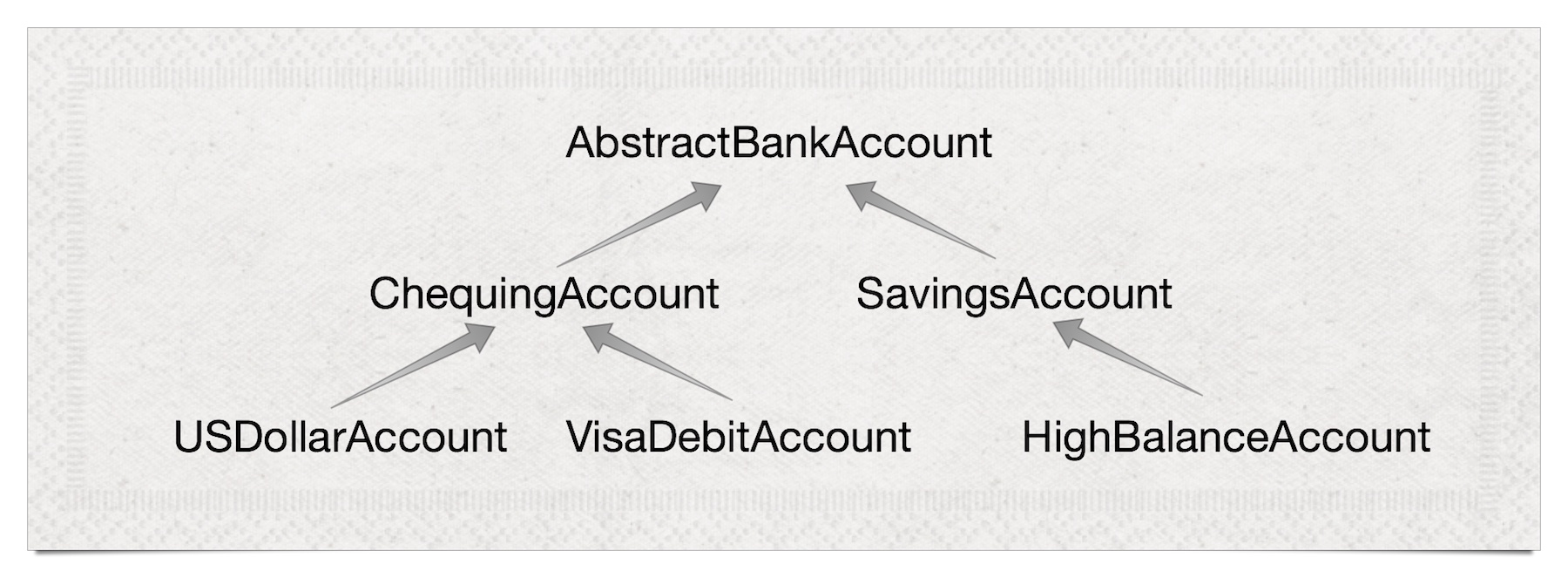
When one class extends another, its methods can access any of the properties and methods defined anywhere on the prototype chain. Given hierarchies designed as trees, a change to a class can break the behaviour of any of the classes below it or above it on the tree.
When two or more metaobjects all have access to the same base object via open recursion, they become tightly coupled because they can interact via setting and reading all the base object’s properties. It is impossible to restrict their interaction to a well-defined set of methods.
This coupling exists for all metaobject patterns that include open recursion, such as mixins, delegation, and delegation through prototypes. In particular, when chains of naive prototypes form class hierarchies, this coupling leads to the fragile base class problem.
In JavaScript, prototype chains are vulnerable because changes to one prototype’s behaviour may break another prototype’s behaviour in the same chain.
In the next section we will look at a technique for reducing coupling between classes. And we will look at avoiding deep hierarchies with mixins.