The Teachings of Don Alex
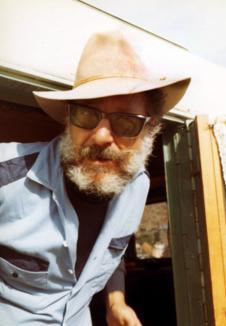
The Teachings of Don Alex.
Some choose a big-screen life, then they act it out with gusto on a Shakespeare stage. Alex Apostolides, a real-life Edward Abbey counterpart, and an actual certified mystic was such a man. He chose adventure, colorful friends, and to walk with Carlos Castaneda along a path with heart. That made quite a story. These are the parts he let me tell before he died.
First, Castaneda comes to mind because he and Alex were colleagues at University of California, Los Angeles (UCLA) back in the Sixties. The noted mystic and prolific author discussed the shamanic world with Apostolides, long before he published his many shamanic books.
Castaneda and Apostolides also had a graduate student friends call Sunny Skies. Sunny was an old hand around Bickel Camp in the Eighties. Interesting to note that I knew Ms. Skies for years, and she never told about the relationship she shared with these men at UCLA. Being mysterious seems to be a pattern with mystics.
For example, a lady named Patti who I called the Camel Lady in this work, may also have had a Castaneda connection. Patti actually arrived at Bickel Camp on Camel back. The story was that her rich husband had helped finance a camel caravan reenactment as a university project. Patti was such a horrible drunk, she couldn’t stay on a camel.
This was after Apostolides left the area, but this is how The Camel Lady hooked up with an outlaw biker I call Outlaw John. That story is a tale of it’s own, but the interesting connections is The Camel Lady may also have been Blue Scout a Castaneda witch.
It becomes apparent Castaneda, Sunny Skies, possibly even Blue Scout learned a thing or two from Apostolides. Much of the Greek’s teachings did in fact later turned up in the guru’s mystic writings.
As an archeologist, Alex knew Mexico well and worked the ancient Aztec and Maya digs for many years. He was in the anthropology department at UCLA when Castaneda was still working on his thesis that was later published as “The Teachings of Don Juan.” Was Alex, the story-telling Greek, Castaneda’s model for his famous Yaqui Indian sorcerer? Sunny Skies simply said she didn’t know, but added, “no one ever saw Don Juan.”
“I would tell Carlos that the secret of exploring a shaman’s life.” Alex recalled on the rare occasion he would discuss his relationship with Castaneda, “was to keep one foot firmly planted in reality. Carlito didn’t listen, and often lost his way.”
Alex certainly never claimed any particular influence on Castaneda. Then, there was much about the wandering writer I didn’t know. I was, after all, a foolish young man in the years Alex lived in the California desert north of Los Angeles. Perhaps he didn’t feel I was worthy of the topic.
I didn’t know until after Alex died, for example, that his sister Kleo was a writer of some merit, and that she was married to the famous science fiction writer Philip K. Dick. Not only did Alex never mention his sister or his noted brother-in-law, he never told me of his own success in science fiction, publishing books with Mark Crafton in the Fifties. These things I discovered after his death at 81 in 2005.
It seems Alex had simply experienced much success, knew a myriad of famous people, and had so many interesting life experiences, he didn’t have time to tell the whole story. That, and there was much of his narrative he didn’t want told. In fact, when I first wrote an early version of this bio, he reviewed it and said something like, “Yea, yea, yea, that’s good enough,” by way of critique. Then he asked that some really good parts be removed.
Years ago Alex was also upset with me for publishing the 1972 story about Walt Bickel. To me getting the first story about Walt Bickel in print in California State University’s Fullerton Daily Titan was a great triumph. Alex felt I had blown the cover of a place that we should keeping a secret. He was both right and wrong.
In the early Seventies, I hiked the desert with Apostolides, and it was indeed like going on a quest for knowledge. Still, my experiences were nothing like the desert wandering told of in Castaneda’s Yaqui Way of Knowledge. My experiences were bright shining and better.
I had just returned from the Vietnam War, and was wide-awake, and fearful. Alex taught friends to approach the natural world with respect, and absolute assurance of the goodness a seeker might find there. So where do I to start?
There are so many stories about Alex; it’s hard to separate fact from legend. For the record, there are those who really believe he was a mystic. He was listed in the staff box of the Los Angeles Free Press as ‘Staff Shaman.’ He ran the Art Scene page there and also reported for Open City in the Sixties, and was a star among Los Angeles’ hip Bohemian crowd.
Dr. Derek Lamar of the Quantum Metaphysics Institute told me of meeting Alex at a L.A. nightspot in 1968. Dr. Lamar tells a a highly entertaining story of Alex chain-smoking “cancer-fee” Mexican cigarettes in the Whisky a Go Go. No surgeon general warning on Mexican cigarettes, therefore no cancer. Well this was Alex’s line, and he did die of smoking those unfiltered joints.
Betty Reimers, an Apache opera singer and Bickel Camp regular once said of Alex, “That damn Greek is a brujo (wizard), but don’t expect him to ever admit it. You know how witches lie.”
There was a good deal of military experience in Alex’s background, but he talked little of this too. I know he joined the British Navy at the beginning of World War II. There were battles, explosions, sinking ships, and survival on tropical islands.
But the damn Greek only told me the funny story of how a British officer had to wear a proper beard or be told by his superiors to “Shave off!” This phrase, Alex would snap in a snooty limey accent when my red beard grew scraggly. “William old sport, your beard is a fright, shave off!”
There are tales of Alex traipsing around South America; for example, doing a survey designed to map radio ‘dead spots.’ For who and why he did this was always given a cryptic answer of, “government.” He slogged through jungles for three months looking for mysterious zones of silence.
He spent most of this time where no radio transmission or reception was possible. This adventure generated great stories of places where compasses go crazy, and plant and animal life has taken strange evolutionary turns. There were even UFO sightings.
About the time I figured I had the real Alex sorted from fable, something would happen to cause me to question such conclusions. For example, I once visited an El Paso, Texas apartment he was living in during the late Seventies. We slept in the guest room/office my first wife Diane, my young son Billy, and I. There was a dest I needed to work at. I couldn’t help but snoop when I saw an interesting letter on his desk.
At the top was the letterhead of an exotic government agency. Alex and his girlfriend Anita were busy packing to go off to Saudi Arabia. He said he was going to Middle East to work for Raytheon, and to set up educational television. My inquisitive scan of the letter implied more interesting associations. I was a reporter at the time.
I said nothing, but noticed him pack a well-worn 38 snub-nosed police special pistol. He saw my inquisitive look. “Just a tool,” he said. He let me play with the pistol a bit. It was a well used tool.
“Now, make yourself useful and come up with some incense that will mask the smell of bacon.” I suggested pot, and gave him a can full. Anita loved the pot but Alex loved the can. My high school friend Eddie Stiglic had cut a can, filled it with the proper weight and had a glass jar embedded inside. It was as if I had gold, and the shifty Greek got my stash and my can.
I asked him about all this before he died and he said, “Less said, the better for everyone concerned,” adding in one of his many voices, “Ve haf ze Patriot Act, and ve know vere you live….”
He then asked seriously that I not talk about which government agency had sent him the letter. At his ashes scattering, there were inquiring minds who wanted verification of their own suspicions. I had little to add, as they do know where I live. In truth I don’t know but feed the myth for fun. Then I wish to be mystical and keep some things mysterious.
Apostolides was born in San Francisco, 29 November 1923. “Jesus that’s a long damn time ago,” said Alex, when I asked his age a few years ago. His father was a doctor and mother had great sway in his life. In 1998, the last time I visited the stone water tank where he lived with his wife Patti, I was showing more age than he.
Maybe in finding a good woman and water-tank house, one also finds a youthful fountain. “Damn, what happened to you?” he said of my aging, as wife Elisabeth, and children Daniel and Analissa and I entered the stone water tank called The Roundhouse. “A few short years and you become Burl Ives.” You know how those damn Wizards lie; I’d hardly aged a bit.
Alex and Patti made their living the last 20 years writing and telling stories of the Old West on a Texas radio program called The Edge of Texas. I tried to talk him into putting what are now over a thousand of these wonderful tales into digital for the Internet. The truth is, it was damn near impossible to get the ornery cuss to even use E-mail. He saw E-mail as too public, calling it a version of the old telephone party -line where “ten thousand idiots are listening in on what ought to be a private conversation. I say to hell with it.”
Use E-mail, and you can talk to his wife Patti. But if you wanted to talk to Alex, you had to send a letter by snail mail and wait for a response. When Alex got a letter, he immediately sat down and typed out an answer, and his letters were well worth the wait. I once got a letter back with him cussing his damn computer. At the time he had only been using a PC four years, but was missing his old Olympia typewriter that had no damn on-off switch, “just hit the g–dam keys and the words came out on the paper the way you wanted them to! F— the 21st Century!” So taking all his highly entertaining stories over to the Internet will have to rest in the hands of others, but it must be done.
I guess I can best explain Alex, then, by looking back to the last century. Well actually, Bickel Camp people, in our hearts were living back farther still, in the 19th century. Nonetheless, It’s around 1974, the time I’m thinking about. We are roaring off into the world in a 1959 Volkswagen bus. We’ve just pulled out of Last Chance Canyon and have hit the paved Highway 14 about 35 miles north of the town of Mojave. We turn north into rolling desert hills in spring bloom. To the west, frosted mountains cut into a cartoon blue sky.
On board the old bus are several good souls who have come to visit Walt Bickel. We are on a day outing looking for adventure and Apostolides is leading the charge. In those days Alex is living in one of Walt’s trailers with his girlfriend Anita. Back then, it seems he’s always just in from some great adventure or about to set off on another. He’s either off working an archeology site deep in Mexico’s Mayan or Aztec country, or he’s on his way to a photo shoot for National Geographic or Arizona Highways. He went off once to ghost write a book for some rich Mexican on his private island. He came back another time from hiking with author Gary Jennings in the Superstition Mountains. He would tell of spending two months talking Aztecs with Jennings while he researched his epic novel, “Aztec.”
So that day, it’s good to have Alex in company. The bus will only reach a speed of about 40 miles per hour. While this is a good speed to see the lay of the land, we attract the attention of a Highway Patrolman who pulls us over to check things out. My first wife Diane holds our sleepy four-year old son Billy in her lap, no seatbelts required back then. The cop looks in the back and sees Alex, Anita, and friends Mike Palin and Eric Standring. Alex tells the officer he’s an archeologist, and that he’s doing some work on local Native American sites. He mentions the names of a few local people; the officer seems satisfied that adults are in charge. I think this is where George Lucas got the Star Wars line, “These aren’t the droids you are looking for.” We’re good to go.
Working local surveys around Owens Lake and Bishop, in fact, was how Alex came to meet Walt Bickel. He had graduated from New Mexico’s Hiler School of Art, and did graduate work in archeology at UCLA, where he taught field techniques. He was working the El Paso Mountains, and eventually stumbled upon Last Chance Canyon in 1958. That started a lifetime of visiting Bickel Camp.
First stop on our trip that day is Fossil Falls where we park on the banks of a dry lake. Back then, hiking for me is an extension of my Navy training. I’m all about covering lots of ground quickly and quietly. I start off with my head down, ready to plow through a few miles of desert, when I notice Alex doing what looks like tai chi movements.
He moves in slow motion, eyes scouring every inch of the ground around and ahead. He sets each foot down carefully and steps around rocks and bushes like a reverent cat. I start to ask him what he’s doing, but then he says, “Ah, here they are,” as if he’s discovered something.
I see nothing and want to know what he’s found. He points out faint rectangular building-sized shapes in the sand. “These were probably railroad workers’ cabins. See their cook fire was over here.” There was a dark spot in the sand with a few rocks almost in a circle. Alex sees a 100-year-old workers’ encampment where anyone else would see only sand. Nothing was still standing, and not a can or bottle was above the surface.
He keeps pointing out subtle signs and suggestions of what might have been. “This must have been a stock pen,” he said as if there was a historical plaque for all to read. “This cabin must have been for the Chinese workers, see how it’s off from the others, and near the animals. I’ll bet you could find some opium bottles if you dug around here.”
So I discovered a whole new way of seeing the desert. Where there had only been rocks and bushes, a new reality comes into focus. We hike on and I assume the slow motion gait. My internal clock ticks to a powerful ancient rhythm; this does wonders for my photography. Snakes, lizards, tortoises and birds study me from the shadows, and don’t show their usual alarm. I move as soft desert wind, and see things I’ve never seen before.
Lichen grows in whimsical patterns, and paints the rocks in day-glow colors. Sand Matt flowers peek up like innocent little eyes. “Look, a hunting encampment,” Alex says pointing what might have been an 8,000-year-old Paiute site. He shows us house rings, campfires, and areas where obsidian tools were flaked. We see boulders with worn concave impressions where seeds were ground, and find worked hand-sized rocks used as tools.
The grandfathers tell us of their existence. “Don’t take anything,” Alex warns. “Watch where your step.” When Alika Herring had taken his son Jack and me to this very spot, we were young boys and only saw things to shoot with our bb guns. Petroglyphs I had walked past since I was a kid and never seen, now introduce themselves. Now strange Indian rock drawing speak and have spiritual meaning.
As we approach the actual site of the ancient dry waterfall, I find a new understanding for one of my favorite spots on Earth. A place I had visited since I was 13 becomes a new friend. After spending time at the falls, we drive to what was then the ghost town of Keeler. We knock on the door of an old woman’s house who was at the time the town’s only resident. She opens the door, shuffles out, cocks her head and says as she comically rocks her new Vans, “Well, now you are lookin’ at a little old lady in tennis shoes.”
Alex introduces us to Lillian Hilderman. She was then 98 years old and had been the town’s postmaster. Alex recounts a time a few years earlier when, at 95 summers, Lillian ran him ragged on a hike to the mine at Cerro Gordo. Our visit with her is sheer delight. We hike from her house down the dusty street to the Chinese cemetery north of town. We search for pottery shards, among the bones of Chinese slaves.
On the way back to Last Chance, the bus dies. The 36 horse power engine flames out forever. We hitch a ride to town, get a tow truck and tow the dead hulk of a bus to John Storm’s ranch. John, a tattered old warrior, and a friend of Alex’s, lives on a ranch against the Sierra Nevada Mountains, near Olancha. He knows Alex from the stories he wrote about the water wars in area. The leather necked Texas cowboy and liked that Apostolides had sided with the ranchers in the Los Angeles underground papers.
Storm is a spry and quick wound spring of a man. He was said to be near 100 years old. He came to California from Texas in 1903, and homesteaded his Eastern Sierra ranch. He has a bulldozer and a contract to maintain the winding road into the mining town of Darwin.
Alex said he once found him filing a 12th notch into the blade of the bulldozer. “What the hell are you doing?” Alex asked. “Oh, this marks the 12th man I killed.” Alex explained that evidently he’d straightened a curve on the winding road and miners, returning drunk from Lone Pine kept trying to round a curve that was no longer there, crashing into the canyon below. We make up a silly song to sing in our happy hippie group about “the road to Darwin being a long and far one,” We never write and forget the words.
“Caint cut a notch on your pistol anymore,” John told Alex, “so the ‘dozer blade has to do.” John had fought for Owens Valley water in the war against the Los Angeles militia back in 1924, and may have had some real notches on his pistol. The ranchers lost that war and Storm was still angry still.
He allows us to leave the bus there, even though we’re from Los Angeles. We’re with Alex, so we can’t be all that bad, he allows. Storm feeds us–big dinner, great family, meat and potatoes by the ton. Storm has his grandson take us to the bus station, which is a gas station in Olancha. We catch a Grey Hound to Ridgecrest.
Somehow being on foot sets us free, and life becomes a buoyant joy. We bounce on to the bus, traipse to the back, and actually turn all heads as we take our seats. Alex and Anita are wearing Mexican sombreros. Alex wears a serape of many colors, over khakis. He always wears sunglasses that seem to imply beat generation. Actually, it was said his eyes had been damaged in some sort of explosion during World War II , and the glasses were necessary protection.
Anita is 18, but looked 13 back then. She’s from Maine, and always wears a perpetual pink sunburn from the Mojave sun. She looks like a happy flower child, with granny glasses and pulled-back blond hair. My son Billy wears a sombrero too and carries a bb gun, presents from Alex.
Billy is filthy dirty and joyous at the thought of the bus ride. Wife Diane wears a yellow coreopsis flower in her hair. In those days she knows how to relax and let adventures happen.
Eric, Mark and I wear the hippie, John-Denver uniform of the time: long hair, beards, work shirt, Levi’s, and waffle-stomper boots. We are decorated with packs, cameras, and frosted in trail dust. Judging by all the turned heads, we don’t look like local folks to the other bus riders.
We ride in a circle of great chatter to Ridgecrest. From there, Alex calls another friend who takes us to Bickel Camp. By the time we got back to camp Alex had agreed to loaned me his truck. Jack Herring and I took my 1953 Ford back the next weekend. Jack gets a ticket on the way home. The cop stops us because anyone towing an ‘59 VW bus it a ‘53 Ford must have weed. He gives us an equipment ticket and we excape.
We come back the next weekend looking for more fun and adventure, and find it. Some time later, Alex comes back from Greece with a strange fellow he met while traveling. The man, evidently became rich from something he invented, and realizes he never has to work again. He decides to go off into the world, “Looking for the teachers,” he says and finds Alex. “What a coincidence,” I tell him. “I’m a teacher.” This man was very serious in his quest, and invites me to accompany him and Alex backpacking.
We load packs and hike out into the Desert. He turns out to be a great camper, and shows how to actually see the Earth rotate. By looking north, focusing on a star and a rock, one can actually see, and then believe they feel the Earth’s movement. He had been traveling for years and has endless campfire tales of his adventures. He tells us he had once tried to sail around the world in a small boat with no motor. The boat becomes trapped in a storm; he seals the small craft like a bottle and rides with the storm for almost two weeks.
When the storm finally releases him, he has no idea where he is, but said it didn’t matter because he had been reborn.I don’t remember the strange man’s name, and Alex couldn’t remember it many years later. I call him The Seeker who especially enjoys Alex’s stories and wants to hear all he can about Carlos Castaneda.
At the time, I had never heard of Castaneda. I was looking for meaning in “Jonathan Livingston Seagull.” Anita laughed hysterically when she heard this asked me to bring up Castaneda with Alex.
It wasn’t necessary as when we are setting around a small campfire up on Sandy’s Mesa; I discover there are new ways of experiencing reality. Alex and The Seeker talk for hours about a strange foreign world of sorcery and shamans. A few years later I’ve devoured every word Castaneda had written. One might say I’m off the deep end in what became a religious quest. I hear the voices of my twin sister Bonnie and first wife Diane telling me my soul is in jeopardy. Alex and I walk the bridge that leads from El Paso to Juarez, Mexico.
On the other side, there’s a cultural museum that has crafts from every region in Mexico. There are beautiful young women explaining each display. Every dark-eyed lady knows Alex well. They flash knowing glances as we chat. At a small apartment, a friend of Alex’s introduces us to ice-cold Membrillo, a quince liqueur. “Few new things under the sun,” Apostolides says, as he toasts the wonderful new drink. Membrillo has a fruity quince flavor, a kick like tequila, and a strange dry-wine after taste. It is indeed one of the few really new discoveries along the way. From there we go to a bar of another friend, and I begin to feel like I’m living in a Hemingway novel. We enter a macho contest with some Sonoran cowboys. We drink many beers, each with a mound of progressively hotter and hotter sauce on top of the can. The idea is to drink the sauce and beer at the same time. We leave, thinking we’ve won this contest, but I have intestinal distress for the next three weeks. So life was in those days, traveling a path with heart. Alex used to write a column in the El Paso Herald-Post and one gets a feeling for how he organizes his world into luminous moments.
– In a 1987 column I love, and have saved over the years, he recalled a fleeting reaction to Thanksgiving at Walt’s. “Last Chance—and Bickel—and one Thanksgiving Day that will burn brightly in the memory as long as we draw breath. Thanksgiving Day saw people converging on Bickel Camp from all points of the compass. Friends who’d slogged long desert miles with us on surveys, others who’d found sanctuary here down the years…which included everybody there—Bickel Camp was sanctuary for the soul.” I remember the Thanksgiving Day Alex writes about, and many other days like it.
How nice it is to enjoy again words that flowed from Alex’s heart, and came out his old Olympia typewriter. He’d bang these thoughts out in one sitting, one draft, and the memories have lasted. “There were 23 people crowded into that desert cabin that Thanksgiving Day of long ago,” Alex remembered. “Good friends tested down the years.” I especially enjoyed gatherings like this when Walt and Alex would tell parts of the same story, each adding memories with deep-belly laughs. At such dinners, it was best to position ones’ self at mid table so as not to miss anything.
And this is not to mention an easy shot at the passing feast spiced with desert herbs. Good Lord, thank you for that food. “There were yams, glistening sunrise-orange beneath their syrup coats and extra stuffing ‘just in case.’ Cranberry sauce and crusty French rolls and shepherd’s bread…and then the talking all would stop and there would be nothing but the sound of reverent chewing as the goodies disappeared,” Alex observed. “And then, there was the good and lazy talk of friends replete with something far richer than turkey on the table. It was the talk of people grown into Family”We all read these words from the column Alex published after that golden afternoon, and are pleased someone is talented enough to express our feelings.
We tip our dusty hats to The Roundhouse in the East. We didn’t know then how few of those days we had left. At least, through Alex, we had learned to live as if each day were our last. In a year, Bickel himself would be driven from the canyon by age and the ignorance of bureaucrats. Bickel Camp would change forever, but not for the better.
Our desert family would scatter like spirits in the wind. “They’re gathering out there again this year,” Alex said of those of us who had survived another winter. “And I find a deep thankfulness in my heart for having had them as part of my life, that crazy miserable gang of desert-rat bandits who are Family to me. God bless you, one and all.”
Alex Apostolides passed away at age 81 on September 27. 2005. His wife Patti, along with a group of friends, scattered his ashes on Sandy’s Mesa at the base of Black Mountain. This is his place of predilection. Sandy’s Mesa is just north of Bickel Camp and is named for Alex’s deceased son. Alex’s ashes join with those of Sandy, and Bickel, and the dust, and the canyon wind.