0. Context
A complex system, contrary to what people believe, does not require complicated systems and regulations and intricate policies. The simpler, the better.
Nassim Nicholas Taleb. Antifragile
Why orchestration at enterprise?
Is this one more book dealing with one more framework for analyzing enterprises? Why bother, if there is a lot of similar stuff already developed and being used in everyday corporate life worldwide?
A short answer to this vital question is as follows.
Nowadays everyone could notice that corporate world have been switching from top-down logical management by goals and objectives to more viable schemas, which are compliant with rapid changes. Using intrinsic power of employees, creating friendly work environment for empowering talents and similar topics are in corporate agenda of enterprises.
First, I would like to add a kind of disclaimer. Here in the book an enterprise means “bold endeavor”, which assumes purposeful undertaking or intention. It may have no a logical form of legal organization. Just purposeful endeavor one wants to see living for ages and bringing fruitful results to the world.
I share a way to looking at big picture of viability. You may imagine it as a viability model applicable to different contexts. Having no evident logical relations between those contexts provides very exciting and colorful experience and worldview.
One could not approach such a tremendous goal other way as staying on “the shoulders of giants”. The book’s narration is based on metaphoric use of books and ideas of different authors. There is no intention to dig up to primary sources and origins as academic research usually requires. There is no logic-only way to answering the questions about viability. That’s why there is no need in mimicry for logical research rules.
I hope that readers may notice that the book is structured according to the principle described in it. “You should eat your own cookies”. Yes, it works here.
If you are used to work with scientific approach, you may find imaginative thinking a bit uncomfortable. I was about me some years ago. There is no much logic here! Yes. This book is intentionally uses another type of thinking, because we touch a domain, where logic is not so powerful. The book is not about science with its postulates, syllogisms, experiments and statistical proofs.
If not science than what? There will be live examples from life that will create an imaginative series that surrounds the topic and allows you to accumulate metaphorical experience and understanding. Please don’t consider this statement as an intention to “reject the science”.
Scientific findings are very important in general and in this book in particular. The only reason is that this book is devoted to a slightly different approach to worldview.
If the book lets you getting an idea that there is no contradiction between imaginative and logical thinking, my challenge is successfully completed.
The trick is that imaginative techniques assume variety of understanding due to it interferes with different experience and different thinking modes of people. One may think about this similar to parables, which bring metaphoric image for setting a viable context. Everyone learns from parables in unique way. Unified explanation of parable significantly reduces learning experience.
Viable object can’t be effectively described in logical way. It’s a “coming into being” entity with intrinsic attribute of uncertainty.
How one could think about that such abstract stuff being productive and without sinking in great number of details?
Metaphor is a basic tool in the imaginative thinking. Common approach in practical not-only logical thinking deals with storytelling. The book gives some intuition here to understand why telling stories is the best method in addressing this challenge.
Orchestration is very useful metaphor. Orchestra conductor is engaged into leading a team of musicians who play different instruments and bring their contribution to music they all deliver. I intentionally use generic business language to emphasize that metaphoric language of music may bring a lot to other domains and contexts. Music is not principal zone of interest in this book, but music vocabulary is one of the best and effective.
One more brilliant metaphor is architecture. I would like to produce a practical guide, not a philosophical opus. Many examples are connected to business domain. Language of architecture may be a good choice for many people, because there are architect roles in any technical engagement.
What is architecture?
Tom Graves says about enterprise architects’ mantra:
- “I don’t know… (but I know how to find out, or find someone who does)”
- “It depends… (and I know how to find out what it depends on)”
- “Just enough… (and I know how to find out what that ‘just enough’ is)”
The art of architecture is in hiding details without losing sense of the whole big picture.
We are going to navigate with this mantra. It describes the essence of imaginative approach quite well.
- Imaginative approach never includes complete registry of ready-for-reading descriptions with comprehensive set of details.
- The registry is unrealistic not due to its expensiveness and exhausting resource demand but because of viability nature. A lot of details appears in “on the fly” mode as a response to current context. They do not exist in reality in advance, just in “coming into being” format.
- While specific level of specification is not ready, nobody knows something about next level. But an architect, who keeps in mind the whole intent and purpose, easily deals with the uncertainty and dispels it adding “just enough” details in time.
Notice, that this “quite good description” is not a logical statement. It’s an image to engage reader’s imagination and call to theirs experience.
Unfortunately, unexperienced person rather cannot benefit from imaginative approach.
You probably don’t find a lot of new discoveries in the book. The idea is to introduce a specific framework as a visualization tool for looking around and discovering the same pattern in many books and approaches. This pattern allows using works of outstanding thinkers as useful metaphors, which provide both big picture and cross-validating viewpoints for bringing peculiarities and fine distinctions to enterprise models.
From the other side, different books add new colors to a palette of the approach. Fine distinctions of the pattern may be well distinguishable just in a specific context and due to fantastic job made by genius researchers. Bringing all their findings to other contexts allows better interpreting important peculiarities hiding shades of model sense.
Going that way we get a network of models, which are interlinked by common pattern of viability. After the tool is applied to a specific case, resulting experience is always subjective at the first phase. It provides custom context-related framework for ideation. Good news for adepts of logic is that having this ideation framework generated, one can use it for absolutely objective activity with measurable results.
I wish if the Enterprise Orchestration approach, accompanied with enough practice-oriented metaphors, enriches your understanding of your world and brings more viability to your projects and teams.
What is in the book?
I see the book as a primer on the imaginative thinking in a business context. It is designed to be short enough and not to focus away from the core things. From the other side, it should let the readers to get a metaphorical environment for learning about orchestration of viable objects. That’s why we need a lot of examples to compare with each other. The illustrative stories are not practical applications here, but one may treat them in that way as well.
Chapters 1 - 5 are to present the Enterprise Orchestration model from different viewpoints. You may find some applications in chapter 6, which are added to bring the practical side into the book.
At the highest level, you may look at the Framework as to a short universal checklist, which allows very fast assessment of your context, its maturity and what you should focus on first to survive and thrive there.
It’s the theory of viability in both the most abstract and the most practical form. It depends on one’s expertise and intentions. The next book (I hope it comes soon) will have more practical stories about what goes wrong if you do not care about the core elements in your context. Let’s start with the core.
Five Elements Architecture
“You can’t think without boxes, so don’t even try”.
“Thinking “Outside the box” is not enough”
Luc de Brabandere, Alan Iny. Thinking in new boxes
How could one get “just enough details” about a viable object?
There is a famous pattern in philosophy, which describes looking at some whole object from different viewpoints. It’s Five Elements or Wu Xing. It has not-logic-only nature, so to describe the pattern one need considering different metaphoric views. It’s very fundamental template. A side effect of this results in its demanding learning curve. Small amount of metaphors related to Five Elements unfortunately does not lead to understanding level, which brings practical benefits. Persistence and “just enough” efforts helps.
Most often we see the template in form of Five Essences, Five Colors or Five Directions. According to book concept, we do not consider all possible options here, but introduce some specific cases, which resonate with the rest of the book in better way.
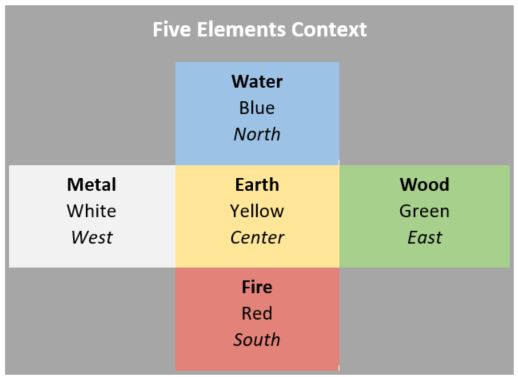
One more approach is to get the pattern by looking into ways of interacting.
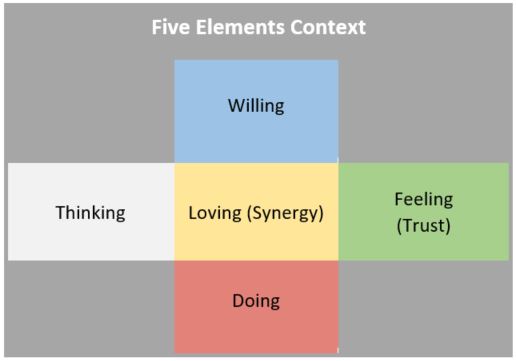
Visual image to represent the Five Elements is extremely important. Non-logical (imaginative) reasoning is quite demanding art, that’s why the image should simplify comparing different metaphors via thoughtful correspondence between elements of models.
Why do we say ‘the true north of our business’ while discussing the purpose and business directions? Exactly, because ‘North’ and ‘Willing in business’ are metaphorically equal viewpoints. They both have blue background as a tip for easy metaphoric linking.
Finding true north is essential for accurate navigation, so it’s about accurate and appropriate direction.
Some readers may say: “Aha, that’s absolutely unreasonable! No logic detected. Just trivial coincidence.” I would like to remind. That’s it. Exactly. It’s about not-logic-only story. And it’s not a final point of the road.
If such a thing disappoints you, probably you should read another book. This one tries to introduce you to non-scientific non-fiction approach to analysis. Without mindset change it does not work. Please take it for granted now, but you may find more intuition about this further.
For those who is curious enough and may afford living in a world partially based on “just coincidence” – let’s go next steps.
Our current goal is to collect some visuals (templates) for Five Elements models. Different situations may call for other visuals. That’s why having some templates for playing with Elements is a good idea.
Criteria for good template is simple. If visual image of the template helps inspiring new associations between contexts and models, and translating useful experience and findings between models, it says the magic happened and the template is accepted.
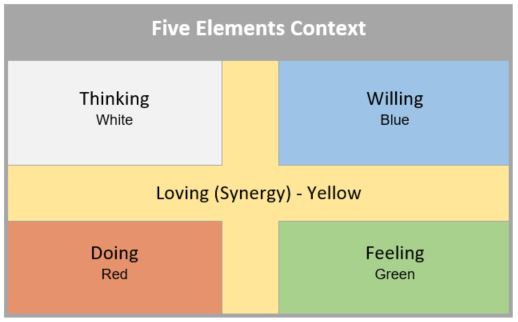
Standard color palette is part of the game, which contributes a lot to simplicity of models linking. You have got the point, if you have no questions about translating Latin Cross model into Rectangular model. Unified metaphoric names play the same role.
The book highly employs Context term and we should get sure that we are on the same page with its meaning. Useful dictionary chapter of the book reveals mechanics of dealing with word meanings.
The word Context literally means interweaving threads together. For viable object we even know names for the threads: Doing, Thinking, Feeling, Willing and Loving (Orchestrating).
The same idea is referred in the Holonomics book by Simon Robinson and Maria Moraes Robinson without mentioning much details.
“… in organic systems, the parts only have an existence and meaning because of their relationship to the whole, a whole which can only be experienced in the way in which it comes to presence in the parts. We therefore need a higher intuitive mode of consciousness to experience the belonging together of the parts in what we now perceive as an authentic whole.”
Logically one should consider organic object parts as tangible ones. But ones more, this book is not about logic. It’s about viability.
Thinking (logic) is only one viewpoint for viability. It’s important, but can’t show all sides. Let’s consider it as “just enough details for now” and back to this point at next loop.
Environment is related to external view to a context. Environment is a context by nature as well. Appropriate environment for an object means that our object is significant for it (contributes to it in some way). Good attribute is valuable response of environment to object’s contribution. It says that the environment recognizes the object and sees it as its part somehow. Considering too wide environment may be useless.
What are additional arguments for importance of environment understanding for viable object?
Doing and Thinking are already inward activities in a team. While defining a context, usually one starts with internal side of it. To get what they do in the context and how they decide there is usually not very complex investigation problem. But to get full picture we need another side of the deal. Feeling and Willing require external, outward view. Really crucial intentions, changing the game for a viable object, always are connected to intangible and logically unreachable side.
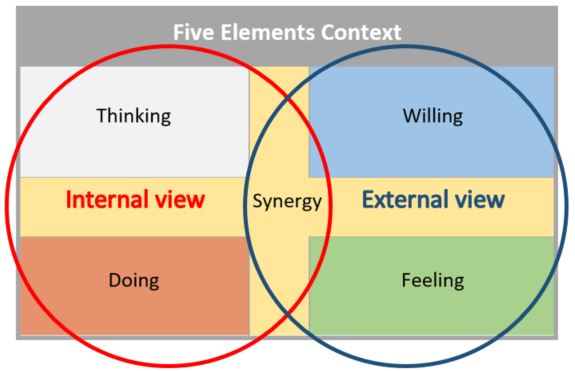
Feel a trinity term as too mystical?
You may just use another set of names to get it in more practical way. Simon Robinson and Maria Moraes Robinson in Customer Experiences with Soul talk about trinity in form of coherence between what person says, what they mean and what they do.
Here one may identify the same structure:
- What they do: most tangible part of the game, internal side;
- What they say: outward oriented part, which express some intentions and thought directions;
- What they mean: a kind of glue between say and do, but an independent part of the trinity, which lives without direct linear correlation with previous parts.
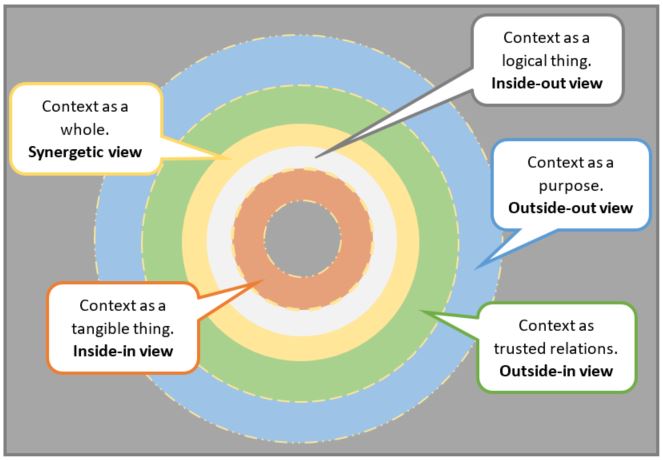
For internal/external metaphors radial diagram may look more natural.
Considering not only trinity but a structure of Five Elements breaks it into Inside-in, Inside-out, Outside-in and Outside-out construction, which is in active usage at Enterprise Architecture models for pointing to different directions in enterprise activities.
Looking that way, trinity model is well aligned with Five Elements. Which one is more useful? You may use successfully both. Just remind about “just enough” architecture details.
The only notice is as follows. It seems that human mind natively accepts Five Elements model, so using it provides a bit richer experience, implementing two level trinity models in one step. Please come back to this statement at next iteration of reading the book.
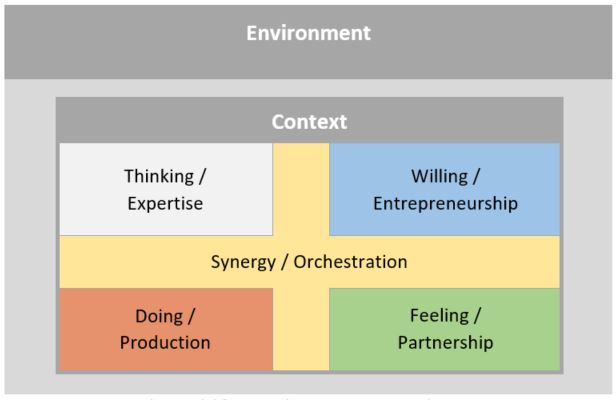
Not to forget about importance of properly defined environment for successful playing with a context, we add Environment box to our Orchestration pattern.
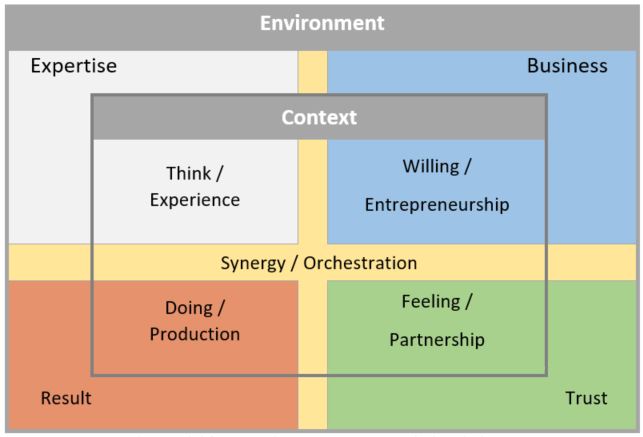
Thinking out of the box. Need for going beyond regular constrains and boundaries while dealing with creative side.
Our visual model demonstrates context as a box with specific environment behind. You should look into environment while thinking out of the box. And the trick is that you find another box outside previous one. It may be useful to get the environment as a box in detail to be more specific and productive.
Which details may be relevant for environment? Environment is a context as well, so we need no new rules here. We already have a rule for generating a list of principal viewpoints for a context. The only thing we need is just applying common template with appropriate viewpoint names.
In any practical case there are some options for the names, which are metaphorically equal. But using good and appropriate choice brings a lot of additional experience, expertise, trusted ideas and directions of development.
Let’s get back to traditional orchestration term. Is environment so significant for orchestration in the context of music?
To get a colorful Yes answer, please enjoy a TED talk How architecture helped music evolve by David Byrne.
Initial description of the Orchestration Framework
The primary focus of the book relates to business environment. That’s why we often apply business-oriented names to Orchestration Framework boxes. One of the privileges of metaphoric thinking is freedom from tedious logical exercises in mastering strict definitions.
Business is based on people engagement, that’s why abstract context term we may replace with team.
The Orchestration Framework visually may look like Five Elements Image presenting some context and utilizing some viewpoint names to allow generating comprehensive context story in minimalistic manner.
Here is typical names description.
DOING
We use DOING / PRODUCTION / RESULT term to point to a part of a context/team dedicated to producing tangible results.
Attributes of Doing / Production are:
- Dealing with results, i.e. with easily sensible (tangible) effects of context actions, recognized by environment
- Sequential instructions to get things (results) done
- Well defined processes
- Policy, best practices
- Keeping process on track
- Dealing with quite short-term plans
- Staying in touch
THINKING
THINKING / EXPERTISE / EXPERIENCE points to a part of a team dedicated to producing smart solutions.
Attributes of Thinking / Expertise are:
- Knowing some different ways for getting work done
- Making experiments to identify if the way is efficient or not
- ‘Fail fast’ while detecting ineffective solution
- Considering not only techniques but working environment as well
- Gathering experience via research
- Do more results with wasting time less by providing production with efficient solution architecture
Words expert, experiment and experience origin from Latin experiti = ex + periti = “beyond”+”bitter end”. To not be disappointed with results, we need expertise and experience to predict “bitter ends” in advance and change solution architecture in time.
FEELING / TRUST
FEELING / RELATIONS / TRUST (in business context) is a name to point to a part of a team dedicated to producing trusted partnership both within the team and outside it (primarily).
Attributes of Feeling / Relations are:
- Looking outside your context to join community of reliable integrated partners
- Feeling the difference and selecting trusted partners for long term harmonic productive relations
- Commitment to ideas and leadership resulted in successful delivery
- Engagement and ideation around business direction or line of business
WILLING
WILLING / DIRECTION / BUSINESS denotes a part of a team dedicated to producing vision and business purpose.
Attributes of Willing / Direction are:
- Looking outside your context to get big picture and provide the team with appropriate vision;
- Generate vision and mission statements for the team and the environment and aspire the team members for going there;
- Think out of the team context box;
- Assure results against effectiveness, not just efficiency.
SYNERGY / ORCHESTRATION
We use SYNERGY / ORCHESTRATION / WHOLENESS terms to point to a part of a team dedicated to producing team orchestration.
Attributes of Synergy are:
- Assuring that the team has the same spirit with its environment
- Provide different parts of the team with conscience and purposefulness
- Using Enterprise Architecture approaches to orchestrate the team
- Care about the team as a viable whole
You may ask: ‘OMG, where do you take those details from?’
First, please don’t start with logic and compare the descriptions with your personal intuition about this. Next, look into the rest of the book and use the stories below as metaphors. I hope, it provides “just enough details” to answer the question.
The book works better in recursive mode. Each iteration brings more intuition. I have tried, so know it for sure.
Getting the details in advance, just for granted and without any justification, is a trick for breaking a circle of interdependent items. To start comparing you need a baseless step of putting something in your hands first.
Fractal nature
One of core architecture principles requires “just enough” details assuming the less is the better. What is about going next step and getting more details in case if we need a bit more complex model?
Sierpinski triangle
As we agreed for this book, good answer always looks like a parable or metaphor. This time it has mathematical nature and says about Sierpinski triangle named by Polish mathematician. As a parable, it should narrate about fractal nature, which may show up in any various conditions and help with dealing with complex things by modelling them using simple image and likeness.
What is Sierpinski triangle?
First step in defining this object is to say: it’s a kind of triangle.

Step one utilizes classic imaginative technique. It defines simple image, which does not provides full experience with the object, gut delivers “just enough” details to start with.
At step two we should make the image more precise. Namely, the next part of definition says that a kind of triangle does not include the middle part of the triangle. We are to break the triangle into 4 parts and remove central one. Here we go.

Is it a final result? No. What we have now is the rule of likeness. It says: at any step fractal image should be composed with some exemplars of initial images. And we will apply the same procedure to those images to get next step.
Sierpinski triangle does not consist just of 3 simple triangles. These are a kind of triangles as well. To get better version of this, we should repeat the procedure of removing central part of any triangle in the picture.

You may easily guess that the procedure is fully recursive. Mathematicians love infinite loops and see no problem in completing definition of Sierpinski triangle set by repeating the trick of removing central part of triangles infinite times.
Just to resume.
To apply fractal approach to object definition one is to follow some steps.
- Set simple image to represent the object initially;
- Define likeness rule or rule of adding details. It is to say how to replace initial image with a set of alike images to get more detailed view of the object.
- That’s it. Using recursion, one may get fractal view of any detail level.
Context changes, but the same approach is applicable. That’s why Five Elements thinking forms a core of more complex techniques. Just use fractals to get more details.
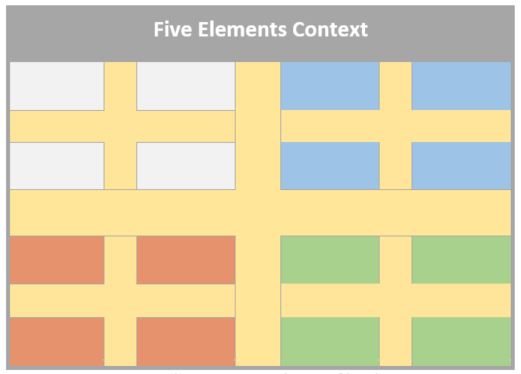
5Ps (Five Elements) framework by Tom Graves
Fractal principle finds its applications in business context. Just to mention Viable System Model (VSM) by Stafford Beer.
Here I would bring your attention to the Real Enterprise Architecture book by Tom Graves. The reason is simple: it gives a great experience with the Five Elements model, which may be easily integrated with the book content without major changes.
Tom Graves introduces his 5Ps framework as follows.
- Purpose is about the why of business: beginnings, intentions, directions;
- People is about the who: the teams and skill-sets and relationships we need to put the strategy into actions;
- Preparation is about what, and where, and when, and how: it grounds ideas and arguments into a concrete plan;
- Process, or Practice, puts the plan into action;
- Performance assesses the results – not just Process, but of the integration of the whole – feeding back into the Purpose for a new cycle.
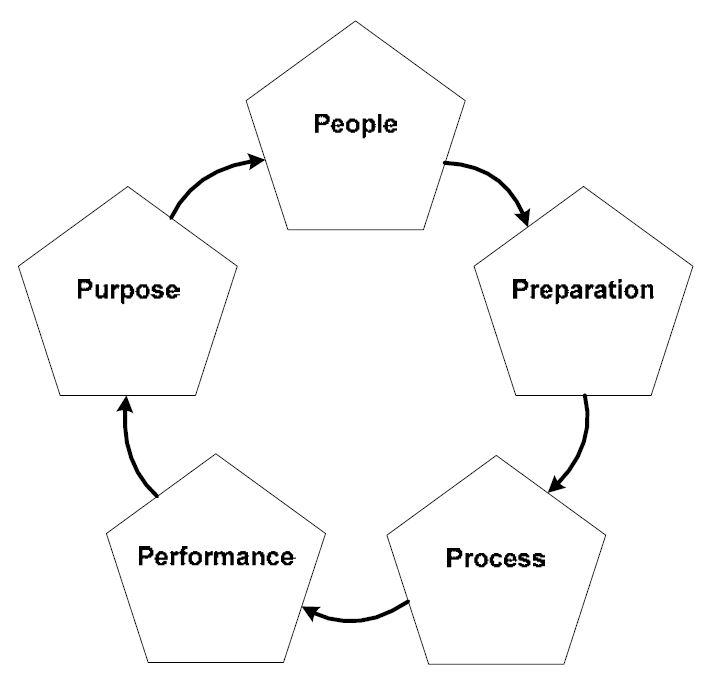
Fractal nature of the framework allows applying the same approach to each item of the cycle.
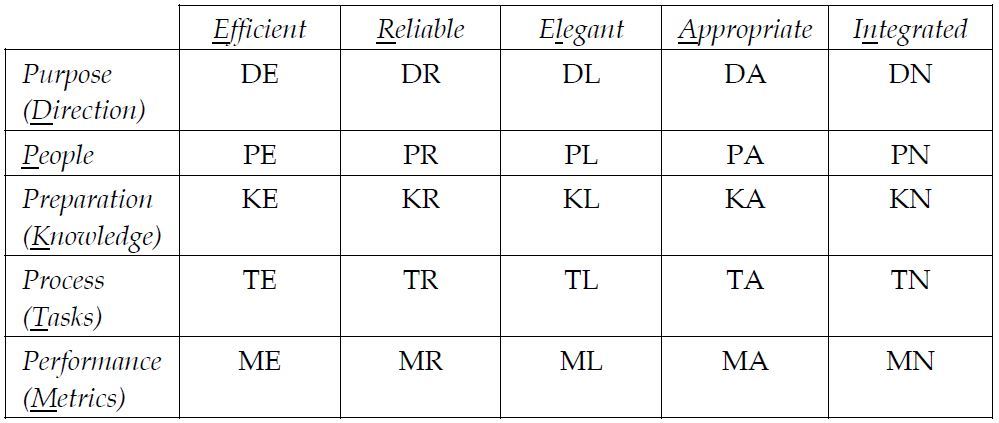
A set above for looking at effectiveness includes adjectives based on the same set of views:
- Elegant – effective from People viewpoint;
- Efficient – effective from Preparation (knowledge, logic) viewpoint;
- Reliable – effective from Process viewpoint;
- Integrated – effective from Performance viewpoint;
- Appropriate – effective from Purpose viewpoint.
We apply the set of the adjectives to each element of the initial cycle to get a more detailed diagram for two level check of enterprise balance.
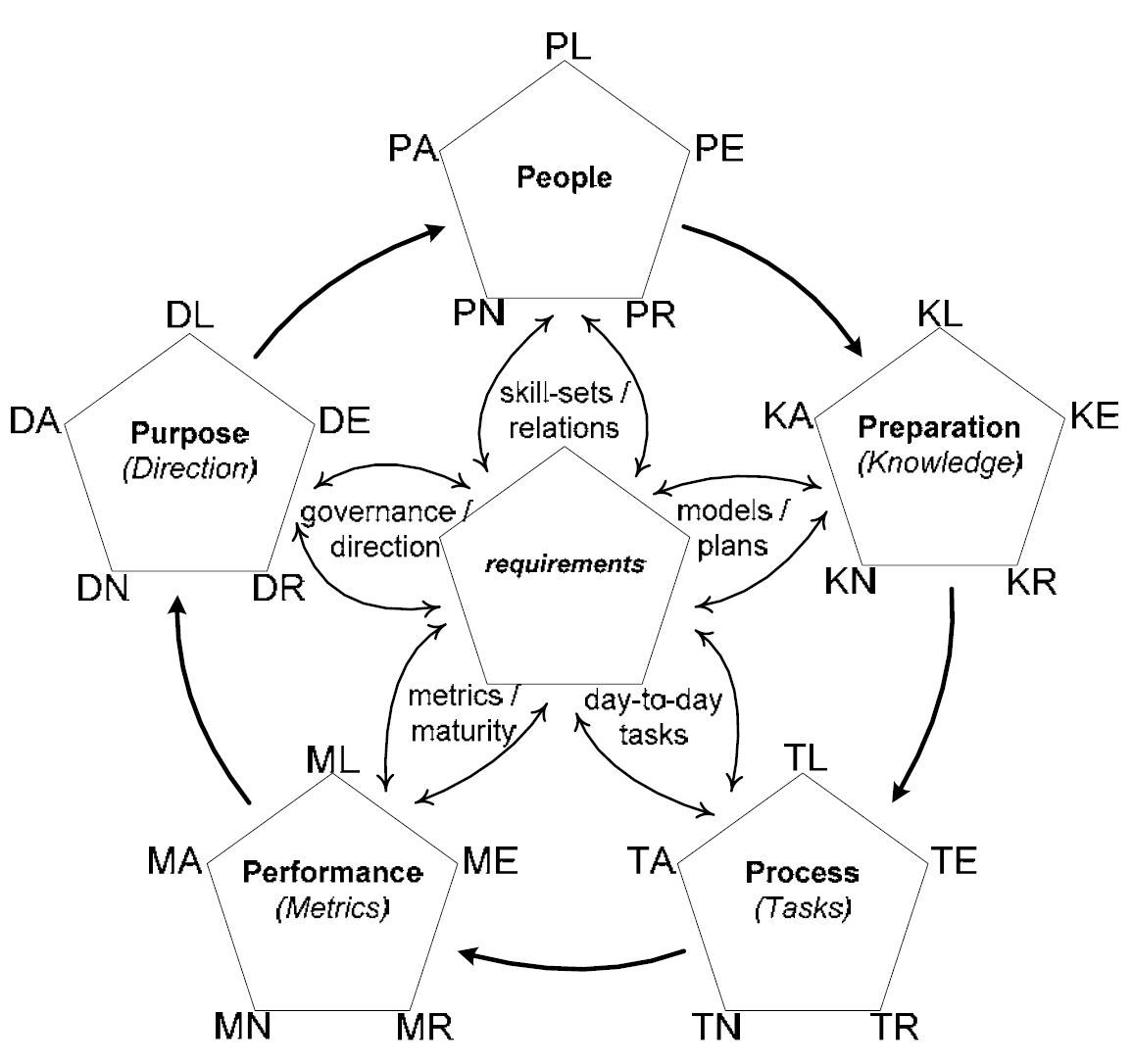
The structure of this book
The book is composed to introduce some visuals for the Orchestration Framework and present it in terms of various cases and research by different authors. Each of the cases deals with specific context, so it uses facts and colors to present the framework in salient and bright manner. Any case gives new metaphoric ability for enriching both framework understanding and imaginative approach in general. That’s why it’s very important to investigate whole the set of cases for better reading experience.
One may notice that the table of the book contents follows the framework structure. The orchestration framework pretends to be self-applicable. I hope it adds some elegance to the reading. The core principle of the book is not to bring new facts, but delivering a systematic architectural approach for imaginative looking at things.
“It depends”: The Orchestration framework is introduced to convenient pointing to core things, which work as primary parts for our considerations. It provides a metaphoric language for speaking on ‘what it depends on’ in a specific context.
“I don’t know”: In general, it’s impossible to say something useful on viability in terms of pure logic. But the Orchestration Framework guides to finding important intuition around that in different books and stories. It allows putting sources to contexts and extracting knowledge from similar research in different contexts.
Getting details and understanding step-by step is an attribute of fractal approach.
“Just enough details”: All the details are taken from great authors and their great books. There is no intention to point to a whole list of brilliant books, which may be relevant to the subject. The same is applicable to authors list as well. May some academic research complete the gaps.
Fractal Principle. Use good overviews rather than original sources. Each step in moving into details should be simple and clear enough. Outstanding authors make very valuable input by reviewing and summarizing works by others, so using it is a good idea to use their books as reviews.
I hope the Orchestration Framework described in the book is a useful not-logic-only tool for extracting more wisdom about viability principles, Five Elements and nature of Orchestration from all works by great thinkers we are lucky to access today.
You may not read the book sequentially from the beginning up to the end. You may start from the part, which you like more and which sounds closer to your nature. But to get the nature of orchestration and its pattern it’s better to get whole vision from all principal viewpoints.
Siarhei Tuzik. Brest, 2018
Useful glossary
Basic source: The New Oxford American Dictionary. Oxford University Press. Kindle Edition. Please look at this list as to a library of useful metaphors.
Architect – via Latin from Greek arkhitektōn, from arkhi- ‘chief’ + tektōn ‘builder’
Attention – from attend, origin from Latin ad- ‘to’ + tendere ‘tend, stretch to’
Business – being busy with purposeful activities
Command – origin from Latin com- ‘together’ + manda ‘entrust’
Control – origin from Latin contra- ‘against’ + roll ‘move, roll’
Communication – origin from Latin communis, com- ‘together’ + unum ‘one, whole’
Company – literally ‘one who breaks bread with another’, based on Latin com- ‘together with’ + panis ‘bread’.
Compensate – origin from Latin compensare, com- ‘together’ + pensare (frequentative of pendere ‘weigh’)
Context – origin from Latin contextus, con- ‘together’ + textere ‘to weave’
Consultant – origin from Latin con- ‘together’, sulta ‘actually desirous’
Convention – origin from Latin verb convenire, con- ‘together’ + venire ‘to come’.
Development – develop, grow or cause to grow and become more mature, advanced, or elaborate. Origin in the sense ‘unfold, unfurl’: from Latin dis- ‘un-‘ + a second element of unknown origin found also in envelop.
Environment – verb environ, from old French environ, en- ‘in’ + viron ‘circuit (virer ‘to turn, veer’)
Excellence – excel, from Latin excellere, ex- ‘out, beoyond’ + celsus ‘lofty’
Expert – origin from Latin expertus, past participle for experiri ‘to try’, (ex ‘out of, beyond’ + periri ‘the bitter end’)
Intelligent, intellect – origin from Latin inter ‘between’ + legere ‘choose’
Intuition – intuit: origin from Latin intuit- ‘contemplated’, con- ‘together’ + templum ‘place for observation’. Summary: Think thoroughly for a long time at an object within specific place for its observation.
Mature – fully developed physically, full-grown; having reached an advanced stage of mental or emotional development characteristic of an adult. Origin from Latin maturus ‘ripe’. Adult – a person who is fully grown to maturity. Origin from Latin adultus, past participle from adolescere ‘grow to maturity’. Grow – grown, Latin translation is adultus.
Orchestra – Latin Orch est ra = ‘The strings play’.
Produce – origin from Latin producer, pro- ‘forward’, ducere ‘to lead’
Profession – origin from Latin profess- ‘declare publicly’ (pro- ‘before’ + fateri ‘admit’)
Purpose – old Franch porpos, propose, from Latin proponere, pro- ‘before’ + ponere ‘to place’
Quintessence – (in classical and medieval philosophy) a fifth substance in addition to the four elements, thought to compose the heavenly bodies and to be latent in all things. Origin from Latin quinta essentia ‘fifth essence’
Structure – origin from Latin structura, from struere ‘to build’
Tangible – origin from Latin tangere ‘to touch’