Making Balance Easier
If we are aware of how to balance, we can change what we are doing to make balance easier or harder. We can vary postures to eliminate the balance component so that we can focus on some other element of body awareness. Or we can add balance in so that balance is the focus.
Removing the Balance Component (And Adding It Back In)
In yoga poses where you are using both feet, the wider your base the easier it is to balance. If you want to focus on something other than balance then it may help to make your foundation wider.
As an example, in Warrior 1, you can make your foundation wider from side to side so that you can focus on, for example, reaching your ribs and arms upwards away from your pelvis.
But then if you want to work on balance in this pose, then make your foundation narrower from side to side.
Note that even with your feet on the same line, your foundation is still wide enough to give you some control over your body. You have some leverage with which you can help stay balanced. However, it isn’t a lot.
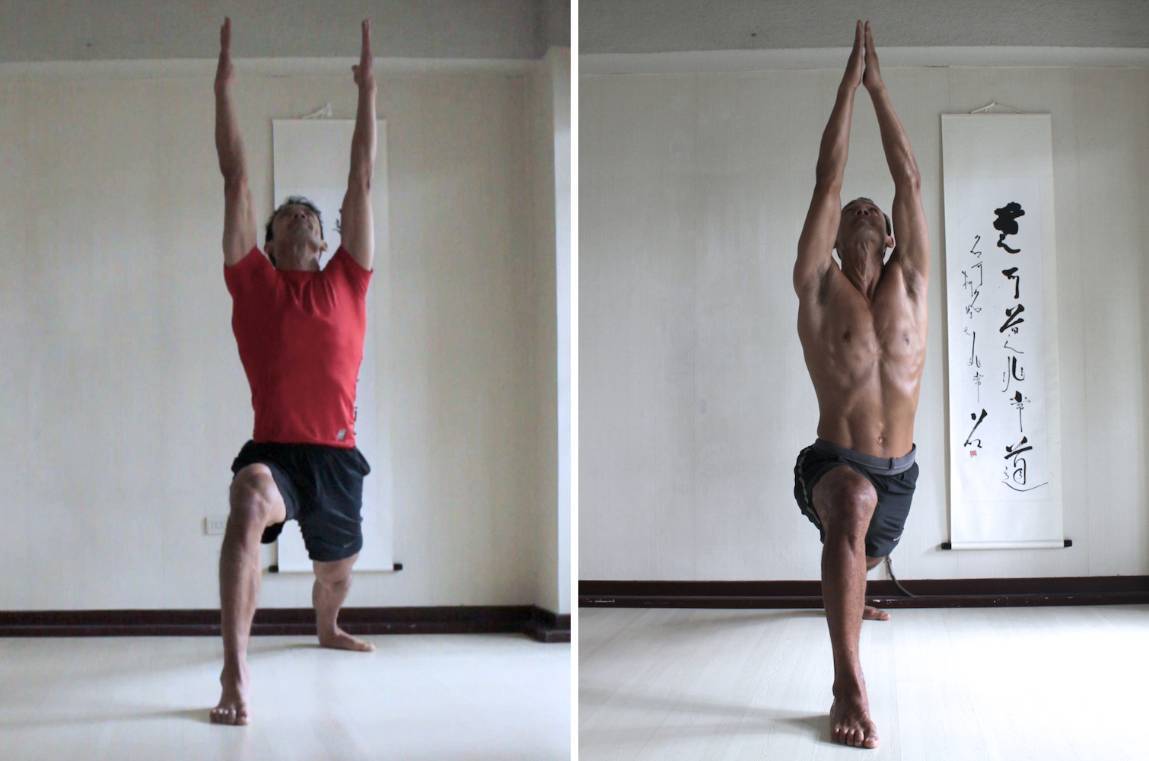
1. Legs wider from side to side.
2. With narrow stance.
With a narrow foundation you’ll have to stay focused to stay upright. (And it helps if you stabilize your feet and ankles.)
Lowering Your Center 1
Standing on one foot you don’t have the option of making your base wider. You can make it smaller by lifting your heel, or for an extra challenge, lifting your forefoot. That aside, you can bring your center of gravity closer to the earth by bending your standing leg knee.
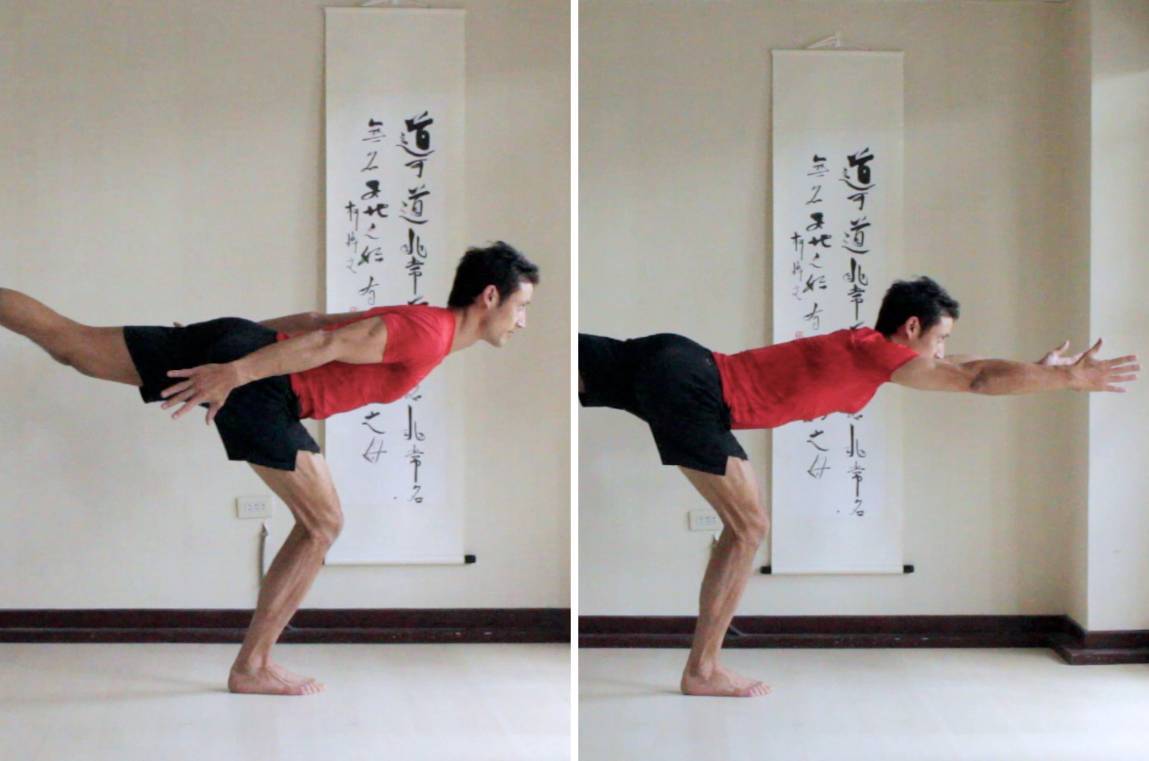
1. Arms back.
2. Arms reaching forwards.
In warrior 3, bending the standing knee lowers your center of gravity, making it easier to balance. It also gives you the chance to focus on something else such as making your body feel long.
To work towards a straight standing leg, first practice straightening your standing leg while inhaling and bending it while exhaling. Do this slowly. Then work at holding the pose with your standing knee straight.
Lowering Your Center 2
Inverted poses, like Headstand and Handstand, can also be made easier by bringing your center of gravity closer to the earth.
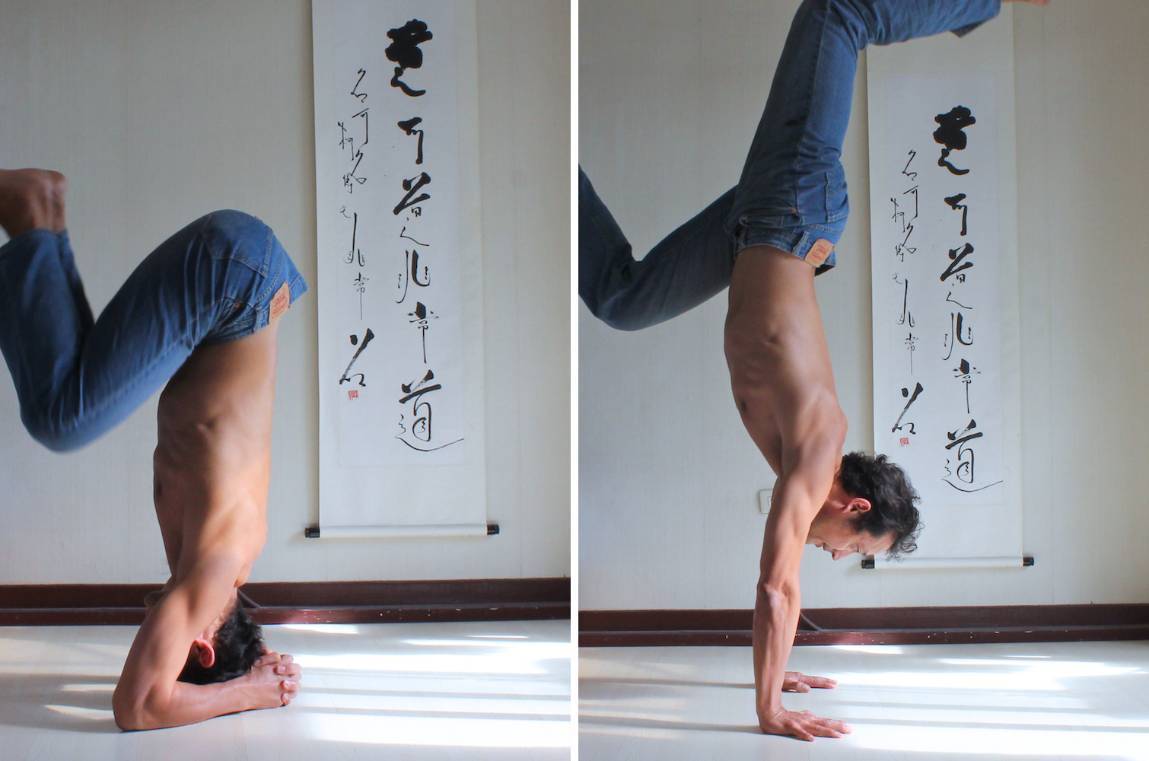
1. Headstand with knees bent.
2. Handstand with legs reaching front and back.
In headstand you can do that by bending your knees and bringing them to your chest. You can also do the same in handstand though it might require you to angle your arms so that your shoulders are ahead of your finger tips.
Another option in handstand (and headstand) is to reach one leg forwards and the other leg back.
For headstand, once you are used to balancing with a lower center of gravity, work at gradually straightening your legs and reaching them upwards while staying balanced. For handstand, work at bringing the legs together, perhaps with knees bent first, and then reach the legs up while staying balanced.
Now, of course, you could make either of these poses even easier by using a wall. You ground contact area then becomes larger. Looking at a handstand your contact area isn’t just your hands, it is also your feet (and possibly your butt if you have that against the wall also.)
How would you get your feet off of the wall in a handstand? Shift your weight so that it is over your hands. You could do this by pushing your butt away from the wall to the point you can pull your feet away. Or you can reach one leg forwards far enough that you pull the other foot off of the wall.
Peacock Made Easier
If you are having trouble in peacock pose, such as not being able to lift your feet while your knees are straight, then bend your knees. You then don’t have to move your body so far forwards in order to get your knees off of the floor.
With feet on the floor your feet become part of your foundation. In order to lift your feet you have to get your center of gravity over you hands. And to that end you can try moving your body forwards relative to your hands.
If that’s too difficult then bend your knees and make your knees part of your foundation. Now you’ve moved your center closer to your head. As a result, in order to lift your knees off of the floor you don’t have to move your body quite so far forward in order to get your center over your hands. Once your center is over your hands you can lift your knees.
Once you’ve gotten used to balancing with your knees bent, you can work at slowly straightening your knees while working at staying balanced.