Balance Basics
The goal in balance is to keep your center over your foundation. To that end it helps if you can feel how your center and foundation relate. When you feel this relationship moving out of balance the goal is to act in such a way that you put it back in balance.
And so to make it easier to stay balanced it helps if you learn how to feel your body and control it. The two things that you can focus on learning to feel and control are your center of gravity and your foundation.
If you can feel and control the way these two things relate you can stay balanced.
So to start of with, lets look at the foundation of a balancing yoga pose.
Three Uses for Foundation
In terms of balance, the foundation has three aspects.
Ground Contact Area
The Ground Contact Area aspect of a foundation is the area over which you keep your center in order to stay balanced.
The part of your body that touches the floor creates a shape, an area over which you keep your center of gravity in order to stay balanced.
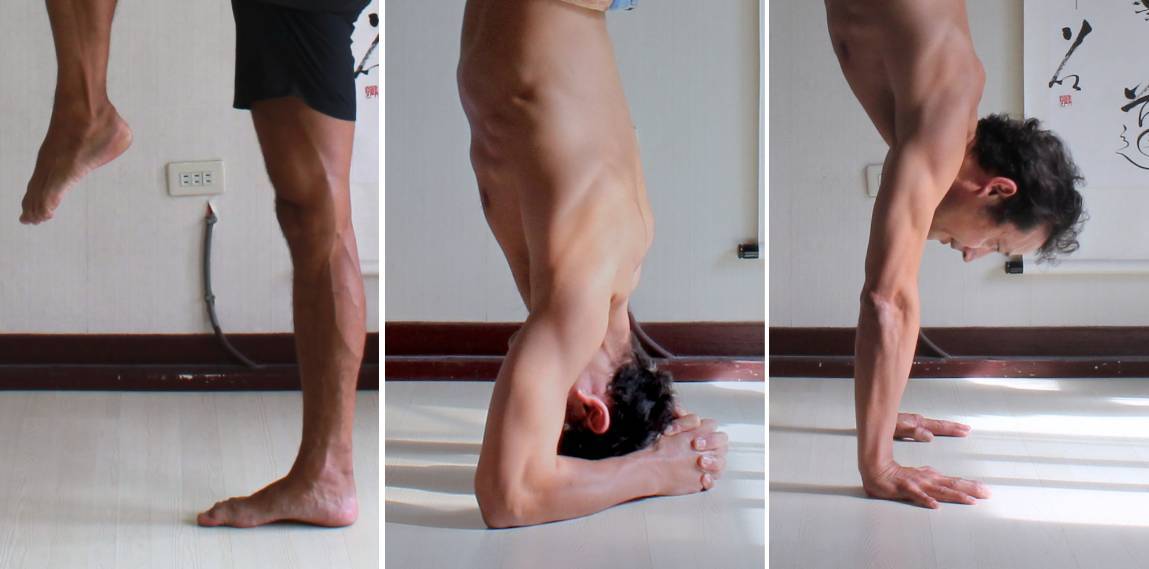
In each of the three pictures above, the “Ground Contact Area” of the foundation is different.
- In the first picture the foundation of the pose is the foot. Balancing on one foot, you have to keep your center of gravity within the border of the standing foot in order to stay balanced.
- In the second picture the foundation of the pose is formed by the forearms and head. Doing a headstand with the arms in this position, you have to keep your center within the triangle formed by the forearms to stay balanced.
- In the third picture the foundation of the pose is formed by the hands. Balancing on your hands, you have to keep your center over the area framed by the hands. That means it can be over one hand, or the other hand or somewhere over the area between the two hands to stay balanced.
The Ground Contact Area of Your foundation marks the boundaries within which you are trying to keep your center.
Stability
For a building, stability is created by digging foundations deep within the earth. The higher the building the deeper (and/or wider) the foundation has to be.
We don’t have that luxury.
Instead we can stabilize the lowest part of our body, the part closest to the ground, to stay balanced.
And actually, a building can be a poor analogy for controlling the human body, because, eventually, we want to be able to move.
Using the same three examples:
- Standing on one leg we can stabilize the standing foot, ankle, lower leg and knee.
- Balancing on head and forearms we can stabilize shoulders and arms, head and neck and perhaps even the ribcage and pelvis (using the abs.)
- Balancing on the hands, we can stabilize hands, wrists, elbows.
You might ask, why does stability for one leg end at the knee? Why, when balancing on the hands, does it end at the elbows?
Because both the forearms and the shins have some rotational freedom. With the foot on the floor, the Lower leg can rotate relative to the foot. If the knee is bent, it can also rotate relative to the thigh. The forearm can also rotate.
How do you turn a roundabout (or merry-go-round, the toy you find in a kids playground)into a stable foundation for standing on? You stop it from spinning. Likewise when standing on one leg or balancing on the arms, one of the ways that you create stability is by preventing either from rotating.
With a stable foundation it is easier to control our body with less effort. When balancing, that means it is easier to keep our center of gravity over our Ground Contact Area.
Sensitivity and Control
The third aspect of a foundation when balancing is sensing and control. We can use it to feel where our center is in relation to our foundation. We can also use it to help control our center.
By learning to use our foundation to feel where our center is we can notice both when we are moving out of balance and when we are in balance. It’s like using a speedometer to check our speed. If we are driving at the speed we desire we do nothing. But if we aren’t then we use the brakes or accelerator as required.
Noticing that our center is moving towards the edge of our area of contact we can operate our foundation in such a way that we move our center of gravity away from the edges of our ground contact area. The earlier we sense our center shifting, the easier it is to subsequently act in such a way that we keep it in bounds.
Center of Gravity
The Center of Gravity is the part of our body that we have to keep over our foundation in order to balance. It’s position changes depending on how the arms, legs, head and torso all relate. This is because each of these parts has their own individual center of gravity.
By changing the shape of our body we can shift our center of gravity relative to ourselves.
Here’s some examples.
Using the Arms to Shift Our Center
To experience how our center of gravity can be affected by moving our limbs (“shape shifting” or “shape changing”) you can stand on tip toes with your torso horizontal. (More on how to balance on the fronts of your feet later.)
Start with your arms back and then reach them forwards while staying balanced. Then move them back again.
Reaching your arms will cause your body to move back so that you stay balanced over the fronts of your feet. Moving your arms back will cause your body to move forwards.
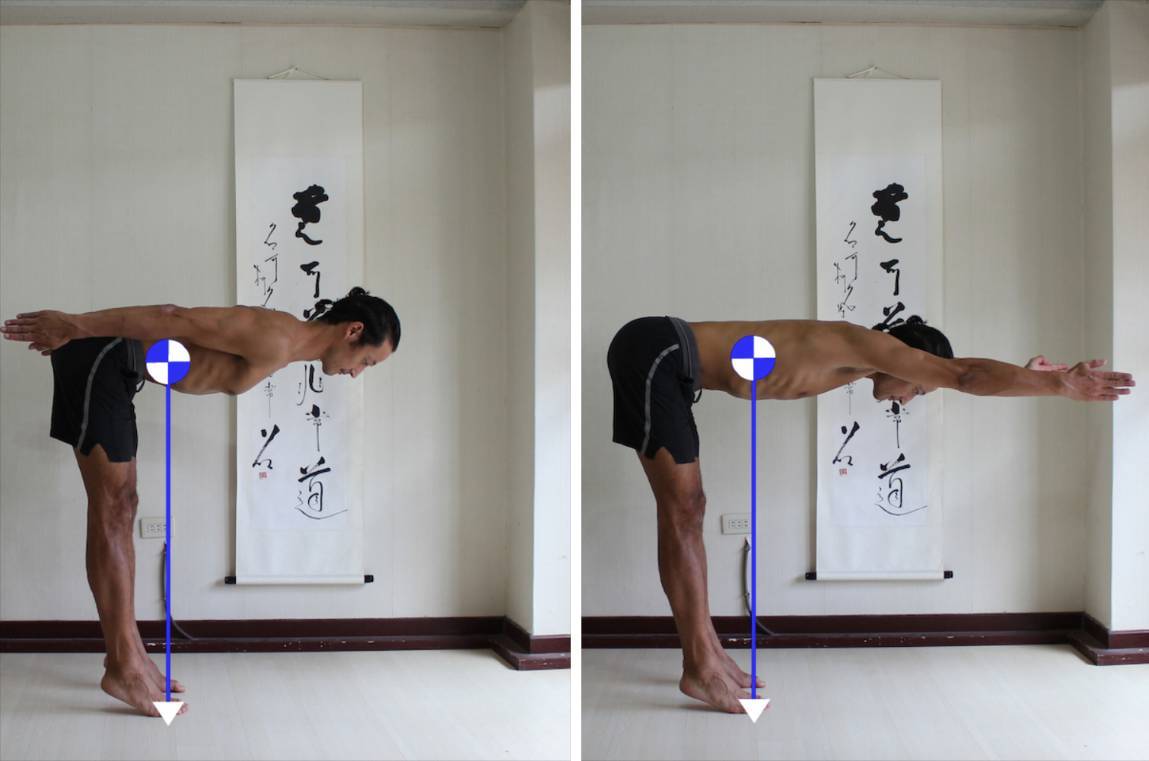
The arms have weight. Because of this we can move them and cause our center of gravity to shift relative to our body.
Moving our arms forwards shifts our center forwards while moving them back causes it to move back. Our body then has to shift if we want to keep our center over our foundation.
Positioning Our Center Outside of Our Body
Another way to experience “shifting” your center is to stand on one leg and do a side bend to the opposite side.
Standing on your left leg, you could try pushing your hips to the left and reach your torso and arms to the right. Or just look at the pictures below.
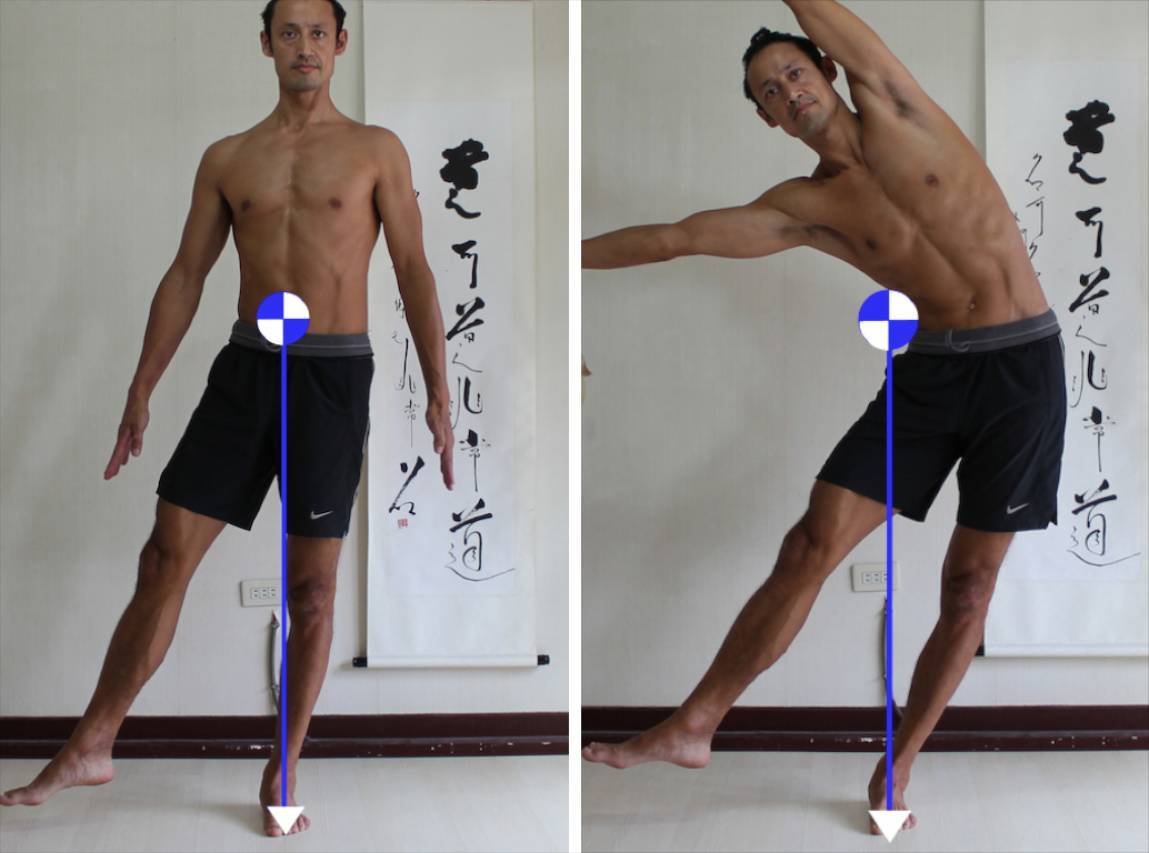
In both pictures I am balanced on my left foot.
In the first picture, with my torso reasonably upright, my pelvis is over my foot and my center of gravity (represented by the circle) is near my belly button.
In the second picture, bending to the side, my center of gravity is to the outside of my waist. It is actually outside of my body! While my center has shifted relative to my body, my body has also shifted with the net result that I’ve kept my center over my foundation.
I’m still balanced.
The point here is that when we understand that “shape changing” can shift our center we can use that understanding to make staying balanced easier.
Knowing that a shape change could change the position of our center of gravity we can move in such a way that we keep our center over our foundation.
Shifting Center In Peacock Pose
In the pose below, called peacock pose the hands are the foundation. But the belly rests on the elbow in what could be thought of as a “secondary” foundation.
One way to shape change in this pose is to bend the knees… and then straighten them again.
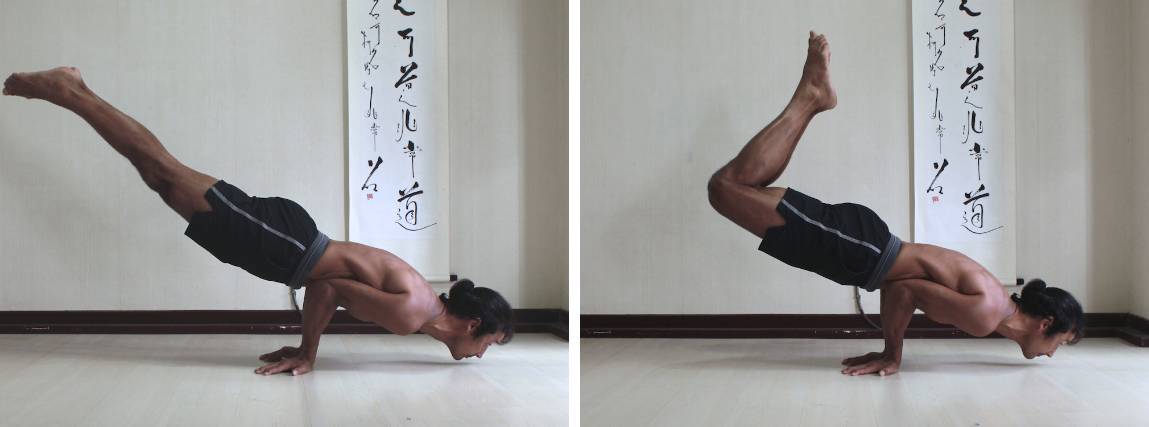
Bending the knees shifts the bodies center of gravity and moves it closer to the head.
With the knees straight the center of gravity is further away from the head.
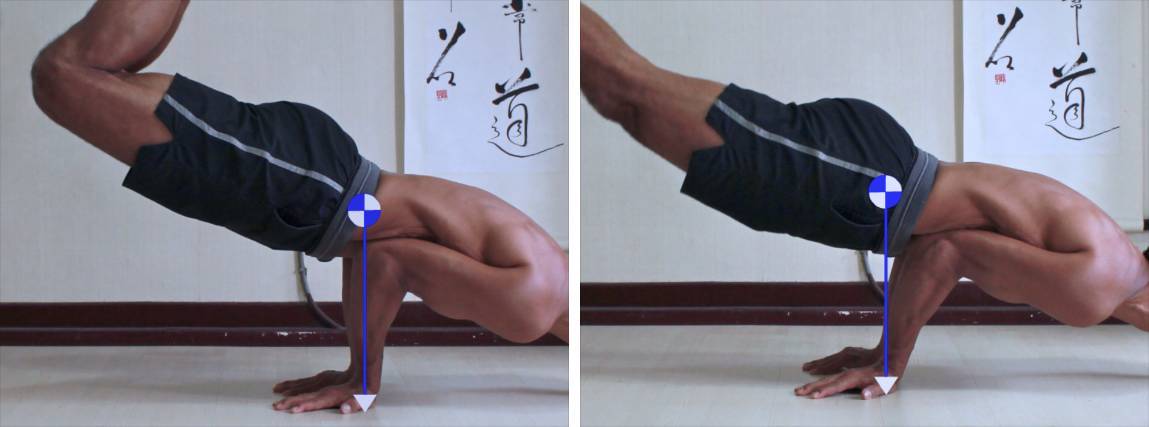
If you look at the two pictures above you can see that with my knees bent, my forearms are more vertical. With knees straight my forearms angle forwards. This adjustment of forearm angle is needed in order to keep my center over my foundation.
Straightening my knees, my center moves towards my feet. So I have to shift my body (and my elbows) forwards relative to my hands to stay balanced.
Bending my knees my center moves away from my feet. So I have to shift my body (and elbows) back relative to my hands to stay balanced.
Shifting Center in Headstand with Legs Straight
The pictures below show two variations of headstand, one with legs horizontal, the other with legs vertical.
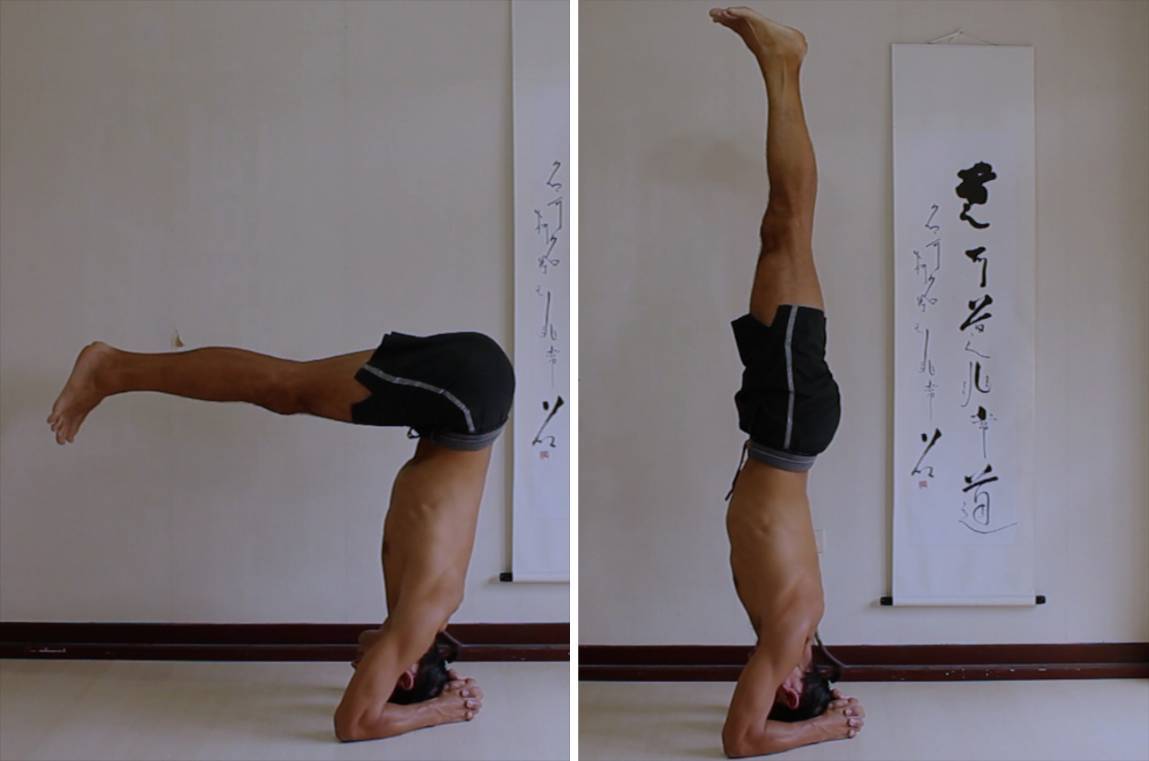
Legs are heavy. And lifting them horizontally in headstand shifts our center relative to our whole body.
With legs horizontal, I need to do something to balance the weight of my legs. So my pelvis moves back. I then stay balanced.
Lifting my legs to vertical, I no longer have to counterbalance the weight of my legs so I can move my pelvis back over my foundation to stay balanced.
In the two pictures above, notice the difference in inclination of my upper body. You can use the edge of the scroll as a reference. In the first picture with legs horizontal my hips lean towards the scroll. In the second picture my torso is more vertical.
Control Your Center
While changing the shape of our body can shift the location of our center of gravity, our center does tend to stay within the region of our pelvis. And so one of the key areas we can learn to feel and control in order to make balancing easier is the pelvis.
The ideal is to be able to feel and control the whole body, but if that isn’t yet possible (or we are feeling lazy) then controlling the pelvis is a pretty good substitute.
If you are using your foundation to feel your center and you feel your center of gravity moving to the left then focus on moving your pelvis to the right until your center is where you want it to be.
If you feel your center shifting forwards then move your pelvis back.
I should say here that while the center of our body is pretty close to our pelvis, our pelvis isn’t our center. The position of our center of gravity relative to the pelvis is affected by the position of all of the parts of our body (each with their own center.)
That being said, controlling the position of the pelvis relative to your foundation is a simple method of staying balanced. If you feel your center moving in one direction relative to your foundation, then move your hips in the opposite direction to stay balanced.
What if it is your hips that you are deliberately moving that causes you center to shift?
Then you’ll have to move some other part of your body in order to stay balanced.
So that you move just the right amount to stay balanced use your foundation, your ground contact area to feel where you center of gravity is.