AI: A Very Brief History
 |
Until a couple of years ago, the average person heard about AI only as an abstraction, either as science fiction or as something that could beat a grandmaster at chess or the game of Go. Suddenly AI is everywhere, creating a false impression that it’s new. Even the new stuff isn’t exactly new. But that’s a moot point. AI meant little to book publishing before ChatGPT. Now it means a lot. |
Understanding the roughly 70-year development of AI can be fascinating, but it’s in no way required to appreciate what’s going on today.
Our World In Data does a nice job of briefly recording the history—I’ll leave it to them.
The current generation of AI was developed mostly over the last decade. Then, suddenly, ChatGPT appeared ‘overnight’ on November 30, 2022. Two months later it had 100 million monthly users, the fastest that any technology has ever moved into the consumer space (Facebook took over two years to reach 100 million users).
Why the rapid adoption? First, it’s fascinating and fun. Second, it’s free. Third, you don’t need to buy a new device to use it. And fourth, you don’t need any training to initially access ChatGPT (or its Chat AI competitors). But those same factors applied also to Facebook, so why ChatGPT?
As Arthur C. Clarke famously noted, “Any sufficiently advanced technology is indistinguishable from magic.” Chat AI is magic. The experience of ‘talking’ in everyday language to a machine… it’s magical. The experience of saying “I want an image of a book in a balloon in a cloud near the sun,” and, seconds later, one appears,

… is also magical. GPT-generated images are starting to look similar in style, colorful and fanciful. So I sent a second prompt “now in a style that looks like a 15th century illustration.” And so:
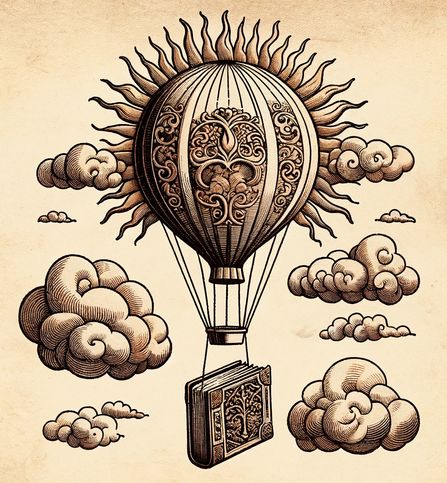
If I want a video of a book in a balloon in a cloud near the sun, there are over a dozen tools to choose from, and presto. And a musical soundtrack to go with the video. Well, how does this sound? It’s just like magic.
For fear of seeming dismissive of AI’s extraordinary abilities by relegating it to the category of inscrutable “magic,” it’s fun to learn that many of the scientists responsible for the current generation of AI admit that they really don’t understand exactly how it works. As a report in a spring 2024 issue of the MIT Technology Review noted, “for all its runaway success, nobody knows exactly how—-or why—-it works.” Exciting, but a little scary.