The Leanpub Podcast 🎙 Feat. Ediz Najim, Author of Systems Thinking for Agentic AI
Build real AI agent systems, not fragile demos. Systems Thinking for Agentic AI is a practical architecture book for software engineers, backend developers, technical leads, and software architects who want to design production-ready applications with large language models. LLMs are pow...

Episode Details
1. Ediz Najim on Systems Thinking for Agentic AI
In this episode of the Leanpub Podcast, host Len Epp sits down with Ediz Najim, a software architect and technical leader based in Istanbul, to discuss his book Systems Thinking for Agentic AI: A Software Architect’s Guide to Building Reliable LLM and Agent Systems.
1.1 Background and Career
Ediz was born in Baghdad, where he completed his university education before moving to Istanbul to begin his professional career. His first project was a challenging Java codebase at a large company, and the experience of taking on additional responsibilities early on gave him the confidence to pursue startup work, where he had the freedom to choose technologies and frameworks. His long-term goal was always to become a software architect, and that ambition drove him to read, write, and experiment continuously.
Asked whether he would recommend university to someone starting out today, Ediz gave a clear “yes”—academic foundations matter—but he emphasised that universities should go beyond basics and give students far more hands-on, real-world software-building experience, not just brief company placements.
1.2 Why an LLM Is Not a System
The central premise of the book is that a large language model is only one component of an agentic AI system, not the system itself. Ediz uses the analogy of the human brain: a brain can think and decide, but it needs eyes, hands, and other organs to act in the world. Similarly, an LLM needs prompts, retrieval, tools, memory, orchestration, guardrails, and observability working together to form a production-ready system.
1.3 Reliability in Practice
Ediz stresses that reliability becomes critical the moment an AI system touches consequential actions—processing payments, controlling accounts, or making decisions with real-world consequences. Because LLMs are non-deterministic, every input and output must be validated by surrounding components. The system must also record every step in a traceable pipeline so that, when something goes wrong, engineers can reconstruct exactly what happened.
1.4 Evaluation
Evaluating an agentic AI system is fundamentally different from testing a deterministic one. Unit tests alone are insufficient when a component can produce anything from a perfectly relevant answer to a completely unrelated one. Ediz argues that teams must define clear input validation rules and explicit evidence criteria that determine whether an output is acceptable—before they build, not after.
1.5 The Controlled Agent Loop
Ediz offers a crisp definition of an agent: “a system that uses a model inside a controlled loop to pursue a task through actions, observations and state until a stopping condition is reached.” The loop handles user input, validates it, passes it to the LLM, manages tool execution requests from the model, and continues iterating until the LLM signals a final result. Crucially, the loop must never be infinite—engineers should set hard limits such as a maximum number of iterations or a token budget.
1.6 Tool Registries and MCP
To manage the tools an agent can call, Ediz recommends an explicit registry—implemented through the Model Context Protocol (MCP)—that declares what each tool does, what input schema it accepts, and what back-end operation it maps to. This lets the LLM simply request an action (“get the weather in Istanbul”) without needing to know the underlying URL, database query, or caching layer.
1.7 The Future of the Software Architect
Looking five years ahead, Ediz believes AI will be used everywhere in software, but cautions that the current maturity of AI systems is not yet sufficient to hand over full autonomy. The role of the architect will evolve, but human oversight and systems thinking will remain essential until AI demonstrates the reliability needed to be fully trusted.
1.8 Writing Process and STAAI
Ediz writes continuously—articles, LinkedIn posts, and drafts—without a fixed schedule, treating daily writing as a creative habit. The book grew out of accumulated notes and posts. He is also developing the STAAI architecture model, a framework of standards and principles for building agentic AI systems, more details of which can be found at STAAI.com.
The episode closes with Ediz thanking his parents for their encouragement, and with a listener request for Leanpub to offer print book services directly on the platform.
This interview was recorded on [interview-date].
The full audio for the interview is here: https://s3.amazonaws.com/leanpub_podcasts/FM338-Ediz-Najim-2.00.mp3. The Leanpub Podcast is available on our YouTube channel at https://www.youtube.com/leanpub, in Apple Podcasts here https://podcasts.apple.com/ca/podcast/Leanpub/id517117137, and almost everywhere else people listen to podcasts.
About the Book
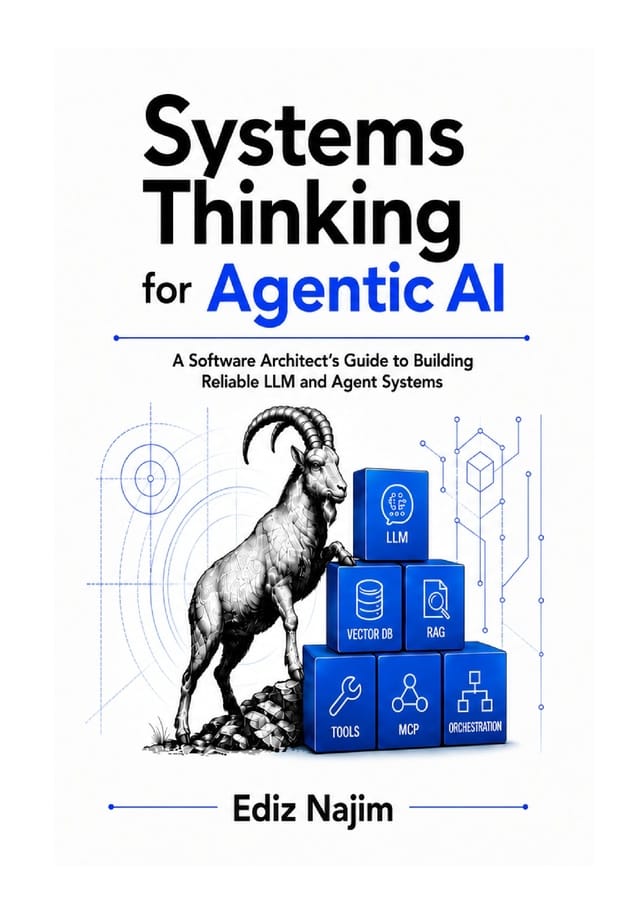
Build real AI agent systems, not fragile demos.
Systems Thinking for Agentic AI is a practical architecture book for software engineers, backend developers, technical leads, and software architects who want to design production-ready applications with large language models.
LLMs are powerful, but an LLM alone is not a system. Real AI applications need prompts, retrieval, tools, memory, orchestration, guardrails, evaluation, observability, and runtime control working together inside clear engineering boundaries.
This book explains how to move from simple chatbot experiments to reliable AI-enabled software systems. It focuses on the production realities that matter after the demo works: latency, cost, failure handling, tool execution, structured outputs, testing, tracing, safety controls, and maintainability.
Who this book is for
This book is for software engineers, backend developers, technical leads, and software architects who want to build practical AI systems. You do not need a machine learning background. If you already build backend services with APIs, distributed systems, and system design in mind, this book helps you extend that skill set into AI-powered systems.
What you will learn
You will learn how LLMs process language through tokens, embeddings, and transformers, how to control model behavior with prompting and structured output, how to connect LLMs to production systems through tools and MCP, how to build RAG pipelines, and how to design agent workflows with planning, memory, orchestration, and controlled execution.
The book also covers guardrails, validation, permissions, human approval boundaries, evaluation, hallucination reduction, regression testing, observability, performance, cost, scaling, retries, fallbacks, and an end-to-end Code Review Agent implementation with Spring Boot.
Many developers know how to call an AI API. Far fewer know how to design a reliable system around it. That gap is where many AI projects fail.
This book treats AI as software architecture, not magic.
About the Author

Ediz Najim is a software architect and technical leader with nearly two decades of experience designing and building distributed systems, microservices, and production-grade backend platforms.
His work focuses on event-driven architecture, reliability, performance, and the practical engineering of AI-enabled software systems.
In Systems Thinking for Agentic AI, he brings a software architecture perspective to LLM applications, RAG, tool orchestration, agent runtimes, guardrails, observability, and production reliability. His writing is aimed at engineers, architects, and technical leaders who want to move beyond AI demos and design systems that can operate under real-world constraints.
Leanpub Book LAUNCH 🚀 Systems Thinking for Agentic AI: A Software Architect’s Guide to Building Reliable LLM and Agent Systems by Ediz Najim
Clips From This Episode of the Leanpub Podcast