Transcontinental Railroad
We’re looking at the background behind the U.S. Department of Justice plan to consider antitrust action against the giants of high tech. We’ll see how ocean transportation gave way to transcontinental transportation. That’s the background we’ll need for seeing how transcontinental transportation became the antitrust action that’s setting a precedent for big tech.
This all sounds ridiculously boring, but don’t worry. Like many things, it all starts with a remarkable flame war. We continue with the transcontinental railroad, which took their case of excessive greed to the Supreme Court—and lost. That loss becomes the centerpiece of antitrust investigations of high tech.
Railroading
Deputy Attorney General Jeffrey Rosen shared the U.S. Department of Justice plan to investigate big tech over antitrust concerns. Rosen cited one and only one specific court case, Northern Pacific Railway v. United States, decided by the U.S. Supreme Court in 1958. Rosen also explained, in that context, that “we should be students of history.”
That court case involved our westward expansion in the USA during the early 1800s, the transcontinental railroads, and specifically the “checkerboard” land grants made to those railroads.
Congress gave the transcontinental railroads (which only existed on paper at that point) vast tracts of land, which the railroads could sell. This was how the railroad company raised funds to pay for building the railroad. The Northern Pacific Railway tried to lock in their customer base by adding a condition to the land sales. The purchaser—while paying good money for the land—could only use the Northern Pacific Railway to transport anything produced on that land.
It’s much like Oracle, Apple, Microsoft, or IBM trying to lock you in to using their product—with a hefty enterprise license. The Supreme Court called the Northern Pacific’s conditions of sale an anticompetitive practice. Rosen’s using that court decision as a centerpiece of DOJ antitrust investigations.
As we watch the antitrust action unfold (assuming it does), bear in mind the delightful Merriam-Webster pair of definitions for “to railroad” something or someone (as a transitive verb):
(a) To convict with undue haste and by means of false charges or insufficient evidence; (b) to push through hastily or without due consideration.
To transport by railroad.
When the tech bros start screaming about being railroaded (definition one), we can all answer, “Yup!” (definition two).
Nat and Mary Bowditch
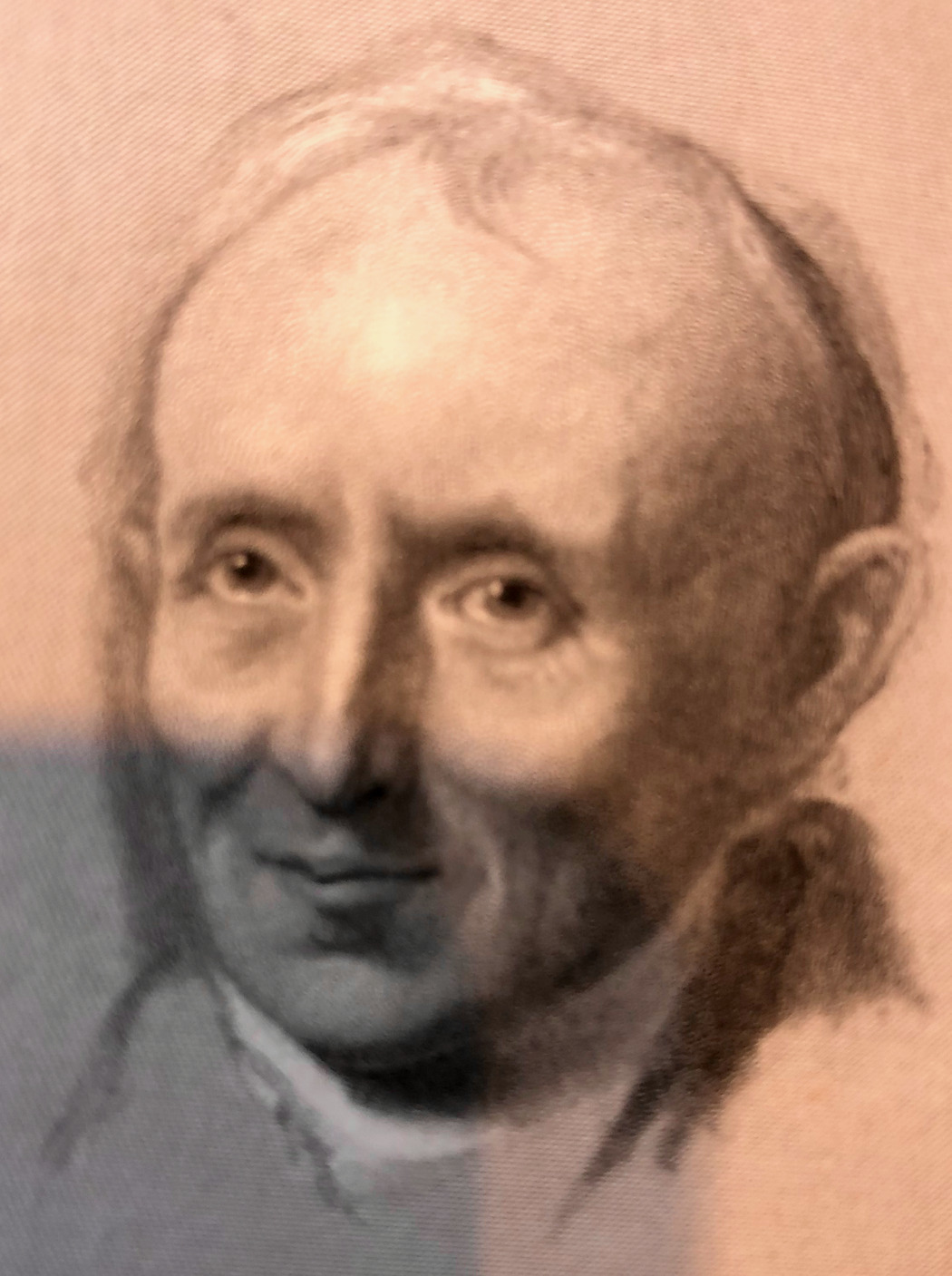
Dr. Nathaniel Bowditch is a “Generation X” person, born in ’73, albeit 1773. See Figure 1, “Nathaniel Bowditch”.
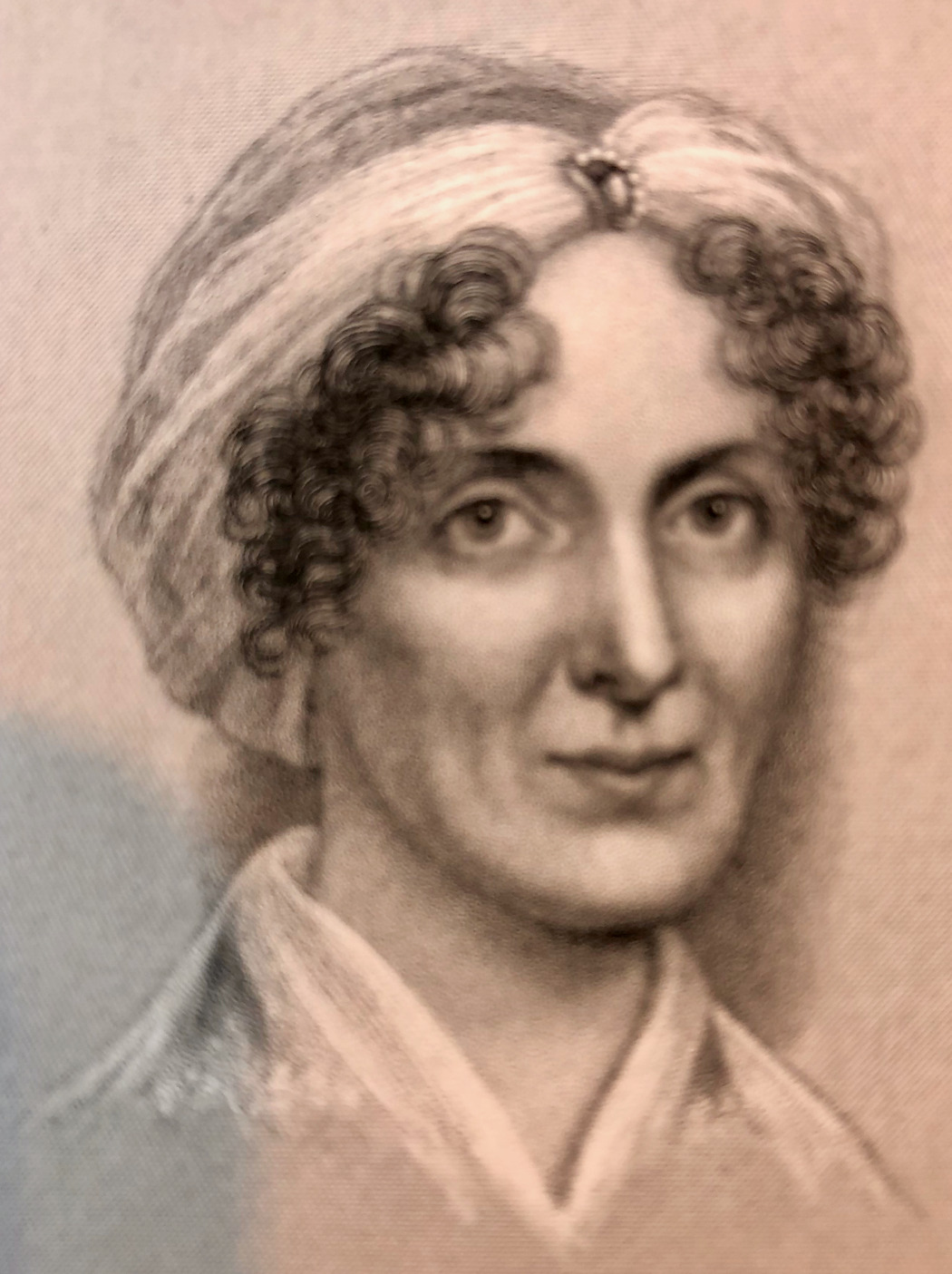
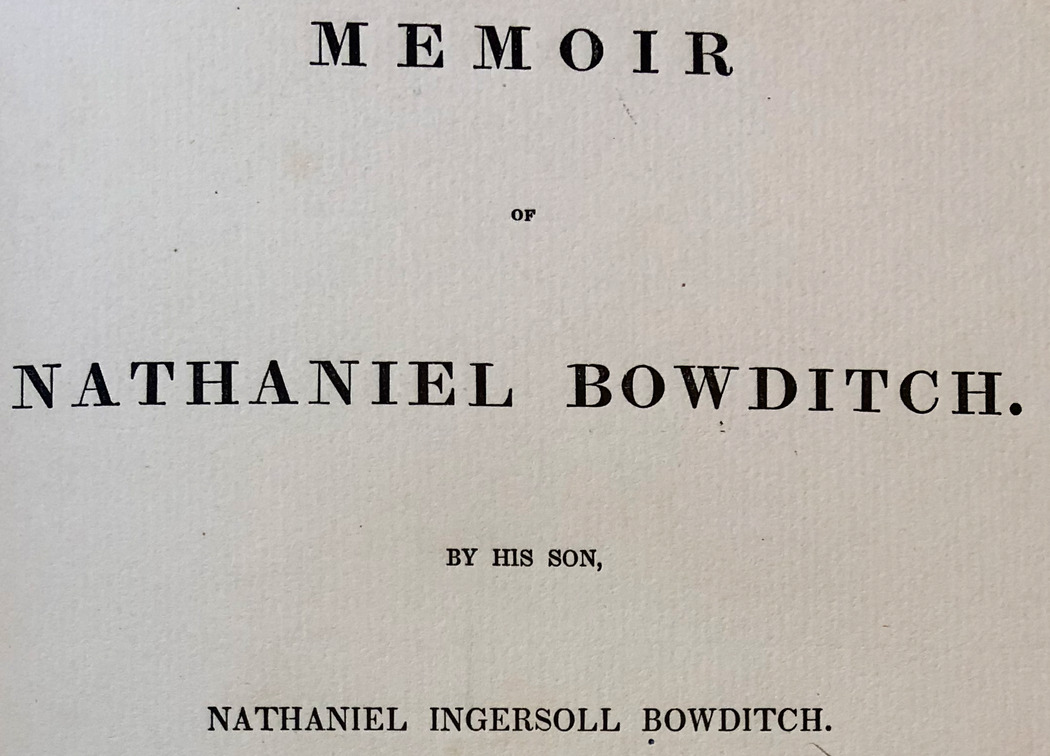
Nathaniel and Mary (Ingersoll) Bowditch (Figure 2, “Mary Bowditch”) had children—and those children published (Figure 3, “Nathaniel Bowditch Memoir”). That will be part of our story. For example, their son Nathaniel Ingersoll Bowditch (1805-1861) was a well-known lawyer and the author of several articles and publications, primarily concerning genealogy and real estate law. Their second son Jonathan Ingersoll Bowditch (1806-1889) took over editorial responsibility for The New American Practical Navigator upon Bowditch’s death in 1838.
Without Dr. Bowditch, we couldn’t have modern capitalism as we know it today. When you think about it, you’ll realize that modern capitalism and antitrust concerns are likely connected.
Popular Astronomy, May 1895, in The Services of Nathaniel Bowditch to American Astronomy reports his encouragement by Harvard (page 388):
In his early years Dr. Bowditch was given much encouragement to pursue his scientific career by Harvard University; in July, 1802, to his great surprise, he was given the honorary degree of Master of Arts… Dr. Bowditch was admitted to the American Academy of Arts and Sciences in 1799… In 1829 he was elected President of the Academy, in succession to the illustrious John Quincy Adams, ex-President of the United States—a high honor which he continued to hold until his death.
Pages 392-393 continue:
He was equally honored in his own country, by being chosen to membership in all the learned societies of the time, and in 1816 at the annual Commencement of Harvard College he received the honorary degree of Doctor of Laws. In 1806 Dr. Bowditch was elected Hollis Professor of Mathematics at Harvard University, but this position was declined owing to an unwillingness to break up his long connection with Salem… in 1823 Dr. Bowditch accepted the position of Actuary to a Life Insurance Company in Boston.
Harvard College was in trouble. Tamara Plakins Thornton, in Harvard Magazine, continues our story in Nathaniel Bowditch: Brief life of a mathematician and businessman: 1773-1839:
He assumed a far more significant role in 1826, when he was named to the Corporation, appointed this time for business, not mathematical, expertise. The College was a financial mess and Bowditch, who had taken charge of a Boston trust and investment company, had a reputation for making it operate like a miniature solar system, a “great machine” running “with the regularity and harmony of clock-work.” Had Harvard’s powers-that-be known what he would do, they might have thought twice about their decision… College monies were mixed in with personal accounts… President John T. Kirkland distributed scholarships without the Corporation’s knowledge or consent, awarded honorary diplomas against its explicit orders, regularly skipped chapel duty to dine with patrician friends in Boston—and then sought reimbursement for the bridge tolls.
The Harvard (college) trust fund was going bankrupt. It had unconscionably lackadaisical management. Dr. Bowditch set things straight—and ruffled feathers in the process. That’s where it gets fun!
Today we have Twitter feuds. Back in the days of Usenet, we had flame wars. They are the same thing. Bowditch was in a flame war. But the people on both sides of the flame war, at the outbreak of flame war, were dead. How cool is that?
On the one side was Bowditch, who was brought in to set the Harvard endowment on a sound footing. On the other side was the previous guy in charge. He picked up his toys and went home. But the flame war erupted after both were dead.
Bowditch died first, 1838. The other guy, a past president of Harvard, died two years later.
The other guy, Dr. Kirkland, was eulogized at his funeral, naturally, which was at Harvard. The eulogy basically said that he had been wronged by Bowditch without actually naming Bowditch. Dr. Bowditch’s children were still alive—and listening (Figure 4, “Bowditch response”).
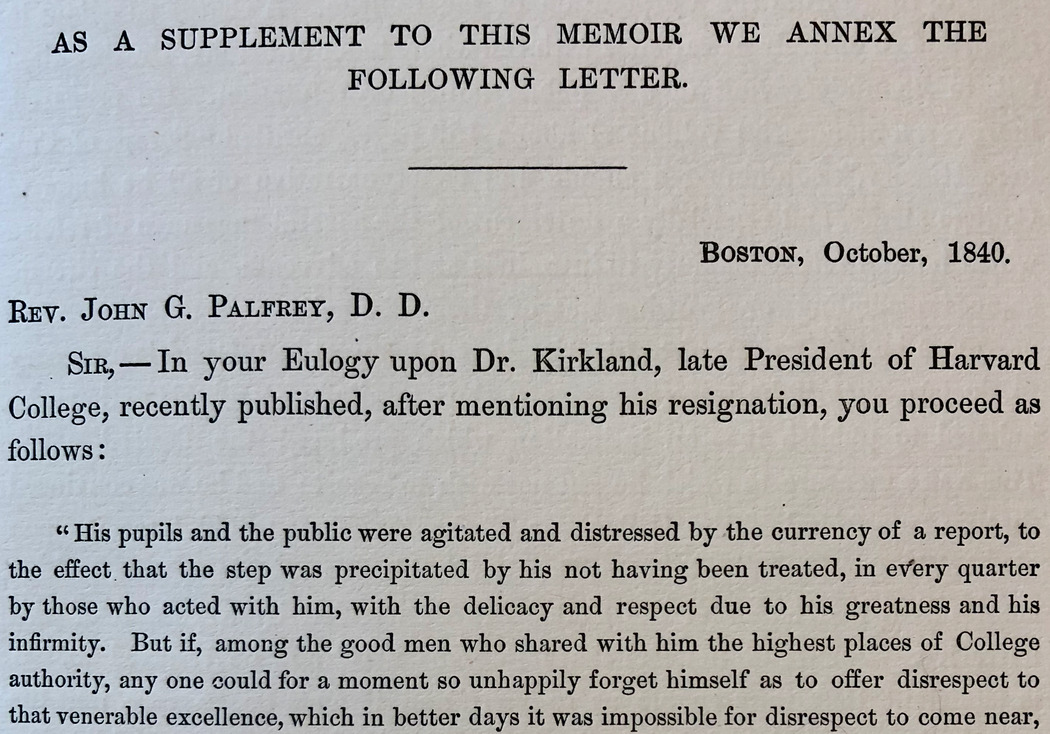
Bowditch’s children were willing to let the eulogy pass. It was just words. But Harvard chose to publish the eulogy. At that point, the Bowditch family found it necessary to say something. In writing. Harvard had just “tugged on Superman’s cape.”
You don’t tug on superman’s cape. You don’t spit into the wind. You don’t pull the mask off that old lone ranger. And you don’t mess around with Jim.
—You Don’t Mess Around with Jim (1972) by Jim Croce
The children published an explanation. Around 1840 they had published A Memoir documenting the life of their father, Nathaniel Bowditch, and family. I found this explanation, signed by the Bowditch sons (Figure 5, “The feud”), in the very back of the third edition, printed in 1884.
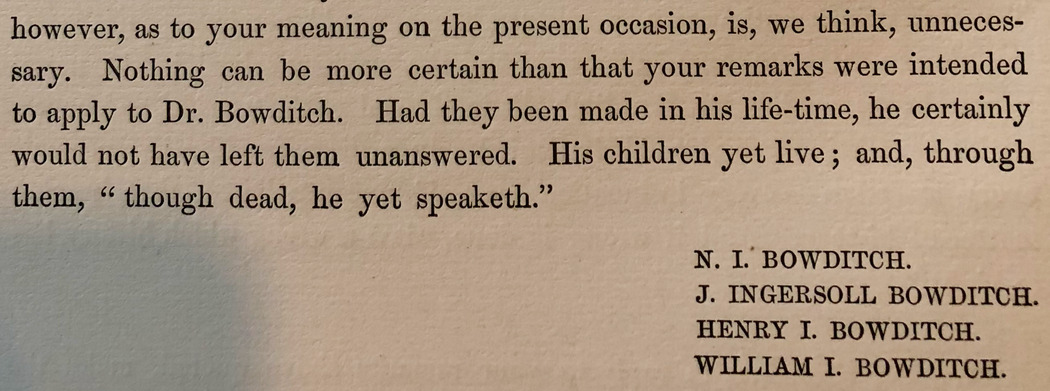
The University of Minnesota Duluth has a copy. The book is falling apart, but they lent it to me anyway. How cool is that? This is where I found traces of the posthumous flame war. What was the problem?
That response in the back of the Memoir explains that, during his lifetime, Nathaniel Bowditch kept receipts. There had been murmuring and complaints during Dr. Bowditch’s lifetime. He’d been heavy-handed in setting the Harvard Endowment straight.
Let me be clear here. This is not a small thing. The Harvard Endowment is a very big deal; in 2018, it was forty billion dollars.
Why is the Harvard Endowment so outrageously large? Dr. Bowditch. He set the nearly-bankrupt endowment on that course. Meanwhile, there was unhappiness amongst those who had been trampled in the process. Thornton explains (linked above):
“Order, method, punctuality, and exactness were, in his esteem, cardinal virtues; the want of which, in men of official station, he regarded not so much a fault as a crime,” Josiah Quincy reflected in his History of Harvard University, and when Bowditch detected such wrongdoing, he “would descend on the object of his animadversion with the quickness and scorching severity of lightning.” … Out went the College treasurer, the steward, and finally Kirkland himself. Proper Boston was appalled, not so much by what Bowditch revealed, or even by the results of his actions, but by the roughshod way in which he had conducted affairs.
The Memoir reports, during Dr. Bowditch’s lifetime, when the bleating got too loud, he called a quiet meeting with the bleaters. He had notes, memos, receipts, names, dates, places, conversations.
Bear in mind Harvard is in, and this flame war takes place in Boston. Dr. Bowditch grew up in and famously sailed from rival seaport Salem. Bowditch’s children state:
When the late President of the University resigned his seat… it was currently reported that Dr. Bowditch had treated him, when enfeebled by disease, with a respect upon which he durst not otherwise have ventured.
He was therefore denounced through the public press as “a Salem sailor,” and called upon by name to retire from the Corporation of the College. A charge so odious in itself… Dr. Bowditch felt to be undeserving of any public notice or refutation.
He prepared, however, a manuscript volume of about 150 pages, entitled “Scraps of College History,” containing a simple and exact narrative of all he knew of College affairs, and especially a statement of the several measures of reform which he had felt it his duty to introduce and to advocate, and the circumstances attending or growing out of their discussion and adoption.
Now we come to the point.
His narrative he freely showed to his friends, and even, at last, found it necessary that if he were any longer assailed, he might, perhaps, be induced to publish it—an intimation which produced the desired effect.
Clearly, Dr. Bowditch’s children were in possession of Scraps of College History—and had the ability to publish. We are, after all, reading this story in a published book. Let the posthumous flame war begin:
Dr. Bowditch died in the belief that he had lived down this calumny. Little could he have anticipated that so soon after his death, upon a most solemn and public occasion, an individual, recently at the head of one of the departments of the College, and who, though not an officer of the institution at the period alluded to had yet the means of knowing the truth, should nevertheless have seen fit, under the disguise, indeed, of gentle insinuations, and the show of much forbearance, distinctly to allude to this charge in a manner which none of his hearers could misunderstand.
The mere insertion of this paragraph in the discourse when delivered, we should not have noticed. But a PRINTED eulogy… of one of its most universally popular presidents… may exist to be referred to by the future historian of the College. (Emphasis in original.)
Had [the remarks] been made in his life-time, he certainly would not have left them unanswered. His children yet live; and, through them, “though dead, he yet speaketh.”
I’m quite impressed with this flame war—since both principals were already dead when it started. Take note of the hallmark of modern flame wars, namely the seemingly-endless rant, which “states the facts.” The published rant covers four large 11-inch by 9-inch pages.
Was this a trivial matter? No. This was over the $40,000,000,000 Harvard Endowment. As the Harvard Endowment hits the news from time to time, remember where it began. Beloved Harvard president Dr. Kirkland fluffed it; self-taught Dr. Bowditch saved it.
Did you catch the lesson for us today? Keep a journal. Only in retrospect will you know what parts were important. A contemporaneous log carries high credibility. It’s a good habit to form.
When some tech bro comes at you like he’s just invented the Twitter feud… Nope. Refer him to the back pages of The Memoir of Nathaniel Bowditch, Third Edition (1884). Note that they feuded when the principals were stone-cold dead, and suggest he might be inspired to take a similar approach.
Meanwhile, Dr. Bowditch did stuff after setting Harvard’s endowment straight. He arguably set us on the path to modern capitalism. He was the first professional fund manager—and, as the Memoir explains, he refused to lend to any woman, ever. His reasoning was that, in the case of default, he could not possibly consider going after a woman to collect on the default. (I but report the facts.)
Clipper Ships
Bowditch had much to do with the wealthy people—the shipowners—staying wealthy. Tamara Plakins Thornton wrote the award-winning book Nathaniel Bowditch and the Power of Numbers: How a Nineteenth-Century Man of Business, Science, and the Sea Changed American Life in 2016. Her book is “at once a lively biography, a window into the birth of bureaucracy, and a portrait of patrician life, giving us a broader, more nuanced understanding of how powerful capitalists operated during this era and how the emerging quantitative sciences shaped the modern experience.” It’s amazing how one relatively-unknown person set forces in motion that we experience today.
Much of the USA’s economic power, in the 19th Century, came from the ships, especially the Yankee Clippers with their split topsails. Bowditch made it possible for them to reach their destinations months sooner thanks to his writing The New American Practical Navigator.
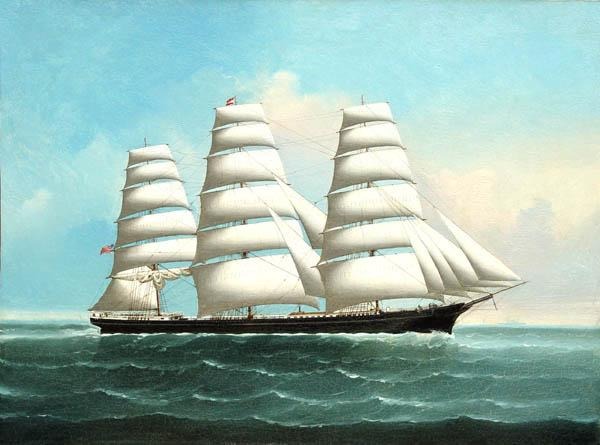
Figure 6, “Portrait of an American clipper ship,” is by Lai Fong, a Chinese artist working in the final quarter of the 19th Century, primarily from his studio in the Indian port of Calcutta, born circa 1869. This painting was owned by the family of Captain Thomas Belch Perkins (1816-1875) of Salem. The flag flown on the ship is a “house flag,” possibly that of I.F. Chapman of Bath, Maine.
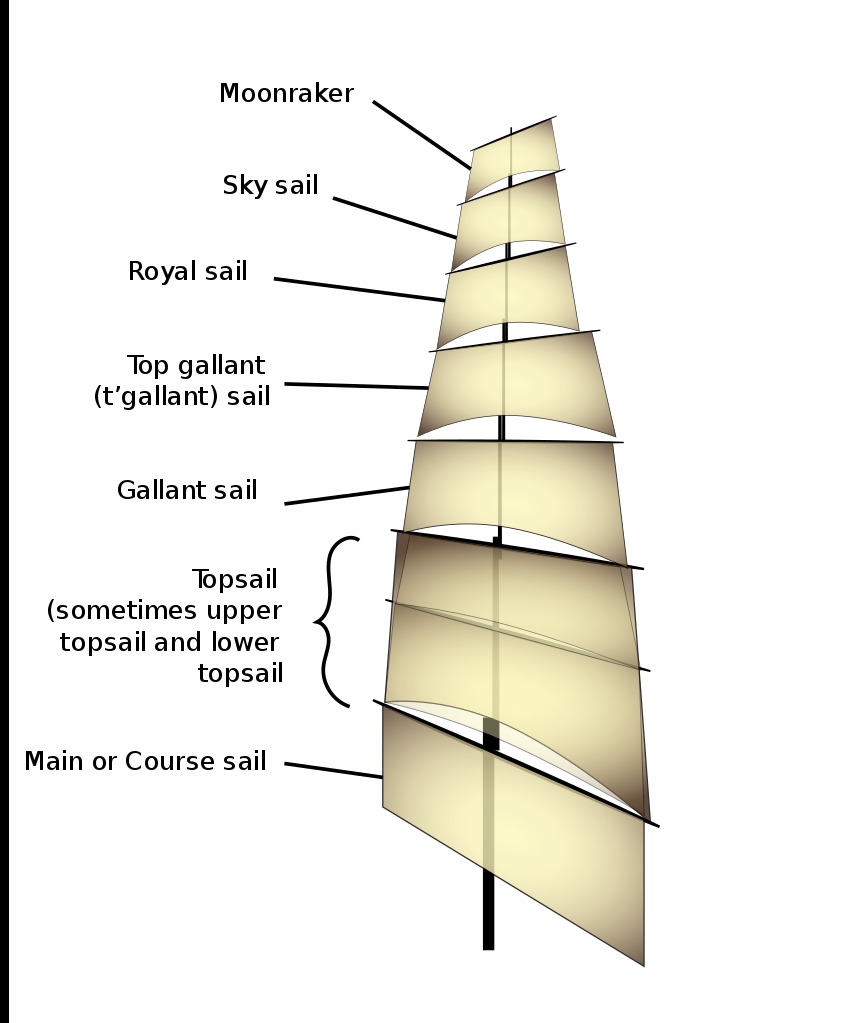
Compare the clipper ship to Figure 7, “USS Constitution,” the earliest known depiction (ca. 1803-1804) of the USS Constitution, “Old Ironsides.” Count the number of sails on the main (center) mast. From bottom to top, the Constitution’s sails are the mainsail or “course,” the topsail, the topgallant, and royal. The “royal” is so-called because it sits above everything else.
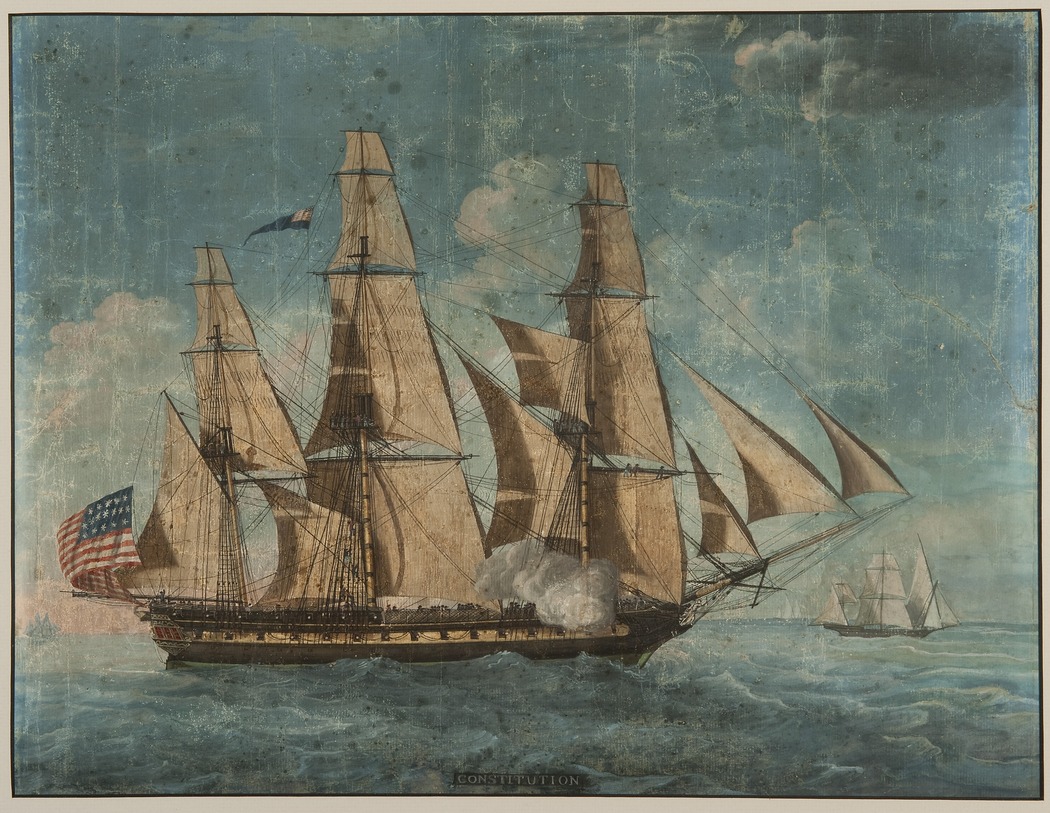
There’s something odd about this painting of USS Constitution. Which way is the wind blowing? The ship is pointed to the right. The direction of the ship, and the shape of the sails, tell me that the wind is blowing from left to right in the painting. Yet the flags indicate the wind flowing from right to left. Perhaps the cannon smoke near the bow gives us the answer. Perhaps the wind is flowing from the observer towards the ship. That would explain why the smoke appears to be blowing back, across the ship.
Remember, ships of this era were entirely wind-powered. Wind and weather are everything. So, in this case, we’re looking downwind to the ship, and that’s why the flag seems to show the wind flowing one direction while the sails are billowing in the other. I mention this oddness because it’s a lesson for software development today. When symptoms or circumstances don’t quite seem to align, it’s a sign you do not yet understand the situation correctly. Keep digging or searching for that understanding!
A half-century later (mid 19th century), merchant vessels, including the clipper ships, split the sails (Figure 8, “Split sail plan”). Merchant ships had far fewer sailors to handle the sails as compared to military vessels such as Constitution. It was far easier to handle the topsail as separate upper and lower topsail. The topgallant was likewise split into gallant and topgallant.
National Geographic Magazine explains that “Clipper ships’ owners made millions… Shipping barons like Warren Delano and Robert Forbes got rich from the opium trade in China. Many of the great clipper ship fortunes funded… universities such as Harvard, Princeton, and Yale.”
Do you recognize either of those names? “Forbes” is probably familiar. You might know of Delano’s grandson, Franklin Delano Roosevelt (FDR). He made the Day of Infamy speech, bringing the United States into World War II. (The linked article describes how FDR crafted his “call to arms” in a remarkably short time frame.)
Have I wandered off course with this talk of sail plans and so on? No. There’s a general principle I follow in software development. We just saw this principle at work with the painting of the USS Constitution. When something doesn’t quite add up, or the known facts don’t all fit the explanation of what happened, it’s important to check further.
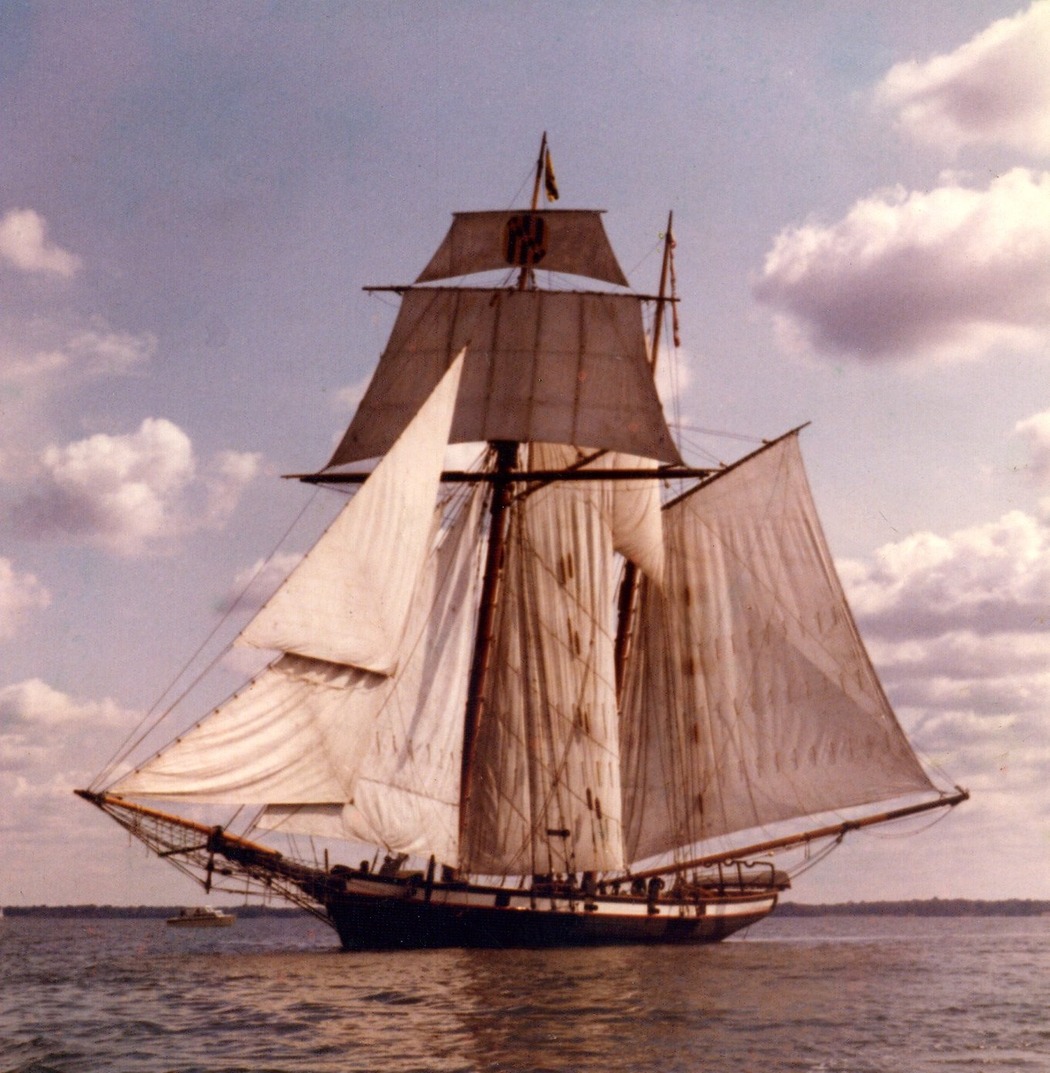
The National Geographic article linked above, titled “Clipper Ship Owners Made Millions. Others Paid the Price,” opens with “Clipper ships traveled at blistering speeds but conditions on board were brutal, and opium was their most profitable cargo.”
So far, so good. The article’s dramatic title got me to click. But the photo is of the Pride of Baltimore, “a reproduction 1812 Baltimore clipper” (Figure 9, “Pride of Baltimore”). It doesn’t look anything like Figure 6, “Portrait of an American clipper ship,” which we know to also be a “clipper ship.” Do you see that the sail plan is quite different?
It turns out that there were two different things, both called clipper ships. Sheesh! Daniel Brown explains in “The Need for Speed: Baltimore Clippers and the Origin of the First American Ship Type” that American shipbuilders created something called the Baltimore Clipper—the perfect pirate ship (privateer) to prey on British shipping during the War of 1812.
The later clipper ships from 1850 onwards (Figure 6, “Portrait of an American clipper ship”) were entirely different. In one regard, this is due to Bowditch’s voyages. Shipowners, during the Baltimore Clipper era (which was the era of Bowditch’s five voyages), didn’t dare use larger ships; the risk of ruinous loss was too great. Once Bowditch demonstrated reliable navigation, shipowners were willing to take advantage of much larger (and therefore much-faster and capable of carrying more cargo) ships to circle the globe.
So, that minor mystery is solved. There was a “Baltimore clipper” in the late 18th and early 19th Centuries, but there were also the better-known “clipper ships” of the late 19th Century. Technology always evolves, and the pace of evolution evolves rapidly. It took a century for clipper ships to change; we measure changes in programming languages and frameworks in months (or days when we joke). Now we can move on!
Great Northern Railway
The clipper ships disappeared. Why? Railroads. First, we had a railroad across Panama. No longer did ships need to double the Cape of Good Hope or Cape Horn. The NASA Earth Observatory explains Cape Horn: A Mariner’s Nightmare:
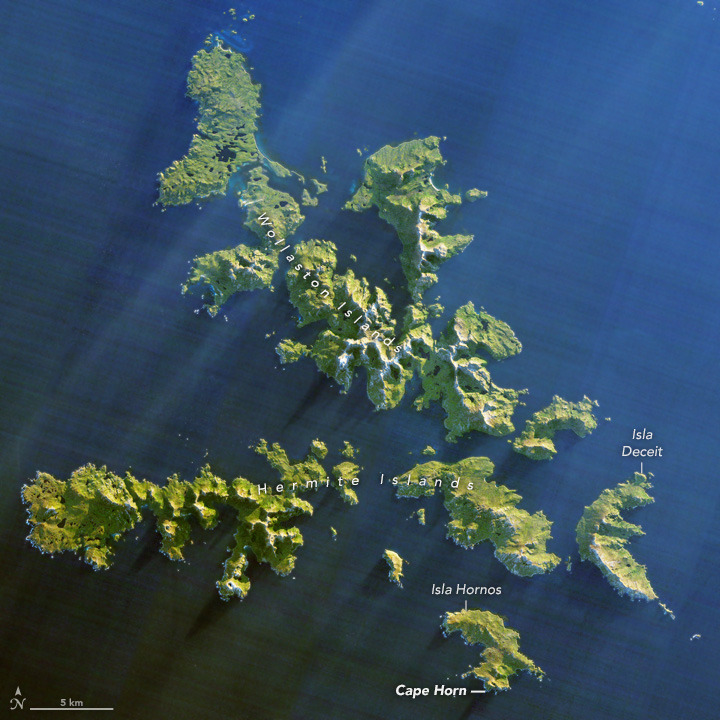
Before the opening of the Panama Canal in 1914, Cape Horn (Figure 10, “Cape Horn”; image from this article) was a place that gave mariners nightmares. The waters off this rocky point, at the southern tip of Chile’s Tierra del Fuego peninsula, pose a perfect storm of hazards.
Southwest of Cape Horn, the ocean floor rises sharply from 4,020 meters (13,200 feet) to 100 meters (330 feet) within a few kilometers. This sharp difference, combined with the potent westerly winds that swirl around the Furious Fifties, pushes up massive waves with frightening regularity. Add in frigid water temperatures, rocky coastal shoals, and stray icebergs—which drift north from Antarctica across the Drake Passage—and it is easy to see why the area is known as a graveyard for ships.
On July 12, 2014, the Operational Land Imager on Landsat 8 satellite captured this image of Cape Horn and the Wallaston and Hermite Islands.
Hundreds of ships have gone down near Cape Horn since Dutchman Willem Schouten, a navigator for the Dutch East India Company, first charted a course around the Horn in 1616. One vessel that narrowly escaped that fate was the HMS Beagle, with naturalist Charles Darwin [for whom the modern Darwin Awards are named] aboard. In The Voyage of the Beagle, Darwin described the harrowing journey as the explorers tried to round the horn just before Christmas 1832.
In Chapter X—Tierra del Fuego Darwin writes:
December 21st.—The Beagle got under way: and on the succeeding day, favoured to an uncommon degree by a fine easterly breeze, we closed in with the Barnevelts, and running past Cape Deceit with its stony peaks, about three o’clock doubled the weather-beaten Cape Horn. The evening was calm and bright, and we enjoyed a fine view of the surrounding isles.
Cape Horn, however, demanded his tribute, and before night sent us a gale of wind directly in our teeth. We stood out to sea, and on the second day again made the land, when we saw on our weather-bow this notorious promontory in its proper form—veiled in a mist, and its dim outline surrounded by a storm of wind and water.
Great black clouds were rolling across the heavens, and squalls of rain, with hail, swept by us with such extreme violence, that the Captain determined to run into Wigwam Cove. This is a snug little harbour, not far from Cape Horn; and here, at Christmas-eve, we anchored in smooth water. The only thing which reminded us of the gale outside, was every now and then a puff from the mountains, which made the ship surge at her anchors.
The early 19th Century American economy, to a large extent, depended on global trade, which in turn often meant doubling Cape Horn. This was an extremely dangerous proposition. The transcontinental railroads (which did not yet exist) provided an attractive alternative.
The railroads become the next stop in our story—the part that the Department of Justice mentioned in Rosen’s Silicon Valley Takedown speech.
James J. Hill was one of the railroad tycoons—in this case, the Great Northern Railway that extended from St. Paul to Seattle. So in the tycoon sense, the transcontinental railroads were a big deal. The Minnesota Historical Society explains the antitrust connection:
The Great Northern was known for its Empire Builder passenger train, which operated service to the west coast by way of Glacier National Park. Despite antitrust proceedings that forced Hill to divest from his other railroad interests, the Great Northern weathered economic downturns and proved to be a profitable railroad for most of the 20th Century.
Ironically, the same railroads that Hill was forced to give up merged with the Great Northern in 1970 to form the Burlington Northern. This network merged with another historic railroad, and a considerable portion of the Great Northern now operates as the BNSF Railway. Amtrak continues to offer service on the Empire Builder passenger train.
To give you an idea of just how rich and powerful these transcontinental-railroad tycoons were, the City of Saint Paul produced a three-minute video about the James J. Hill House. “Completed in 1891, railroad magnate James Jerome Hill’s 36,000 square foot mansion was the largest and most expensive house in Minnesota.” The transcontinental railroads—and their presidents—were among the very most powerful institutions in the USA. We can now say the same with our tech giants of Seattle and Silicon Valley. That’s why we’re delving into the railroads. Breaking the railroads may well be our blueprint for bringing “big tech” to heel.
Daniel Boone
Congress, throughout the 19th Century, passed various laws assisting the development of the railroads. We’re focusing specifically on the transcontinental railroads intending to reach from the Mississippi River to the Pacific Ocean.
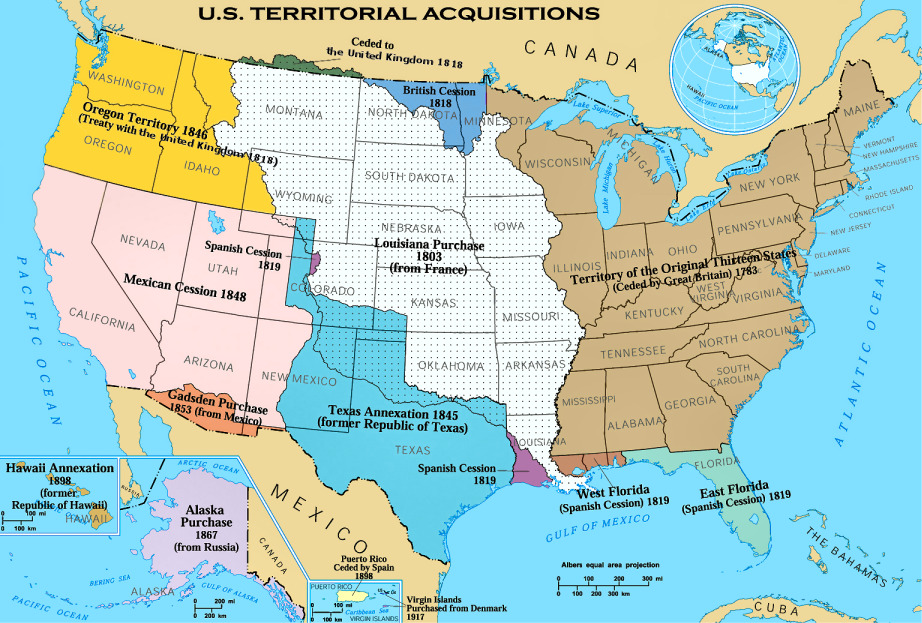
Congress “owned” lots and lots of land (Figure 11, “U.S. territorial expansion”). The westward expansion was highly political. The program was genocidal with respect to the Native Americans already living throughout the land. President Andrew Jackson’s Indian Removal Act of 1830 and the resulting Trail of Tears is one example; to the north was the Black Hawk War of 1832. Both promulgated U.S. policies of removing Native Americans in favor of white settlement, planting, and ranching.
Its possession was also the result of wars with, or purchase from, the European powers who also claimed ownership. Once in U.S. possession, tycoons and robber barons coveted the natural resources (which remains true today).
Local and federal government played games to obtain settlers and homesteaders, as did local business interests. Settlers meant money and increased commerce, to be sure, but “proving” land (creating a productive farm or ranch) was also part of the process of taking the land from its prior occupants.
The Daniel Boone Home is near St. Louis, Missouri. Why is that? Do you associate Daniel Boone with Missouri? Do you recall the TV series theme song?
Daniel Boone was a man. Yes a big man. With an eye like an eagle and as tall as a mountain was he.
But the TV series took place in Kentucky, not Missouri. What’s the story?
As the Daniel Boone Home tour guide explained to me years ago, the Spanish invited Boone (age 65) and family to move into Missouri in 1799, in anticipation of the Louisiana Purchase. This situation was quite literally a celebrity endorsement for homesteading in Missouri (called Upper Louisiana at the time).
The State Historical Society of Missouri explains,
In 1804, Boone lost his land claims after Spain had transferred the territory to France, which in turn sold it to the United States.
The page linked above has the petition of Daniel Boone, submitted in 1810 and finally considered in 1813, to the U.S. Congress for land in the Louisiana Territory “together with the resolutions of the legislature of the State of Kentucky relative to said petition.” Even celebrities can get burned when doing a country a favor, but it certainly helps to be a celebrity when trying to get it back.
In a similar fashion, “Little House on the Prairie” in Minnesota was a result of various homesteading acts inviting people to take up land in the west. Never mind that this was closely related to the US-Dakota War of 1862 that resulted in the largest mass execution in U.S. history.
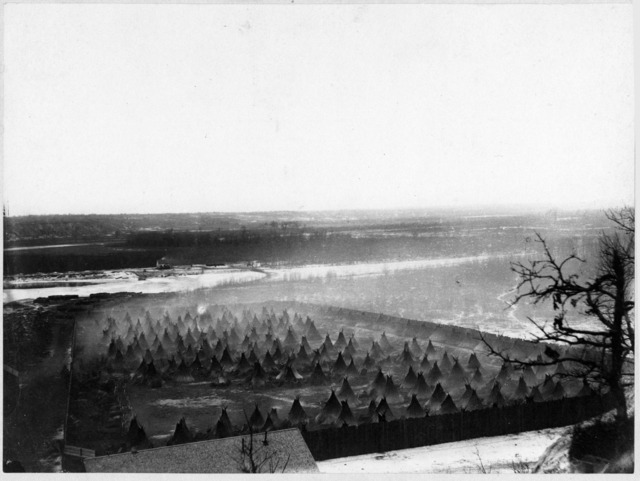
The Minnesota Historical Society (MNHS) describes the Fort Snelling concentration camp:
The Dakota non-combatants arrived at Fort Snelling on November 13, 1862, and encamped on the bluff of the Minnesota River about a mile west of the fort. Shortly after, Marshall and his soldiers moved the Dakota to the river bottom directly below the fort. In December soldiers built a concentration camp (Figure 12, “Sioux concentration camp”), a wooden stockade more than 12 feet high enclosing an area of two or three acres, on the river bottom. More than 1,600 Dakota people were moved inside. A warehouse just outside the camp was used as a hospital and mission station. Throughout the camp’s existence, soldiers of the Sixth, Seventh, and Tenth Minnesota Volunteer Infantry Regiments guarded the stockade, controlling movement in and out. It is estimated that between 130 and 300 Dakota people died over the winter of 1862-63, mainly due to measles, other diseases, and harsh conditions.
The concentration camp at Fort Snelling was not a death camp, and Dakota people were not systematically exterminated there. The camp was, however, a part of the genocidal policies pursued against Indigenous people throughout the US. Colonists and soldiers hunted down and killed Dakota people, abused them physically and mentally, imprisoned them, and subjected them to a campaign calculated to make them stop being Dakota.
We learned about global transportation systems, both clipper ships and transcontinental railroads. But what does this have to do with antitrust actions concerning the giants of high tech?
That comes next. The Northern Pacific Railway took its case all the way to the U.S. Supreme court—and lost. They struck out.
The outlook wasn’t brilliant for the Mudville nine that day: The score stood four to two, with but one inning more to play, and then when Cooney died at first, and Barrows did the same, a pall-like silence fell upon the patrons of the game. They thought, “If only Casey could but get a whack at that—we’d put up even money now, with Casey at the bat.”
The sneer is gone from Casey’s lip, his teeth are clenched in hate, he pounds with cruel violence his bat upon the plate; and now the pitcher holds the ball, and now he lets it go, and now the air is shattered by the force of Casey’s blow.
Oh, somewhere in this favored land the sun is shining bright, the band is playing, and somewhere hearts are light; and somewhere men are laughing, and somewhere children shout, but there is no joy in Mudville—mighty Casey has struck out.
—Casey at the Bat (1888) by Ernest Lawrence Thayer (1863-1940)
Summary
We have now laid the groundwork for Rosen’s reference to the Northern Pacific Railway. Dr. Nathaniel Bowditch placed the fabulously rich Harvard Endowment on a solid footing. Thanks to being difficult with a president of Harvard in the process, those two engaged in a flame war—after both were stone cold dead.
The clipper ships gave way to the transcontinental railroads. We’ll find out in Part II what a tangled mess this became.