1. Setting the stage: Fundamental concepts of sustainability and digital development
In order to base our work with sustainability on a solid ground, we must first go through some important sustainability concepts. This first chapter covers key ideas and definitions. The goal of the chapter is to give you a glimpse of the complexity which we must be able to handle when working with sustainability. The concepts span many different scientific disciplines, including biology, geology, physics, chemistry, law, economics, and social sciences. Working with sustainability asks of us to navigate in different intertwined disciplines, requiring a holistic approach from those of us working with digital products, solutions and services.
Why is sustainability urgently important right now?
Let’s go through some substantial theories that emphasize the urgency of taking action for sustainability in all areas, including the digital. Read about:
This is the age of the Anthropocene
The Anthropocene is the name of a proposed epoch, beginning in the 20th century, in which human activities are affecting life on Earth to an extent that they are causing both local and global changes in the state of the planet. In 2024, the international geological community formally decided not to adopt the Anthropocene as an official epoch on the geological time scale (Witze 2024) — but the concept remains widely used across the sciences, because it captures something real: humanity has become a planet-shaping force.
In the past, geological processes had the greatest influence on life on Earth and the properties of the planet surface, but our agriculture, buildings, roads, wars, excavations and other activities are changing the landscape.
This change is comparable to the major geological impacts on Earth in the past, such as major volcanic eruptions and meteor impacts. The Anthropocene heralds new times where humanity is not only responsible for its own future, but also holds the future of a livable planet in its hands.
The human emission of greenhouse gases is one example, and the consequences for soil, plant and animal life, and thus for human life, are enormous.
The sixth mass extinction is on the horizon
In biology and ecology, we are also witnessing a historic and global event that scientists describe as the sixth great mass extinction, a process in which a great part of the Earth’s different animal species become extinct within decades or centuries. The time we live in can be compared to the time when the dinosaurs went from being the dominant species on Earth to mass extinction.
The sixth mass extinction is expected to be as pervasive for nature as the dinosaur extinction was, with the risk that a third of all animal species could disappear (Urban 2024). As with the Anthropocene, human activity is also the cause of the sixth great mass extinction. This too is happening right now.
We are part of the Great Acceleration
Some scientists theorize, that a global change began with industrialization in the 1800s, and accelerated rapidly after the 1950s. Global change is accelerating and we are accelerating the activities that are changing our planet, such as the release of greenhouse gases and the destruction of various biotopes (Steffen et al. 2015).
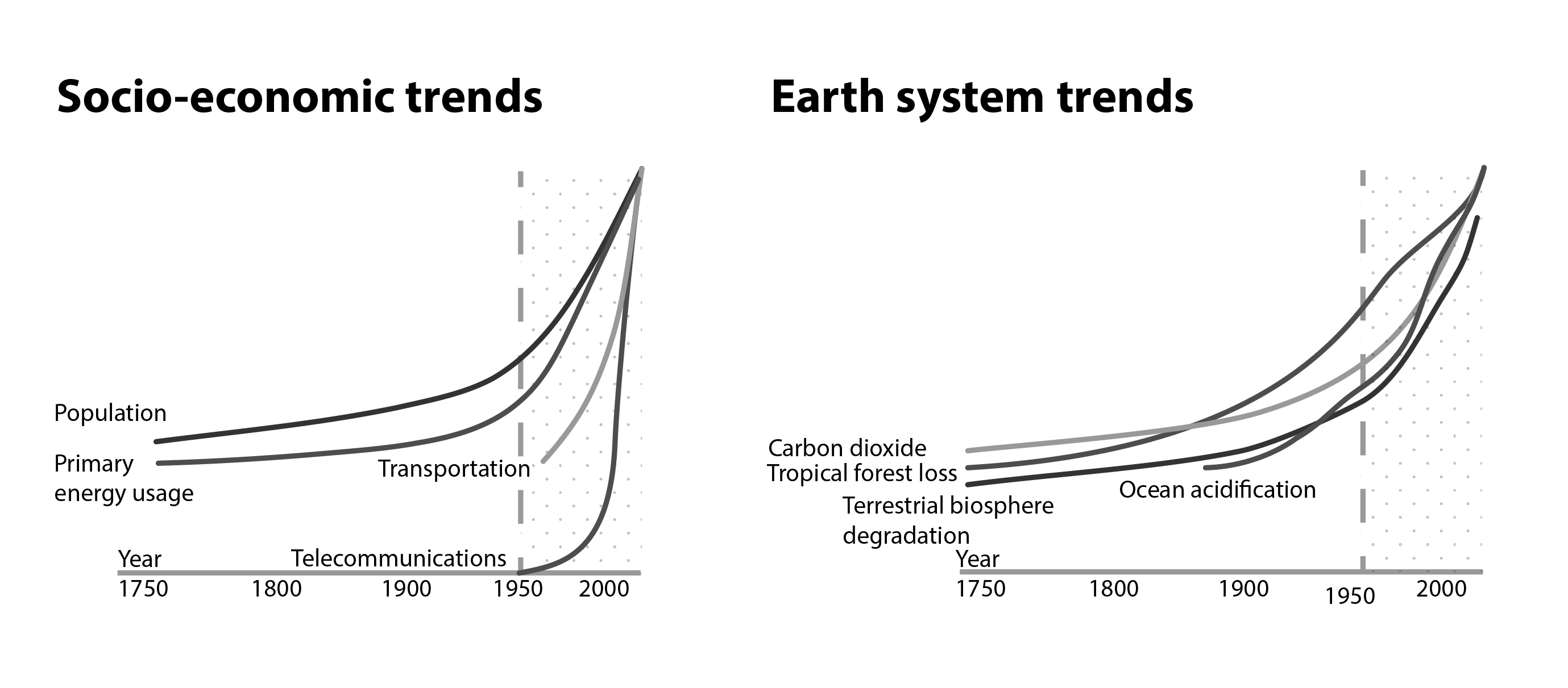
We are pushing the planet’s boundaries
The world’s population is growing, our industrial activity and consumption is growing, and economies are also growing year after year - but the planet’s size and resources limit this perpetual growth. Planetary boundaries is a concept developed by researchers at the Stockholm Resilience Centre, describing nine major planetary subsystems that regulate Earth’s systemic stability and resilience (Rockström et al. 2009).
Scientists have estimated limits for Earth’s planetary subsystems in which humanity can continue to evolve and thrive for generations to come, without causing irreparable damage to Earth as we know it. If the limits are exceeded, the systems may become unbalanced, leading the planet to a new and different reality.
Developments in recent decades show that, unfortunately, we are increasingly exceeding these limits for sustainable global development: the most recent scientific assessment found that six of the nine boundaries have already been transgressed (Richardson et al. 2023). There is a risk of serious global consequences if we do not begin to respect the limits as soon as possible.
We are driving climate change
Current global development is neither durable nor sustainable. In the coming decades, we must turn all industrial (and digital) development in a sustainable direction to enable people to live a good life.
We must be able to continuously improve and develop our world without fearing the long-term consequences of our actions in the form of droughts, floods, destruction of rainforests and landscapes, major political challenges, migration, and loss of life. We have an ethical obligation to protect nature, which is our origin and our future.
With the help of scientists who continuously monitor global climate change, a number of actions are underway globally that aim to change the trend to something more sustainable (Science Based Targets initiative). But we will need every effort. That’s why it’s important that we incorporate sustainability into all our activities - including digital ones.
People in information technology and digital services are both the villains and the heroes
Information technology and digital transformation are phenomena that surprise us daily with its latest inventions, opportunities and challenges, shedding light on new aspects of our everyday lives - and our existence.
Social media, virtual worlds, sensor networks, autonomous agents, artificial intelligence, generative AI, machine learning, Internet of Things (IoT), data science… All of these IT concepts have emerged in recent years and are still evolving as they change our world.
Modern IT is accelerating some dimensions of science and research, and the computing power of processors and the efficiency of algorithms are increasing every year. It is now the speed of human cognition that limits the speed of development.
Information technology and digital transformation are two sides of the same coin. Digital transformation focuses on people, organizations and their processes, and information technology focuses on the digital technologies themselves.
- Digital transformation is the use of information technology by people and organizations.
- Information technology consists of hardware, software and networks: Electronics, algorithms and systems.

There is no digital transformation without technology, and technology also makes the most sense when viewed in the context of the people and organizations that use it. IT (like all technology) is artificial and man-made, and as such is often seen as standing in opposition to nature and the environment.
However, technology and nature must be able to coexist in mutual and positive interaction. And this is where sustainability should help create a fruitful balance and exchange between technology, people, nature and the environment.
Accept, embrace and live up to your digital responsibility
As an information technology and digital professional, what is your role in this global equation? Can IT and digital development contribute to a better world and a more sustainable future if we use technology with long-term thinking?
You may not be able to solve the sixth mass extinction event and balance nature in the Anthropocene era overnight, but many small steps - including your professional contribution to the sustainability agenda - will contribute to positive changes in the world.
Fundamental sustainability concepts
Let’s continue by reviewing some key concepts that form the basis for working with sustainable digital development. You may already be familiar with some of the concepts and skip reading about them, but hopefully you can also read up on something new and exciting:
Definition of sustainability
We can see sustainability as a path towards a brighter and more stable world both on an individual, societal and environmental level. Sustainability is a kind of long-term development where nature and the environment are respected and thrive.
Sustainable development helps us avoid major disasters in the future by addressing problems in the present. That’s why sustainability requires action from us today, both for the future, for ourselves and for the world around us.
There are different definitions of sustainability, but the most widely cited one comes from the UN, which in 1983 established a World Commission on Environment and Development headed by the then Norwegian Prime Minister Gro Harlem Brundtland. The Commission’s work resulted in a publication from 1987 entitled Our Common Future - the Brundtland Commission’s report on environment and development.
The report defines sustainable development as development that meets the needs of the present without compromising the ability of future generations to meet their own needs. This definition is a good starting point for our work, but in the following we will also look at sustainable development from other angles. If sustainability is something that protects the possibilities of future generations, what is the opposite? Let’s take a look at “unsustainability”.
Unsustainability
Unsustainable products and services are defined by the fact that, despite their useful value in many contexts, they often have serious, unintended and far-reaching negative impacts in the long term.
| Short-term (here and now) gain | Serious problems in the long term | |
|---|---|---|
| Pesticides such as glyphosate | Weed-free areas | Poisoned drinking water, destroyed biodiversity |
| Fossil fuels | Efficient and cheap energy source | Climate change, natural disasters |
| Plastic materials | Inexpensive and versatile material for many applications | Plastic waste and microplastics are flooding the world’s ecosystems |
| Cryptocurrencies such as Bitcoin | Decentralized, international digital currency | Huge energy consumption and emissions, and available for criminal application |
| Smartphones | Effective and entertaining communication tool | Environmental and social issues related to the extraction and recycling of materials; addiction-like problems for users |
The table above provides some examples of unsustainable products that may create great value in the short term, but have serious negative consequences in the long term, i.e. they are unsustainable (as for now).
For example, herbicides are effective in controlling weeds, but over the years they can leak into the groundwater and poison our drinking water. It may not happen immediately, but over decades they can contaminate the water we depend on as people and as a society: monitoring across Europe finds pesticide levels above the quality standard in 11–18% of groundwater bodies (European Environment Agency 2024).
The use of fossil fuels is another example of an unsustainable product, partly because we will run out of them at some point in the future, and also because their use contributes to climate change. Climate change does not happen immediately, but over many decades. We may already be feeling the effects, not least as we experience record high temperatures and increasingly intense rainfall, storms and heatwaves (WMO 2026). Other examples of unsustainable practices are:
- Using more energy than necessary
- Consuming the earth’s resources such as water and minerals without considering alternatives
- Draining nature’s resources without ensuring that the equivalent is returned to nature.
Short-term solutions are like taking painkillers for a broken leg without addressing the fracture - they relieve the discomfort for the moment, but the underlying problem remains and may get worse over time. From a holistic point of view, it makes more sense to make long-term efforts to ensure a good future than to gain short-term benefits. Overall, it is unsustainable to create short-term solutions that have undesirable long-term effects, even if those effects occur much later or in places other than where the solutions work (e.g., when smartphone use in Europe leads to pollution in Africa and Asia).
The hurdles to sustainability
But why aren’t we all working sustainably if it’s so sensible? There are several reasons - here are four selected examples of obstacles to sustainable development:
It is difficult to predict the long-term and far-reaching consequences of our actions. Many of the behaviors we have developed throughout history are proving to be fundamentally unsustainable. Innovations that seem groundbreaking and beneficial on the surface - such as pesticides or materials like asbestos - have turned out to be seriously harmful in the long run. Over time, however, we can become better at taking the long view and learning from past mistakes. This accumulated knowledge is valuable and can be actively used and integrated into decision-making processes to promote a sustainable future.
Working sustainably can be more expensive upfront (but in the long term, sustainability can pay off). Most IT companies build data centers on the existing power grid, which is affordable and straightforward. Other companies base data centers only on renewable energy sources, which means the data center doesn’t have any direct greenhouse gas emissions. It’s a better solution climate-wise, but it’s initially more expensive than connecting the data center to the regular power grid, which doesn’t require an investment in its own power plant. Conversely, if the renewable energy plant works well, the data center will get cheap electricity in the future, and the data center’s profit will increase over the years as its own wind turbines, solar panels or other renewable sources manage to produce electricity cheaper than the market price.
There are a record number of people on the planet and everyone wants a better standard of living. This is leading to unprecedented growth in production and consumption, which we can only manage if we can reduce this increased (and still growing) environmental footprint.
Working sustainably requires a degree of altruism, a respect for the planet and its inhabitants, but not everyone shares this consideration for future generations and the environment. Furthermore, the negative impacts of a company’s operations are often distant in time and place from its daily activities, making them easy to overlook.
Let’s look at an example from the digital world where these problems can be observed: a smartphone. Using a smartphone has become an everyday occurrence for most people, but this simple everyday device has far-reaching global consequences. Smartphones are made from naturally occurring minerals from different distant places and its parts are manufactured all around the world.
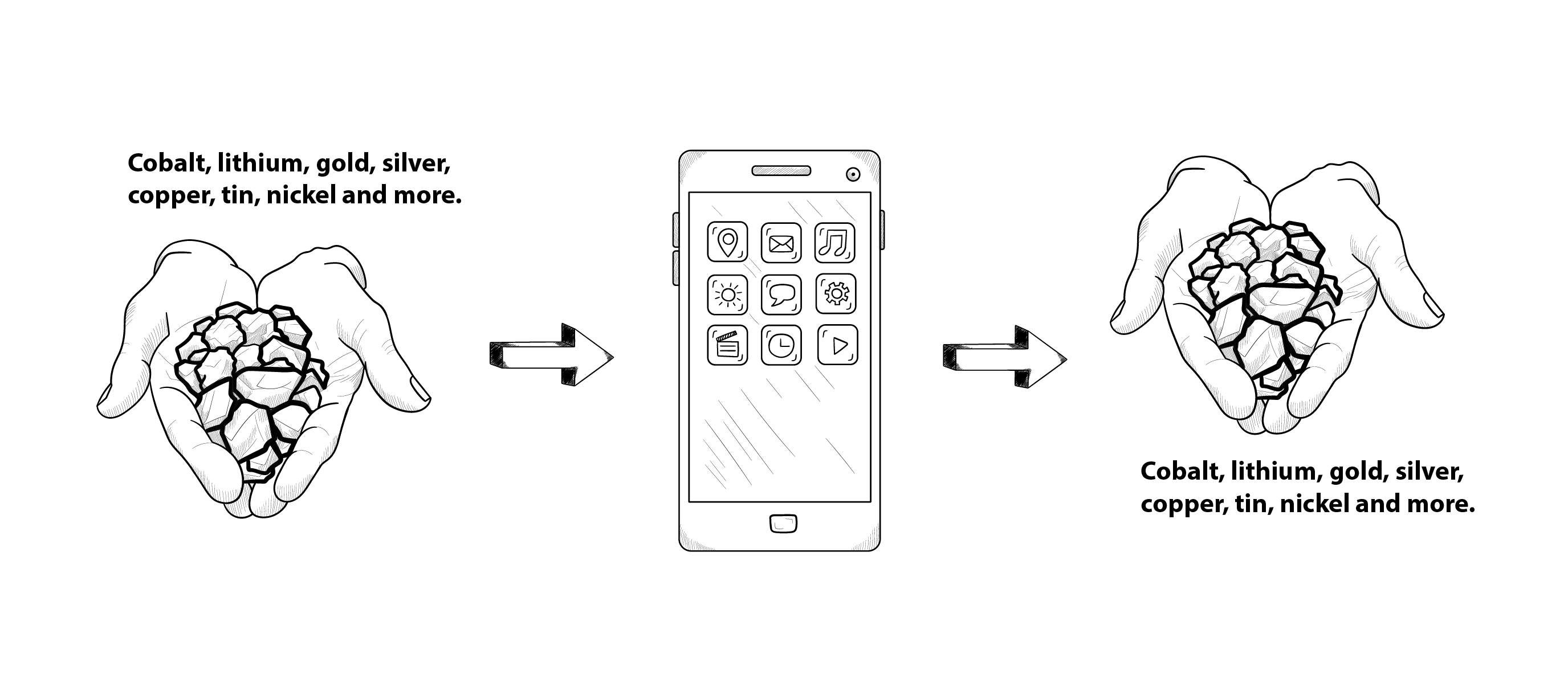
The extraction of minerals used in smartphones involves pollution, child labor, deforestation, and health problems associated with working in mines in Africa. Assembly line work in Asia may involve poor working conditions. Last but not least, the applications that run on smartphones can have a bad impact on its users. But this is not something we often think about. Because owning a smartphone has become commonplace, it’s hard to think about the long-term and global consequences, because it’s relatively vague and far removed from our own reality. So it’s easier not to think about it.
In an ideal world, manufacturers and legislators would try to make the resulting problems explicit and do something about them. The Dutch smartphone manufacturer Fairphone, for example, does this by visiting their suppliers’ cobalt mines and actively improving working conditions in the mines based on their experiences during the visit (Angela 2023). Are they obligated to do this? No, they are not. They are doing it first and foremost for the mineworkers and their environment, and in return Fairphone can position its smartphone as a greener and fairer phone. However, these actions do not come for free and their phones are therefore relatively more expensive compared to the competition.
Embracing uncertainty for a sustainable future
It is clear that we cannot fully guard ourselves against all the unintended future consequences when developing new solutions. By its very nature, it is impossible to design and develop measures for risks that cannot be foreseen.
However, when it comes to the long-term risks we are able to identify, we have a moral obligation to act. This is especially true in the area of sustainability, where we must accept that we can never fully control the future. Even if we plan and execute our activities carefully, there will always be unforeseen difficulties - such as environmental, social or economic challenges - that can negatively impact the sustainability of our projects.
We must be able to live with the realization that the world around us can be influenced and shaped to some degree, but never completely controlled. This unpredictability should not be seen as an obstacle, but as a fundamental premise for working towards sustainable solutions. Despite our best efforts, the real world can always surprise us - both positively and negatively.
Green sustainability
Sustainability has many facets, e.g. technical, economic, social, individual or environmental. Environmental sustainability can also be referred to as green sustainability, and because of the climate crisis, this is clearly the most urgent dimension of the overall sustainability field.
It is also the most visible aspect of sustainability at the moment, as climate change is on the agenda in many parts of the world. An example of a company actively working with green sustainability is the Danish window manufacturer Velux. Like most responsible companies, Velux is focused on making its operations greener and more sustainable in the long term.
They announced in 2023 that they will fund forestry projects to capture carbon equivalent to its emissions from its founding in 1941 until 2041 (Petersson 2023). The company also plans to reduce its operational carbon emissions by 100% by improving energy efficiency and switching to renewable energy.
Velux’s plan is both forward-thinking and compassionate. There is no law requiring companies to compensate for their past emissions or to become carbon neutral by 2041, but Velux is devoting resources to support this development. Velux is working with external partners to estimate past greenhouse gas emissions and offset equivalent amounts of CO2 in forests in countries such as Uganda, Madagascar and Vietnam.
While the Velux example is not directly related to IT and digital development, the company demonstrates an action that digital companies could benefit from adopting. For example a digital hosting company could compensate for the greenhouse gas emissions they have emitted over time - since their startup.
Are Velux’s initiatives genuinely producing an impact on a global scale, or are they merely symbolic gestures with limited effect? While their actions represent an ambitious step in the right direction, the contribution of a single company is insufficient to address the magnitude of the climate crisis. It is only through collective, large-scale efforts across industries and nations that meaningful progress can be achieved. In this regard, Velux’s example may serve as an important point of inspiration, highlighting the potential for global solutions if all stakeholders contribute at a similar scale.
If Velux really succeeds in eliminating 100% of its future greenhouse gas emissions, then the window manufacturer is definitely a climate-friendly company. But that doesn’t mean it has become a truly “sustainable company”. In order to achieve that, the company needs to go full circular on their activities, and address other dimensions of sustainability before it can call itself truly sustainable.
Greenwashing and greenhushing
When a company sends out marketing communications about its green initiatives, there is always a chance that the company’s brand will be portrayed as more green than it actually is. It is not always easy to distinguish between real sustainability achievements and greenwashing, i.e. empty promises with little to no substance behind the communication.
In the case of Velux, is this a genuine environmental initiative with significant impact, or is it greenwashing? We can hope for the first, but only time will tell.
There is no clear line between greenwashing and green marketing, and it can be difficult to tell the difference in practice. The EU has, however, adopted binding rules against misleading claims: the Empowering Consumers for the Green Transition Directive (Directive (EU) 2024/825) applies from September 2026 and bans generic environmental claims such as “green” or “climate friendly” unless they can be substantiated, as well as product claims of climate neutrality based on carbon offsetting. A stricter, complementary proposal (the Green Claims Directive) was put on hold in 2025, when the European Commission announced its intention to withdraw it. But similar guardrails exist elsewhere: the US FTC’s Green Guides govern environmental marketing claims, and the UK’s Green Claims Code serves the same purpose.
There are also companies that deliberately avoid talking about their environmental improvement activities in common terms for fear of being perceived as greenwashers, instead they use synonyms that create positive connotations in consumers’ minds. This behavior is called greenhushing.
How to avoid greenwashing?
Fortunately, there are established benchmarks that help determine whether a company or product is genuinely sustainable or merely engaging in “greenwashing.” One such benchmark is the company’s documentation of its environmental and social practices, commonly referred to as an ESG report (Environmental, Social, and Governance).
More and more companies embrace ESG reporting, and publish information on how they apply up-to-date (and not outdated) sustainability measures in their operations and development. We have to be critical when reading these ESG reports. It’s essential to examine whether the company’s environmental actions are in proportion to its activities or products. Does the scale of the company’s sustainability initiatives match the environmental problems caused by the company’s operations? If the initiatives are too vague, frivolous and disproportionate, then the claims can be considered greenwashing.
A good example of greenwashing is “biofuel”, which you can buy at several gas stations. Here, 5% or 10% ethanol (alcohol) is mixed into the gasoline and called “biogasoline”, even though it is still 90-95% fossil, black gasoline. There is a lack of proportionality between the measure (mixing gasoline with ethanol) and the claim the product makes (i.e. that it is “bio”, better than regular, black gasoline). “Biofuel” sounds like some kind of environmentally friendly gasoline, but it’s not. In reality, it’s black, fossil gasoline that has been “masked” with the addition of ethanol.
Detecting and avoiding greenwashing is not easy, but the aforementioned EU rules should make it harder for companies to make empty green claims — and easier for consumers who want to choose green products over “black” ones.
Ecology and ecosystems
One of the most important concepts in sustainability is ecology and ecosystems. The word ecology denotes a branch of science that studies the relationships between living organisms and their environment (Britannica 2024). Ecology is concerned with systems of living organisms, their interplay, and their surroundings, called ecosystems.
Ecosystems are the basis of all life on Earth, and without them we as humans cannot survive. We are part of the ecosystem whether we like it or not. Without the biosphere we cannot exist as humans. Every place on earth has its more or less unique ecosystem, and we have an obligation to protect it for future generations.
We ourselves are ecosystems: We are hosts for the bacteria that live on us, in us, and without which we cannot live well (if we can live at all). It is essential to be able to think in systems, especially ecological systems, when working with digital sustainability. Ecology and understanding the interconnectedness of ecosystems provides useful knowledge about how our actions affect the environment on a systemic level.
Some of the systemic principles of ecology can be paralleled in information technology as both ecosystems and IT systems can be understood with a systemic approach. In the IT business, we sometimes talk about digital ecosystems, where an intertwined network of technology, companies and people thrive together in loosely coupled networks.
Just as some plants cannot reproduce without the insects that pollinate them, there are technologies that require cross-pollination. For example, the Android smartphone operating system cannot thrive without its own digital ecosystem. What this means is that Android would not be the same without the many types of phones, phone manufacturers, networks, applications, and users that make up the product’s unique ecosystem. Android smartphones would lose essential features without the many developers who provide millions of applications for the phones.
But ecosystems are not unique to Android - the concept can be found in many other successful IT-based products and in many other digital contexts. These include information ecosystems, software ecosystems, knowledge ecosystems, product ecosystems, and media ecosystems. And just as high biodiversity is a sign of a healthy ecosystem in nature, high diversity in a digital ecosystem is a sign of a successful product. Digital ecosystems function as open and dynamic systems that, through self-organization and diversity, can ensure innovation and long-term success for the parts of the system involved.
Environmental aspects of sustainability: Energy and materials
If only we had an infinite amount of clean energy at our disposal, we could be more relaxed about the climate. We can for example already build machines, that pull CO2 out of the air, but as we lack clean energy to operate them, their usage is not feasible at a large scale.
As nothing is infinite on earth, we have to innovate circular uses of energy and resources, so instead of continuously ingesting “new” energy and “new” materials into our businesses, we have to learn to circulate energy and materials in a sustainable flow. Digital technology paves the way for such a transformation, because it enables us to document, model and understand the complex systemic consequences of our flows of energy and materials. Let’s dig into the following environmental aspects of sustainability:
A flow of energy and materials
Although our society has access to plenty of energy and materials from many different sources on the planet, all our resources are finite and we are reaching our planetary limits. In the future, we will have no more to extract from the planet, nor can we afford to pollute more. Therefore, in the name of sustainability, we must be efficient and sustainable when using the resources available to us.
But how could that be done? Let’s identify some concepts about energy and materials that are essential to our approach to sustainable digital.
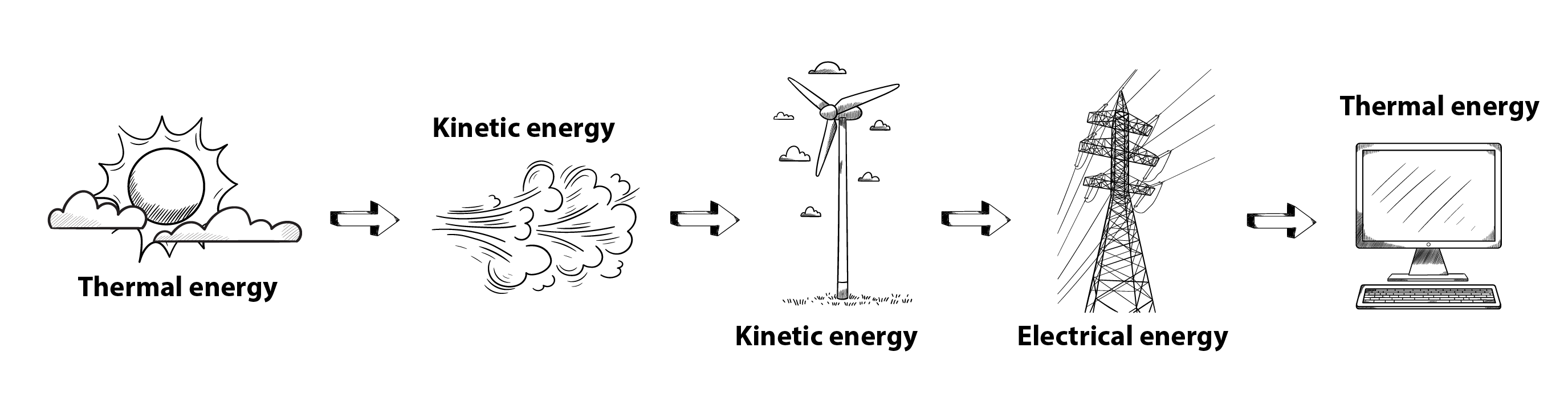
Energy cannot appear out of nothing, nor can it disappear on its own. However, the energy that exists in the world can be transformed from one form to another. This is one of the fundamental laws of physics: energy cannot disappear — it can only be transformed. The figure illustrates how energy from the sun’s rays is transformed into different types of energy that eventually power your computer:
- The sun’s energy heats the air in the atmosphere.
- This thermal energy causes the air to move, creating wind (kinetic energy or motion energy)
- The kinetic energy of the wind turns the blades of a wind turbine, which converts it into electrical energy.
- When you charge your computer’s battery, the electrical energy is stored as chemical energy.
- The stored energy powers the computer’s processor—and as a byproduct, releases heat (thermal energy again).
The amount of energy originally provided by the sun is equal to the amount of heat your computer gives off, because energy does not disappear — it is only transformed. (This simplified example ignores the fact that, in practice, we always lose some usable energy at various points in the chain—such as in power lines or generators. This loss should not be understood as energy disappearing, but rather as a small part of the energy erodes on the way to its final destination: your computer.)
Fossil energy sources versus renewable energy
The use of fossil fuels such as oil and coal has brought wealth to our society, but the emission of greenhouse gases causes climate change - an unbearable cost in the long run. In addition, we are running out of fossil fuels because they are not renewable.
Renewable energy comes from sources that replenish themselves and do not diminish over time. They include solar, wind, hydro, geothermal, and wave energy. In contrast, fossil fuels such as gas, oil, and coal, which are extracted from the ground, immediately pollute the atmosphere as soon as they are burned, causing irreparable damage to the environment.
Nuclear power does not produce the same greenhouse gas emissions as fossil fuels, but it is expensive to build and maintain. It also poses radiation hazards and produces waste that is difficult to manage and impossible to dispose of. While many countries are investing in nuclear power in the coming years as an alternative to coal and gas, it remains controversial. In the longer term, scientists hope to develop power plants based on fusion energy - a form of nuclear power that promises “inexhaustible” amounts of clean energy without the radiation risks associated with current nuclear technologies. But working fusion reactors may be decades away.
Therefore, when working with sustainability, it is important to remember that the energy and materials we put into a system are transformed - and that transformation creates byproducts. Sustainable companies must take responsibility for these byproducts, for example, by creating circular systems that minimize and recycle energy and materials without damaging the environment. Operating sustainably also means prioritizing renewable energy sources to power digital technologies and infrastructure.
Circularity and regenerative, circular processes
Nature teaches us that sustainable systems are built on different cycles: cycles of water, cycles of energy and cycles of different elements and materials. One of the most familiar and simple cycles in nature is the water cycle. Water falls from the sky as precipitation and hits the ground. Here it collects in rivers and lakes and organisms absorb the water - and later release it in the form of vapor. Some of the water also seeps underground, only to emerge later in rivers, lakes or the sea.
The amount of water is essentially the same in the system - no new water is added and no water is lost from the system, as vapor forms solid crystals in the cold, higher layers of the atmosphere and falls back to the earth’s surface as rain. There is a continuous flow in the global cycle. Climate change does not add water to this system, but it intensifies and redistributes the cycle — which is why some regions are experiencing more flooding while others face more drought.
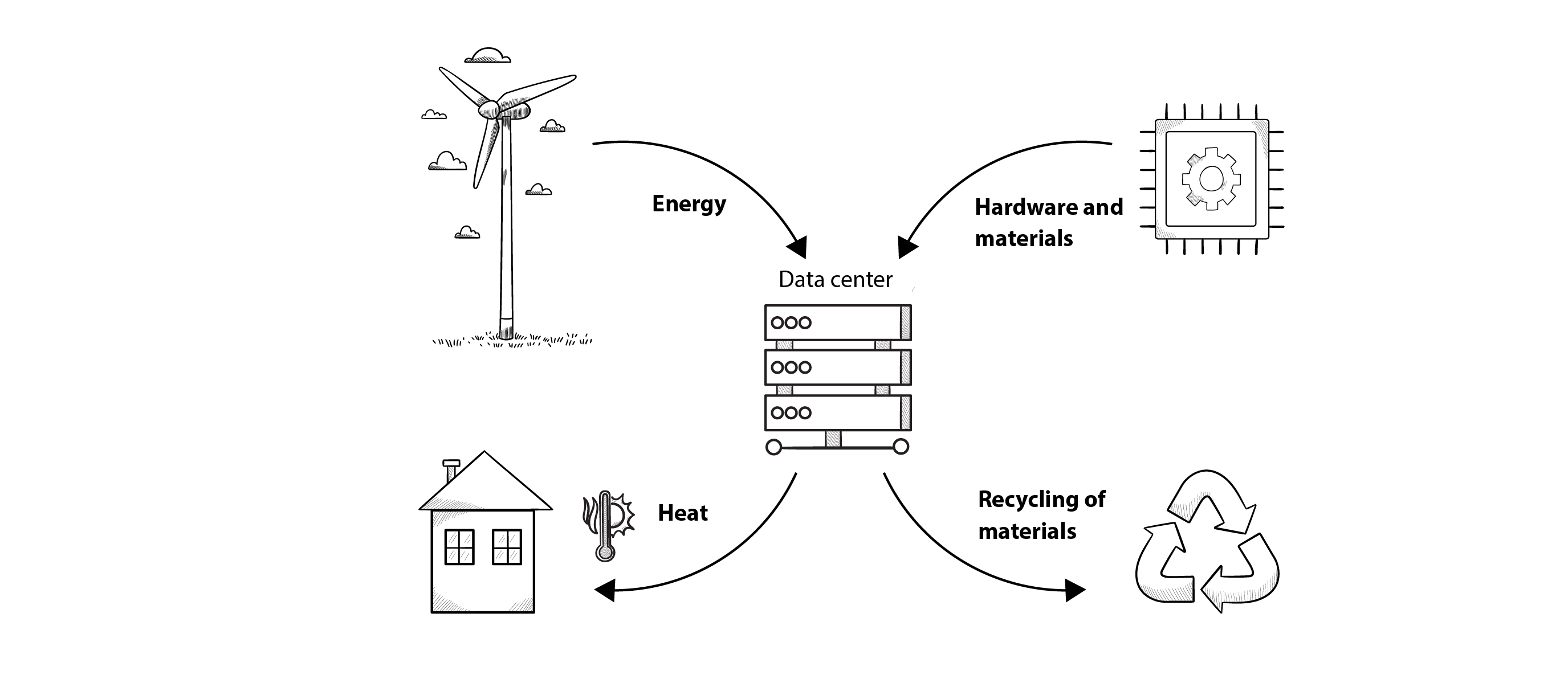
Life on Earth is based on circular and regenerative processes, as shown in the figure. For thousands of years, our ancestors followed the rhythm of nature: planting, fertilizing, harvesting, and beginning the cycle again year after year. Not all production was circular, but with fewer people on the planet, natural resources such as water, forests, oil, and iron seemed inexhaustible. New supplies could always be found. Today, however, those supplies are under serious pressure. The human population has grown, and we are consuming more of the Earth’s resources at a rate that is pushing us toward and past planetary boundaries.
We have good reason to assume that we will run out of more and more resources if we do not improve our ability to develop new technologies and business models based on circular processes, where energy and materials are reused and recycled from raw materials. In digital practice, this could be as simple as using renewable energy or ensuring that all e-waste is sent to companies that can effectively recycle it. In theory, the vast majority of e-waste can be recycled.
Look to nature for inspiration when designing digital products. One of the most effective ways to create sustainable solutions is to design cyclical systems where energy and materials are repeatedly recycled or regenerated without being lost or discarded. In other words, sustainable processes are circular and regenerative, and they can be repeated many times without generating significant amounts of waste or wasted energy. Working with sustainability means designing the best possible circular and regenerative processes.
Greenhouse gases (GHG) and climate change
Fossil fuels (coal, oil, and gas) cannot be considered sustainable energy sources because they are not part of a circular cycle and because they pollute the atmosphere with greenhouse gases. Even before the turn of the millennium, scientists began warning of global warming caused by greenhouse gas emissions from fossil fuels.
Unfortunately, despite these warnings, we continue to extract fossil fuels from the Earth’s crust and burn them for energy. This process releases CO2 and other greenhouse gases as a kind of waste that we leave behind in nature. More specifically, we leave CO2 in the air, where it will remain for millennia, forming a kind of “blanket” that warms the Earth. CO2 itself is not toxic - the problem is the increasing volume of emissions that are heating up the planet. If we could simply recycle greenhouse gases and store them underground, we wouldn’t be facing the climate crisis we are today (but we may face new problems underground.)
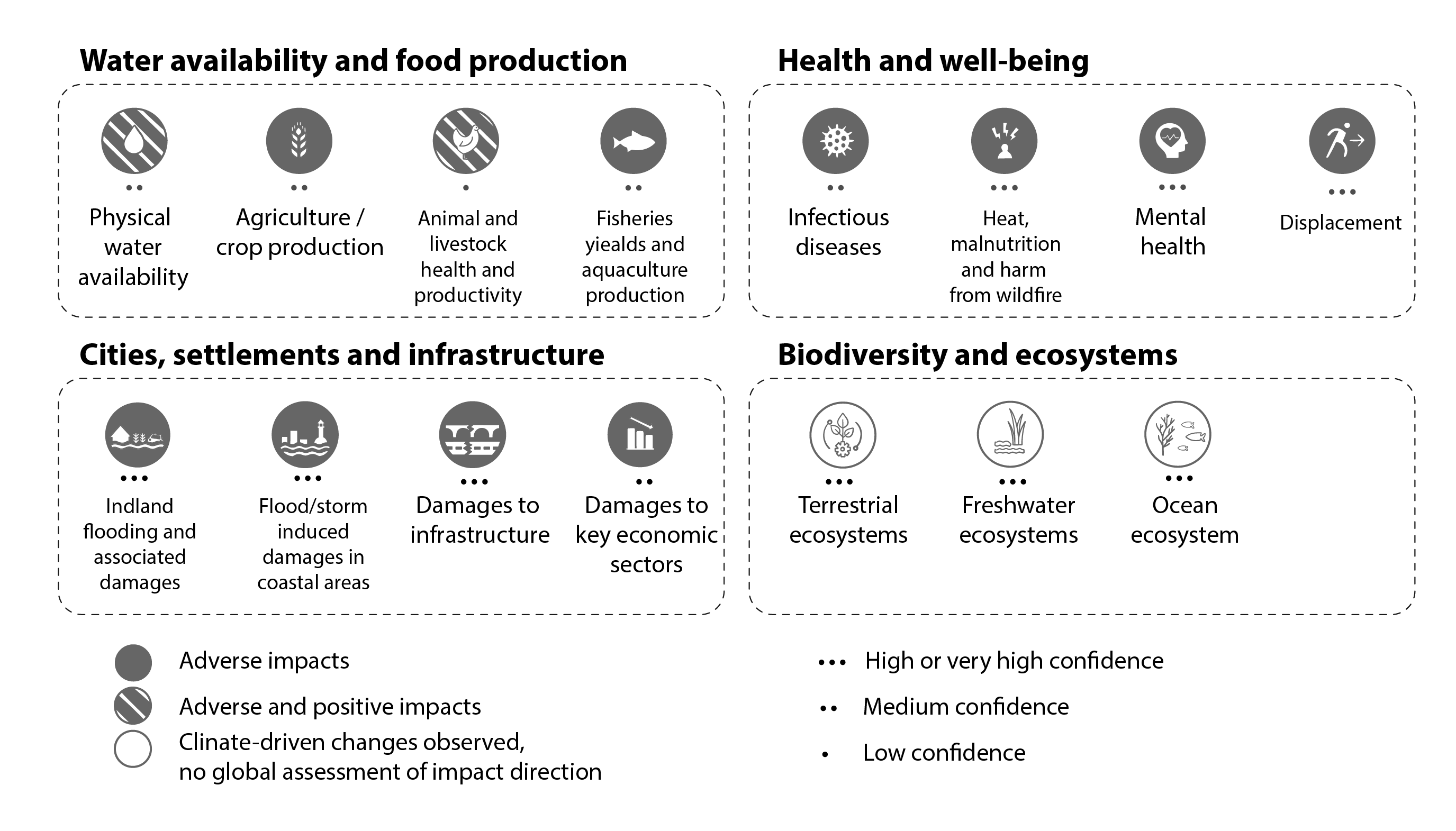
Unfortunately, all the evidence points to global warming as a serious threat to the potential for a good life in the future - for everyone on the planet, including humans, plants and animals. The figure illustrates the extent to which climate change is driven by human actions, and the consequences that these changes have already had or may have in the future.
Global warming doesn’t just mean higher average temperatures; it also means that weather is becoming more extreme, unpredictable, and unstable. We’re already experiencing more frequent and intense weather events because of the excess CO2 we’ve already released into the atmosphere. If we are to prevent this from getting worse, we must drastically reduce emissions - ideally within the next decade (IPCC, 2023). This urgent goal must influence development in all sectors - including IT.
Fortunately, there is hope and progress on the horizon. Many countries have recognized the problem, and governments and organizations from around the world meet annually under the umbrella of the United Nations at the COP conferences to address climate issues. Work is progressing, albeit slowly: at COP28 in 2023, the world’s nations for the first time formally agreed to transition away from fossil fuels (UNFCCC 2023).
Direct and indirect emissions (scope 1, 2 and 3.)
Eliminating the use of fossil fuels and the resulting greenhouse gas emissions is in everyone’s best interest. However, this is a difficult task because modern society is built on these energy sources. To understand the green transition, we need a detailed understanding of the processes that emit greenhouse gases, both directly and indirectly.
Take a gasoline-powered car as an example. We can easily observe its direct emissions: we fill the car with fossil fuel, it burns, and CO2 is released along with other gases through the exhaust pipe. But the car is responsible for far more emissions than just those from combustion. Its indirect emissions include those generated during the production, transportation and eventual disposal of the vehicle. In fact, these indirect emissions can account for a significant portion of the car’s total environmental impact.
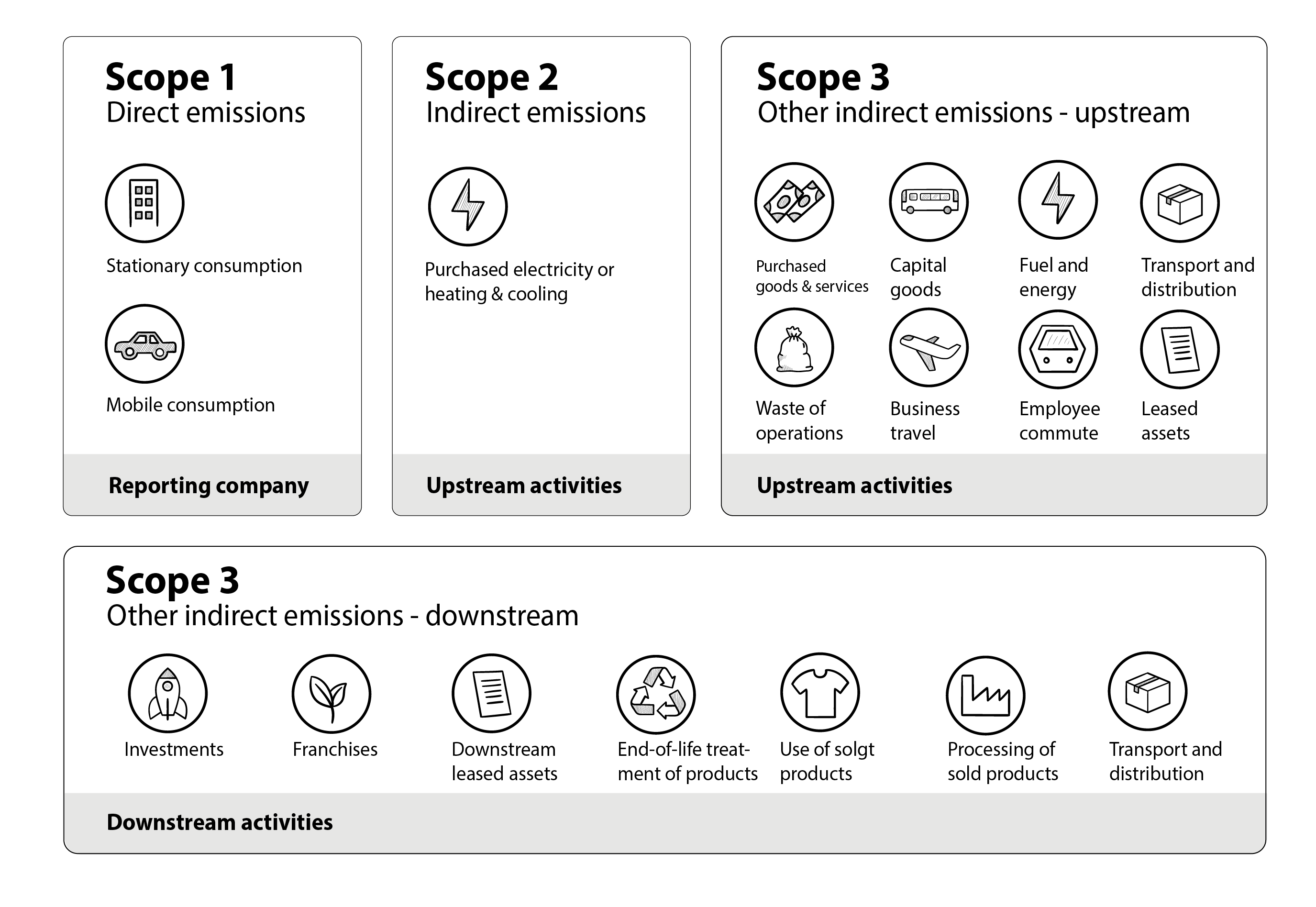
When calculating the CO2 emissions of a product, service, or company, we can categorize the emissions using the Greenhouse Gas Protocol (GHG Protocol). This framework helps quantify both direct and indirect emissions resulting from a company’s activities. The GHG Protocol distinguishes between three types of CO2 emissions (Confederation of Danish Industry, 2022), as shown in the figure:
Scope 1 refers to direct operational emissions that occur at the organization’s site. Examples include emissions from buildings, vehicles and machinery.
Scope 2 covers indirect emissions that result from the organization’s consumption of energy resources such as electricity and heat. Although these emissions are not directly produced by the organization, the organization can influence them by managing its energy consumption.
Scope 3 includes indirect value chain emissions that result from the company’s consumption of goods and services throughout its supply chains. These are often the largest contributors to a company’s total emissions.
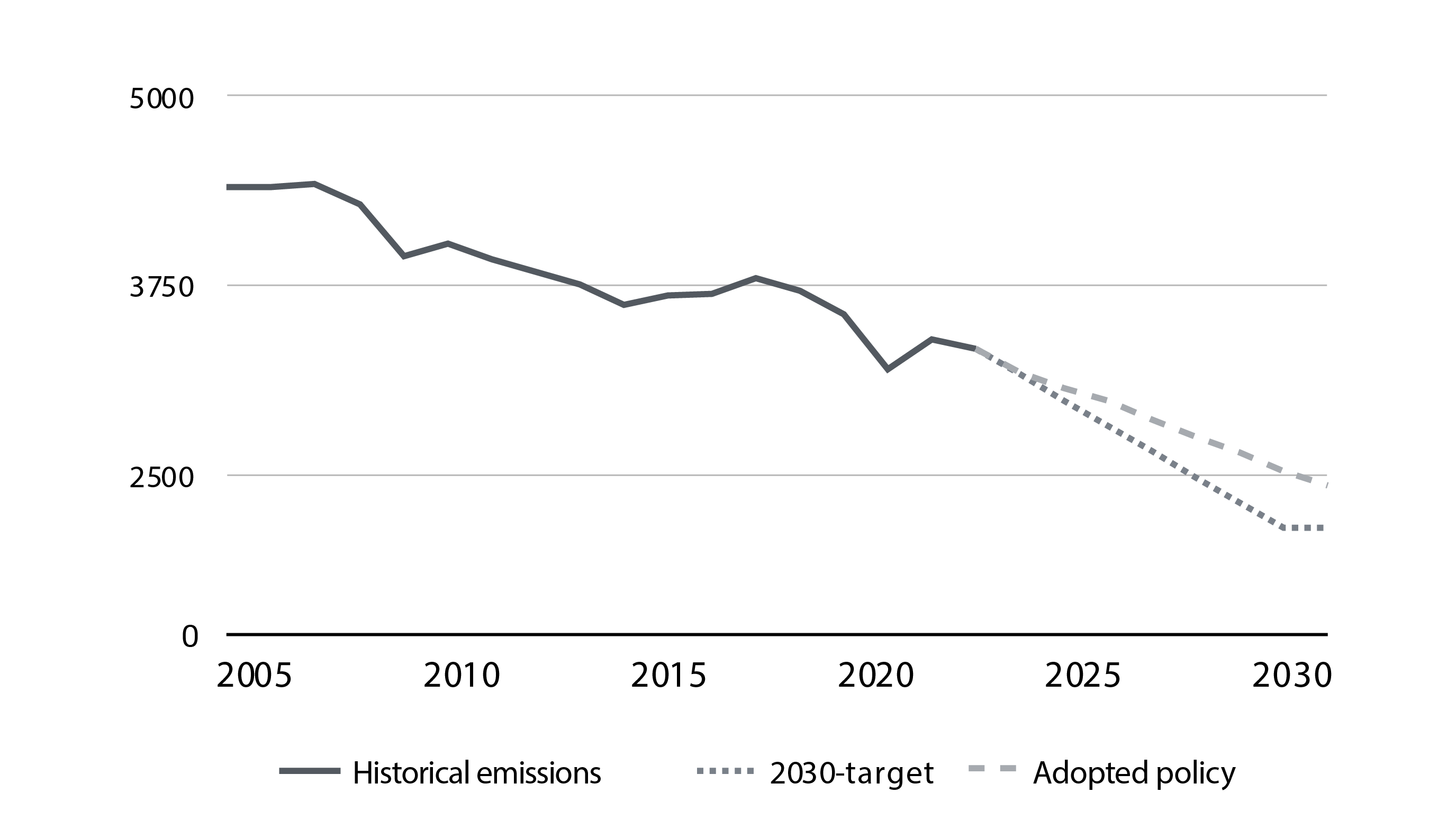
The three scopes of the GHG Protocol are used by organizations and companies to assess and report their direct and indirect contributions to greenhouse gas emissions. These emissions can be tracked over time, and ideally, as shown in the figure, there should be a steady decline in emissions year after year.
It is worth recalling that the global community has already succeeded in stopping a major environmental disaster: the destruction of the ozone layer. Through a united global effort and strong international cooperation, humanity helped prevent a global ecological catastrophe. If we managed it once, we can do it again and help save the climate.
Climate pessimism and climate optimism
More and more people perceive climate change as a significant threat, but at the same time, most of us find it difficult to assess how much the climate change will affect our own lives and everyday life, and what role we should play in the green transition.
Most of us want to maintain and develop our standard of living as much as possible despite the climate crisis, but we are also happy to support climate-friendly and environmentally friendly initiatives. According to a study by behavioral economist Peter Andre and his colleagues, “69 percent of the world’s population is willing to sacrifice one percent of their income for climate action” (Andre et al. 2024), and Myanmar tops the list at about 93%. Most people are willing to act to combat climate change, but there is uncertainty about what to do.
It is also difficult to point to single actions that can combat the climate crisis, but climate optimists would say that it is possible to change the world and implement the green transition for the benefit of most people (Kirkegaard 2024). This would involve phasing out fossil fuels in favor of renewable energy sources and reducing greenhouse gases in the atmosphere to an acceptable level.
The climate pessimists, on the other hand, expect that society as we know it today will collapse within a few decades, and that radical global changes will be needed to best weather the catastrophe. Jem Bendell has presented a theory about this scenario, which he calls deep adaptation (Bendell 2018). He believes that the global response to climate change is insufficient and that we are heading towards a collapse of society as we know it today. The theory of deep adaptation describes how we ought to manage the transition from our current society to the one that follows. He points to four key themes:
- Resilience: Focusing on preserving what we value despite climate change; developing communities that are self-sufficient in energy, food and health.
- Relinquishment: Encouragement to give up aspects of our lives that are unsustainable. For example, giving up fossil fuel-dependent lifestyles, abandoning vulnerable coastal infrastructure.
- Restoration: Proposing to revive sustainable practices and systems from the past and contribute to more nature and more resilient ecosystems.
- Reconciliation: Preparing to make peace with the changes and losses that climate collapse brings.
Although we cannot predict the future with certainty, Bendell’s “deep adaptation” scenario seems a plausible possibility. Whether Bendell’s theory is pessimistic or realistic is debatable, but the implication is the same as that of climate optimists: we need to create rapid, fundamental systemic changes in society and the way we live and work.
Perhaps the distinction between optimism and pessimism is less important than finding ways to connect citizens’ commitment to climate action with Bendell’s concrete proposals. This linkage can broaden the scope for action and create the basis for more effective action. But there is still a gap between Bendell’s call for profound change and the limited transition that people are willing to accept so far.
Bendell’s work also provides food for thought about digital development and the great risks associated with our dependence on digital systems. These systems are vulnerable to power outages, software failures and cyberattacks, and can be compromised during crises. Therefore, the theory calls for the development of more robust and less technology-dependent solutions, which can also guide the development of new digital technologies.
Environmental challenges in extraction and industry
Whether you are a climate optimist or a climate pessimist, it is essential to keep in mind that environment cannot be reduced to climate only. To achieve truly sustainable information technology and digital services, it’s not enough to focus on greenhouse gases alone; we need to address the surrounding environmental challenges as well:
- Air, water and soil pollution (by other contaminants than greenhouse gases)
- Microplastic pollution
- Pollution in space
- (Electronic) waste management
- Protection of ecosystems
- Working and environmental conditions for workers
- The consumer’s well-being
- And more…
These challenges can often fade into the background because climate is a top priority on a global scale, but responsible organisations should also address the environment in a broader sense. As we’ll see in the coming chapters, in cooperation between companies, organizations and citizens, we can effectively work together to reduce these problems.
Organizations shape our sustainable future
It’s important to recognize that while sustainability clearly has activistic dimensions - such as Greta Thunberg’s work for the climate - it is often the economy and companies that act as the primary driving force in our society. Activists shape our thoughts and the public discourse, but economic considerations shape the strategies and actions of organizations. Although other dimensions of sustainability - such as environmental, social, and cultural concerns - also play a role, they can be difficult to fully integrate into practice without the right economical and financial underpinning. How can organizations ensure that their financial sustainability is aligned with broader sustainability goals?
In the following sections, we explore a range of perspectives and methodologies which aim to reconcile economic priorities with long-term responsibility. We examine alternative ways of measuring performance that go beyond the traditional bottom line, and we highlight principles that emphasize the reuse of resources rather than their depletion. We will also look at mechanisms that show how even well-intentioned actions can sometimes lead to unintended negative consequences:
Economic growth and sustainability
It is a guiding principle of economics that growth is good. Companies can make more profit, more jobs are created and more taxes are collected when the economy grows. If there is no economic growth in a country, alarm bells go off. It’s time to tighten belts, make cuts and shed jobs for lack of funding - and hurry to get out of the downward spiral of recession. And the danger is real, there are many examples in history where a sustained recession has caused countries to go bankrupt, resulting in severe social problems.
Most countries’ economic policies aim for the highest possible economic growth year after year, it will make the country richer and there will be more money to run society. The problem is that if we only think about next year’s or next quarter’s growth, we’re not thinking long-term - and we’re not thinking sustainably at all. Instead, we are only amplifying the great acceleration, which leads to us outgrowing the planetary boundaries.
It could be said that the traditional understanding of economic growth stands in the way of sustainable development in society. In a 2021 briefing, the European Environment Agency writes that: “It is unlikely that a long-lasting, absolute decoupling of economic growth from environmental pressures and impacts can be achieved at the global scale; therefore, societies need to rethink what is meant by growth and progress and their meaning for global sustainability”. (European Environment Agency 2021)
In recent years, digital companies have shown that they can generate huge economic growth. In a relatively short time, software companies like Google, Facebook, and Microsoft were able to grow into some of the world’s largest companies by developing powerful software once and generating enormous profits by selling it millions of times over, with minimal additional cost.
It’s interesting to consider that people (including the authors) are willing to pay for software licenses for Microsoft Office, even though similar open-source alternatives are freely available. This illustrates a powerful business opportunity: once a company manages to create software with a high perceived value, it can sell the same product repeatedly at virtually no additional production costs, generating enormous profits. The success of companies like Microsoft shows how perceived value, rather than actual cost or uniqueness, often drives successful software and digital solutions.
However, this also highlights the important role that open source software can play in challenging this model. By offering free, transparent, and community-driven alternatives, open-source projects have the potential to disrupt traditional software markets—especially if they can match or exceed perceived value i.e. the quality, usability, or ethical appeal of proprietary solutions. In this sense, open source not only democratizes access to digital tools but also forces commercial vendors to continuously innovate, justify their pricing, and demonstrate real, ongoing value to users.
Financial and non-financial indicators: The triple bottom line
In a holistic approach to business, it’s not enough to focus solely on financial metrics; business operations also need to be viewed through a broader sustainability lens and in longer terms. How does the company interact with the environment and society? How will its activities affect future generations?
In order to promote more sustainable practices, companies would be wise to adopt a comprehensive approach to their operations, one that integrates financial performance with broader sustainability objectives. Some organizations are required to summarize their key financial figures and produce an annual report once a year, which outlines the year’s financial performance, including revenues, expenses, and the overall performance of the business. Conventionally, the narrative in an annual report is based on financial figures such as profit, return, solvency, liquidity, and employment. The vast majority of data in these reports are financial figures, describing how capital and financial values flow in and out of the company.
It is imperative for companies to shift their focus beyond profit to prioritize people and the planet. Consequently, sustainable business must consider metrics that cannot be directly measured in money. The non-financial indicators provide insight into how energy, materials and human resources flow in and out of a company. These indicators offer insights into aspects of value creation that are not fully captured by traditional financial metrics. Such aspects include, but are not limited to, customer satisfaction, employee well-being, energy efficiency, waste recycling, speed of innovation, and carbon emissions.
As companies endeavor to accentuate the sustainability facets of their operations and disclose information regarding their environmental and social impacts, non-financial indicators assume particular significance.
The concept of the triple bottom line refers to a business practice in which performance is evaluated not only in financial terms, but also in terms of social and environmental outcomes. This approach underscores the significance of exerting a beneficial influence on people, the planet, and the bottom line. The triple bottom line can function as a management instrument and is closely aligned with the principles of ESG (Environmental, Social, Governance).
ESG and CSR
Modern companies can no longer focus solely on financial performance; they must also demonstrate positive results across all three dimensions of the triple bottom line: economic, environmental, and social. Adopting a holistic business approach means that financial indicators can no longer stand alone. Instead, companies are increasingly expected, and in some cases legally required, to provide annual reports that document their efforts and progress in achieving a balanced and responsible triple bottom line.
The table below illustrates a number of examples of themes which can be included in ESG reports to document the development of sustainability practices in a company’s activities. The reports should year after year contain comparable indicators which make it possible to monitor and analyze development over time.
| Environment | Social | Governance |
|---|---|---|
| Climate action | Fair working conditions (health, wages, psychological work environment, training) | Business ethics and code of conduct |
| Responsible sourcing, use and disposal of materials | Equality (e.g. in relation to gender, ethnicity and age) | Composition and independence of the Board of Directors |
| Water consumption | Inclusion of minorities | Executive salaries |
| Energy consumption (including renewable energy) | Interaction with society | Whistleblower schemes |
| Waste, pollution and circular economy | Derived societal effects | Lobbying and political activity |
| Interaction with ecosystems | Human rights | Risk management |
| Biodiversity effects | User influence | Collaboration with suppliers and buyers |
These non-financial indicators measure the “soft” values of a company, which are often put under the umbrella term ESG (Environment, Social, Governance). The concept of ESG has gained traction as society increasingly acknowledges that companies carry responsibilities extending beyond profit, growth, and employment. Companies are increasingly being held accountable for their direct and indirect climate and environmental impact, their efforts in relation to working conditions, gender equality and community relations. Not only are their customers making stricter demands, but there is also more and more sustainability regulation both nationally, from the EU and globally. A company’s ESG efforts can ensure that the company can live up to the expectations of the outside world in relation to the environment, society and corporate governance.
- Environment covers the company’s actions in relation to the environment and climate.
- Social refers to social aspects such as gender equality, working conditions and human rights.
- Governance refers to responsible, legal and ethical corporate governance, where the company’s top management must demonstrate that they can not only manage the company’s finances, but also its business ethics, risk management and benefit to society.
Another term that often comes into play in this context is CSR (corporate social responsibility). The term CSR can be used to describe how a company takes responsibility for the society it is part of. It is not only legislation or economic interests that guide a company’s actions, and companies can also be motivated by ethical or philanthropic considerations. Interestingly, CSR is a kind of self-regulation of the company, because it is the company itself that identifies the areas it wants to take responsibility for. What ESG and CSR have in common is that they are often part of the company’s overall management and operations, and as such these sustainability initiatives are reported annually.
Circular economy: from cradle-to-grave to cradle-to-cradle
As you read earlier in this chapter, sustainability is often linked to various cycles of materials and energy, for example. If we want sustainable organizations, it is necessary to view organizational processes as circular processes. As shown in the figure below, the traditional linear business model for industry and services takes resources from nature and uses them in production, and the resources will eventually end up as waste. Unfortunately, this business model is responsible for many of the environmental problems we see today. We can no longer afford a “use-and-throw-away” mentality, but must instead aim for a circular economy.
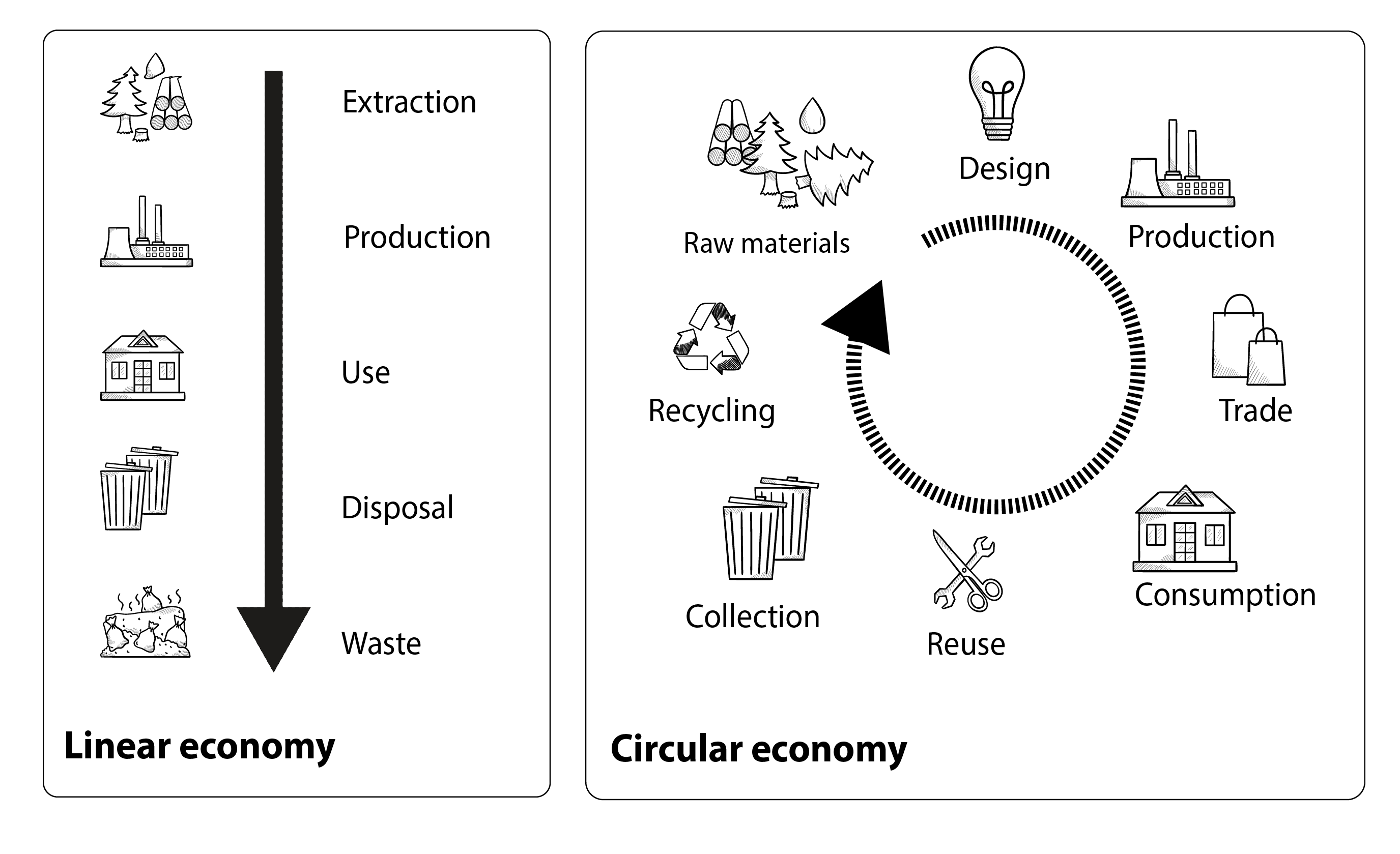
According to the Ellen MacArthur Foundation, circular economy can be defined as a system where “materials never become waste and nature is regenerated”. In a circular economy, products and materials are kept in circulation through processes such as maintenance, reuse, refurbishment, remanufacturing, recycling and composting. The circular economy tackles climate change and other global challenges, such as biodiversity loss, waste and pollution, by decoupling economic activity from the consumption of finite resources. (Ellen MacArthur Foundation 2024) Note the word regenerated in this definition: an ambitious circular economy is not only about minimizing harm, but about regenerative practices that leave ecosystems and communities in a better state than we found them - a theme we will return to throughout the book.
The 7 R’s of the circular economy
A practical way to bring circular thinking into your daily work is the hierarchy known as the 7 R’s, roughly ordered from greatest to smallest impact:
- Rethink - question whether a product, purchase or feature is needed at all, and consider service or sharing models instead of ownership.
- Refuse - say no to unnecessary devices, gadgets, features and materials.
- Reduce - use less: less hardware, less energy, less data.
- Reuse - give equipment a second life, for example by redeploying older laptops or servers for lighter tasks.
- Repair - fix devices instead of replacing them, and choose repairable hardware in the first place.
- Refurbish - restore used equipment to near-new condition, or buy professionally refurbished hardware.
- Recycle - as the last resort, recover the materials so they can become part of new products.
Notice that recycling - often the first thing we associate with circularity - is in fact the last step in the hierarchy. The greatest sustainability gains come from rethinking, refusing and reducing, so that fewer resources ever need to be recycled.
In the coming decades, the production of information technology must become so circular that, in an ideal scenario, the acquisition or disposal of a mobile phone has no greater environmental impact than picking a fruit from a tree or letting it fall to the ground. The life cycle of our IT equipment must be deliberately designed to follow the cradle-to-cradle principle. This concept holds that end-of-life products should serve as the foundation for new ones without becoming waste (Hauschild, 2021). Whereas a traditional life cycle refers to a cradle-to-grave process, the cradle-to-cradle model eliminates the “grave”: the end of one product becomes the beginning of another. In other words, the materials used to produce our digital hardware must be recaptured and reused all the way into the creation of new products—closing the loop and eliminating waste.
Beware of the rebound effect
The rebound effect refers to the phenomenon where efficiency improvements not only lower the cost of products but also lead to increased consumption. In other words, making a technology more efficient is not necessarily sustainable, as the gains in efficiency often encourage greater use.
Digital development creates tremendous value by streamlining processes. Tasks that once took hours to complete manually can now be accomplished in seconds with the right IT solutions. However, not all optimisations deliver sustainability benefits. A clear example is storage: the dramatic increase in available capacity of storage and cheaper storage options has not reduced our demand for storage space. On the contrary, it has encouraged us to take higher-resolution photos, record more videos, and save more data, ultimately driving up consumption.
The rebound effect is also known as the Jevons paradox. William Stanley Jevons studied energy economics during his time in the 19th centure, and it was with the increasing availability of coal that he observed that the presence of coal increased energy consumption - instead of replacing previously inefficient energy sources (fires). “It is a confusion of ideas to suppose that the economical use of fuel is equivalent to diminished consumption. The very contrary is the truth.” he wrote in The Coal Question in 1865. It’s a somewhat frustrating fact that our prowess in developing new sustainable forms of energy has added to our consumption instead of replacing less sustainable energy sources. The Jevons paradox or the rebound effect can be a powerful key to interpreting the lack of sustainability effects, even when witnessing impressive digital innovations.
Societal - and individual - aspects of sustainability
We have now covered a wide range of sustainability concepts and explored various aspects of sustainable development. We have examined the foundation for sustainability in terms of energy and material cycles, and we have discussed the role of companies and organizations through frameworks like ESG and CSR. Now, we turn our attention to the societal and individual dimensions of sustainability.
The challenges related to the environment and climate are so complex that they must be addressed at all levels of society. It is not enough for individuals to live sustainably, or for companies to show consideration for society and the environment. Governments and international partnerships must also create the frameworks for sustainable development through effective legislation and environmental programs. At the same time, companies and individuals should be aligned with and support these efforts in order to reach shared goals:
Sustainable Development Goals
The United Nations (UN) functions as a global umbrella organization, representing nearly all countries worldwide. Over the past few decades, the UN has increasingly prioritized sustainability and has played a leading role in shaping the global agenda for sustainable development.
In 2015, the UN adopted the 17 Sustainable Development Goals (SDGs), which commit all member states to take concrete action toward building a better, fairer, and more sustainable world. These goals offer a unifying and widely accepted framework for understanding sustainable development on a global scale. The 17 global Sustainable Development Goals are:
- No poverty
- Zero hunger
- Good health and well-being
- Quality education
- Gender equality
- Clean water and sanitation
- Affordable and clean energy
- Decent work and economic growth
- Industry, innovation and infrastructure
- Reduced inequality
- Sustainable cities and communities
- Responsible consumption and production
- Climate action
- Life below water
- Life on land
- Peace, justice and strong institutions
- Partnerships for the goals (from UN Sustainable Development Goals)
National governments and their authorities are basically responsible for providing the framework for achieving the SDGs, but companies, NGOs and individuals are also invited to work towards these specific goals. The motivation for companies to work with the SDGs can be ethical, for example if they want to work for a better future, but working with the SDGs can also benefit the company: It can give the company a better reputation and a more solid ESG foundation, if selected and relevant specific goals and targets are included in the company’s operations and development.
It is probably impossible for most companies to work towards all the SDGs at once, but it is a good sustainability practice to identify one or a few selected SDGs and specific targets where the company can make a real difference. Here, the company can examine which specific and measurable targets are relevant to the company’s sustainability strategy and focus on these targets.
The latest evaluations of the achievement of the UN’s SDGs unfortunately show that, although many have started working with the SDGs, there is still a long way to go to achieve them globally. (The Sustainable Development Goals Report 2025) Nevertheless, the SDGs provide a guideline for what is meant by sustainable development on a global level, and hence they can be used as guidelines in the digital field as well.
Policy, legislation and regulation
If we really want a lasting and effective change towards a more sustainable society, we need policies and legislation that oblige everyone to follow the necessary sustainability practices.
A notable example of policies advancing the sustainability agenda is the growing requirement in many countries for citizens and companies to sort waste into separate categories. As a result, waste sorting has become a part of everyday life for most people. The rationale is clear: plastic, metal, and glass can be recycled and reused, ensuring the continued availability of these valuable materials. Food waste can be transformed into biogas, a renewable energy source that substitutes for fossil fuels, while the remaining byproduct is used as fertilizer, feeding into the circular economy.
Despite these evident benefits, resistance to waste sorting still exists. This highlights both the challenge of achieving widespread acceptance of sustainable practices and the difficulty of persuading everyone to consistently “do the right thing.”
Scandinavia has a long history of leading the way in soft sustainability values like education, health, decent working conditions, and food safety. The EU also has a wide range of regulations that promote sustainable development. For example, the largest EU companies must comply with the CSRD (Corporate Sustainability Reporting Directive), a set of rules on corporate sustainability reporting - although the EU’s “Omnibus” simplification package narrowed its scope considerably and postponed its deadlines in 2025. The point of these regulations is to show how companies are doing with their environmental, social, and governance (ESG) commitments and how they are making positive changes. The EU is not alone: disclosure standards based on the ISSB’s IFRS S1/S2 have been adopted or proposed in more than 20 jurisdictions including the UK and Japan, China’s major stock exchanges require sustainability reports from their largest listed companies from 2026, and California’s climate disclosure laws reach most large companies doing business there.“ Other EU-level rules include the Ecodesign for Sustainable Products Regulation (Regulation (EU) 2024/1781), which sets requirements for environmentally friendly product design, and the Empowering Consumers for the Green Transition Directive which, as described earlier in this chapter, bans unsubstantiated green marketing claims from September 2026.
The introduction of sustainability regulation at both national and EU level is positive, because it provides certain guidelines and creates incentives for all companies to adopt more sustainable practices. On the other hand, regulation can feel slow and cumbersome because of the increased bureaucracy and time it takes to comply.
And we must not forget that even in the best-case scenario, where the regulations work as intended and the EU becomes both sustainable and carbon neutral within a few years, there are “only” 448 million Europeans, a small part of the world’s total population of eight billion. We can hope that EU inspires and cooperates with the rest of the world - or learn from countries that move faster.
Working conditions, including work-life balance
Sustainability is not just about the environment and society, it also has many lesser known facets. Individual factors can also have an impact on the sustainability agenda, such as making people (individuals) feel good about their work. “Human resources” is a capitalist approach to business, where people are considered a resource on par with energy, materials and finances. In an unsustainable company where there is no focus on circular processes, human resources can be overexploited, with detrimental consequences for individuals.
In the spirit of sustainability, it is therefore essential that responsible companies also focus on the well-being of their employees, both on a day-to-day basis and in the long term. A sustainable labor market is characterized by parameters such as:
- A salary that allows for a good life.
- Work-life balance.
- Absence of negative health effects from the work itself.
- Meaningful work for the individual employee.
- Opportunities for professional development through continuing education and training.
There can be large geographical differences in what constitutes fair pay or good working conditions in each country, so these need to be determined based on local conditions (Eurofound 2024). While a 37-hour week with flexible hours, free food and beverages and training facilities at work are not uncommon in IT companies, the working hours and benefits vary widely across the globe.
Gender equality is also an important factor in sustainability, as it is important that the most suitable people do the job, regardless of gender, ethnicity, religion or age. Discrimination, whether negative or positive, can lead to tensions and imbalances that are detrimental to long-term development.
Well-being of end users
As digital products become an integral part of daily life, the responsibility of those who design and develop them also increases. They must ensure that their products support, rather than compromise, the health and well-being of users.
At the turn of the millennium, when digital technology was still unfamiliar to most people, a wave of fascination swept through society. Suddenly, the impossible became possible: we could send instant messages, share photos and videos with old friends on social media, and access virtually all the world’s information from a device small enough to fit in our pockets.
Over time, we have become increasingly aware of the darker side of digital technologies. Excessive use of screen based digital media has in some cases been shown to be harmful to our mental health, and social media can distort our sense of self and our understanding of the world, and digital agents such as generative AI can influence our thinking for better or worse.
At the same time, there are many positive achievements. Digital technologies can support our health and personal development, think of popular running apps and other digital health tools that actively promote physical and mental well-being.
From a sustainability perspective, it is important to recognize that our interactions with digital products and solutions affect users in many different ways. These interactions should promote well-being rather than encourage harmful patterns or habits. Tools such as nudging can help guide user behavior in positive directions. At the same time, we must remain vigilant against unethical design techniques, known as deceptive patterns, which manipulate users into choices that are not in their best interest. Even more critically, the rise of AI-generated digital propaganda demonstrates how technology can distort the perspectives of entire populations.
A more sustainable digital future
Information technology, in itself, cannot be called sustainable. It has both dark sides - such as environmental impact and overdependence on social media - and bright sides, in the form of the many opportunities it creates. In fact, there is no such thing (yet) as fully sustainable IT or truly sustainable digital development.
Modern digital technology is not circular; it still relies heavily on the continuous input of new resources, such as rare minerals and fossil fuels, just to keep the Internet and digital infrastructure running. However, we are seeing positive developments: more IT systems are now powered by renewable energy, and material cycles in hardware manufacturing and recycling are gradually improving. While we already recycle a minor portion of hardware components, current methods still fall short of creating circular systems which allows materials to be reused year after year.
Whether digital development can become a true driving force in solving the climate crisis remains an open question. But as the authors of this book, we remain optimistic. We believe that digital development has the potential to make a positive difference for both people, planet and profit.
This belief is reflected in three key ideas that shape our approach-and the foundation of this book:
The Karlskrona Manifesto
Sustainable digital development is about developing modern technological solutions and products without compromising the living conditions of future generations. It’s a complicated undertaking that we can better address if we can break this goal down into some concrete areas of action.
The Karlskrona Manifesto is a collaboration between researchers and practitioners to inspire both academics and practitioners to integrate sustainability into information technology development processes. The Karlskrona Manifesto’s sustainable system design guidelines set out five different dimensions of sustainability (Becker et al. 2015):
- Individual sustainability refers to maintaining individual human capital (e.g., health, education, skills, knowledge, leadership, and access to services).
- Social sustainability aims at preserving the societal communities in their solidarity and services.
- Economic sustainability aims at maintaining capital and added value.
- Environmental sustainability refers to improving human welfare by protecting the natural resources: water, land, air, minerals and ecosystem services.
- Technical sustainability refers to longevity of information, systems, and infrastructure and their adequate evolution with changing surrounding conditions.
The Karlskrona Manifesto defines sustainable information technology as IT solutions that create value for many people and contribute to long-term positive development in areas such as the environment, climate, society, working conditions, and the well-being of individual users. In short: Sustainable digital solutions should not pollute the soil, water, or air, and they must respect and support both the people involved in the design and production, and also those who use the technology. The manifesto (available in full online) presents a set of sustainable design principles intended for software developers, researchers, users, and purchasers.
The ESG criteria and the Karlskrona Manifesto dimensions overlap in their focus on environmental sustainability and social issues, but the Karlskrona Manifesto broadens the ESG perspective by including technical and individual sustainability. The “Governance” element of ESG relates in part to the Karlskrona dimension “Economic Sustainability,” especially in relation to responsible governance and long-term economic viability.
Developing, procuring, and operating sustainable IT solutions is essential, but also challenging, because we still lack a clear and widely accepted understanding of how to define and measure sustainability within the IT industry. The Karlskrona Manifesto is broader and is more applicable in digital contexts as it focuses on both technological implications and individual accountability - concepts not directly addressed by the ESG criteria. While the ESG concept targets all kinds of organizations regardless of what they do, the Karlskrona Manifesto guidelines are specifically aimed at the development of digital systems. You can see a comparison between the focus areas of the two concepts in the table below.
| ESG criteria | The dimensions of the Karlskrona Manifesto |
|---|---|
| • Environment | • Environmental sustainability |
| • Society | • Social sustainability • Individual sustainability |
| • Governance | • Economic sustainability• Technical sustainability |
Throughout the whole book, we base much of our discussion on the Karlskrona Manifesto’s sustainability dimensions. We believe these provide a thoughtful and nuanced approach to sustainability, which aligns closely with the ethical, social, and environmental responsibilities of those working in the digital field.
Twin transition
The relationship between sustainability and information technology is captured by the concept of the twin transition. Born out of the EU’s ambition to achieve climate neutrality by 2050, the term refers to two great shifts happening at once: the green transition - the global effort to address climate change, biodiversity loss and resource depletion - and the digital transition - the ongoing shift to a more data-driven, automated and connected society.
These two transitions are occurring in parallel and increasingly influence each other. An integrated approach is essential to take full advantage of the benefits and potential synergies of both transitions and to mitigate the risks of addressing the two agendas separately (Müller, 2024).
The idea that digital development can help us solve our sustainability challenges in a simultaneous and dual transition is gaining traction both in the EU and internationally. “Twin transition” is thought to have the potential to create positive synergies between digital and green development. For example, a district heating plant can retrieve automatic forecasts for weather, energy prices and heat consumption and can, through digital control, optimize the operation of production so that district heating can be produced in the most efficient way (IEA 2017).
The challenge with the twin transition is that all digital development also has a negative climate footprint from the hardware and energy used. So in digital projects with a positive sustainability aim, the positive impact of the project must be significantly greater than the negative effects of the technology used. In the case of the district heating plant, the optimization gains must be significantly greater than the derived negative environmental effects of the new digital control system. In addition, it is also important to take into account the rebound effect and make it likely that increased efficiency will not ultimately lead to even higher consumption.
Digitainability
While twin transition focuses on exploring the connection between green and digital development, the concept of digitainability goes further by presenting the idea that we can combine the development of sustainability and digital development in practice and, in this way, contribute to a more sustainable future.
The term digitainability is a contraction of the words digital development and sustainability. The concept was developed by Shivam Gupta et al. in order to support the UN’s Sustainable Development Goals with digital tools (Gupta et al. 2020). The concept of digitainability combines digital innovation and sustainability principles as a tool to create technological solutions that not only promote economic growth, but also protect the environment and support social responsibility.
Gupta is also a climate optimist, arguing, among other things, that the “cross-fertilization” of digital and sustainability strategies can revolutionize the way we develop and use technology. He and his team propose a tool called the DSM ( Digitalization–Sustainability Matrix) that can be used by interdisciplinary groups to explore the digitainability potential of different development scenarios.
Bringing it together: Key insights from this chapter
You’ve reached the end of the first chapter, take a moment to appreciate your progress! You’ve explored the fundamental principles of sustainable digital development, learned new concepts, and refreshed your understanding of others.
Hopefully, you’ve gained an appreciation for the many dimensions of sustainability, spanning from geology and ecology to economics and social sciences. Adopting a holistic perspective is essential if you wish to contribute meaningfully to sustainability.
Your role in the green digital transformation
No single individual can grasp every aspect of the complex digital and sustainable transformations taking place. Fortunately, through international collaboration, many skilled professionals and experts continually develop guidelines and recommendations that we all can incorporate into our own practices.
While it’s true that individually we can’t singlehandedly solve the world’s pressing challenges, our collective lifestyle choices and professional decisions can significantly influence global trends. Gandhi summarized this well: “If we could change ourselves, the tendencies in the world would also change. As a man changes his own nature, so does the attitude of the world change towards him.” (Quote Investigator 2017).
In your professional role, you have the power to make meaningful choices. For example:
- Select suppliers committed to renewable energy instead of fossil fuels.
- Prioritize hardware solutions that minimize electronic waste.
- Support the Sustainable Development Goals (SDGs) relevant to your field.
Whether your strengths lie in software development, UX design, project management, digital communication, network technology or other fields, the greatest impact comes from integrating a long-term, sustainability-driven mindset into your daily work.
Reflect and rethink
To promote sustainability in your everyday decisions in your profession, consider the following questions:
- Is my work as sustainable as possible?
- Does my work have a positive impact on the environment, climate, society, working conditions, and the health and well-being of individual users?
- How do my professional choices today affect future generations?
- What specific improvements can I make to ensure that my work is climate-neutral and ethically sound?
- Does my work align with the principles of the Karlskrona Manifesto or relevant sustainable development goals?
The following chapters will provide you with essential tools and knowledge to put these considerations into practice. Next, we’ll explore how systems work and how to effectively understand, model, and influence them. After this foundational theory chapter, we’ll delve deeper into practical applications, specifically in digital development and information technology.