Chapter 9: Benchmarks, Evaluation, and the Path to AGI
Previous chapters showed how to build synthesis systems that learn, reason, and compose. This chapter asks a different question: how do we know whether those systems are actually any good? Benchmarks and evaluation frameworks are the bridge between the research program of program synthesis and the broader ambition of artificial general intelligence (AGI). A synthesizer that solves one curated example is interesting; a synthesizer that solves a battery of tasks with a measurable generalization gap is interesting and trustworthy.
The examples are in source-code/09-benchmarks-evaluation-agi/ and expose their harnesses in plain Racket. Each file now uses explicit provide, (module+ main ...)/(module+ test ...), and a struct result with named fields; expand-command raises a contract error on unknown tokens, and synth->fn distinguishes no-program (no coverage) from 0.0 accuracy.
Evaluating General Intelligence: Per-Task Metrics
The example 01-evaluation-framework.rkt sets the baseline. Rather than report a single binary outcome (“solved” / “failed”), we measure four numbers for each task:
1 (struct result (name train-acc test-acc prog))
The four numbers we care about for any synthesis benchmark are:
- Train accuracy — did the synthesizer find a program consistent with the data it saw?
- Test accuracy — does that program generalize to held-out inputs?
- Program size — how parsimonious is the explanation? A compact program is more likely to have captured the underlying rule than a memorized lookup table.
- Candidates considered — how efficient was the search? A synthesizer that brute-forces 10,000 candidates to find a 3-node program is doing something qualitatively different from one that finds it after 8 candidate evaluations.
The benchmark suite in the example consists of five small algebraic tasks (identity, double, square, increment, two-x-plus-one), each defined by a train set and a held-out test set. The synthesizer is a simple candidate-list enumerator over a fixed set of expressions:
1 (define (synthesize examples)
2   (let loop ((rest (candidates)) (n 0))
3     (cond
4       [(null? rest) (cons #f n)]
5       [(andmap (lambda (ex)
6                  (= (eval-expr (car rest) (car ex)) (cdr ex)))
7                examples)
8        (cons (car rest) n)]
9       [else (loop (cdr rest) (+ n 1))])))
The harness walks each task, runs the synthesizer, and assembles per-task reports. The full run-task from 01-evaluation-framework.rkt, whose result struct carries the four metrics:
 1 (struct result (name status prog train-acc test-acc size considered) #:transparent)
 2
 3 (define (run-task task)
 4   (match-define (list name train test) task)
 5   (match-define (cons prog considered) (synthesize train))
 6   (if (not prog)
 7       (result name 'fail #f 0.0 0.0 0 considered)
 8       (let* ([train-correct (count (lambda (ex) (= (eval-expr prog (car ex)) (cdr ex))) train)]
 9              [test-correct  (count (lambda (ex) (= (eval-expr prog (car ex)) (cdr ex))) test)])
10         (result name 'solved prog (/ train-correct (length train)) (/ test-correct (length test)) (size prog) considered))))
Running the example produces a per-task report and an aggregate summary:
 1   identity: solved
 2     prog = x  (size 1, considered 0)
 3     train-acc=1  test-acc=1
 4   double: solved
 5     prog = (+ x x)  (size 3, considered 7)
 6     train-acc=1  test-acc=1
 7   ...
 8
 9 Solved 5 / 5 tasks
10 Average train accuracy:  1.0
11 Average test accuracy:   1.0
12 Average program size:    3.0
13 Average candidates tried:7.8
This shape matters: for AGI evaluation we want per-task visibility into correctness, generalization, parsimony, and search cost, not a single leaderboard number that hides the distinction between a memorizer and a reasoner.
A Key Benchmark: ARC in Miniature
The Abstraction and Reasoning Corpus (ARC) is the canonical benchmark for testing “fluid intelligence” in machines: each task presents two or three small input/output grid pairs and asks the system to apply the discovered rule to a held-out test grid. The point is that the rules are not in any training distribution; you have to infer them from nearly no evidence.
The example 02-arc-style-task.rkt implements a 1-D analogue. The grid is a list of small integers, and the DSL provides six candidate transformations: identity, reverse, sort, sort-desc, inc-each, and double-each.
1 (define dsl
2   (list (cons 'identity   t-identity)
3         (cons 'reverse    t-reverse)
4         (cons 'sort       t-sort)
5         (cons 'sort-desc  t-sort-desc)
6         (cons 'inc-each   t-inc-each)
7         (cons 'double     t-double-each)))
Given two training pairs, the synthesizer finds every DSL entry that is consistent with both:
1 (define (solve-arc train-pairs)
2   (filter (lambda (entry)
3             (andmap (lambda (pair)
4                       (equal? ((cdr entry) (car pair)) (cdr pair)))
5                     train-pairs))
6           dsl))
For the chosen training pairs the answer is uniquely reverse. The system then applies the discovered transformation to a held-out test input and checks the prediction:
1 Train pairs: (((1 4 2 3) 3 2 4 1) ((2 3 4 1) 1 4 3 2))
2 Consistent transformations: (reverse)
3   reverse predicts (2 3 1 5) on test input (5 1 3 2) (expected (2 3 1 5)) -> CORRECT
This tiny example captures the evaluation pattern ARC uses: very few training pairs, a held-out test, and a requirement that the system commit to a specific transformation. The same machinery scales to richer grid DSLs, larger training sets, and full ARC problems.
ARC in Practice: Versions, the ARC Prize, and Real Scores
The 1-D example above treats ARC as one fixed benchmark. It is not. Since François Chollet released the Abstraction and Reasoning Corpus in 2019, it has grown into a series of benchmarks, each built after systems began to solve the last one, and an annual prize that serves as the main public record of how synthesis, search, and LLM methods compare.
ARC-AGI-1 is the original corpus, with 400 public training tasks and 400 public evaluation tasks, plus hidden sets for scoring. ARC-AGI-2 (2025) keeps the grid format but asks for deeper composition: rules that interact, symbols whose meaning depends on context, and several rules applied at once. Its makers tested every task on people; each one was solved by at least two human test-takers in two attempts or fewer, in a study of over 400 members of the public. ARC-AGI-3 (launched March 25, 2026) breaks from the static format. Each task is a turn-based game with no instructions, rules, or stated goal. The agent must explore, work out what the game does and what counts as winning, and carry what it learns into harder levels. At launch, people could solve every environment, and frontier AI systems scored below 1%.
The ARC Prize runs on Kaggle, where entries must run offline with fixed compute on a private task set, so a score measures the method rather than the size of a model behind an API. A grand prize, for 85% on the private set, has not been claimed.
- ARC Prize 2024 (ARC-AGI-1). The best private-set score rose from 33% to 55.5%. MindsAI posted the 55.5% but did not open-source its method, so the prize went to the ARChitects at 53.5%. The prize’s technical report credits two families of methods: deep-learning-guided program synthesis and test-time training, the fine-tuning of a model on each task’s own examples (the test-time adaptation idea of Chapter 7).
- OpenAI o3 (December 2024, outside the Kaggle rules). A preview of o3 scored 75.7% on the ARC-AGI-1 semi-private set at the prize’s high-efficiency setting, and 87.5% with about 172 times the compute. The ARC Prize team later noted that the released o3 is a different model from the one tested.
- ARC Prize 2025 (ARC-AGI-2, March 26 to November 3, 2025, 1,455 teams). NVARC won with 24.03% on the private set at about $0.20 per task, ahead of the ARChitects (16.53%) and MindsAI (12.64%). NVARC combined a test-time-trained model in the ARChitects’ style, a large body of synthetic tasks, and parts of the Tiny Recursive Model (TRM). TRM won the paper award: a 7-million-parameter network that reached 45% on ARC-AGI-1 and 8% on ARC-AGI-2.
Representative scores, as reported by the ARC Prize team through the 2025 results:
| Benchmark | System | Approach | Score |
|---|---|---|---|
| ARC-AGI-1 | the ARChitects (2024 winner) | test-time-trained LLM, Kaggle limits | 53.5% |
| ARC-AGI-1 | OpenAI o3 preview | reasoning LLM, many samples | 75.7% (87.5% at ~172x compute) |
| ARC-AGI-1 | TRM | tiny recursive network, 7M parameters | 45% |
| ARC-AGI-2 | Gemini 3 Pro | LLM alone, $0.81 per task | 31% |
| ARC-AGI-2 | Claude Opus 4.5 (Thinking, 64k) | LLM alone, $2.20 per task | 37.6% |
| ARC-AGI-2 | Poetiq refinement on Gemini 3 Pro | LLM inside a refinement loop, about $30 per task | 54% |
| ARC-AGI-2 | NVARC (2025 winner) | test-time training plus synthetic data, Kaggle limits | 24.03% |
| ARC-AGI-3 | frontier models at launch | LLM agents | below 1% (people: 100%) |
Scores on these benchmarks change month to month, and newer results exist than this table shows. Check the leaderboard at https://arcprize.org for current numbers, and compare rows with care: Kaggle entries run under tight compute limits on a private set, while the commercial results come from a semi-private set with no such limit.
Two patterns in the table matter for this book. First, the gains come from hybrids. The same LLM scores 31% alone and 54% inside a refinement loop that proposes a solution, checks it against the task’s training pairs, and revises it. That loop is CEGIS from Chapter 4, with the training pairs as the verifier and the LLM as the proposer of Chapter 5. The prize’s 2025 report also singles out evolutionary program synthesis entries that generate and verify candidate programs in the same way. Second, the drop at each new version shows what the benchmark is for. Methods tuned to ARC-AGI-1 lost most of their score on ARC-AGI-2, and agents that handle ARC-AGI-2 score almost nothing on ARC-AGI-3. Each version measures the gap between skill on known kinds of task and the ability to pick up a new kind, which is the generalization gap of this chapter at the scale of a field.
Compositional Generalization: A SCAN-Style Gap
ARC tests novelty (a rule never seen before); SCAN and similar benchmarks test compositionality: the ability to generalize to longer or structurally richer commands than any seen during training.
The example 03-compositional-benchmark.rkt builds a 1-D SCAN analogue. Commands are sequences of atoms from {walk look jump run} combined with and (sequencing) and twice (repetition). The training set covers only short commands (length ≤ 2 tokens of meaning); the test set requires longer compositions such as (walk and look) twice, which expects the output (walk look walk look).
Two synthesizers are compared. The length-bounded synthesizer now filters to known commands before expanding, so and/twice no longer silently vanish; it still fails structurally because it truncates to two tokens:
1 (define (length-bounded-synth tokens bounded)
2   (define known (filter (lambda (t) (assoc t command-table)) tokens))
3   (if (<= (length tokens) bounded) (expand-command known) (expand-command (take known bounded))))
4 ;; expand-command now raises on unknown tokens: (expand-command '(foo)) => contract error
The compositional synthesizer is a small recursive parser for the grammar
1 expr     :=  seq [twice]
2 seq      :=  primary (and primary)*
3 primary  :=  walk | look | jump | run
which evaluates any composition and therefore composes past the training distribution. Running the example:
1 --- Length-bounded synthesizer (max depth 2) ---
2   (walk and look twice) -> (walk) (expected (walk look walk look)) FAIL
3   (jump and run twice) -> (jump) (expected (jump run jump run)) FAIL
4 --- Compositional synthesizer (recursive parse) ---
5   (walk and look twice) -> (walk look walk look) (expected ...) OK
6   (jump and run twice)  -> (jump run jump run)   (expected ...) OK
The gap between the two strategies is the gap between systems that memorize lengths and systems that model grammar. That is the SCAN question in one slide.
Generalization-Gap Leaderboard
The final example aggregates these ideas into a small leaderboard. We run three learning strategies across a battery of three tasks (identity, double, square) and report train accuracy, test accuracy, and the generalization gap train - test. The example 04-generalization-gap-leaderboard.rkt defines the runners:
- Nearest-neighbor memorization wraps a closure that always returns the value of the closest training input.
- Simple grammar enumerates
{x, 1, 2, 3, x+1, 2x, 3x}— enough for identity and double but not square. - Rich grammar adds
x*x,2x+1, andx*x + x.
Dead parse-tokens is removed; eval-program and parse-expr now signal errors on unknown symbols instead of returning ().
The leaderboard printing function computes per-task accuracy and averages, and synth->fn distinguishes a failed synthesis (no-program, tagged no-coverage in the report) from a program that scores 0.0:
 1 (define (synth->fn result)
 2   (cond [(procedure? result) result]
 3         [(or (symbol? result) (list? result) (number? result)) (lambda (x) (eval-linear result x))]
 4         [(not result) (lambda (x) 'no-program)]))
 5
 6 (define (display-results label runs)
 7   (displayln (format "--- ~a ---" label))
 8   (for ([r runs])
 9     (define tag (if (not (result-prog r)) "no-coverage" (format "prog ~a" (result-prog r))))
10     (displayln (format "  ~a: train ~a  test ~a  ~a"
11                        (result-name r)
12                        (exact->inexact (result-train-acc r))
13                        (exact->inexact (result-test-acc r))
14                        tag)))
15   ...)
The output is a clean demonstration of what each metric means:
 1 --- Nearest-neighbor memorization ---
 2   identity: train 1.0  test 0.0
 3   double: train 1.0  test 0.0
 4   square: train 1.0  test 0.0
 5   avg train-acc = 1.0, avg test-acc = 0.0, avg gap = 1.0
 6 --- Simple grammar  (no square) ---
 7   identity: train 1.0  test 1.0
 8   double: train 1.0  test 1.0
 9   square: train 0.0  test 0.0  no-coverage
10   avg train-acc = 0.67, avg test-acc = 0.67, avg gap = 0.0
11 --- Rich grammar    (with square) ---
12   identity: train 1.0  test 1.0
13   double: train 1.0  test 1.0
14   square: train 1.0  test 1.0  prog (* x x)
15   avg train-acc = 1.0, avg test-acc = 1.0, avg gap = 0.0
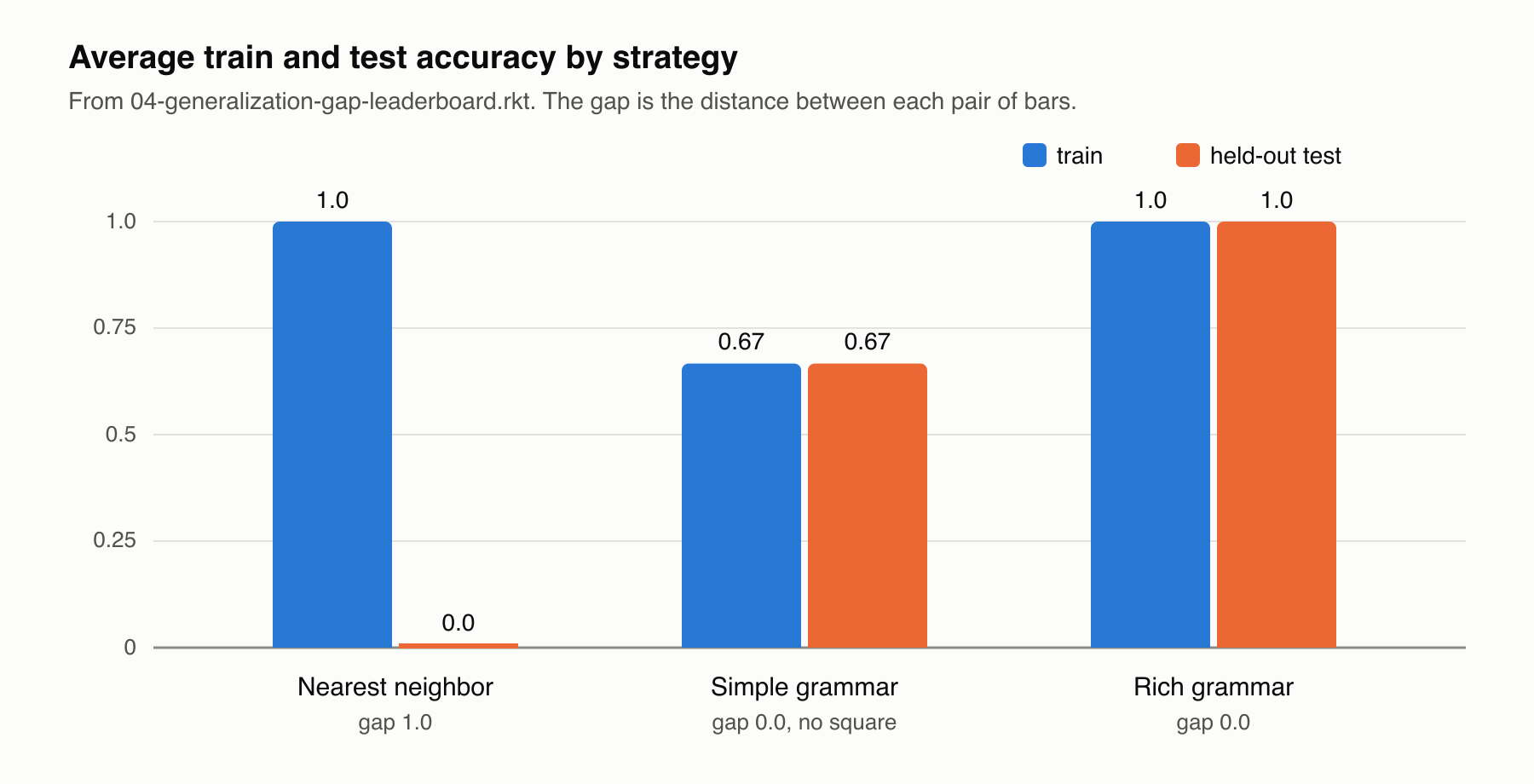
The memorizer has the pathological gap of 1.0; it scored everything on the training set because the test inputs are exactly what it never saw. The simple grammar has zero gap but limited coverage: it cannot represent square, so it scores 0 everywhere on that task. The rich grammar has both full coverage and zero gap—the only strategy that actually solves the benchmark.
Real benchmarks show the same gap. ARC Prize scores entries on a private task set that no entrant has seen, because public tasks leak into training data and tuning choices. In 2025 the winning team, NVARC, scored 27.64% on the public leaderboard and 24.03% on the private set. The private score is the one that counts, and the difference between the two is a direct measure of how much a method fit the tasks it could see. The ARC-AGI versions above are the same idea one level up: each new version is a held-out test for the methods built on the last one.
This pattern—report train, report test, and compute the gap—is the core of any meaningful claims about progress toward AGI. Without it, “90% accuracy” tells you nothing about whether the system memorized or generalized. With it, we can rank approaches and measure real improvement.
Running the Examples
1 cd source-code/09-benchmarks-evaluation-agi
2 racket 01-evaluation-framework.rkt
3 racket 02-arc-style-task.rkt
4 racket 03-compositional-benchmark.rkt
5 racket 04-generalization-gap-leaderboard.rkt
6 raco test .
Each prints a narrated trace: per-task metrics for the evaluation framework, the unique reverse-rule and its held-out prediction for ARC, the contrast between bounded and compositional parsing for SCAN, and the three-strategy leaderboard for the generalization gap.
Wrap Up
Evaluation is the empirical backbone of any AGI-flavored claim. A synthesis system that cannot be benchmarked cannot be improved, and a benchmark that reports only accuracy cannot distinguish memorization from understanding. The four examples in this chapter cover the four pillars of a useful evaluation:
- Per-task metrics (train/test accuracy, size, search cost) make behavior visible at the task level.
- ARC-style tasks test abstraction from scarce evidence.
- SCAN-style tests expose compositional generalization.
- Gap-based leaderboards aggregate strategies and make overfitting explicit.
Taken together, these show that program synthesis is not just a technique for writing programs but a testbed for measuring one of the most elusive properties of intelligence: the ability to learn a rule from two examples and apply it correctly on the hundredth. The research program that succeeds on these benchmarks, particularly on tasks like ARC that resist memorization, will have taken a real step toward general intelligence. The ARC Prize results to date point at what that program looks like: learned models that propose, search that explores, and checks that verify, the three parts this book has built one small program at a time.