The Start of Playing
Fingers
Must cover each hole completely otherwise air will escape and the sound will be wrong; squeaking and/or the note you are playing will go up in pitch.

|
You should place the pads of the fingers flat over the holes rather than use the end of your fingers. |

finger-placement
Try not to hold the flute too ridgidly.
Mouth
You should place your mouth on the end of the flute as if you were using a straw. Try to partially cover the hole with your top lip. This will give you better control over the amount of air/breath which is entering the flute. In doing so you will be able to slow down the rate of air which is entering the flute. This will help conserve some of your breath and allow you to play for longer before needing to take your next breath.
Blowing
blowing-clock
Slowly, like breathing out normally. Blow from the back of the mouth not the front. This will produce a more solid, rounded sound. Blowing from the front, as one does when whistling, will produce a more harsh, hollow sound.
You should also practice by timing how long you can hold one note for. Try to keep your breath at a constant rate to keep the note even and controlled. You will need slightly more breath for the higher notes. Presumably there’s a physic explanation for this but I don’t know what it is.
Tongue
Should be kept at the bottom of mouth (again not at the front otherwise the sound will be hollow). Later on the tongue will be used to help articulate, but not yet.
Music Tablature
There are several sites that offer NAF tablature. The finger positions, represented by small flute images, are very easy to read as they are placed under the normal music score. Reading the timing on the score, however, may be a little more tricky but this can be ignored initially while you play to your own speed and ability. Ideally base your speed/timing on your memory from previously listening to the music.
- flutetree.com
- yahoo groups - has a couple of groups which cater for Native American Flutes. There are quite a few tablatures uploaded by the forum members.
LIST MORE SITES
Primary Scale
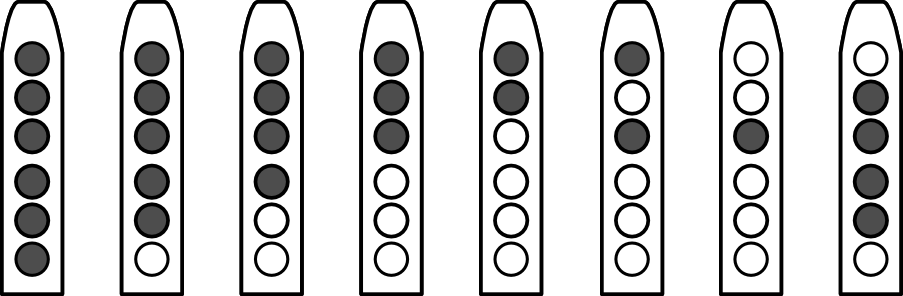
Primary scale
Common problems
Squeaking is usually occurs if you are not covering the holes completely or you are blowing way too hard. It is possible to make the flute jump up in pitch (by and octave) by blowing harder while covering all the holes. Sometimes this is desirable but usually not while learning.
Flat notes are caused by blowing too softly. Sharp notes are caused by blowing too hard.
Deteriorated quality of play after a short/long time, maybe fifteen minutes plus. This is usually caused by the flute wetting out. This is caused by the heat front your breath creating moisture as it makes contact with the cooler surfaces withing the SAC chamber and along the bottom of the block. To remove the moisture easily place one finger over the sound hole in front of the block and make a short, sharp blow into the mouthpiece. This will dislodge the moisture and allow you to continue playing for a while. This will only work upto a point. You will then have to stop playing that flute and play another one (one benefit of having more than one flute).
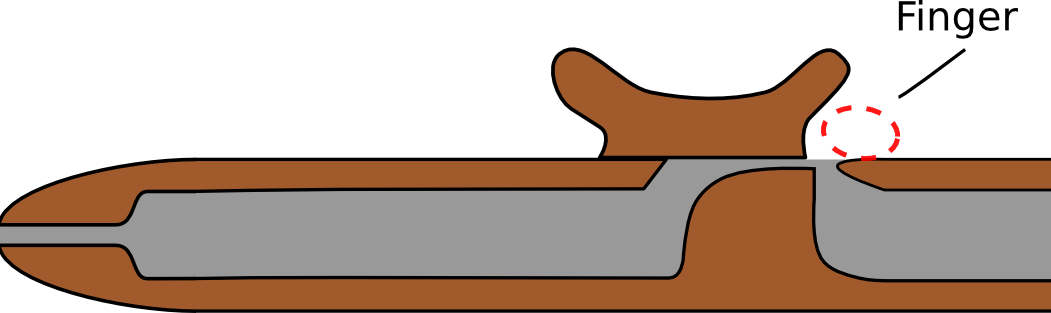
Clearing moisture
How To Practice
Practice so that you can attain freedom
Scott August[^1]
If your like me, practicing is one of those things that you know you are supposed to do it, but your not quite sure how to practice well. Look through the sites listed in the reference section and find a tablature for a piece of music you know and ideally like. I haven’t previously been very good at practicing but I have now fallen into a routine which works for me.
- Learn the notes While reading the tablature, play the tune over and over note for note. You’ll probably find that you sound like a robot for the moment but that doesn’t matter. Here we are just trying to remember the notes. Continue until you can play the notes without needing to read from the tablature or until you can play them while glancing every now and then at the tablature.
- Play the tune You should find you are now playing automatically. At this point you can move onto adding a little expression and feeling to the music and finally moving onto improvising the tune.
- Improvise Once you’re comfortable playing the tune automatically you can start playing around with the notes and the timings. See the improvisation section for several simple approaches to help you.
Oh and remember. Keep relaxed and keep smiling. It will definately help your playing flow more naturally. You may also find that after playing for an extended period you start making mistakes. In that case take a break. Either stop playing for the day or just noodle around for fun. Not all learning has to be carried out in a strict manner. Noodling helps too.