7. Arrays
In Go, an array is a numbered sequence of elements of a specific length.
Arrays are easily understood with the help of this example:
Program: ar1.go
 1 package main
 2
 3 import "fmt"
 4
 5 func main() {
 6         //exactly 5 ints. The type of elements
 7         //and length are both part of the array's
 8         //type. By default an array is zero-valued,
 9         //and int types are by default initialized
10         //with a 0 value.
11         var arr [5]int
12         fmt.Println("arr:", arr)
13
14         //We can set a value at an index using the
15         //array[index] = value syntax, and get a
16         //value with array[index].
17         arr[3] = 10
18         fmt.Println("set:", arr)
19         fmt.Println("get:", arr[3])
20
21         //The builtin len returns the length of
22         //an array
23         fmt.Println("len:", len(arr))
24
25         //Use this syntax to declare and initialize
26         //an array in one line.
27         arr2 := [5]int{1, 2, 3, 4, 5}
28         fmt.Println("arr2:", arr2)
29
30         //multidimensional array
31         arr3 := [2][2] int{ {1,2}, {3,4} }
32         fmt.Println("arr3:", arr3)
33 }
The output is:
arr: [0 0 0 0 0]
set: [0 0 0 10 0]
get: 10
len: 5
arr2: [1 2 3 4 5]
arr3: [[1 2] [3 4]]
Note that you can have the compiler count the array elements for you:
b := [...]string{"Golang", "Challenge"}
In both cases, the type of b is [2]string.
Go’s arrays are values. An array variable denotes the entire array; it is not a pointer to the first array element (as would be the case in C). This means that when you assign or pass around an array value you will make a copy of its contents. (To avoid the copy you could pass a pointer to the array, but then that’s a pointer to an array.)
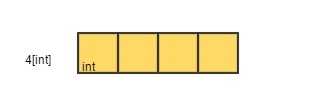
The in-memory representation of [4]int is just four integer values laid out sequentially:
Array