Analysis of Colossians 2.11-12
Diagramatical analysis
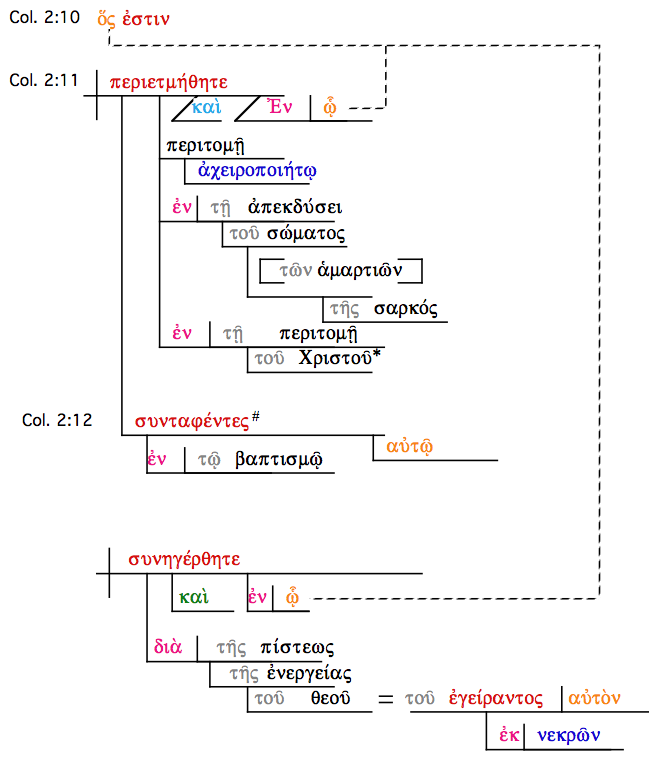
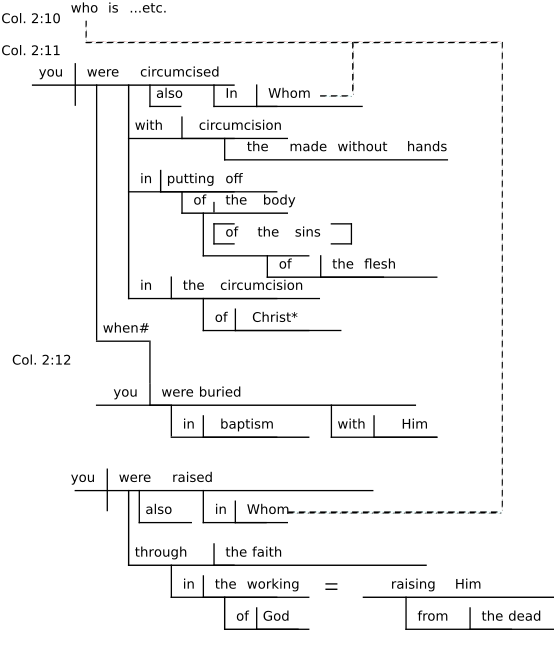
This translation takes the Greek as a temporal participle. The instrumental participle is also a possibility.
Possible Interpretations of the Grammar
“the circumcision of Christ”
- Attributive Genitive. (Also called the genitive of quality or description. The noun in the genitive [Christ] describes the character, quality or nature of the substantive [circumcision].) See Ferar Fenton, John Eadie, J. O. Buswell, and Lightfoot. If this usage were applied here it would mean “Christian circumcision” (in distinction to “Mosaic circumcision”).
- Objective genitive. (The noun in the genitive receives the action.) See Meredith G. Kline, By Oath Consigned, pp. 44-47, 71-73. This usage would point to either Christ’s circumcision when He was eight days old which prefigured His later crucifixion, or it would refer to his death in 30 AD (metaphorically called a circumcision) which was prefigured by His literal circumcision.
- Subjective Genitive. (The noun in the genitive produces the action.) See Amplified New Testament. See also Kline, p. 71. This usage would point to regeneration as a spiritual circumcision performed by Christ on the heart.
- (F. F. Bruce combines explanations 2 & 3.)
“buried with Him in baptism”
This is an adverbial clause that modifies the main verb “you were circumcised.” There are two possible uses of this participle:
- Temporal participle. See Ferar Fenton, Amplified New Testament, Vincent, and Moffat. This is by far the most frequent usage of the adverbial participle, and it indicates the time at which the action of the main verb takes place. See Wenham, Elements of N.T. Greek, pp. 147ff, and Dana & Mantey, A Manual Grammar of the Greek New Testament, pp. 226,230. If this usage were intended, it would be translated “when you were buried.”
- Instrumental participle. See J. O. Buswell. Examples of this usage are Acts 16:16; Matt. 6:27; 1 Tim. 1:12. If this usage were intended, it would be translated “by being buried with Him…”
Whatever may have been intended by the details of the passage it is an unavoidable fact that baptism and circumcision are identified as the same. Thus whether we say with Buswell, “You were circumcised… by being baptized” or whether we say with others, “You were circumcised … when you were baptized,” the same conclusion is reached. Baptism is the New Testament counterpart to circumcision. And many Baptists have recently admitted that this passage does teach a definite correspondence between baptism and circumcision.
After an examination of Colossians 2:11-12, Paul K. Jewett says, “the use of the aorist passives throughout the passage (περιετμηθητε, συνταφεντες, συνηγερθητε) makes it evident that to experience the circumcision of Christ, in the putting off of the body of the flesh, is the same thing as being buried and raised with him in baptism through faith. If this were true, the only conclusion we can reach is that the two signs, as outward rites, symbolize the same inner reality in Paul’s thinking. Thus circumcision may fairly be said to be the Old Testament counterpart of Christian baptism. So far, the Reformed argument, in our judgment, is biblical. In this sense ‘baptism,’ to quote the Heidelberg Catechism, ‘occupies the place of circumcision in the New Testament.’”72 David Kingdon says, “Christian baptism takes over and deepens the spiritual and ethical significance of Old Testament circumcision, but it does not take over its national and fleshly meaning, for that has dropped away now that the ‘new age’ in the Spirit has come.”73
That last statement by Kingdon is the common attempt to avoid the conclusion of infant baptism. These Baptists insist that there is a movement in redemptive history from external to internal, from visible to invisible, from earthly to heavenly, from fleshly to spiritual and from corporate to individual and personal. To quote Walter Chantry: “But the New Testament Church is come of age. It is by way of contrast, inward, spiritual, and personal.”74 Paul K. Jewett says, “… this THEN is of capital significance - the temporal, earthly, typical elements of the old dispensation were dropped from the great house of salvation as scaffolding from the finished edifice.”75 Infant baptism, they teach, is part of that corporate, external, national scaffolding that has fallen away.
However, as we have seen under principle 6, the individual infant is every bit as important to the covenant as the individual believing adult, for of such is the kingdom of heaven (Luke 18:15-16). And the corporate reality of families and nations is not removed but expanded. Peter promises a time when “all the families of the earth shall be blessed” (Acts 3:25, emphasis added), and John anticipates a time when “all nations shall come and worship before” Him (Rev. 15:4, emphasis added). Thus there is an expansion from Jewish families and Jewish nation to all families and all nations. Certainly the Great Commission for the church is not an individualistic affair. Rather it is a command to disciple “all nations” (Matt. 28:19), a command which will be fulfilled in God’s mercy: “And the Scripture foreseeing that God would justify the nations by faith, preached the gospel to Abraham beforehand, saying, ‘In you all the nations shall be blessed.’” Indeed, every Old Testament blessing signed and sealed by circumcision finds a fuller and richer expansion in the New Testament. There is no falling away of external blessings. The promise of land is expanded to inheriting the earth (Matt. 5:5) and being “heir of the world” (Rom. 4:13). Provisional prosperity in the Old Testament is expanded with the wish that “you may prosper in all things and be in health, just as your soul prospers” (3 John 2, emphasis added). The external historical blessings promised in such passages as Psalm 72 are far fuller than anything experienced in the Old Testament. The nations are prophesied to submit to God’s civil laws (Is. 42:4). Even our fleshly bodies will be resurrected and we will inherit a new heavens and new earth in eternity (Rom. 8:18-23; 2 Pet. 3:13). Thus, Kingdon and Jewett have not been successful in evading the requirement that the sign of the covenant be applied to our children. The development from Old Testament to New Testament is not one of diminishment, but of expansion and fuller expression.