retreat
part 2 : process
4 format
5 protocol
6 prepare
4 format
We can use darkness in various formats for different reasons. Here, I describe formats in which I have experienced deep rest and gotten positive results in my energy level, psychic state, and general well-being. I also explain ways darkness can go wrong and how to easily avoid them.
I recommend gradually increasing the length of stays in darkness. First darken your bedroom for sleeping and maybe a mini-retreat (12–16 hours). This improves your sleep and gives you a taste of a retreat. Upgrade your room for a 5-day -4 retreat. You will get relief, profound rest, and hints of healing. It will also work for 9-day Czech -4 retreats.
A dedicated darkroom works better for 9-day standard -4 retreats and medium -4-length retreats (3–8 weeks). I believe we can heal from the core of our suffering in a medium retreat. Your experience at home might inspire you to build such a darkroom yourself. Interest in darkness is growing. The world needs more and better facilities than the dozens that exist.
Even greater preparations must be made for a long -4 retreat (3-12 months). It promises to enable us to heal from everything. This includes what few people believe can heal: major physical illness and injury, missing teeth, age-related symptoms. Even birth defects, including ugliness, brain damage, amputation, and nanite infestation might heal. It stands to reason. The self-healing organism cannot help but attain perfect health if the conditions are provided.
In general, the longer a retreat, the better its conditions must be. This means more silence, space, comfort, and support. You can pull off a 5-day retreat nearly anywhere.
A 9-day standard retreat requires upgraded conditions. Besides birth, a retreat might be the most important event of your life. It deserves serious attention—possibly more than your birth got.
sleep
tonight
Get relief tonight from most outdoor ambient light. In 5-10 minutes, fix dark, dense sheet material over your bedroom windows and doors.
- over door and windows, tack or tape up
- extra curtains, blankets, sleeping bags, dark bedsheets
- black plastic, carpet, or cardboard
- or prop up plywood, old doors, or big table tops
- use whatever you have to cover the windows
- extend corners of flexible materials as far as possible past door on each side
- turn off or cover devices in your room that produce light
- make sure you have plenty of fresh air, even if it lets in a little light
- block some of the remaining light with a mask from an airline or travel store; a tall dark, winter hat pulled down, or a dark t-shirt draped over your eyes. Every bit helps.
We often feel groggy after sleeping a lot after many short nights. Some call this getting too much sleep. But that is a physiological impossibility. The body never errs. It’s a matter of how tired people can get and still keep their jobs.
In fact, we are tapping into the first layer of a backlog of lost sleep. Feeling groggy is the first phase of catching up. This can take days. Reversing sleep deprivation is like withdrawing from a strong drug. Like me, you may need a retreat to get to the other side of it without backsliding.
In the meantime, this format helps us remember how important darkness is. The next step is to make an instant mask -10. When ready for perfect darkness, make window coverings -10 and a door seal -10, maybe lightproof vents -10 and a fan mount -9, and maybe even a silencer -9. Then your room will be dark, quiet, airy, and easily reopened to light during the day.
nightly
We require total darkness to sleep well. No one is an exception to this. You may be able to fall asleep despite the street light outside your bedroom window, but only at the expense of overall function (see Law of Vital Accommodation in process -1). The circadian system has not changed one iota since industrialization. It never gets used to anything. If light intrudes on your sleep, it will signal the circadian system to make your sleep less deep and restful, whether you know it or like it or not. It’s like what many clients told me after their retreats: “I had no idea how tired I was.”
A friend darkened his bedroom. He reported a huge improvement in the quality of sleep he and his mate got. Vivid dreams returned as well. I have experienced the same thing whenever I have been able to darken the room I sleep in. The darker the room, the better the sleep. 100% darkness is a 10,000% better than 99.9% darkness. Extinguishing that last bit of light leaves the mind nothing to hang onto. It gives new meaning to “falling asleep”. See for yourself.
It is best to go to sleep early, from 18:00 to 22:00 at the latest. Four hours later, one naturally awakens from this “first sleep” for a candle-lit “watch” of about 4 hours. At this hour, one is freshly rested, yet the promise of sleep lies ahead. The world outside is quieter; children are asleep; the mind runs more slowly; and inhibitions are slightly relaxed.
This makes sex especially gratifying. Many consider it an auspicious hour for meditation or prayer. Use a candle or other dim, warm lighting. Avoid cold-tinted lighting, which greatly stimulates the circadian system.
Light exercise, light reading, and light snacking (on fruit) are fine, too. Perhaps a menial chore or two. But serious work can over-stimulate the mind and distract from getting back to sleep when tired again.
A second sleep lasts 4 more hours. It is deliciously renewing. A nap in early afternoon, as short as 20 minutes, will refresh you yet again. That is, if you can stand feeling so good.
Before widespread public lighting, this was a common sleeping pattern. It’s called biphasic or segmented sleep. It is natural. Retreating strongly resets it. If it happens with you, consider it a normal part of life recovered.
Many aspects of modern life seem out of control. Blackout blinds offer the unique thrill of reclaiming control over one of life’s most basic functions: sleeping and waking. No more will sun and street-lighting determine when you wake up. You will, and when you are good and ready.
retreat
short
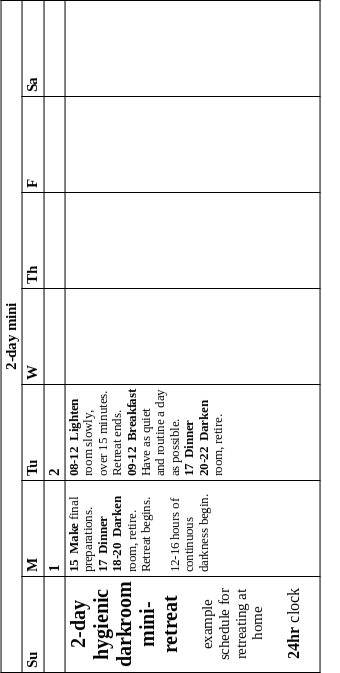
Short retreats last 0.5–9 days. You can begin at home.
mini
Note: I do not recommend a mini-retreat. I merely suggest it as a possibility. Only do it if you can do it exactly as instructed, thus not endangering yourself. I cannot do them properly, so I don’t try anymore. But some people will have the capacity and circumstances to make it ok. If you have a negative experience, don’t try again. Use a 5-day or 9-day retreat to recover.
A mini-retreat allows you to dip your toe into retreating while keeping to your schedule. It includes the two primary phases of a retreat: sleeping long and deeply, and being awake by yourself without distraction for some hours.
It is the same as sleeping nightly in darkness except you:
- turn off lights by 20:00 sharp*
- maintain darkness whether or not you wake up in the middle of the night
- get 1-2 extra sleeps in the morning
- stay in darkness 12–16 hours*
- have a quiet day at home and an early night
A mini-retreat could help maintain restedness between 5- and 9-day retreats. Some benefits of retreating fade and at different rates. Extend them. Smooth the transition to your next retreat with a mini-retreat per week or month.
Find a schedule for 5-day retreats in calendar form below.
CAUTION: Start a mini-retreat by 20:00 at the latest, and stay no more than 16 hours. I learned both these rules the hard way. It induced mild shock and very negative feelings and thoughts. Recovery took a 5-day retreat.
If you can’t start your mini-retreat on time, postpone it till you can. Starting regular retreats an hour late is less than ideal, but it still works because the organism has time to compensate. Not so with mini-retreating.
cycle
The human organism in darkness seems to go through a 48-hour cycle. The point of no return seems to be 16 hours. (I predict that research will bear this out.) So either exit a mini-retreat before going past this point or plan a 5-day retreat to complete the cycle.
Otherwise you may have a bad experience. For me it was like getting out of a Ferris wheel halfway up. Read my post, how not to retreat, for more on the debacle.
Biological rhythms are very powerful. Apparently, they cannot be messed with in this way.
On the positive side, 48-hour cycles seems to work best in pairs. In the first cycle, suffering is relieved. Energy accumulates. False capacity is jettisoned. In the second, the extra energy is used to heal one of the causes of suffering and restore normal capacity. This is why a 9-day retreat is much more than twice as effective than a 5-day.
5-day
Once your darkening and ventilating measures are working smoothly for nightly use and mini-retreats, you can easily add the remaining elements of a darkroom for a 5-day retreat.
Everyone interested in a 5-day retreat can do one. Though not guaranteed, it is possible to catch up on all the sleep one ever lost. The amount of deep sleep that can be had in such a short amount of time is impossible to conceive beforehand and hard to believe even after experiencing it.
You get relief from distress and overstimulation. You recover homeostasis. You regain hope and make a memory of feeling very good. While most effects fade after a few weeks, you will recover bits of your lost self.
You start learning how to be in darkness. Your supporter starts learning how to be around a retreater. You will see better how and when to do future retreats, and for how long.
Running water is unnecessary for a 5-day retreat. See water -11 meet the simple requirements.
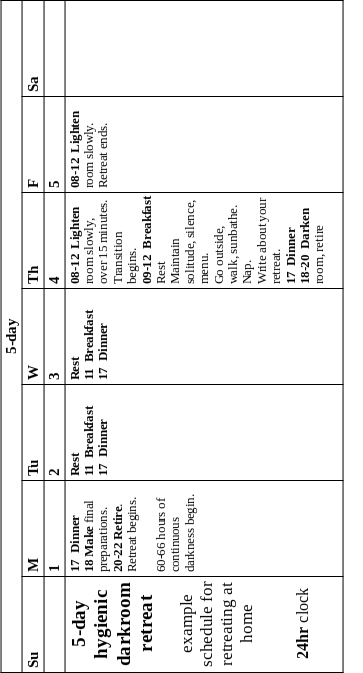
Timing of multi-day retreats is flexible compared to mini-retreats. Plan to turn off lights between 18:00 and 20:00. If something comes up and you are late, it’s ok. But 22:00 is the deadline. If you miss it, start the next evening.
Things come up. Insomnia, anxiety, and addiction screw things up. Darkness is how to begin seriously interrupting these illnesses. Most effects of a short retreat will fade. But you will glimpse the light at the end of the tunnel.
In accordance with the natural diurnal cycle, go into darkness in the evening and come out in the morning. Just stay in extra days in between. This makes the dark part of the 5-day retreat ~2.5 days (~60 hours). Avoid checking the time. Use a cellphone alarm set to a specific day to know when the retreat is over.
Besides sleeping as much as possible, eating, exercise, eliminating, bathing, what does one do in darkness without work, people, or media? One keeps attention -5 in restful places.
Afterward, slowly re-adjust to light. You did not just watch the flickering light of a matinee in a dark cinema. You spent days in total darkness. Sudden exposure to daylight would be a shock. Spend a minimum of 15 minutes gradually relighting the room. Open the door or uncover a window a few millimeters at a time.
CAUTION: I did too many 5-day retreats (13!). It was like getting caught in a whirlpool. I lost too much false capacity -1 before normal capacity could be restored to compensate. Avoid this mistake.
If you do a 5-day retreat, just do one. Then press on with arrangements for a 9-day Czech retreat. This begins with sharing the idea with others. You support their 9-day Czech retreats, probably in your darkroom, till one can support yours. More below about this.
A schedule for 5-day retreats in calendar form is below.
lit
Surprise: in a good dark retreat, some days are sunlit.
Medium and long retreats also have lit days.
transition
It takes time to properly readjust to light and ordinary life. So a period of unstressed transition back to it is just as important as darkness itself. For every three days of darkness, schedule one day of transition with sunlight. Uncover windows and spend time outside during daylight hours. Hand write a report about your retreat. Everything else about the retreat remains the same.
Hormones need time to readjust to light. The sense of balance can also be affected. Retreating has often felt like a chemical process. I have felt sleepiness or coolness flood through my brain or hands. It takes time to reflect on what just happened. One begin integrating the changes, extra energy, and value of the retreat.
Spend transition days quietly, visiting no one. First, slowly uncover at least one window. Take a slow walk or two. Sunbathe or sit in the sun outside without sunglasses. Take a nap inside with windows covered. Uncover them again. Re-cover them by 20:00 and spend the whole night in darkness. Repeat for each transition day.
After your last sleep, slowly uncover the windows. Leave the room by noon at the latest. Take some time leaving. Maybe take another walk or sit in the sun. Have a few words with your supporter, not much.
extra
One becomes more vulnerable during a retreat to shocks and stresses of the world. When in unfamiliar places, the being must be more protected. Extra days before and after a retreat allow for this. There are two kinds: buffer and travel.
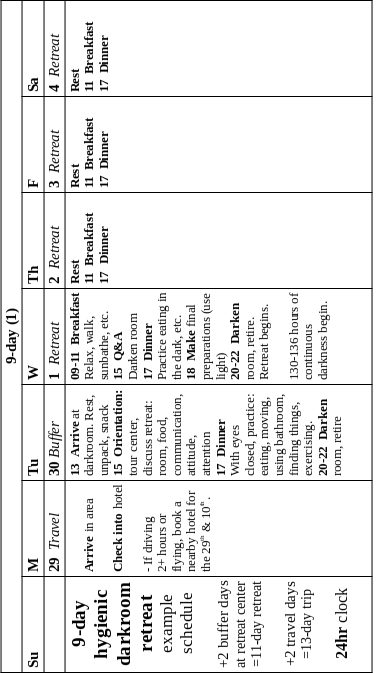
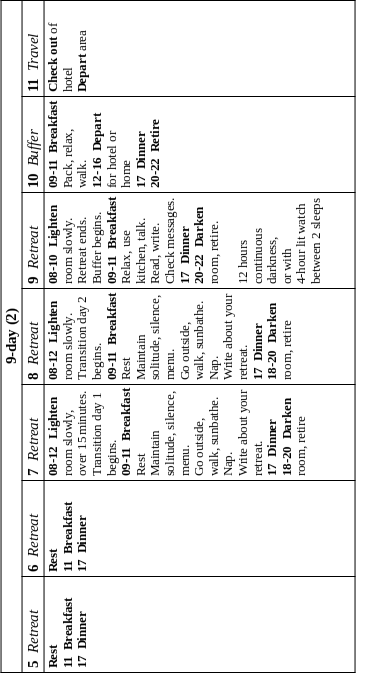
When retreating away from home, add 2 buffer days to your retreat, one before, one after. Thus, a 5-day retreat would require 7 calendar days. Buffer days are taken at the darkroom.
When traveling to a retreat center by plane or more than 2 hours on wheels, add 2 more days for travel, one before, one after. Thus, a 5-day retreat involving such travel would require 9 calendar days. Travel days are taken at a hotel.
Let’s walk through it.
- Travel the first day of your trip. Stay in hotel. Get the plane, traffic, and crowds out of your system.
- The next day—the first buffer day—go to the retreat center. This gives you time to disconnect from the world and get used to the darkroom and staff. To choose furniture, appliances, etc.
- Do your retreat: darkness + transition.
- The buffer day afterward gives you time to reconnect to the world. Talk to people, check messages, review your work schedule, etc. Leave for the hotel. Gear up for the crowds, traffic, and plane again.
- Travel home the next day. The benefits of the retreat, stowed safely in your being, will arrive intact and ready to flower in your daily life.
My Australian collaborator, Marion Abbott, discerned the need for these extra days when planning for her first client. Who loved the luxury of time they imbued her whole trip with.
I love it, too. Extra days seem as important to me for successful retreats at a center as transition days are everywhere. Marion’s insight is an example of the care for life that hygiene inspires. Let us be careful about it and take our time.
After returning home, ease back into your regular life. Avoid non-routine activities the first week. You will likely continue to notice effects from the retreat. Due to their dreamlike intensity, I call this phase the aftermath. See post-retreat -5.
9-day
The organism’s response to darkness is cumulative; the healing process deepens every day. Nine days is more than twice as beneficial as five.
Many of my early clients felt like they were just beginning to get somewhere when their 5-day retreats ended. Some were either very wound up or very rested to begin with. There was not enough time for them to get anywhere, whether with their exhaustion or deeper issues. So I upgraded my darkroom to handle 9-day retreats for first-timers.
Sure enough, they did fine. They expressed greater satisfaction with their retreats than 5-day retreaters. A first retreat of 9 days ensures a breakthrough of some kind is made.
In rare, highly crystallized personalities, a noticeable breakthrough may require a medium retreat. Healing must deepen sufficiently for strong defenses to dissolve. But 9-day retreats have great potential to support recovery of the lost self in nearly everyone.
The over-loss of false capacity is avoided in a 9-day retreat. Two 48-hour cycles allow a cause of one’s suffering to permanently heal. One will gain noticeable measures of energy and personal stability.
In terms of the 48-hour cycle, the 9-day retreat seems to have an extra day. I want to make sure there is enough time for significant healing to occur. If it has by the 5th morning in darkness, a day before the transition is scheduled to begin, then the transition can begin then. If not, keep to the schedule. Two transition days are required in either case.
If you have built your own darkroom, do a 9-day retreat once a friend has done a 5-day or 9-day retreat and can support you. If retreating at an established darkroom, you can begin retreating with a 9-day retreat.
A [schedule for 9-day retreats in calendar form is further below.
standard
A standard 9-day retreat has all the conditions of a 5-day retreat, plus:
- a second 48-hour cycle
- a second transition day
- a separate building for the darkroom
- the support team has three people. They have all retreated and read this book. Two are onsite all the time. One runs errands and stays nearby, on call. This creates psychic shielding for the retreater.
- a fully functional bathing facility to support emotional as well as physical cleansing. For remote locations, see my design for a portable indoor shower -11.
These conditions enable the retreater to relax and heal as deeply as possible for this length of retreat. Imagine sanctuary: its silence and peace. Life will have everything it needs to finally tend its wounds.
Conditions have proven difficult to provide. How do we get there? Czechs have given us the missing rung of a ladder -4 to climb to this height.
Czech
I lived awhile in Czech Republic in 2019. I visited several dark retreat centers.
A typical Czech retreat lasts from Friday to Friday, 7 nights, 6 days of continuous darkness. Retreaters are advised to return home for the weekend and relax as a kind of transition. The room is cleaned. Another retreater begins the same day.
This fits the schedule and budget of most Czech retreaters. And it keeps operators in business. It is not a country rich in money. Czechs are resourceful and economical.
Czechs are highly intelligent, with a rich culture. But for hundreds of years, they lived under the boots of foreign powers. To protect their souls, they developed rich inner lives.
Darkness came naturally to Czechs. Within 15 years of the Soviet collapse, Czech Republic became the dark retreat capital of the world. Now it has 30 centers with 70 rooms for a population of only 10 million. Per capita, this is 200x more than America.
Some darkrooms are simple detached cabins. Some share walls with other darkrooms in the home of the operator. Often, only one supporter serves multiple retreaters. Sometimes, it works. But sometimes, noise, poor air quality, and stressed supporters compromise retreats.
A hygienic Czech retreat has:
- nearly as much continuous darkness (6 nights, 5 days)
- the same total amount of darkness (8 nights, 10 with buffer days)
- time to absorb the benefits (2 transition and 2 buffer days)
- a single qualified supporter (who has done a 5- or 9-day retreat and understood my book)
- one building for both retreater and supporter
- with sonic isolation between darkroom and supporter quarters
- kitchen and bathroom can be used by supporter
- lower expectations for results than in a standard retreat
- a quiet, well-ventilated darkroom of superior design
- hygienic (frugivorous) food
- better prepared retreaters
The typical 7-day retreat of the Czechs may be why they avoid the injury of over-loss of false capacity despite deficiencies in their operations. Their wisdom in this can safeguard us, too, until we can organize standard 9-day and medium retreats.
Problems: Supplies might run out. The supporter might get tired or need to go out. Here are solutions:
- planning: think of contingencies. Buy extra stuff: food, spare heater, fan. Whatever might break or run out.
- help:
- a friend, assistant, or a grocery delivery service
- a substitute supporter relieves the main supporter for a night halfway through the retreat’s dark period
- telephone: supporter goes shopping with a phone, telling retreater. Retreater has a darkened programmed phone to call with. 3 hours max. This can happen once halfway through and on buffer and transition days. This is a last resort.
- breaks: supporter gets long breaks between supporting retreats, 1-2 weeks
Don’t push things. Err conservatively. Build in surpluses and redundancies wherever possible. The retreater needs someone around for minimal psychic shielding, as with the standard retreat. The supporter needs care, too.
schedule
Here are schedules in calendar form for:
- 2-day mini-retreat
- 5-day retreat
- 9-day retreat
Or read them in linear form.
ladder
For a long time, I was stuck in the course of retreats I had envisioned. It was like a ladder made for 3m high giants. And it had a missing rung between 5-day and 9-day standard retreats. It was too far to get a leg up. And I could not stay with 5-day retreats and suffer more over-loss of false capacity -1.
The Czech retreat -4 is the missing rung. Now the ladder is complete:
- read my book
- darken your room for sleep
- upgrade it for a 5-day retreat
- do one
- improve your life (after every retreat)
- upgrade room for 9-day Czech retreats
- support them for others, training some of them as supporters
- have one of them support a Czech retreat for you
- build a darkroom in a separate building
- do and support 9-day standard retreats
- build portable hygienic houses
- move to a better location with them
- do and support medium retreats
- do and support long retreats
medium
A medium retreat lasts 3–8 weeks (including ~25% transition days). This length of a retreat will enable the organism to heal the root causes of one’s psychic suffering. Some problems will vanish, others may remain. But one will finally be able to solve them. With so much time at rest, the organism can restore its primary system. One will finally have the capacity to put things right again.
Minimize internal obstacles: get away from all accustomed influences and associations. Now that you know what you’re doing in darkness, it’s worth paying extra for this. Take a trip at least a couple hours away. Fly to a darkroom on another continent if necessary. Or rent a fully functioning small house in an unpolluted place and darken it yourself, arranging for maintenance and support with experienced fellow retreaters.
The darkroom needn’t be fancy, only function in every way without fail or compromise. One of the supporters must be handy enough to keep it that way. There’s nothing like mechanical issues to ruin a retreat.
Two of three supporters should be available all the time to make sure you have food, basic comforts, and someone to talk to for a few minutes when necessary. By the time you decide to do it, you will know you are doing one of the most important things in your entire life. Prepare accordingly.
The benefits of short retreats are impressive but still limited. Doing many of them does not equal doing a few long ones. The law of diminishing returns combines with the frustration of glimpsed but unrealized potential. Boldly escalate from a couple short retreats to a medium one.
I did a long series of 4-5-day retreats. My next retreat will be 9 days. I aim for 21 days (including transition days). In 2008, in my second successful retreat, I had a vision: in 2 weeks of darkness I will heal from my psychic trauma at the core. This will enable me to put the rest of my life back together afterward. With 5 transition days, this will make for a 21-day retreat.
I do not know exactly how long others would have to retreat to reach the same point. I assume others will have similar visions in their short retreats of how long their medium retreats must be. Thus the time range of 3-8 weeks.
One of my clients has been considering this for awhile. In his early experiments with darkness, he sensed that he would need 3 weeks of darkness (plus a week of transition days). I believe people come to know precisely what they need the more they get of it.
long
A long retreat lasts 3-12 months. I have heard reports of retreats like this. They had results we would consider miraculous. But they are within man’s potential. The organism made itself to begin with. Under good conditions, it is able to remake itself, perhaps better than new.
Stories persist of astonishing physical healing occurring in Ayurvedic dark retreats lasting 3-12 months: growing new teeth; recovering lost hair and eyesight, even youth itself. It is worth looking into.
The hygienic protocol for long retreats is yet to be determined. Short retreats give us clues about medium ones. Medium retreats will give us clues about long ones. Reports from other traditions are useful.
For example, in the above story, the yogi exposed himself to a tiny amount of light. His assistants would leave the darkroom door cracked when they brought him food before sunrise, after first light. Is this a good idea? Let’s find out.
He attributed his miraculous recovery, not to his practices in darkness nor the ayurvedic herbs he took, but to Lord Krishna. Krishna is an incarnation of Vishnu, the preserver. He is a projection of the self-preserving power of life.
Jesus the Christ is called the author of life. The Christ principle is in all living things. Jesus modeled it. His complete identification with the Christ naturally resulted in miracles.
He said all who believe in Him, the Christ, would do all he did and more. For he would go to the Father, something even greater that we cannot yet behold.
One needn’t be a Hindu or Christian to appreciate the vivifying principle in these ideas—and in every organism. The principle means you and I are enough. We have within ourselves the living power we need to recover ourselves. We need only provide it the proper conditions.
This much we can do.
There are five harmful and dangerous ways to retreat in darkness. I learned about them the hard way and am paying the price to this day. The only possible point of my enduring them was so I could warn you. These are little gateways to hell. I sincerely wish you to heed my words and to avoid such suffering.
Fortunately, avoiding them is easy once you know. In the list, each is linked to longer discussions of them elsewhere in the book. Just say no to:
- mini-retreating even one second behind schedule. See retreat > mini section above.
- retreating without transition days. See 5-day retreat above and post-retreat -5.
- doing more than one 5-day retreat rather than advancing to 9-day, medium, and long retreats. This is a serious no-no, folks. See 5-day retreat above and false capacity -1. The matter cannot be overstated.
- sub-standard darkrooms. We become vulnerable in darkness. We are fools to tolerate the irritations and compromised retreats due to poor design and construction: noise, low air-quality, toxic materials, discomfort, cold drafts, etc. See chapters 7-11 for how to build or judge a darkroom suitable for hygienic retreats. Precious few people operate them. It’s time to get serious and build world-class darkrooms.
- poor support:
- insufficient support
- inexperienced, ignorant, or indifferent support
- other people who are around who are hostile to you or to retreating itself. Say no to abusive relationships of all kinds.
- I said five. But now I’m going to talk sternly.
By ignoring my instructions and warnings, maybe you can discover more ways to get hurt in darkness. But as my late legal counsel, DeWaynn Rogers, would ask, What is the penalty for following instructions?
In the future, we will have more data. We will have studied, applied, and reflected upon all this enough to see better ways. I will update my writings to reflect them, just as I have for 15 years.
Until then, stick to the tried and true. Err conservatively. Be reckless about some other part of your life. The most amazing thing you ever do is bound to have rough edges if handled incorrectly. Don’t pet pigs backwards, either.
Ok, now you know how to keep yourself safe in darkness. Back to the many wonders of hygienic dark retreating.
future
I aim for the simplest way to restore health fully. Broken bones can heal perfectly. So can we, and in every aspect. To this end, I would like to see hygienic retreat centers worldwide with facilities and support for:
- short, medium, and long dark retreats
- fasts (a la Albert Mosseri’s groundbreaking method)
- physical retraining
- training in healthy lifeway, including both lifestyle and livelihood
- open-source research and development of the above
- a village residence for staff, family, friends, and guests, where all this gets applied and tested in real life
In 4–5 visits over 2-3 years, one would be:
- restored to full function and vitality
- able maintain it in daily life
- healed of all trauma, poisoning, and exhaustion of the past
For a few years, I focused on designing and building public darkrooms. Then came a few more years of making private darkrooms at home. As a consultant, I am also available to help:
- operators of retreat centers who would like to switch to the hygienic approach
- developers of hygienic retreat centers described above
If you support hygienic dark retreating, I will refer clients to you. Write me.
~/~
It may take a few generations of healthy living to fully restore our health and realize man’s potential. I believe we can get most of the way back in our lifetimes.
We have examined different formats of the restful use of darkness for different circumstances and purposes. Let’s look ahead to more of what happens in a retreat and exactly how to conduct it.
9 air
The tricky part of making a darkroom is not darkening it but ventilating it. After all, now its windows and doors are sealed. So we’ll address ventilation first.
Silencing a room is even trickier. But we have a couple aces up our sleeve for that.
We need to understand how ventilation works so we can design a good system. Ventilation affects both the silence and temperature of a darkroom. We will examine each of these conditions, then see how they work together in a mechanical system. Then we will make the components of the system.
Numerals with - x + are in millimeters (see metric -8).
ventilation
This section is on ventilation in general. I will give design constraints and describe various systems. But first, I will address its physiological importance.
breathe
Nature gives us a constant, abundant supply of fresh air. So must our buildings.
I have observed a shocking number of people who seem oblivious to their own needs for fresh air. Everyone knows we die within minutes without air. Yet the importance of a continuous fresh supply of it has escaped many.
I can only attribute this negligence to mass psychosis. It is my stock explanation for the appalling features of civilized life. The need for fresh air is one of the most basic, most obvious facts of life. At the risk of insulting your intelligence, I am bound to address it.
Fresh air is always important. It is a normal condition of life. Along with warmth and safety, it is one of our most urgent necessities. Every second of our lives, quintillions of organic processes occur. Virtually all of them require oxygen. It is the most important nutrient we consume. We can live without food for weeks, and without water for days. But without air, we are gone in minutes.
Just like food, air becomes a part of one’s organism. It affects quality of life to a very great degree. It seems like nothing. But the amount of air you breathe masses twice as much as the food you eat. In a darkroom, you have little to do besides breathe. If you haven’t paid attention to air quality, you will notice it in darkness.
Even if you don’t, poor air quality cancels most benefits of a retreat. Intermittently airing the room out does not work. I mean opening the door a couple times a day with eyes covered. Put this approach out of your mind. This is darkness, not the dark ages. Whatever it takes, no matter where you are or what you are doing, always provide yourself with continuous fresh air.
For a dark retreat, this means either:
- following the instructions below
- hiring an HVAC contractor to clean, repair, replace, or install ventilation in your home
- moving somewhere the ventilation system just works (like the tropics or a new house in northern Europe)
- using houseplants: high oxygen producers and air-purifiers
- or a combination of these
Somehow, it must be done. Forget darkness a moment. We rarely have a more urgent concern in life than arranging to breathe fresh air continuously and comfortably. Keeping it foremost in your thinking about darkroom design and construction will help ensure a successful retreat.
Not freezing to death and avoiding danger are more urgent than continuous fresh air. Building systems can meet all these needs harmoniously. Unaddressed fear and ignorance result in design conflicts between them. For example, we still often depend on windows for ventilation instead of a proper, separate system. The rest of this chapter will help you avoid such errors.
constraints
- system provides plenty of fresh air
- absolutely lightproof
- silent: absolutely no hum or harmonics from fan and exterior noises mostly extinguished
- comfortable temperature: no undesired cold drafts
- economical: ie, no wasted heat to the outdoors. This is more involved and a lower priority than retreating itself, so don’t get stuck on it. It requires a heat recovery ventilator (HRV). Besides significantly lowering heating costs, an HRV improves air quality and comfort in nearly all climates. More about it below.
system
Somehow, fresh air has to get into the darkroom and stale air has to get out, without letting in noise or light.
In the terms of the HVAC industry (Heating, Ventilation, Air Conditioning), the fresh air vent is the supply and the stale air vent is the return.
Sometimes, supply and return vents exist in the same room. This is the fanciest version of balanced mechanical ventilation. If your place has it, thank your lucky stars. Just make sure it runs continuously. Unless your room is huge, intermittent is not good enough.
More commonly, balanced systems put supplies in bedrooms and living rooms, and returns in kitchens and bathrooms. This means air escapes a bedroom around the door. Unless the space outside the door is totally dark, this calls for a threshold lightproof vent (plans below).
Balanced systems are rare. More common are negative pressure systems: bedroom and living room windows act as passive supplies and bathroom and kitchen exhaust fans as active returns. In this case, a lightproof universal vent, built into a window blind, is the supply. Or a silencer if noise surrounds your dwelling. A threshold vent is the return, letting stale air escape the bedroom to the exhaust fan.
Rooms with totally passive ventilation rely on open windows, exterior vents, and infiltration through cracks. These will get sealed against light. Such rooms will need universal vents in blinds at different heights to take advantage of convection. But they probably call for a fan and a silencer, maybe ducting.
By closely observing buildings I have discovered some simple ways to ventilate them. Sometimes rooms have lightproof and sound-dampened holes built into them in unexpected places:
- unused holes for pipes, wires, chimneys, and ventilation.
- behind a cupboard or piece of furniture, or inside a closet
- a removable panel or wide piece of trim that could be temporarily replaced with a panel with a hole in it.
Once, a new door exactly the same size as my darkroom’s door caught my eye. It was in the garbage at a building supply store because of cosmetic damage. We were buying other materials, so they let us take it. I stored the original door and cut supply and return holes in the salvaged door for ventilation.
Another darkroom had no ventilation or suitable holes anywhere. But it also had no door. So we built a frame inside the doorway with a narrow door on one side and a narrower panel on the other. We cut holes in the panel for ventilation ducts. We fixed the frame in the existing doorway with metal straps screwed into old hinge holes. When dismantling the darkroom, we left no trace.
Similarly, we hung 7m of ducting that ran through three rooms; attached a silencer to it; made three window panels; and covered five more windows in the building on the way to the bathroom—all with only one new screw hole in the entire rented house. And that hole was invisible behind a loose piece of trim. “Leave no trace” is a fun game that often improves design.
Sewage pipes drain downward but are ventilated upward. Once, friends and I replaced a flush toilet with a composting toilet. The exposed drain pipe, being oversize and in a single-story house, wasn’t subject to backflow. So it proved a perfect exhaust duct for a case fan at floor level. Imagination conquers all obstacles (and renews itself in darkness).
Separate ventilation from windows whenever possible. Give it its own holes in walls. This improves many attributes of a shelter: security, economy, comfort, silence, darkenability, and overall control.
vent
Here are further design constraints, photos, plans, and instructions for making and installing lightproof vents.
constraints
(universal / uv-short specifications in parentheses)
{threshold vent specifications in curly braces}
- durable (protected by cardboard shell){protected by wood reinforcement, subject to damage by kicking but easily rebuilt, could be made of sheet metal or shielded with cardboard or thin wooden boards}
- thin enough to fit between blind and window (<84-) or door and threshold {adjustable}
- cross-sectional area >78cm2 (85cm2){60–120cm2} to equal standard 100- diameter ducting
- fully blocks light, sending light around at least 5 corners (6 corners / 4 corners + enclosure’s corners){2–6 fabric-covered corners}
- short airway (465- / 312-){370-}
- minimal size (220 x 290 x 77 / 140 x 281 x 67){fits under door, sticks out 20- each side and up 60-}
- easy to make (medium){medium}
- elegant (yes: simple compact form, uses common materials){yes: adapts to nearly all swinging doors}
- cheap ($4 in materials, 2-hour assembly time){$2 in materials, 1-hour assembly time}
universal
The universal vent works nearly anywhere. It attaches by its face or side to a slot in any material. It can be made of cardboard or wood. Its principle adapts to any size. Walls and baffles can be thinner or thicker. It can be shortened for enclosure, eg, inside a silencer. All its rigid parts are rectangles, easily cut with a knife or table saw. It works for supply or return air.
The old helix vent is in the zip file. It requires no painting or sealing and less cutting and gluing. It is more intricate in its measurements, markings, cuts, and folds.
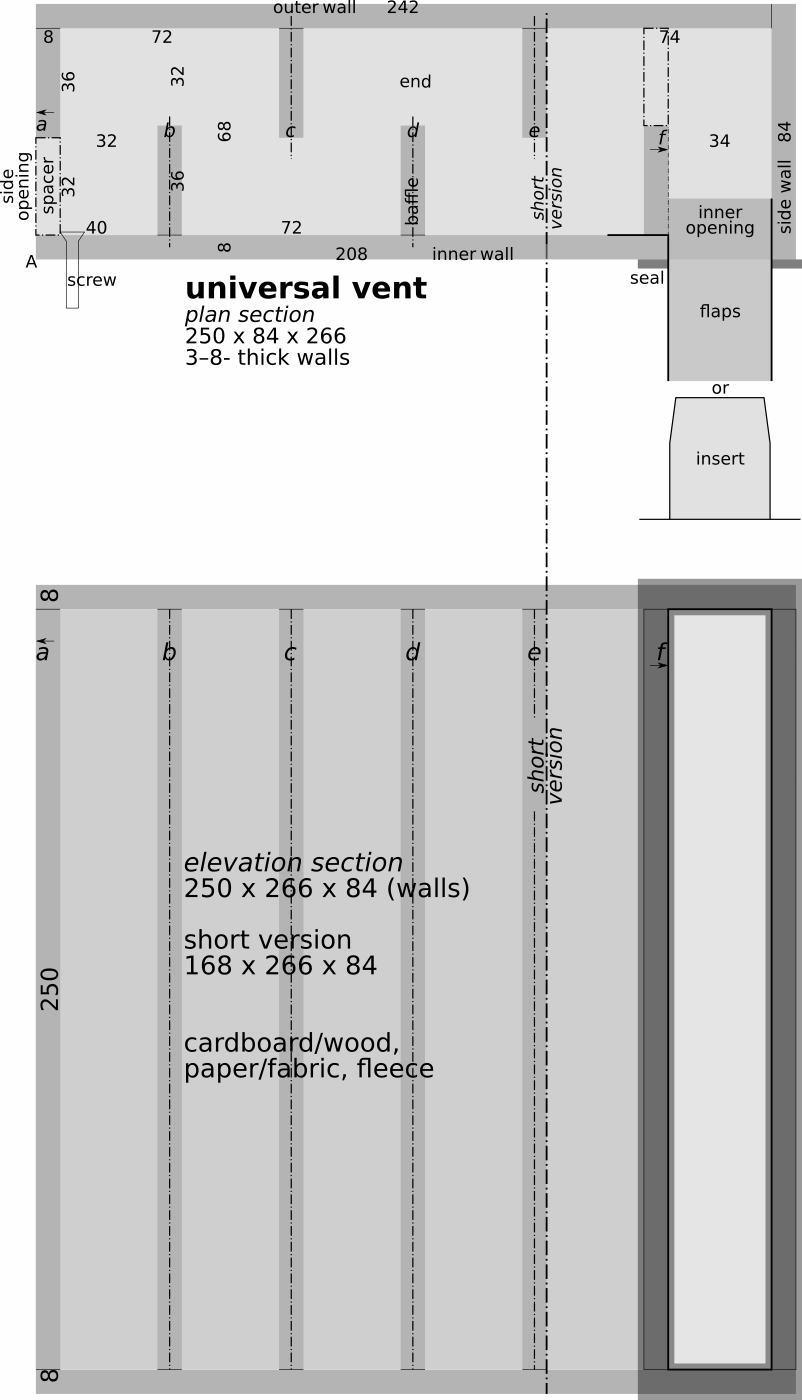
plan: universal vent - download
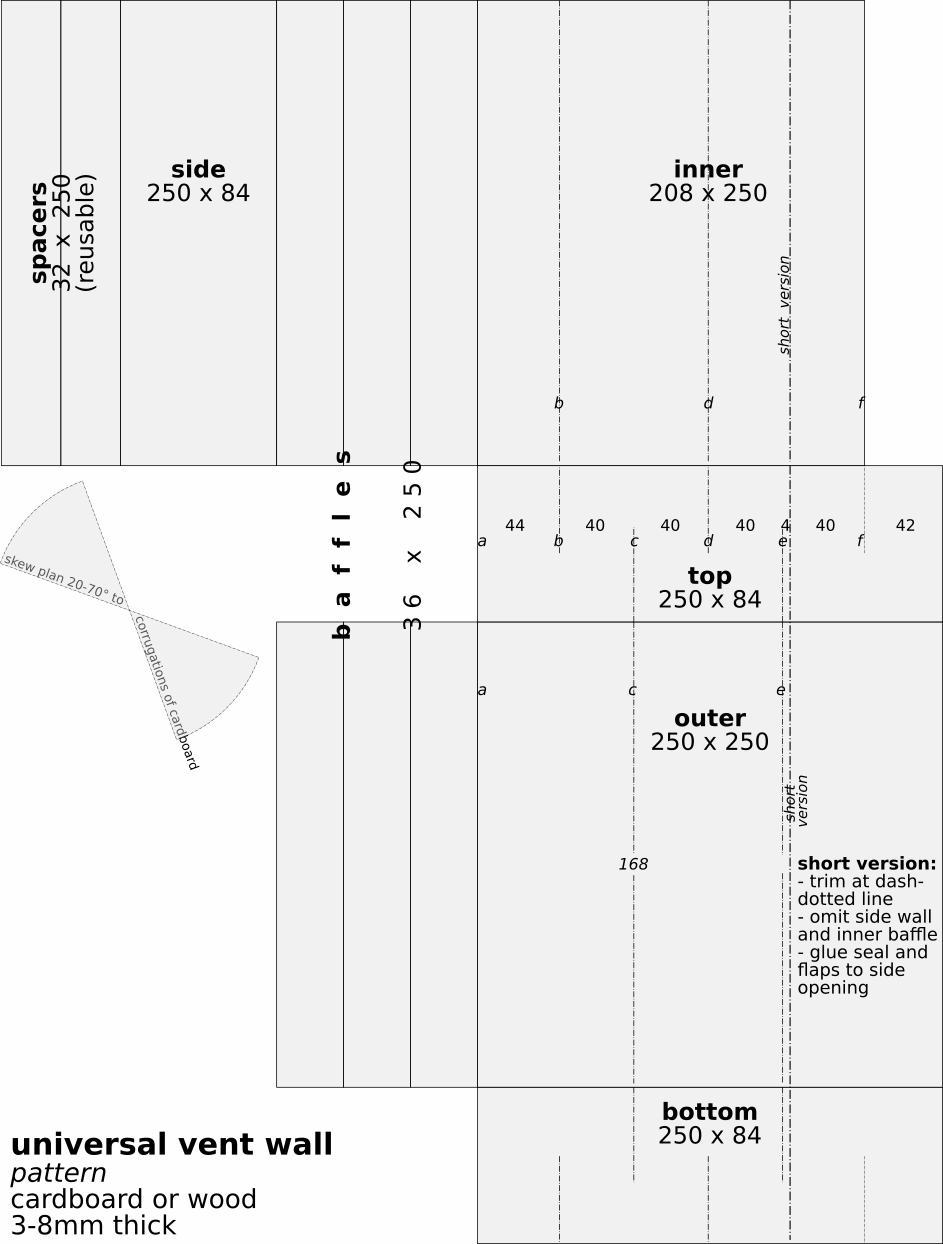
plan: universal vent, walls - download
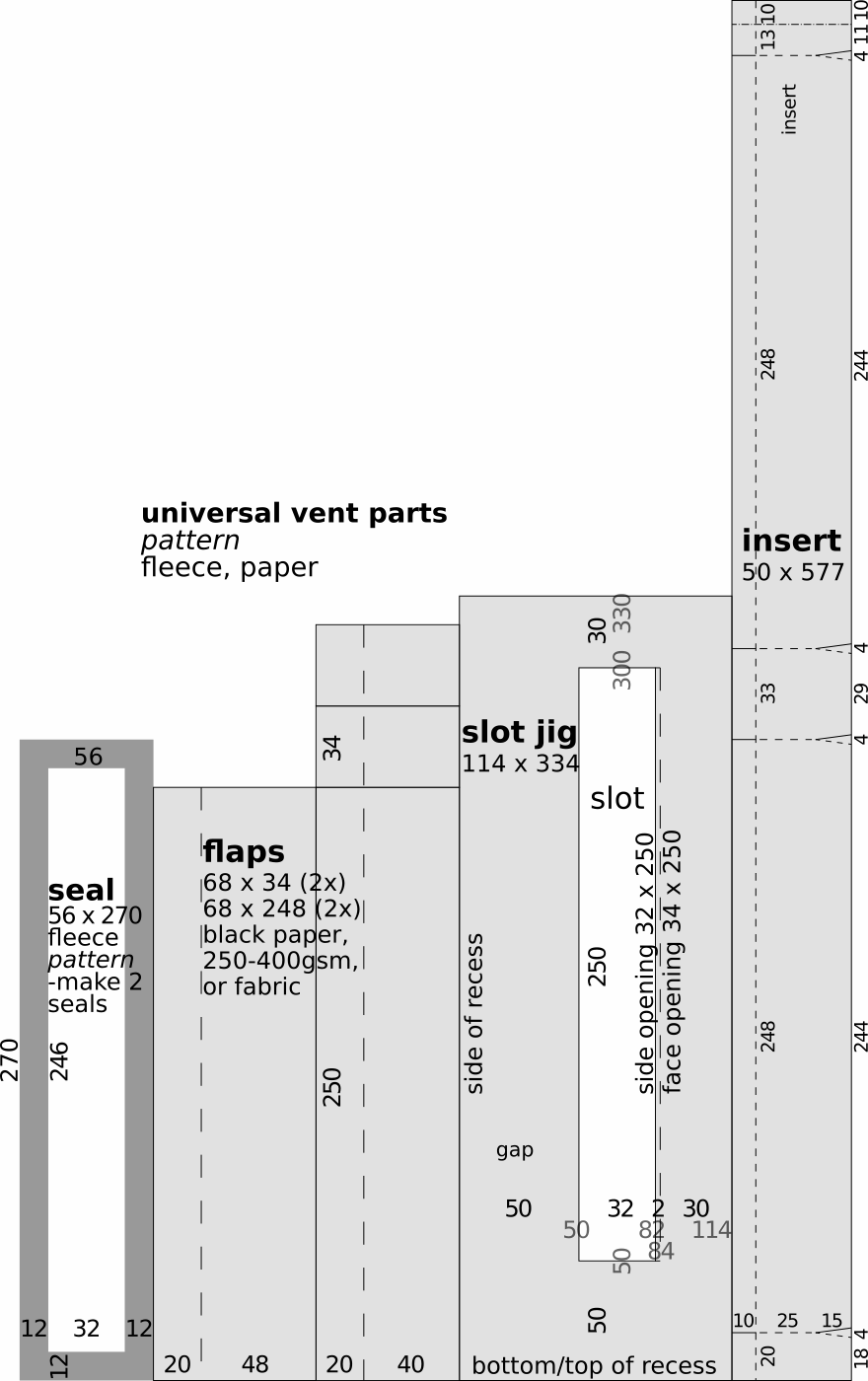
plan: universal vent, parts - download
The universal vent can go anywhere: a blind, a door, a wall, etc. Flaps and seal attach to either opening. They poke through a slot and get taped or glued down. Mostly it attaches to a blind with the face opening.
- blind: attach it to a blind and slightly open the window behind it.
- door: cut slot in it and use universal vent instead of a threshold vent.
- existing vent in a wall: cut a hole in a cardboard box the same size as existing vent hole. Cut a slot on the opposite side of the box for a universal vent. Attach universal vent to box and box to wall over existing vent.
- enclosure (like silencer): use shortened version inside or out. It has fewer light-stopping corners because enclosure already has two or more. Attaches at side wall. See note in drawing and dash-dotted lines and measurements.
If your darkroom’s ventilation is passive, put vents both low and high in room to enable convection. This works better the greater the inside and outside temperature difference; the greater the vertical distance between vents; and the more vents.
For manufacturing: a set of simple wooden or sheet metal templates and jigs, maybe a table saw with a sled, can speed production tremendously while keeping equipment and investment to a minimum. Start in your garage.
Read through instructions once while studying plans.
prep
- materials:
- walls, 3–8- thick
- cardboard: double-layer is stable if kept dry and out of direct sun and intense heat.
- wood: thin tongue and groove boards, masonite, exterior plywood aged 3+ months, or marine plywood. Avoid interior plywood. Its especially toxic glue outgasses a long time.
- flaps: black acid-free posterboard/cardstock/coverstock, 250–400gsm or thin tightly woven fabric like poplin or twill
- seal: black polar fleece, medium weight. Quality check: a 10-layer stack should measure 30–35- high.
- tricot or no-see-um netting
- glue: school and wood
- acrylic paint, matte black. Or glue black paper to one side of cardboard and both sides of baffles. Do one or the other before cutting walls and baffles.
- walls, 3–8- thick
- follow instructions in fabricate -8
- determine exact vent location
- in blind, panel, or silencer
- whether it will attach at side or face opening
- vent must clear window handles, locks, and frame
- if used with a double blind, shade hole in insert from direct sunlight
- the plan adapts to wall material between 3–8- thick. Just move walls and baffles toward point A to accommodate it. Use these rules:
- keep inner wall flush with inner and left edges of end
- keep baffle a flush with left edge of end
- move outer wall inward
- keep inner and outer walls 68- apart (with spacers)
- keep baffle f flush with right edge of inner wall (thin dash-dotted line)
- keep baffles b, c, d, e centered on dash-dotted lines, shifting them downward (in short version, keep e flush with right edge of end and outer wall)
- keep side wall against outer wall
assemble
- seal: glue 2 seals together with minimum of school glue: a skinny bead around outer perimeter, with a little extra at the corners.
- inner half
- inner wall
- top end
- long folded flap, 1 short flap
- baffles b, d, f
- side wall
- 2 spacers. Attach a piece of tape around an edge so you can pull them out from the openings once vent is dry. Use only 2 dots of glue on each spacer for removability, just enough to hold them in place as you fit the halves together.
- outer half
- outer wall
- baffles a, c, e
- seal inside corners with black acrylic paint, fabric, or paper
- glue halves together
- inner half
- outer half
- bottom end
- add
- 3 other flaps
- seal
- Let it dry. Until installation, keep it in a dust-proof bag.
install
- mark slot with slot jig
- it spaces slot correctly on most blinds and panels. It can be further from corner but only 20- closer on panels.
- face opening, 35 x 248, on blinds, panels, or outside silencer, with shell
- side opening, 32 x 248, inside silencer or other enclosure, without shell
- cut out slot
- position vent over slot and fit vent flaps through it
- when attaching to soft material like fabric, plastic sheeting, or cardboard, pull long flap snug, use back of table knife tip to crease the outside of it right where it passes through slot
- fold flap at crease and tape it down. Tape makes vent removable. Only glue it in place if you are certain of not moving it for years.
- repeat with other long flap, then with short flaps
- secure side opening with screws. Screw through inner wall into panel or blocks. Or screw from other side into inner wall. If blind material is soft (plastic, fabric, paper, cardboard), use fender washers.
- vent must be shaded to minimize fading of black paper and warping. Usually, insert of double-blind or white material over window will do this. Otherwise, cover shell with white paper. If in direct sun, shade it somehow.
shorten
Shorten the vent for use inside a silencer or other enclosure. The enclosure must have two or more blackened corners that light must go around. Follow instructions in wall drawing. Note dash-dotted lines in plan and elevation views.
The short version is 168 x 266 x 84. If an even smaller vent is required:
- use thinner cardboard, 2–4-
- slide baffles leftward, maintaining 32- and 34- spacing
- trim protruding walls
- or shrink the design proportionally
- or use old helix-z vent (140 x 281 x 68 in the body), in zip file
With thought and experiment, every engineering problem can be solved. This is the awesome and terrifying power of technique: of physics and engineering. Let us use it to our advantage, for the purpose of coming back to life.
threshold
A bedroom door often has a gap under it, at the threshold, for ventilation. A threshold vent uses this gap to let air through but not light. The design adapts to door width, door thickness, and gap under the door. It also adapts to how much light is outside the door.
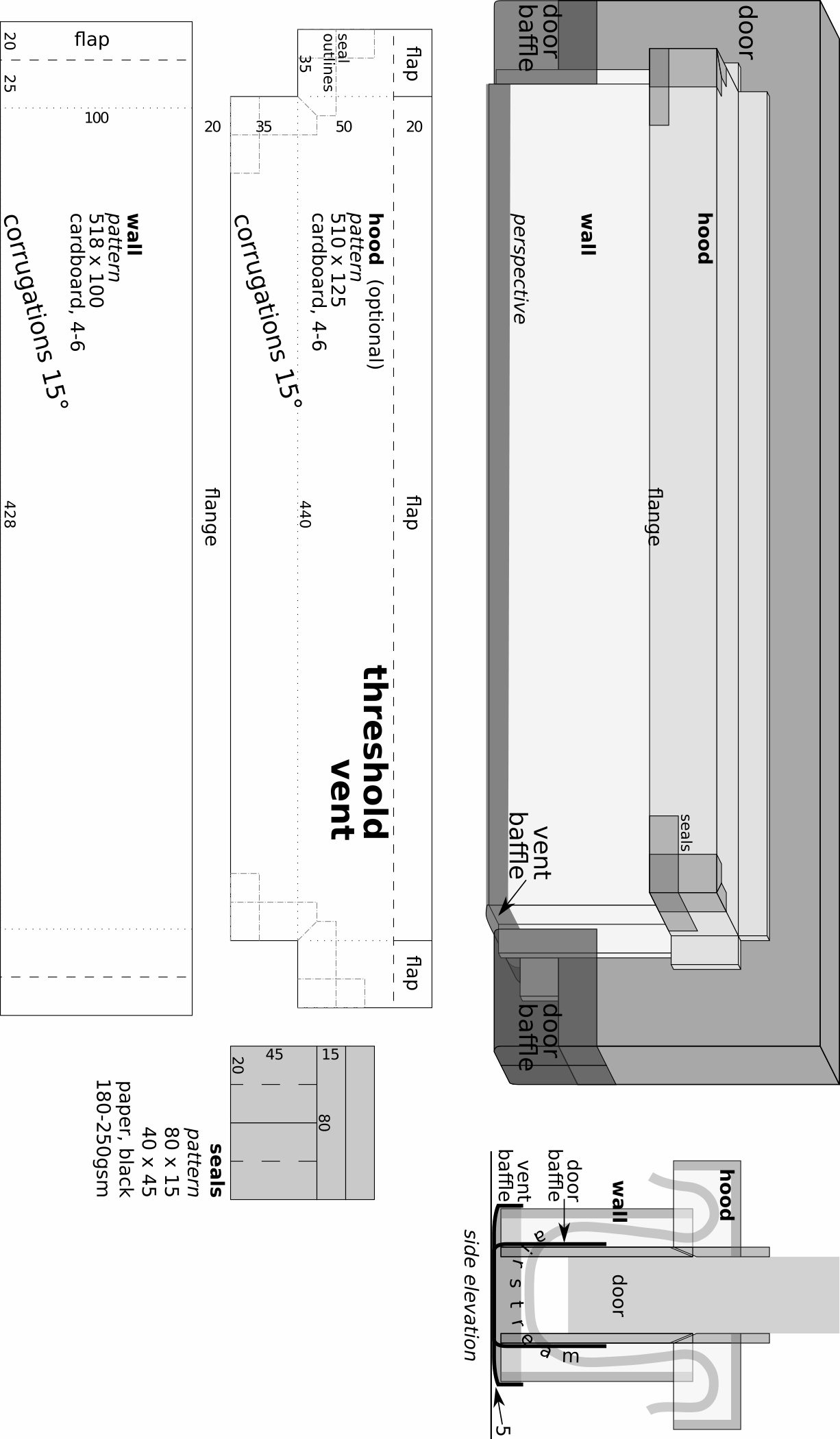
plan: threshold vent - download
If gap is greater than 40-, add wood to bottom of door; build up threshold with boards; or modify the design. If less than 13-, use black paper for the vent baffle instead of fleece, along with black paper over the threshold. If less than 6-, trim the bottom of the door or find another way to ventilate the room.
If the light outside the door is dim, just the vent walls are enough. If bright, use one or two hoods as well. You can add them later after testing.
Usually, you need to darken the area outside your door anyway. Either you need a path to a bathroom. Or your supporter needs to get in without lighting up your room. Cover windows in the hallway. Make a curtain across the hallway with a dark blanket fixed to the walls and ceiling with tape or tacks.
Or make a removable partition. It’s a wooden frame filled with black plastic sheeting. Fleece seals the frame. Ducting or universal vents can penetrate the sheeting. A little wider than the hallway, it wedges in place at a slight angle.
fabricate
- materials
- cardboard, double-wall, 4–6- thick (400 x 600 x 130 flat produce boxes are perfect)
- fleece, black, 200 x 1000
- muslin, black, 500 x 700
- cardstock (posterboard), black, acid-free, 180–300gsm, 550 x 700 for seals, maybe threshold.
- double-sided clear plastic tape or adhesive
- double-sided foam mounting tape or 3M Command strips
- prepare pattern with instructions in fabricate -8
- cardboard
- fold at creases a little past 90°
- edges of hood that fold into each other: crush to 45° so that edges of outer facing of cardboard meet
- glue the seals onto hood, long skinny ones first
- cut and glue muslin inside wall and hood pieces, except on flaps
install
- position one vent wall on door so that it is 5- above high point of floor in swing area of door. Tack in place with masking tape. Once it is perfect, mark its position with tape. Duplicate marks on the other side of the door.
- attach muslin over area of door that vent will cover. Width: 420-. Length: from 20- above wall on one side to same height on other, wrapped under the door. Use double-sided tape. Seal with finger nail. If no hood is needed, masking tape works, too. Use wall as guide or remove it and use tape marks. Remove wall afterward.
- vent baffle
- cut piece of fleece 470 x (90 + door thickness)
- glue to bottom of one wall
- glue extra length at sides up the sides of the walls. Cut slit where flaps are.
- attach vent walls to door at marks. Use double-sided foam tape or 3M Command strips.
- glue vent baffle to bottom of other wall
- measure and cut door baffles wide enough to seal door where there is no vent. Add 10 + half the door thickness. Length = (46 + door thickness). Attach them to door 20- above bottom of door. Use masking tape.
- if light leaks under the door, cover the threshold with black paper or fabric
- if there’s a danger of kicking it in, glue pieces of wood, 10 x 428 x 38, to the bottom of the walls. Screw them in from the inside with 3 x 15 screws and fender washers.
soundproofing
principles
At some point, noise defeats a retreat. One must attenuate it somehow, even in remote locations.
Shelter is the normal -7 means of controlling exposure to pollution. Pollution includes noise.
Outside, noise comes from machines, traffic—including boats, trains, and airplanes—construction, music, fireworks, and talking and playing people. Inside, it comes from machines—refrigerators, fans, water pipes and pumps), people in adjoining spaces, and their music.
The four principles of soundproofing are:
- mass: use heavy materials absorb low-frequency (bass) sounds
- absorption: use fine fibers absorb high frequencies and prevent echoing
- dampening: use rubbery material dampens vibration in resonant materials like metal, wood, masonry, glass
- decoupling: disconnect structures and airspaces to prevent transmission of sound vibration between them
Soundproofing tutorials abound online.
These principles apply to ventilation as well. Dampening and decoupling figure in the fan mount; mass and absorption, in the silencer. The silencer absorbs most noise, including the fan’s.
Fans make noise directly and indirectly. Small fans have little hum to start with, but they run at high speed, so they develop harmonics. Bigger fans start with more of a hum but they run more slowly for the same air output, so they develop less noise overall. Use fan mount to avoid amplifying these vibrations.
Even the quietest fan makes noise because of the friction of air itself against the fan blades, housing, ducting, and vents. Because of air friction, fully silencing a ventilation system requires a silencer of some type at the room-ends of ducts.
silencer
A silencer is an larger duct section lined with insulation. Its greater volume depressurizes the airstream. This transforms low-frequency sound into into high-frequency sound. High-frequencies vibrate the fine fibers lining the silencer, transforming the sound into heat. Genius!
You can make or buy silencers.
- my double-turn box design is below, $2-$10 depending on your material salvaging skills.
- DIY straight tube
- for sound booths. With dark insulation and enough bends, this eliminates the need for a lightproof vent.
- manufactured silencers are made of metal and other super durable materials and cost $100–200.
- acoustic ducting, at least 3m of 100- with 2–3 bends
Silencers and acoustic ducting are standard industrial components, making buildings quiet worldwide. Thanks to Richard Nöjd of Skattungbyn, Sweden, for showing me these solutions.
I built silencers into window recesses on two occasions. They were simpler and more effective than I hoped. They swallowed up sound. The window, open at one end, provided one face of the box. The thick wall provided 4 sides. Boards against the inside of security bars formed the box’s outer face, about 20cm from the glass. Shredded fabric insulation lined the box. This technique disables the window as a light source. It is a temporary solution. It works if you have other windows you can uncover during transition days.
The design below is a zig-zag channel through insulation inside a wooden box with a hole at each end. Each hole has 4 possible locations: face, sides, or end. Cut a circle for ducting or fan, a slot for a universal vent. The fan mount adapts to all 4 locations, inside or out.
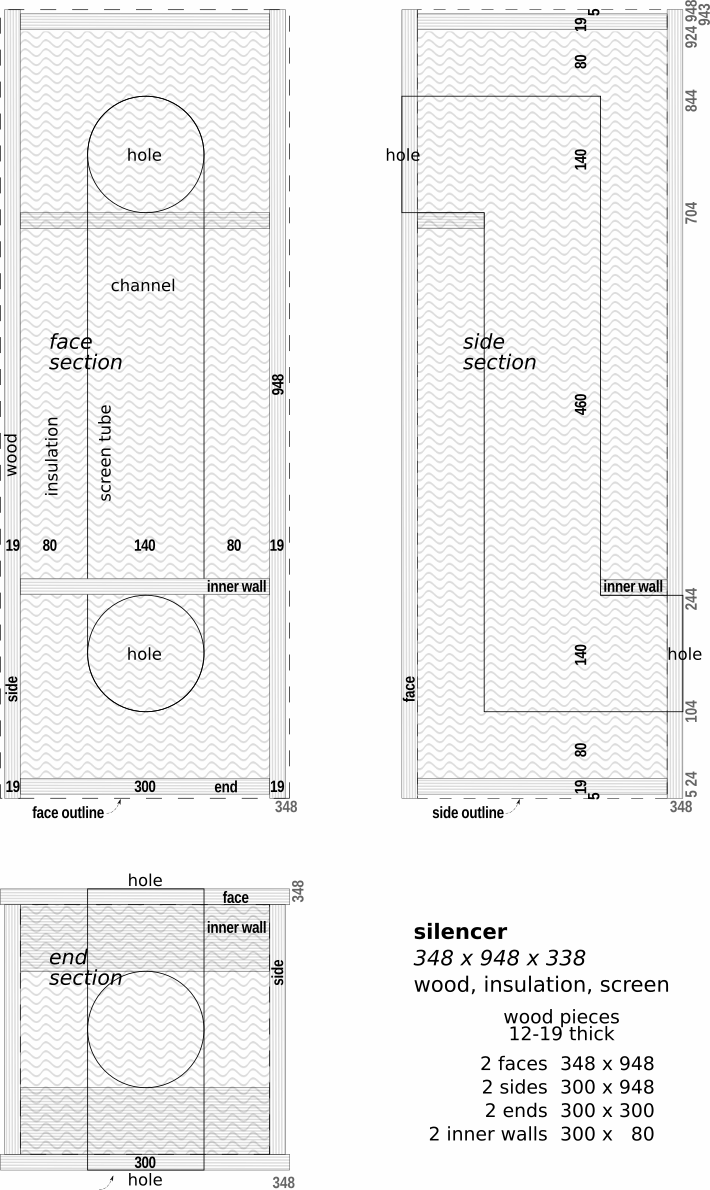
plan: silencer - download
The box is lined with porous non-toxic insulation. clean wool, shredded fabric, wood fiber could all work. Note, the shredded fabric and wood fiber I’ve tried had faint smells that I disliked.
Rockwool works. It is unpleasant to work with, but it is fairly odorless. Polyester pillow filling and quilt batting and acoustic foam work. But I don’t like my air going through plastic.
Fiberglass is terrible to work with and often smells of chemicals. Closed cell foam, like styrofoam, polyisocyanurate boards, camping pads, etc, does not work due to non-porosity.
Discarded furniture is made of melamine, an excellent material for silencer boxes. It is particle board with resin veneer, usually 15- or 19- thick. Marine plywood uses non-toxic glue. Otherwise, avoid plywood or line with foil or mylar.
Use a table saw to cut the 8 pieces so they come out square. Or have a carpenter do it for you, including the holes. Just take the drawing with you, modified for your needs. The carpenter probably has some extra melamine laying around to sell you cheap. To screw pieces together, first drill pilot holes so edges don’t break. I always drill pilot holes in wood less than 30- wide for this reason.
To insulate, make round tubes of plastic screen. Cover with porous fabric if insulation is fine, like cellulose. Stuff insulation around it and close the box. Roughen the plastic surface first with sandpaper so the glue sticks.
hum
People all over the world have reported hearing a strange hum. Its source is rarely found. In Europe, I heard it in many places.
The hum is a low-frequency sound and vibration that comes through the air and ground. My first explanation was that all the machines we use combined generate this hum. This includes cars, trains, airplanes, factories, ventilation (ironically), underground pumps (whose sound carries far), farm machinery, etc.
Most people can’t hear it. I talked to a famous musician in Australia. She knew people worldwide who had heard it. She said it tends to occur in people who feel their internal conflict and disconnection acutely but cannot resolve or repair it yet. They still project responsibility for their suffering on the world at large. It’s not all in one’s head, but one is too vulnerable due to an error in attitude.
I had started to suspect something like this. She already had it nailed.
In Czech Republic, I visited a large music recording studio in the middle of Brno on a busy street. It was 8m x 14m inside with a 4m ceiling. The engineer let me lie on the floor in the dark for 10 minutes. I don’t recall if I was hearing the hum at that time. Their building technique was extremely effective in stopping the deafening noise outside.
They called it “house-in-house”. In America, “room within a room”. My brother had mentioned building a few music studios like this. The walls and ceilings of each structure don’t touch. The inner room’s floor “floats” on vibration-dampening springs or rubber blocks.
Then I visited an anechoic chamber at the Petrof Piano Factory in Hradec Kralove. It was extreme soundproofing! It was a 6m concrete cube, resting on leaf springs inside another building, with a 1m gap between the two.
To enter, I stepped over a gap, as in a subway, through a 120cm thick door. Foam cones 1m long protruded from the ceiling, walls, door, and floor. Suspended in the middle was a steel grill platform for a piano and engineer. With no measurable noise or echo inside, they could test a piano’s sound with extreme precision.
You have probably heard of these rooms. People claim to start going crazy in them. That is hype. The silence was heavenly. I could have stayed in there for a month.
The engineer was kind enough to give me 10 minutes. Sigh.
Anyway, the house-in-house technique is practical for silencing bedrooms for darkrooms. The gap between the houses must be at least 50- all around. The floating floor is 12–19- plywood on a frame, insulated and sheathed. Walls and ceiling are also insulated frames with drywall on both sides. Dual pane windows, airtight door seals, and silenced ventilation complete the construction.
machines
fan
Use an axial case fan, also known as a squirrel cage fan. Most common in desktop computers. Specifications:
- DC (direct current)
- 12V (volts) but run on as little as 6V, reducing speed, noise, and airflow
- 120–200- diameter
- 600–1200RPM (revolutions per minute)
- maximum 20dB (decibels)
- 65–200cmh (cubic meters per hour) or 40–120cfm (cubic feet per minute)
I recommend 200- fans. I redesigned the fan mount for them rather than the 120- fans I used for years. They move a lot of air and are very quiet. I have Cooler Master brand. Noctua makes the best, quietest fans available, running as low as 7dB. Maybe you could hear that if you’re a bat.
However, a common 120- fan is better than nothing. It usually requires a silencer. It is salvageable from a desktop computer power supply, $3 at thrift stores or flea markets, or $5–40 at a computer or electronics store. Avoid AC (alternating current) fans due to their penetrating hum (more on noise below).
Power it from the grid with an AC/DC adapter. 12V case fans run on as little as 6V. A universal adapter with pole switching and variable voltage (3–12V) for speed control is $5–10 at variety stores. Thrift stores have boxes of cheap adapters of fixed voltage if you know what voltage you want.
Off grid, use car or household batteries or a solar power system. To control speed, use a DC/DC car adapter from eBay. If you have no fan movement? Switch the +/– poles on the adapter or switch the positive and negative wires.
Blower fans are interesting. They overcome resistance in ducts and HRVs and move a ton of air. 120- units on eBay are $10–20. They need silencers and more powerful adapters. Larger slower quieter ones would be better. I built one once, about 500- dia x 100- thick. It was fun but it took a lot of time!
fan mount
The fan mount totally dampens vibration from the fan, already smooth and quiet. The silencer then absorbs airborne noise from the fan. It is inspired by studio microphones and tensegrity structures. It fits the silencer.
It is a fan suspended in a web of 2 concentric rings of rubber, stretched between 4 screw posts, anchored in a wooden base. It is modular, fitting silencer in any configuration.
- materials
- base: 272 x 272 x 19 (center hole, 194- diameter). Cut precisely with jig, band, or coping saw; router; or have a carpenter do it for you. Screw hole centers 20- from corners
- case fan: 200- (computer fan)
- screws: 4, 5 x 60 machine + 4 nuts + 4 T-nuts, 4 fender washers
- rubber: 28 x 1700 x 1–2. Use regular bicycle inner tube. Distances between loops and buckles vary with thickness of rubber. Tighten webbing enough to suspend fan without too much movement.
- loop: wire, 1-, bent to fit tight
- gap: 0.5–1- between base and fan
- assembly
- lay out rubber strip.
- figure out order to slide loops on. Do so.
- add buckle
- tighten and adjust rubber
- fit fan with foam standouts into rubber
- align fan directly over the hole in base. Gravity may pull it to one side or another. Tug on fan or webbing to reposition fan.
- slide webbing up or down screws to adjust base-fan gap
- screw base onto silencer over a hole in any position
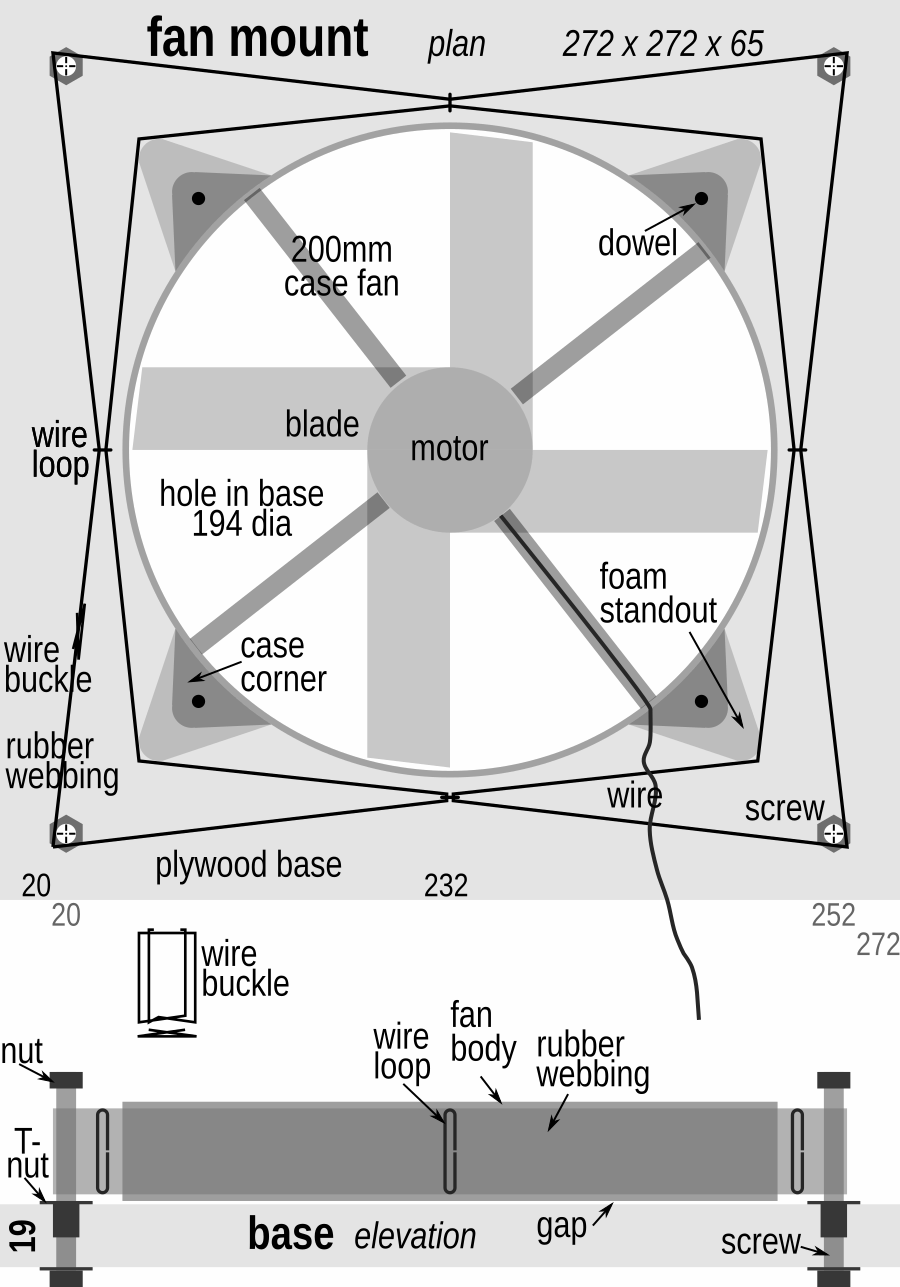
plan: fan mount - download
power
In my first major darkroom in Guatemala, I had no electricity.
At first, to create a draft, I made lamps that burned cooking oil inside a lightproof chimney. It was a messy, unreliable, and labor-intensive process. No one should ever repeat it. But it worked long enough for my brain to make the leap to the 20th century and remember the existence of batteries.
AA batteries made a quick and dirty solution. One night requires 4–8 batteries, alkaline or rechargeable. Connect them in series: positive end of one to negative end of the next.
Voltage adds up like this. Each battery is 1.5V, so 4 batteries = 6V. Some fans need 7V or 9V to start, thus 5 or 6 batteries. Increase fan speed by adding batteries to the pack, up to 8. Increase pack life by using bigger batteries or another series in parallel (fan wires contacting ends of both series).
I was isolated and just learning. This simple discovery encouraged me after weeks of the fascinating absurdity of oil lamp-driven convective ventilation. However, changing batteries every day also quickly got to be a pain. So I bit the bullet and got a proper solar power system for less than $100:
- solar panel: 12V. Size depends on location: 10W in Guatemala, 40W in rainy Oregon winter. ($10–$100 on eBay)
- charge controller: 12V, 4 or 6-pole ($35 on eBay)
- battery: 12V 7A, lead acid ($30 at a motorcycle shop)
- wire, 20 AWG, enough to connect everything ($0–10 from your shed, a dumpster, yard sale, or hardware store).
Once built, maintain by wiping dust off panel once a week. What a luxury! Of course, if you have reliable wind or hydro power, that’s great, too.
warmth
For warmth, I often use a portable oil-filled electric heater. It is silent and can be positioned by a window or vent to warm incoming cold fresh air. Before buying, check that its indicator lights are easy to cover (not glowing from the interior through multiple cracks) and that it doesn’t rattle or hum. Old or cheap ones often make noise. Buy it new.
If you live in a cold place, I highly recommend buying and installing a Heat Recovery Ventilator (HRV) for both health and economy. It conducts heat from return air to supply air while keeping airstreams separate using an exchanging core and fans.
Fine wire heat exchange (fiwihex) technology is my favorite. It is 15x more efficient than plate exchangers. It is compact. A low power fan will supply air to one person. So it can be installed at point of use with little to no ducting. Fiwihex cores have been available for $150 from Viking House and possibly Fresh-R. These companies’ Breathing Windows embody an intriguing design for a complete ventilation system.
However, I lived with one for six months and found it too loud due to its small, high-RPM fans with no silencing. If fans were separated and silenced, fiwihex would be great. A 200- axial case fan works (I tried it). DC blower fans could work with silencing. Building your own HRV is doable.
It also needs a filter despite the manufacturers’ strange denials. Just a leg of a stocking inside a tube for each intake is enough. It’s much easier to remove, clean, and replace than using the core itself as a filter (the manufacturer’s strange instruction).
The most interesting plate exchangers use the Mitsubishi Lossnay core, found in ERVs (Energy Recovery Ventilators) such as Renewaire’s. Made of high-tech paper, the Lossnay recovers heat-trapping water vapor as well as heat from air.
Lossnay’s principle has DIY-potential, using non-siliconized parchment paper (“sandwich paper” in supermarkets). After 20 years of contemplation, I conceived a design for a convection-powered fiwihex ERV (solid state, silent). It would take a small factory to produce. Maybe someday I will.
purity
In some cases, an air purifier becomes necessary. Get one if your house is near a factory, busy roads, in a smoggy city, or near a smelly restaurant or neighbor. Purification methods include:
- activated carbon
- HEPA
- Photo Catalytic Oxidation (PCO) is a new, interesting technology that destroys pollutants at the molecular level. Several companies make filters with it. Prices vary widely.
- UV-C light bulbs with 253.7nm wavelength destroys VOCs and germs and cost less than $10. These would use the regular case fan and just need a universal vent to stop light.
Do not use an ionizer. It produces toxic levels of ozone.
Recently, I upgraded the ventilation system of a darkroom in Czech Republic where people burn coal for heat. Coal smoke smells terrible. I installed an activated carbon filter into the silencer. The $50, 180 x 180 filter eliminated the smell. Catching the particles would require HEPA filtration, but it was less important at the time.
The filter also stops all light and some sound. It requires a fan more powerful than a case fan to overcome the resistance it presents. A blower fan does this. I have yet to test one with a silencer. If that works, I’ll adapt the fan mount for one.
If air quality at your home is bad enough, consider moving. Lots of places in small towns and the countryside have clean air and are less polluted in general. It is a cheap and simple solution to multiple problems, some of which you may not know you have yet.
~/~
That’s it for lightproof ventilation, silence, power, heating, and purification. On to darkening doors and windows.