2. God Has Indeed Spoken: Proper Use of Textual Criticism
By Phillip Kayser, Ph.D.
Biblical Presuppositions
Textual Criticism is a useful tool but it must be applied according to Biblical presuppositions. Eleven such presuppositions follow.
1. Every Word Preserved
We believe that the preservation of every word of Scripture is of critical importance to God (Rev. 22:18-19; Deut. 29:29) and therefore God has promised to preserve every detail of His Word in every age (Matt. 5:17-19; Mark 13:31; Luke 16:17; 21:33; Ps. 12:6-7; cf. also Deut. 29:29; Ps. 19:9; 102:18; 111:7-8; 119:89-91,152,160; Isa. 40:8; 59:20-21; Dan. 12:4; Matt. 4:4; Rom. 15:4; 1 Cor. 9:10; 10:11; 1 Pet. 1:25).
The preservation of every word of the Bible is of critical importance to God. At the beginning of the Bible He promises that “those things which are revealed belong to us and to our children forever” (Deut. 29:29), and at the end of the Bible God promises severe vengeance upon anyone who adds to or takes away from the Bible:
If anyone adds to these things, God will add to him the plagues that are written in this book; and if anyone takes away from the words of the book of this prophecy, God shall take away his part from the Book of Life, from the holy city, and from the things which are written in this book (Rev. 22:18-19)
While the last Scripture anticipates people who would indeed add to and take away from Scripture, God assures us that this attempt will not be successful. For example, the Psalmist writes: “The words of the LORD are pure words. You shall keep them, O LORD, You shall preserve them from this generation forever” (Ps. 12:6-7). This preservation of every word of Scripture in every age is a subject repeatedly promised in the Bible (Matt. 5:17-19; Mark 13:31; Luke 16:17; 21:33; Ps. 12:6-7; cf. also Deut. 29:29; Psa. 19:9; 102:18; 111:7-8; 119:89-91,152,160; Isa. 40:8; 59:20-21; Dan. 12:4; Matt. 4:4; Rom. 15:4; 1 Cor. 9:10; 10:11; 1 Pet.1:25). For example, Christ said, “it is easier for heaven and earth to disappear than for one tittle of the law to be deleted”13 (Luke 16:17). On another occasion Jesus assures us (“Assuredly I say to you”) that “till heaven and earth pass away, one jot or one tittle will by no means pass from the law till all is fulfilled” (Matt. 5:18).
If God has promised to providentially preserve the text of the Bible, this automatically places the Scriptures into a totally different category than the transmission of secular documents like the works of Aristotle or Shakespeare. Indeed, the Byzantine manuscripts show such unity14 that liberal scholars have in effect cried “conspiracy,” thinking that such faithful transmission would be impossible in the first three centuries. Westcott and Hort formalized this proverbial cry of “conspiracy” in their theory of the Lucianic Recension (or similar variations). Though both critics and defenders of the Byzantine text have repeatedly disproved such a recension of manuscripts,15 the theory still seems to drive textual critics. It is easier to believe an unproved thesis of a Lucianic Recension than to believe that God could indeed providentially preserve the text from corruption.
2. Accountable to Every Word
We believe that God must preserve every word of Scripture if He intends to hold us accountable to live by every word (Matt. 5:17-19; Luke 16:17-18; Deut. 29:29; Ps. 19:7-11; 102:18; Isa. 59:20-21; Matt. 4:4; Rom. 15:4; 1 Cor. 9:10; 10:11).
After stating that the smallest letter in the Greek (iota = “jot”) and the smallest difference between a letter in the Hebrew (kereia = “tittle”) would be preserved till heaven and earth pass away, Christ then makes an application:
Whoever therefore breaks one of the least of these commandments and teaches men so, shall be called least in the kingdom of heaven; but whoever does and teaches them, he shall be called great in the kingdom of heaven (Matt. 5:18-19)
The preservation of the jots and tittles was for the purpose of holding men accountable to keep all God’s word. Unless the jots and tittles are preserved, no one can fulfill this injunction. So a theoretical preservation in God’s mind, or in the sands of Egypt does not suffice.
Isaiah 59:20 speaks of the coming of Jesus Christ and then follows with verse 21:
“My words which I have put in your mouth, shall not depart from your mouth, nor from the mouth of your descendants, nor from the mouth of your descendant’s descendants,” says the LORD, “from this time and forevermore.”
In order for that to be fulfilled, God would have to preserve His Word from generation to generation from that time and forever. God commands us to live by every word that proceeds out of the mouth of God (Matt. 4:4). Deut. 29:29 says,
The secret things belong to the LORD our God, but those things which are revealed belong to us and to our children forever, that we may do all the words of this law.
God preserves His word from generation to generation precisely because He wants us to keep it — “every word.”
3. Protective Providence
Since God has promised to preserve His Word (point 1) so that every generation can live by every word (point 2), it logically follows that His protective Providence over this Book will be entirely different than over non-inspired books. Contrary to the theories of modern textual critics, God has indeed promised to intervene in unique ways for the preservation of the Scriptures (Deut. 29:29; Ps. 111:7-8; 119:160; Isa. 40:8; 59:21; Dan. 12:4; Matt. 4:4; 5:17-18; Mark 13:31; Luke 16:17; Heb. 2:2; 1 Pet. 1:25; cf. also Ps. 102:18; cf. eg. Rom. 15:4; 1 Cor. 9:10; 10:11).
4. Faithful Transmission
Since the church was ordained by God to be the “pillar and ground of the truth” (1 Tim. 3:14-15), and since God gave many careful warnings to care for the Scriptures (Rev. 22:18-19, Deut. 4:2; Prov. 30:5-6 and 2 Pet. 3:16), and warnings about heretics who would corrupt the text (Rev. 22:18-19; 2 Pet. 3:16), it is natural to assume two things 1) the church would have been careful in accurately copying the Bible 2) heretics who had a low view of Scripture would have been less careful. Thus it is not at all unreasonable to assume that the “Ecclesiastical Text” (i.e. the Majority Text) is superior to the non-ecclesiastical text.
The modern school of eclectic criticism stands in diametric opposition to this presupposition. They presuppose that godly, devout scribes would be motivated to change the text!!! For example, evangelical scholar Gordon Fee says, “For the early Christians it was precisely because the meaning was so important that they exercised a certain amount of freedom in making that meaning clear [i.e. by changing words in the text]”16
Kurt Aland says that devotion to Christ might make them add words and phrases to give a more polished effect. He insists that pious scribes would be troubled by problems in the Scriptures and would seek to minimize such problems by trying to harmonize apparent conflicts in Gospel accounts, by alleviating Scriptural difficulties, by replacing unfamiliar words with familiar ones, etc. Thus Aland explains away the smoothness of the Greek in the Byzantine text by saying that scribes were offended by the coarse and faltering Greek of the original and sought to change the word usage to make the poor Greek sound better.17 Bruce Metzger says much the same.18
On the other hand, Church history substantiates the Biblical presupposition. The church fathers were very zealous to guard against even the slightest deviation from Scriptural usage. Polycarp says, “Whoever perverts the sayings of the Lord … that one is the firstborn of Satan” (7:1). Justin Martyr claimed that the heretic Marcion had changed the text of both Luke and Paul’s epistles. As a result of this perverting of Scripture, the church was even more careful to check the manuscripts (Apol. i.58). Gaius in the later 100’s named four heretics who altered the text and then had multiple copies of these altered texts prepared by their disciples. Dionysius (bishop of Corinth from 168-176) complained that heretics not only tampered with his writings, but they also tampered with the Scriptures. He insisted that the church had received a pure tradition. This contradicts current textual critical theory, which claims that most corruptions had already come into the Ecclesiastical text (as well as the Alexandrian text) by that time. Irenaeus says, “True knowledge consists in a very complete tractatio of the Scriptures, which has come down to us by being preserved without falsification” (Massuet’s rendering in footnote 8 page 508.) He was not only concerned about careful transcription of Scripture, but also of his own writings so he put at the close of his treatise, “I adjure you who shall copy out this book, by our Lord Jesus Christ and by his glorious advent when he comes to judge the living and the dead, that you compare what you transcribe, and correct it carefully against this manuscript from which you copy; and also that you transcribe this adjuration and insert it in the copy.”19 He vigorously defended the number 666 versus 616 which some scribe had tried to enter into Revelation 13:18, saying that 666 was found “in all the most approved and ancient copies” and that “those men who saw John face to face” bear witness to it. He warns those who made this single letter change, “there shall be no light punishment upon him who either adds or subtracts anything from the Scripture” (xxx.1). Obviously they did not have a light attitude toward textual transcription. He claims that they still had witnesses to the original text, “those men who saw John face to face.” This may include Polycarp, Iraneaus’ mentor. He was a disciple of the apostle John.
Church history tells us that those from the third century were no less certain of the transmission of the text. Tertullian (early 200’s) says, “I hold sure title-deeds from the original owners themselves … I am the heir of the apostles. Just as they carefully prepared their will and testament, and committed it to a trust … even so I hold it.” He obviously had access to the autographs of at least some New Testament books in his day. Though Pickering thinks this may be an exaggeration, I see no reason to doubt Tertullian’s word. In “On Prescription Against Heretics” 36, he tells people that if they want to know the exact wording of some other epistles, the original autographs could still be found. He said that Corinthians could be found in Achaia, Philippians and Thessalonians in Macedonia, Ephesians in Asia, and Romans in Italy. Therefore, at least five New Testament books had autographs still in existence. Since the church fathers state that the Scriptures of the apostles were read in every church, there must have been hundreds of copies already at this early time.
The fourth century continues this claim to a pure tradition of copies. Jerome complained of copyists who “write down not what they find but what they think is the meaning; and while they attempt to rectify the errors of others, they merely expose their own.”20 Bishop Spyridon (350 A.D.) took on the distinguished Triphyllios of Ledra who used the more refined Attic Greek word for bed when he quoted, “Rise, take up your bed and walk.” Spyridon “sprang up and indignantly called to him before the whole assembly, ‘Are you, then, better than He [Jesus] who uttered the word κρᾶββατος, that you are ashamed to use His word?’”21 Even slight changes simply were not tolerated (and this was an oral quote!).
Copyists were extremely careful in subsequent centuries as well. Andrew of Caesarea in Cappadocia, in his commentary on Revelation (600 A.D.), “expressly applied the curse recorded in Rev. xxii. 18-19 to those literati who considered that Attic usage and a strictly logical train of thought were more worthy of respect and more to be admired … than the peculiarities of Biblical language.” Many other quotes have been multiplied in books to illustrate the fact that the church was indeed careful.
5. Suspect Grammar
Texts exhibiting grammatical carelessness and stylistic inferiority should be suspect. (cf. eg. Ps. 12.6; 19; Prov. 30:5-6; Heb. 12:27; Gal. 4:9; Gal. 3:16; John 8:58; Matt. 5:18)
Were unlearned peasants capable of smooth, stylistically beautiful Greek? On the face of it, our presupposition seems false, but careful reflection gives us cause to wonder.
For example, nearly all evangelical scholars agree that at least portions of these “peasants” writings (in any manuscript tradition!) are unparalleled in beauty and stylistic sophistication. The book of Revelation is a marvel of structure. How can this be? Our view of inspiration helps us to account for the symmetry, beauty, smoothness, fullness, and stylistic sophistication of the Majority Text.
Speaking of consistency and niceness of language, Scripture is described as “perfect,” “sure,” “clean,” “true,” “pure,” “right” (Ps. 19). Psalm 12:6 describes Scripture this way: “The words of the LORD are pure words, like silver tried in a furnace of earth. Purified seven times.” Proverbs 30:5-6 says, “Every word of God is pure … do not add to His words lest He reprove you, and you be found a liar.” Grammar is in large part convention, it is true, but Scripture indicates that God supervised the very details of grammar when the Bible was written.
Thus there is significance to a phrase (Heb. 12:27 - makes a theological point over “yet once more”), the voice of a verb (passive versus active in Gal. 4:9 - “now after you have known God, or rather are known by God”), the tense of a verb (John 8:58 - “before Abraham was I AM”), the number of a noun (Gal. 3:16 - “not seeds as of many, but as of one, and to your seed, who is Christ”), and the individual letters of a word (Matt. 5:18 – “one jot or one tittle”). Such Scriptures would lead one to believe that the Bible would not be grammatically awkward, garbled, or careless.
Yet this is precisely what evangelical textual critics affirm. They assume that the apostles would not have been capable of beautiful Greek, and that it is more likely that scribes polished the Greek than corrupted it. One of the oft-repeated proofs that the Majority text is an imposter is the beauty of its Greek - obviously the corrected work of embarrassed scribes! As one example, J. Harold Greenlee says,
Byzantine readings are characteristically smooth, clear, and full. A conjunction or an appropriate word may be added to smooth out a rough transition … The text may be changed to clarify a meaning … A difficulty of meaning or a reading harder to understand may be alleviated … The theology or the meaning in general may be strengthened … One of the most common characteristics of the Byzantine text is the harmonization of parallel passages22
Greenlee intends this as a proof that editors must have changed the text because of embarrassment with its crude character, but is it not possible that the crudities and roughness of the Egyptian texts came as a result of non-Greek heretics butchering the text, and non-caring heretics making changes? Does it seem strange that the Greek of the Bible should be smooth, clear, full with appropriate words all in their place, and rough transition avoided, with difficult meanings absent, and with not a trace of weak theology!? Is it really that difficult to believe? Many people are embarrassed with the great Greek in 1 Peter and have a hard time defending Petrine authorship since the Greek of 2 Peter is rougher, but the problem is alleviated in the Byzantine text.
Nor should it be thought that these editors prefer rough text when an entire textual tradition supports it. In many cases they prefer the coarser Greek of Vaticanus and Sinaiticus to every other manuscript. For example, Kurt and Barbara Aland state,
Not only does the text tend to grow, it also becomes more stylistically polished, conformed to the rules of Greek grammar. In Mark 1:37, for example, there is a typically Marcan construction: και εὑρον αὐτον και λεγουσιν. The overwhelming majority of Greek manuscripts replace this with the better Greek expression: εὑροντες αὐτον λεγουσιν. Only a few manuscripts such as Codex Sinaiticus (א), Codex Vaticanus (B), L, and a small number of other manuscripts withstand the temptation and preserve the stylistically embarrassing text.23
But what he considers a “typically Marcan construction” is only so in the Alexandrian text. As Aland and many other scholars agree, the Byzantine (Majority Text) reading is polished, grammatically proper, and smooth.
6. No Guessing Allowed
Conjectural emendation (assuming an original reading that cannot be found in any Greek manuscript) should never be necessary (logical deduction of #1,2). If words and even letters would not pass away from the Bible till heaven and earth pass away (Matt. 5:17-18; Mark 13:31; Luke 16:17), even the theoretical possibility of textual emendation is out of accord with the Bible. Yet evangelicals will on occasion resort to this.24 Wescott & Hort had some 60 conjectural emendations.25 The UBS text occasionally resorts to this as well (cf. eg. Acts 16:12).
7. Suspect Singular Witnesses
Since God has established the principle that “by the mouth of two or three witnesses every word shall be established” (2 Cor. 13:1; Matt. 18:16), we should be skeptical of readings that have only one witness. We should be even more skeptical when the united witness of a multitude of manuscripts contradicts that single witness. Yet modern versions frequently follow the UBS text even when it is supported by only one manuscript.26
8. The Issue of Numbers
The true texts will far outnumber corrupt texts. This is a logical deduction from Col. 4:16,18; 1 Thess. 5:27; 2 Thess. 3:17; 2 Pet. 3:15-16; Jude 3; Rev. 1:11 with 1 Cor. 4:17; 7:17; 14:33; 16:21 and from 2 Thess. 2:2; 3:17; 2 Pet. 3:16-17; Rev. 22:18-19; Gal. 1:8.
This is true for a number of reasons, among which are the following two:
- The originals of each book of the New Testament (signed “by my own hand”) were passed around to multiple churches in the apostles’ lifetime (Col. 4:16,18; 1 Thess. 5:27; 2 Thess. 3:17; 2 Pet. 3:15-16; Jude 3; Rev. 1:11 with 1 Cor. 4:17; 7:17; 14:33; 16:21). This gave numerous “first copies” and gave transcriptional probability that the original would be preserved in many manuscripts in many places.
- The church was warned to avoid those who distort the Scriptures (2 Thess. 2:2; 3:17; 2 Pet. 3:16-17; Rev. 22:18-19; Gal. 1:8). This would ensure that corrupted versions would remain more localized and would not as easily be copied in the church.
Gordon Clark shows how modern textual critics have a diametrically opposing viewpoint.
The critics, however, propose a rule that number is less important than weight. A dozen or a hundred manuscripts all copied from a single original ancestor count only as one; and therefore a lone manuscript of a different type equals the other hundred in weight. This argument, which seems plausible at first, is not so weighty a criterion as the critics seem to believe. There is another factor involved, which, if they have mentioned it, I have missed the mention. It is this. If a score or two score manuscripts have a single ancestor, it implies that a score or two score copyists believed that ancestor to be faithful to the autographs. But if a manuscript has not a numerous progeny, as is the case with B’s ancestor, one may suspect that the early scribes doubted its value. Possibly the early orthodox Christians knew that B was corrupt, while the later heretics were less interested in wasting time copying their own altered text.27
As one example, in 1 Timothy 3:16
300 Greek Manuscripts read ‘God’ while only eight read something else. Of those eight, three have private readings and five agree in reading ‘who.’ So we have to judge between 97% and 2%, ‘God’ versus ‘who.’ It is really hard to imagine any possible set of circumstances in the transcriptional history sufficient to produce the cataclysmic overthrow in statistical probability that is required by the claim that ‘who’ is the original reading.28
In contrast, Aland says,
It is true that the longer ending of Mark 16:9-20 is found in 99 percent of the Greek manuscripts as well as the rest of the tradition, enjoying over a period of centuries practically an official ecclesiastical sanction as a genuine part of the gospel of Mark. But in Codex Vaticanus (B) as well as in Codex Sinaiticus (א) the Gospel of Mark ends at Mark 16:829
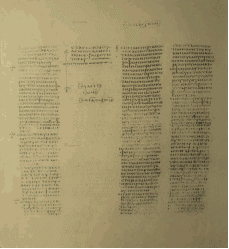
What the reader is not told is that Sinaiticus has a blank space at the end of Mark (see picture above). Though the significance of this is disputed, the last verses of Mark in Vaticanus seem even more clear. The following image of Vaticanus has text beginning at Mark 15:43 and ending with 16:8. The closing book title begins a little further down the second column. Note that the third column is completely blank — the only place in Vaticanus where there is an entire blank column.
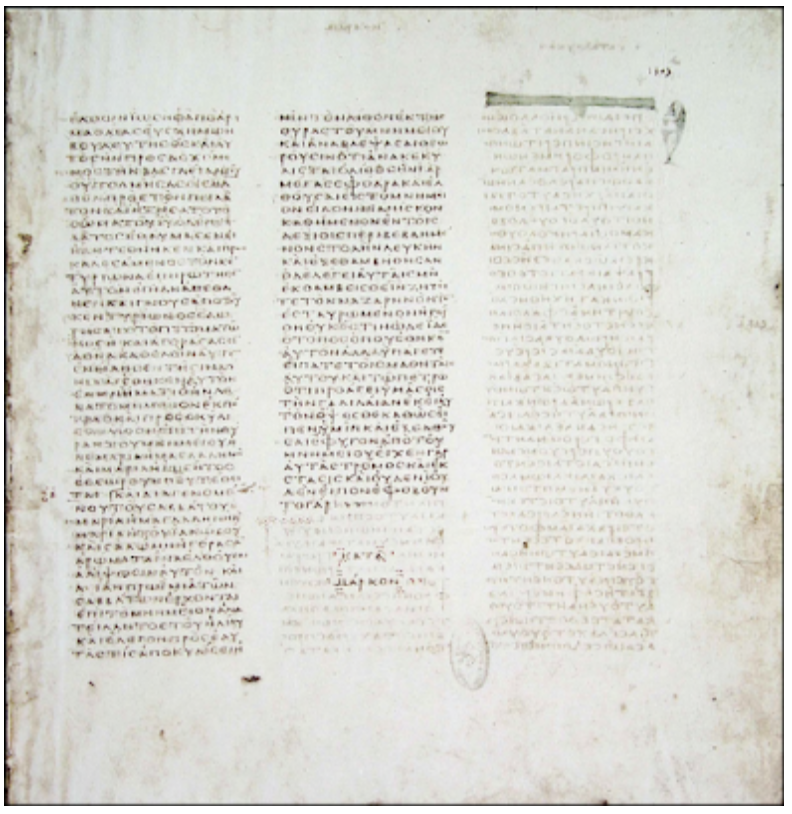
Though both Daniel Wallace and Maurice Robinson believe that the space is not long enough for the longer ending, David Alan Black is not so sure, stating, “Vaticanus actually contains a blank column after 16:8 that could possibly contain verses 9-20, suggesting that its scribe was aware of the existence of the longer reading.”30 James Snapp, Jr. has done a reconstruction of what might have originally been there by using the scribe’s own handwriting, using a clever cut-and-paste technique. He uses the scribe’s own compacted lettering that is used in the first six columns of Luke.31 This technique makes the longer ending of Mark fit into the space perfectly.
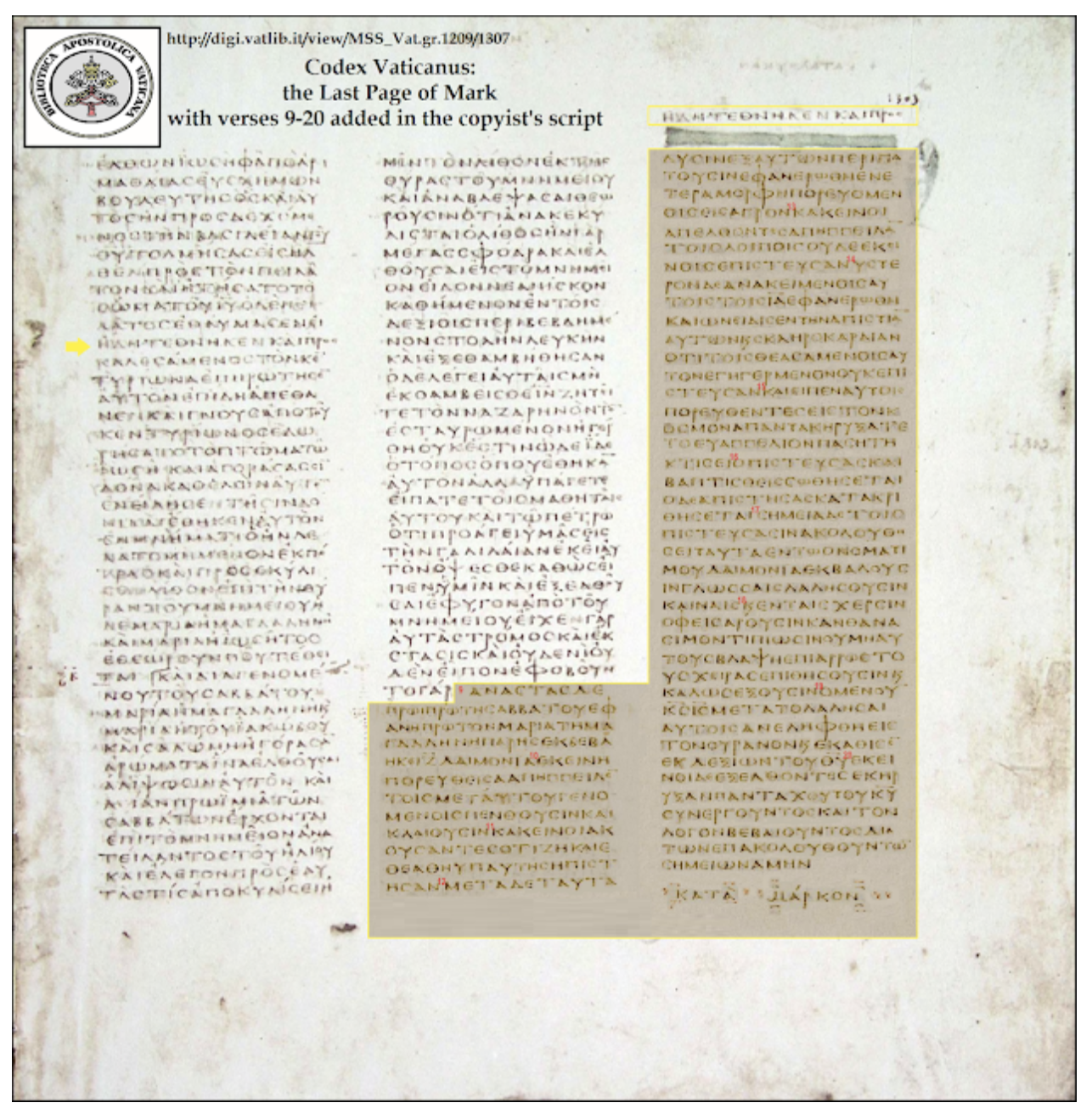
This shows that even Vaticanus is not an unambiguous testimony against the longer ending, and may be a testimony in favor. Yet modern versions dishonestly imply that the evidence is much stronger for leaving the verses out.32
9. Isolation of Errant Texts
Corrupt texts would tend to become more localized and time bounded (logical deduction from previous presupposition as well as from 2 Thess. 3:17; 1 Cor. 16:21; Col. 4:18).
This is the flip side of presupposition #4. The church was warned to avoid those who distort the Scriptures (2 Thess. 2:2; 3:17; 2 Pet. 3:16-17; Rev. 22:18-19; Gal. 1:8) and to be careful of using letters that did not bear the marks of authenticity (2 Thess. 3:17; cf. also 1 Cor. 16:21; Col. 4:18). If this command was followed, texts corrupted by Marcion and others would not frequently be copied in the church and the main source of those texts would be in the local areas where the heretics taught and worked. If a heretical group died out, the manuscripts would have the tendency to die out as well.
In fact we find that most of these so-called “best texts” come from Egypt, which became a hot bed for heretics. They also died out early. The Byzantine text, on the other hand, dominates the church. This is where the Majority Text principle of transcriptional probability fits the evidence.
(See the previous example relevant to 1 Timothy 3:16.)
10. Number, Weight, and Age
The credibility of a witness should be seen by how frequently it is in error, not by how old it is. (See Biblical doctrine of witnesses; Numb. 35:30; Deut. 17:6; 19:15; Matt. 18:16; 2 Cor. 13:1; Rev. 11:3.) Critics of the Majority Text complain that witnesses should be “weighed, not counted.” We believe they should be both weighed and counted.
When the two “best” manuscripts from the Egyptian tradition are “weighed” in terms of transcriptional accuracy, they are found wanting. They not only disagree with the Byzantine texts over 6000 times, but they disagree with each other several thousand times as well. Dr. Scrivener speaks of the beauty and expensiveness of Sinaiticus and Vaticanus, but he also demonstrates the carelessness of the scribes. He speaks of “the occurrence of so many different styles of handwriting, apparently due to penmen removed from each other by centuries, which deform by their corrections every page of this venerable-looking document.” P66 is claimed as an old witness to the “Alexandrian text,” yet it has “roughly two mistakes per verse.”33
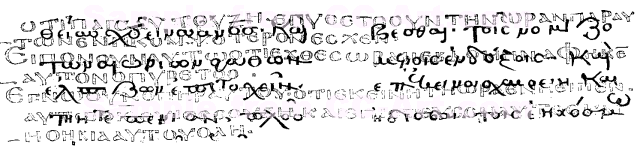
Of the 250 uncials available today, 52 are palimpsests. A palimpsest is a parchment (animal hide) that has been re-scraped, washed and written over again. The person that erased it to use for another purpose obviously had little respect for the authenticity of the manuscript, yet many of these are given a fair degree of weight. St. Ephraem, a Syrian Church Father of the fourth century, erased “Codex Ephraemi Rescriptus” so that he could write his own essays on the parchment. “By the application of certain chemical regents and with the use of the ultraviolet-ray lamp, scholars have been able to read much of the almost obliterated underwriting, although the task of deciphering it is most trying to the eyes” (Metzger, p. 12). It is doubtful that such an enterprise is worth the effort and patience expended. The Egyptian texts have such conflicting testimony that they are not trustworthy witnesses. The Byzantine Text (especially the portion used in the church) is united with very few (and very minor) divergences across the 5000 plus manuscripts that represent this Traditional Text.
11. Caution with Internal Evidence Assumptions
Internal evidence should be used with extreme care in determining the text (1 Cor. 2:11; Jer. 17:9-10).
Internal evidences are guesses as to what motive a scribe had to change the text. For example, the first rule of internal evidence states that the “shorter reading is to be preferred” because it was assumed that scribes tended to add material rather than omit material.34 The second rule states that “the harder reading is to be preferred” because it was assumed that scribes would try to simplify the text and/or resolve apparent contradictions or theological problems by changing the text. These and other rules of internal evidence are pure assumptions. While these rules of internal evidence give the illusion of being a scientific method, the reality is that motives are hard to read, and the best textual critics come to widely ranging conclusions. The use of internal evidence has made textual criticism extremely subjective. Scripture is clear, “For what man knows the things of a man except the spirit of the man which is in him?” (1 Cor. 2:11). Jeremiah 17:9-10 indicates that no man can fully understand the motives of the heart.
Furthermore, the subjective opinions of these five liberal scholars are frequently driven by their theological bias, yet the NIV and NASB have accepted their readings anyway. For example, in the Majority Text, John 3:13 reads: “And no one has ascended into heaven except the One who descended from heaven, even the Son of Man who is in heaven.” The last phrase, “who is in heaven” speaks of Christ’s omnipresence while on earth. All modern versions leave that out even though the liberal committee was divided two to three. Only twelve manuscripts leave it out. Most retain it. Almost all early church fathers quote the phrase as genuine.
Why was it left out? Metzger says, “the majority of the Committee, impressed by the quality of the external attestation supporting the shorter reading, regarded the words ‘who is in heaven’ as an interpretive gloss, reflecting later Christological development.” This statement presupposes that it was not possible for people in the first century to have such developed views of Christ. Similar arguments are made on Galatians 3:17 where the phrase “in Christ” is left out of all modern Egyptian-based translations because this would indicate a pre-incarnate presence of Christ in the Old Testament. This runs counter to liberal views of how doctrine “evolved.”
Conclusion: What Authority Guides Us?
Given the humanistic assumptions that drive the editors of the Nestle’s and UBS Greek texts, it is astonishing that evangelicals have almost blindly followed their recommendations.35 On the other hand, given the wealth of information that the self-attesting Scriptures give as to how God would preserve His text, it is equally astonishing that the Majority Text has not become the standard for evangelicals.
Ultimately, it is one’s presuppositions that will determine the outcome on this debate. Everyone reads “the evidence” through a worldview grid of presuppositions. The debate will not be settled with more evidence. The evidence is clear, yet it is interpreted differently. The debate will only be settled when Christians are willing to allow their presuppositions to be challenged by Scripture and to be taken captive to Scripture. The question that must be settled is this: “What is the final authority in determining the text?”
There are several competing claims:
- Rome claims to be the infallible determiner of both the canon and the text of Scripture.36 Of course, this begs the question since the church has never stated which of the textual variants in the Latin Vulgate reflect the true text. The Church as infallible guide is thus a theoretical stance, but not a helpful one.
- Another authority that is popular is individual autonomy. This is the approach taken by most modern commentators. They do not ordinarily follow a unified tradition. Nor do they tend to follow one edition of the critical text blindly. Instead, commentators often seem to assume that textual criticism can be an individual endeavor. On this view the commentator’s own mind becomes the final judge and arbiter of truth. This makes the individual the highest authority.
- The authority of a panel of five experts seems to have been the third option people have taken. Though there have been other panels, the dominant panel to be trusted today is the one that makes up the United Bible Society Greek New Testament.37 Since these men hold to presuppositions hostile to the authority of Scripture, this is a strange choice, yet it is the choice of most modern versions of the Bible and of the average evangelical pastor.
- The Textus Receptus position claims that God providentially enabled Erasmus (or Stephanus or one of the other editors of the “Textus Receptus”) to be free from error. This makes one man an authority for the whole church. There are no Biblical presuppositions that would warrant elevating one man to such a status. It also fails to explain why one edition of the Textus Receptus should be followed rather than another.38
- In contrast to all of these authorities, the Reformers insisted that Scripture and Scripture alone must be the authority in all matters related to life and practice. They insisted that the church’s job is merely to recognize what God in His providence has made obvious, not to determine the text. They recognized that the moment man sets himself up as a judge of the text, he removes himself from the authority of the text (James 4:11) and comes under the curse of adding to or subtracting from the text of Scripture (Rev. 22:18-19).
The difference between recognizing and determining the text of Scripture may seem like splitting hairs at this point, but it has enormous implications. The Reformers insisted that the Bible gives us the criteria by which to recognize what is true and what is not true. The following quotes are representative:
The Old Testament in Hebrew … and the New Testament in Greek … being immediately inspired by God, and by His singular care and providence kept pure in all ages, are therefore authentic; so as in all controversies of religion, the Church is finally to appeal unto them.39
What does the church appeal to according to our Confession? Not to some theoretical autograph that we can never find and do not know about. An unpreserved text does the church no good. Rather the Reformers insisted that we are to appeal to the manuscripts that have been kept pure in every age. The London Confession of Faith (1689), the Philadelphia Confession (1742), and the Savoy Declaration all affirm the same statement. The following quote from the Helvetic Consensus Formula (1675) shows that the Continental church taught the same:
God, the Supreme Judge, not only took care to have His word, which is the “power of God unto salvation to every one that believeth” (Rom. 1:16), committed to writing by Moses, the Prophets, and the Apostles, but has also watched and cherished it with paternal care ever since it was written up to the present time, so that it could not be corrupted by craft of Satan or fraud of man. Therefore the Church justly ascribes it to His singular grace and goodness that she has, and will have to the end of the world, a “sure word of prophecy” and “Holy Scriptures” (2 Tim. 3:15), from which, though heaven and earth perish, “one jot or one tittle shall in no wise pass” (Matt. 5:18).40
These and similar quotes make it clear that the Reformers self-consciously committed themselves to the self-referential statements of Scripture. “What saith the Scriptures?” was their cry. Thus on the subject of textual criticism they unashamedly began with a certain set of presuppositions from the Bible. All men approach everything they do with a set of presuppositions, but not all are self-consciously aware of what those presuppositions are. “To argue by presupposition is to indicate what are the epistemological and metaphysical principles that underlie and control one’s method.”41
The textual critics who have determined in large part the readings for the NIV, the NASB and almost all modern translations have a set of presuppositions that are completely out of accord with the Bible’s statements about itself. That should not be surprising since the men who put together the United Bible Societies Greek New Testament are all theological liberals. What is disconcerting is that evangelicals have never bothered to discuss the presuppositions of these men, but have treated these men as objective, trustworthy guides.42 Van Til in discussing another subject once said, “I would not talk endlessly about facts and more facts without ever challenging the non-believer’s philosophy of fact.”43 It has been the purpose of this book to get the reader to do so with textual criticism.
The following essay by Wilbur Pickering demonstrates that the Egyptian text is corrupt. However, corrupt presuppositions are the reason why this evidence has been ignored by so many. It is my prayer that Christians would return to the text of the Reformation (the Ecclesiastical Text44). This “Majority Text” is the only text that fits all eleven Biblical presuppositions.