Software for Book Publishers
There is little built-from-the-ground-up AI software specifically for book publishers (though there’s lots available for authors).
Scholarly publishers have more options, with a variety of AI tools for research, writing and publishing.
For trade publishers most of the options relate to AI and audio. Outside of audio, the choices are coalescing around editing and marketing tools. There are also several AI content-detection tools, and content licensing tools and services.
The editing software is positioned towards authors, not professional editors — there are many more authors than editors, and the quality demanded by professional editors is far more onerous than for (mostly self-published) authors.
The marketing tools likewise aim more broadly than just book publishers, but to marketers everywhere, with tools for web content, copy generation and SEO. Jasper.ai is a leader in this category, and claims HarperCollins as a customer.
Shimmr, a sponsor of this book, is an AI-powered ad creation tool specifically for book publishers. The company, and its founder, Nadim Sadek, were profiled in a May 2024 article in Publishers Weekly.
“What we do is use AI to consider the psychological profile of a book and match it to the frame of mind of a specific audience, ensuring a more effective connection between readers and books,” Sadek told PW. “We call it ‘Book DNA,’ and it involves not only knowing the characters and plot of a book, but the values, interests, and emotions of the book.”
Calling on the Book DNA, Shimmr’s AI tools then create targeted advertisements for search and social media channels (currently Google and Meta). The ads take the form of display ads, featuring AI-generated images accompanied by taglines.
I point out to publishers evaluating Shimmr is that it can provide incremental revenue, which is what we expect a new advertising/marketing tool to bring to the table.
If you want to experience another “only with AI” software tool, check out Hypnovels, which animates chapters in fiction books. “Narration, image, and motion, all generated by AI, come together with great storytelling in a way that’s less literal than traditional animation (hence the “hypno”) and more sensorily engaging than an audiobook, in a style that makes the chapter unique and compelling.”
Another new vendor born out of the opportunity with AI, is Veristage (also a sponsor of this book). Veristage offers Insight, its “AI Publishing Assistant,” a task-specific front-end across multiple publishing functions.
The Insight journey starts with the manuscript. Uploading an early version unlocks a range of tools, some more valuable to editorial, others more valuable to marketing. After working with any and all of the features, you can download a PDF report that includes editorial aspects, like writing tone, tropes, cliches and use of adverbs and adjectives, and then marketing content, like descriptions, metadata, unique selling points, comps, Amazon-optimized content, and suggested social media posts.
What I like best about Insight is that it takes a holistic approach to applying AI to the publishing process, rather than having to gather multiple software tools, each for a different function.
I want also to highlight here my publishing platform, Leanpub. They’ve been amazing to work with. Small is beautiful: they take chances with technology and services that larger companies would steer away from. Of top interest to authors and smaller publishers is their new TranslateWord service, where you can translate a book written in Microsoft Word into up to 31 languages, via the GPT-4o API (which powers ChatGPT). That’s what I’m using to translate this book.
I looked elsewhere to try to find a service for book translation. There are tons of translation firms, some employing AI. The only one I could find that offers book translation is DeepL. But it’s not a focus for the company. Right now Leanpub is the place to go.
Business software for book publishing
 |
The existing business systems vendors serving the publishing industry are starting to layer in AI technologies, as we’ve seen at the enterprise-scale companies, like Salesforce and Oracle. |
I’ve spoken with several of the publishing system software vendors, including Firebrand, and all are looking at the opportunities, but treading carefully.
I’m looking forward to the opportunity to talk about AI with a diverse group of attendees at Firebrand’s Publishing Innovation Forum in September, 2024 in Nashville, TN.
knk has run two webinars on AI, and released a whitepaper, but (as of June 26, 2024) has not yet announced any AI features in its products.
Virtusales has recently launched its first set of AI-enabled tools, including image tagging, alt-text generation, copyediting tools, sales and marketing copy generation, and translations of that copy.
I spoke with Klopotek on its Klopotek Publishing Radio. They have “started an AI initiative in the area of Customer Services,” though no details are available.
Supadu, which offers publishers “web design, ecommerce and data solutions,” now features “Supadu Smart AI,” (pdf) with “avatar-lead title video review with Smart Buy,” “avatar video-driven promotional collateral for marketing & sales teams,” and “easy multi-language translation of author & title videos.”
AI software for book publishers: the startups
Some people are familiar with the work I’ve done around book publishing technology-based startups. There is a report in Publishers Weekly that describes the work, and links to the database.
As you’ll see in the report, I look pretty broadly at startups across the book publishing spectrum. I don’t include new book publishing companies, unless they are doing some unusual things with technology. The basic criteria is: do you use technology to try to invigorate some aspect of the book(ish) publishing process? I’ve got over 1,600 companies in the database, most launched after Amazon released the first Kindle in 2007.
After you get an overall sense of the database, you can start to dive in more deeply. On the far right tab you’ll see a way to sort only by the AI-related publishing startups.
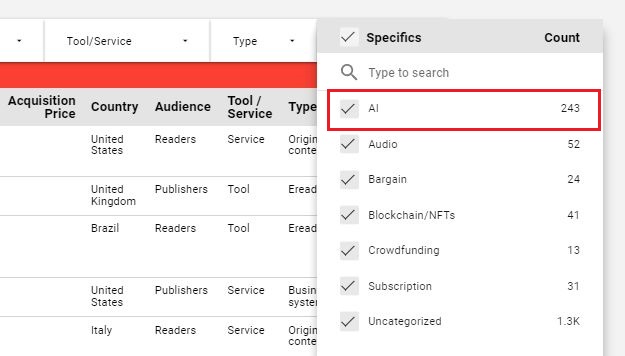
As you can see in the illustration, there are over 240 AI-related publishing startups (as of early July, 2024). We count the audio publishing startups that employ AI as a separate category and the total of the two is over 300 companies. The majority, over 280, were launched after ChatGPT first appeared in November of 2022. This volume of new business startups is unprecedented within book publishing. It’s astounding.
As is characteristic of the full database, these AI startups mostly target authors (70%). Some 13% are looking, per se, to serve publishing companies. 10% are children’s publishing-focused.
About 50 of the startups target readers with a range of inventive offerings. Several are storytelling platforms. There are quite a few summarizers. There are multiple discovery sites, “Use AI to find your new favorite book.” Fast-improving AI-generated voices have led to a selection of “read it to me” tools.
And some interesting ideas that wouldn’t be possible without AI.
Bookshelf: Reading Tracker is a combination book discovery and personal library app that includes “automatic time tracking, reading goals & reminders, and insightful stats & trends.” Its AI librarian “can generate summaries and flash cards, discuss key ideas and takeaways, and much more.”
My friend Ron Martinez recently launched a site called Inventionarts.ai which introduces “a new conversational medium.” As the site explains, “Talk to multiple AI personalities, each with their own identity, expertise, and awareness. Invite different personas to join you in scenarios. And you can play a fictional role, too!” A literary game, of a sort.
As is characteristic of the larger startup cohort, many of these startups are between tiny and miniscule, just one person with a website and a half-baked idea. I include them all—who knows where they’re headed.
I strongly encourage you to play with the database. Click a few links. I think you’ll be tickled by the innovation and audacity of many of these organizations.
One of the sponsors of this book, Book Advisors, specializes in mergers and acquisitions in the publishing industry. I’m always advocating to innovative startups that they look for partners, and Book Advisors is where I send them to talk through the process. Book publishing has several respected M&A firms to call upon, including The Fisher Company and Oaklins DeSilva+Phillips. Book Advisors is the only firm I know that also works with technology startups.