The Leanpub Podcast 🎙 Feat. Fiodar Sazanavets, Author of Production-Grade Python, LangChain & LangGraph
Learn the engineering skills behind one of software’s most valuable emerging fields AI engineering is rapidly becoming one of the most commercially valuable areas of software development. Companies are moving beyond simple chatbot prototypes and looking for engineers who can build relia...

Episode Details
1. Fiodar Sazanavets on Production-Grade Python, LangChain & LangGraph
In this episode of the Leanpub Podcast, host Len Epp speaks with Fiodar Sazanavets, a senior software engineer, former Microsoft engineer, and four-time Microsoft MVP, about his Leanpub book Production-Grade Python, LangChain & LangGraph.
1.1 From Belarus to British Software Engineer
Fiodar grew up in Belarus and moved to the UK in 2001 due to political circumstances. He describes the economic chaos of post-Soviet Belarus, including hyperinflation on the scale of Zimbabwe, and how arriving in the UK gave him a sharpened sensitivity to opportunity that many around him seemed to lack. His academic background was unconventional for a software engineer: a bachelor’s degree in biology and a master’s in environmental informatics, which led to his first job as a flood risk analyst. Finding that career a dead end financially, he taught himself to code starting with VBA in Excel, then VB.NET, eventually building a decade-long career in the .NET and C# ecosystem.
1.2 Building a Career as an Educator and Author
Fiodar began teaching on Udemy in 2018 and was subsequently approached by technical publisher Packt to narrate code samples from books. He also wrote long-form articles for John Sonmez’s Simple Programmer platform. In 2021, he wrote two books simultaneously — a mindset book called Battle Hardened Developer for Simple Programmer and a technical book for Packt. With the manuscripts in their publishers’ release pipelines, he discovered Leanpub through an article by bestselling Leanpub author Jeff Geerling, who wrote about his experience self-publishing a book on Ansible. Inspired, Fiodar quickly converted an existing Udemy course into his first Leanpub book, SignalR on .NET 6: The Complete Guide, and found it more successful than expected. He has since published additional titles, including The Easiest Way to Learn Design Patterns, and praises Leanpub’s Markdown-based writing workflow, WYSIWYG editor, and print-ready PDF export feature.
1.3 Why This Book Exists
As AI engineering became the dominant force reshaping software development, Fiodar noticed that Python’s ecosystem for AI was far more mature than .NET’s. Running his own consultancy, Orion AI Engineering, he wanted to serve clients with the best available tools rather than being constrained by his own specialisation. He began studying production-grade Python intensively — not the syntax, which he already knew, but the engineering fundamentals: project structure, dependency management, FastAPI, async programming, testing, deployment, and observability. He accumulated extensive notes and realised that many developers with basic Python knowledge faced the exact same gap. The book is, in his words, “the book I wish I had when I started.”
1.4 Production Engineering in the Age of AI
A central theme of the conversation is why deep engineering knowledge remains valuable even as AI tools become capable of generating large amounts of code. Fiodar argues that AI models are trained on average code — mostly hobby projects and tutorial examples from public repositories — and will produce average results unless guided by someone who understands production requirements. Non-functional requirements such as scalability, performance, fault tolerance, and partial failure handling are invisible to those without engineering training, but are precisely what separates a working prototype from a reliable production system. He also emphasises that engineers remain accountable for AI-generated code and must maintain deterministic guardrails such as linters, static analysis tools like SonarQube, and structured code review practices.
1.5 A Real-World Agentic System
To illustrate what readers can build, Fiodar describes an agentic system he built for a company with a large industrial data platform. An orchestrator agent routes user queries to specialised sub-agents — one for retrieving documents, another for time-series data such as wind speed measurements — with a final consolidation agent that combines responses and applies hallucination prevention before returning output to the user. LangGraph handles orchestration and session checkpointing, while LangChain manages direct LLM interaction and memory. This architecture, he explains, works better than a single agent because language models handle narrow contexts more reliably than broad, multi-concept ones.
1.6 Writing Process and Leanpub Workflow
Fiodar describes his writing process as analogous to software development: outlining first, then building the book chapter by chapter, treating it as a product to be engineered rather than a literary endeavour. His current book has around 60 short chapters averaging three pages each, keeping concepts digestible. He prepares a companion repository before writing, in this case a realistic production-grade example of a Python project with LangChain and LangGraph implementing an agentic IT support ticket monitoring system. He uses AI tools for proofreading and code review and applies the same deterministic quality tools he recommends in the book. When asked for a feature request, he nominated integrated print-on-demand publishing, a wish shared by many Leanpub authors.
This interview was recorded on [interview-date].
The full audio for the interview is here: https://s3.amazonaws.com/leanpub_podcasts/video1091098144-edited.mp3. The Leanpub Podcast is available on our YouTube channel at https://www.youtube.com/leanpub, in Apple Podcasts here https://podcasts.apple.com/ca/podcast/Leanpub/id517117137, and almost everywhere else people listen to podcasts.
About the Book
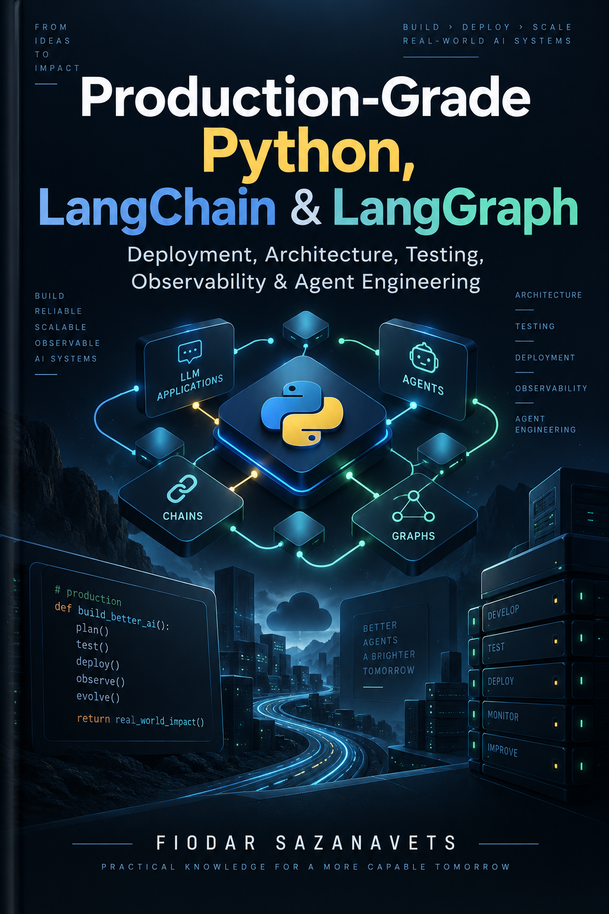
Learn the engineering skills behind one of software’s most valuable emerging fields
AI engineering is rapidly becoming one of the most commercially valuable areas of software development.
Companies are moving beyond simple chatbot prototypes and looking for engineers who can build reliable AI-powered applications, agentic workflows, retrieval systems, model integrations, and production infrastructure. That creates strong demand for developers who understand both software engineering fundamentals and modern AI application frameworks.
Python sits at the center of this ecosystem. It is the dominant language across AI, machine learning, data engineering, model tooling, and an increasing share of agent development. LangChain and LangGraph add the abstractions needed to build applications around large language models, tools, retrieval, state, and increasingly autonomous workflows.
These skills also occupy an interesting position in the changing software market. AI can automate more routine implementation work, but organizations still need engineers who can design the systems around AI: integration, orchestration, reliability, evaluation, security, deployment, observability, and production control. Learning to build the systems that use AI is therefore a compelling way to move toward the part of software engineering that AI itself is helping to create.
Production-Grade Python, LangChain & LangGraph is designed to take you there.
The book assumes that you already know basic Python syntax. Instead of teaching loops, functions, and classes again, it focuses on the engineering knowledge required to turn Python code into real production software.
You will learn:
- How Python actually executes code through CPython, bytecode, modules, and processes
- Modern project structure with
pyproject.toml - Virtual environments, dependency management, locking, packaging, wheels, and reproducible builds
- FastAPI and production API design
- Configuration and secrets management
- Async programming and concurrency
- Database access, transactions, migrations, and persistence
- Caching and external service integration
- Error handling, retries, timeouts, and idempotency
- Structured logging, metrics, tracing, and health checks
- Unit, integration, API, and system testing
- Containers, CI/CD, and production deployment
- Security practices for backend and AI applications
The second half applies those engineering foundations to modern AI engineering with LangChain and LangGraph.
You will learn how to build:
- LLM-powered applications
- Structured model interactions
- Tool-using agents
- Retrieval-Augmented Generation systems
- Stateful workflows
- Conditional and parallel execution
- Persistent agent state
- Durable workflows
- Human-in-the-loop approval
- Streaming applications
- Long-running agent processes
- Multi-step and multi-agent systems
- Testable and observable AI workflows
The emphasis throughout is on production engineering, not demos.
Calling an LLM is easy. Building a system around it that remains secure, reliable, observable, recoverable, and maintainable is where much of the real engineering value lies.
A complete production-style support-agent application brings the concepts together using FastAPI, SQLAlchemy, LangChain, LangGraph, persistence, authentication, observability, human approval, and safe execution of irreversible actions.
The book also includes a companion code repository containing the complete application, runnable examples, tests, deployment configuration, and every code sample used throughout the manuscript.
If you already know basic Python and want to position yourself for the growing field of AI engineering, this book gives you the production foundations and agent-development skills needed to move beyond prototypes and build systems organizations can actually depend on.
About the Author

Fiodar Sazanavets is a senior software engineer specializing in AI systems, distributed applications, and data-intensive software. A former Microsoft engineer and fourt-time Microsoft MVP, he has more than a decade of professional experience designing and building production systems across a wide range of industries.
His core areas of expertise include Python, .NET, cloud technologies, distributed systems, and modern AI engineering. Throughout his career, he has worked on systems ranging from railway passenger information platforms and distributed IoT clusters to e-commerce applications and financial transaction-processing systems. He has also led engineering teams, mentored developers, and helped organizations translate complex technical requirements into reliable software that solves real business problems.
Alongside his engineering work, Fiodar is passionate about technical education. He writes books, creates online courses, mentors developers, and regularly publishes practical software engineering content. His teaching focuses on the skills developers need to build real-world systems: architecture, reliability, cloud engineering, AI, and production software development.
He writes about software engineering and AI at fiodar.substack.com/.
Leanpub Book LAUNCH 🚀 Production-Grade Python, LangChain & LangGraph: A deployment-first handbook for developers who know Python syntax but have not shipped Python by Fiodar Sazanavets
Watch Clips From The Video