Leanpub Book LAUNCH 🚀 The Histories of Diagnostics, Observability, and Debugging by Dmitry Vostokov
A memory dump can preserve a damaged object after a program has stopped. Two copies of a manuscript can agree on a word because both preserve the same copying error. In each case, we work backwards from what survives. Which observations would help us distinguish one explanation from ano...

Welcome to the Leanpub Launch video for The Histories of Diagnostics, Observability, and Debugging by Dmitry Vostokov!
About the Book
A memory dump can preserve a damaged object after a program has stopped. Two copies of a manuscript can agree on a word because both preserve the same copying error. In each case, we work backwards from what survives. Which observations would help us distinguish one explanation from another?
The Histories of Diagnostics, Observability, and Debugging brings together thirteen histories. We begin with software, hardware, medicine, machine learning and AI, and technical diagnostics. We then follow diagnostic practices through the natural, formal, social, and engineering sciences, the humanities, and the arts, before turning to writing and publishing and to management. Along the way, we consider which analysis patterns can travel between disciplines. Comparing two records, for example, requires us to ask how each was produced and whether their agreement provides independent evidence.
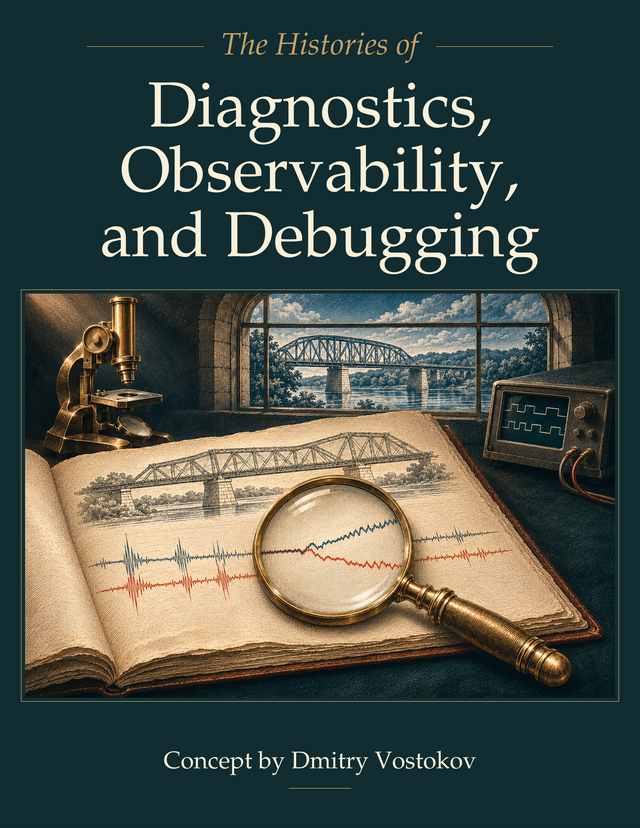
The concluding chapter, When Diagnostic Evidence Changes Hands, follows a bridge inspector’s finding from a marked photograph to a field bulletin. A fine line identifying the joint for follow-up disappears during publication. Restoring the line corrects the bulletin. The joint still needs to be examined. What must travel with a diagnostic finding so that the next person can act on it?
About the Author

Dmitry Vostokov is an internationally recognized expert, speaker, educator, scientist, inventor, and author. He founded the pattern-oriented software diagnostics, forensics, and prognostics discipline (Systematic Software Diagnostics) and Software Diagnostics Institute. Vostokov has also authored over 50 books on software diagnostics, anomaly detection and analysis, software and memory forensics, root cause analysis and problem solving, memory dump analysis, debugging, software trace and log analysis, reverse engineering, and malware analysis. He has over 30 years of experience in software architecture, design, development, and maintenance in various industries, including leadership, technical, and people management roles. Dmitry founded OpenTask Iterative and Incremental Publishing and Software Diagnostics Technology and Services (former Memory Dump Analysis Services). In his spare time, he explores Software Narratology and Quantum Software Diagnostics. His interest areas are theoretical software diagnostics and its mathematical and computer science foundations, application of formal logic, semiotics, artificial intelligence, machine learning, and data mining to diagnostics and anomaly detection, software diagnostics engineering and diagnostics-driven development, diagnostics workflow and interaction. Recent interest areas also include functional programming, cloud native computing, monitoring, observability, visualization, security, automation, applications of category theory to software diagnostics, development and big data, and diagnostics of artificial intelligence.